The Nighttime Crowd in Boulevard Montmartre at Night
A closer look at this element in Camille Pissarro's 1897 masterpiece
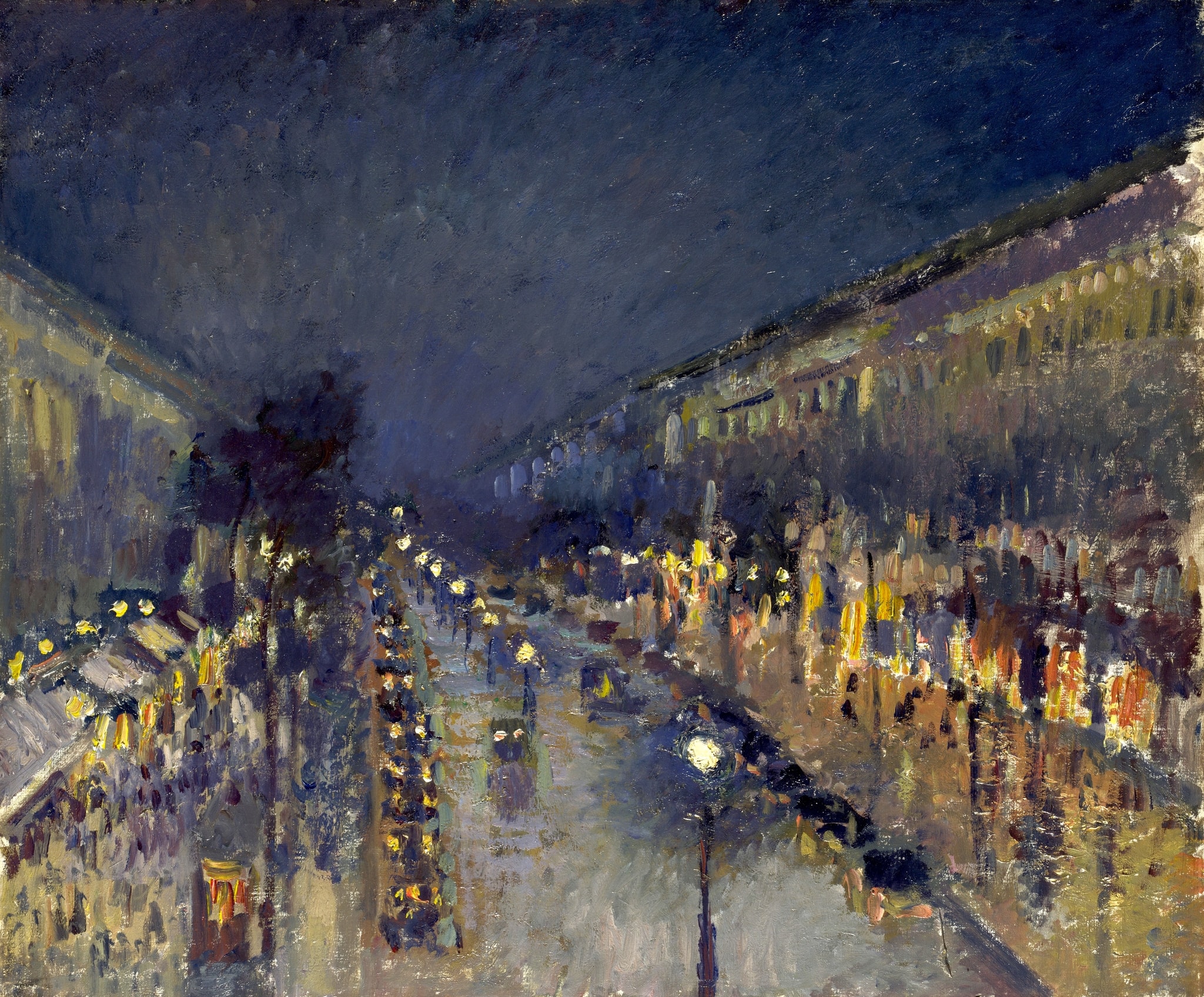
Seen from Pissarro’s hotel window, the Boulevard Montmartre becomes a river of motion: pedestrians, cabs, and omnibuses fused into flickering strokes and pricks of light. The nighttime crowd is both subject and sensor, registering new electric illumination against the warmer glow of shopfronts and carriage lamps, and turning the boulevard into a modern stage.
Historical Context
Painted in early 1897 from a fixed, high perch at the Grand Hôtel de Russie, Pissarro’s series on the grands boulevards set out to capture the site “under all possible effects,” including after dark. The Night canvas is the sole nocturne of his career. From this vantage he confronted the technical problem he described as tricky: rendering carriages, buses, and people milling below. He solved it with animated, broken brushwork that compresses traffic and passersby into a luminous flow along the boulevard’s diagonals 1.
Pissarro’s own shorthand for the motif—“carriages, omnibuses, people”—comes from letters written during the series, confirming that the fluctuating human and vehicular throng was not backdrop but core subject. Set on Haussmann’s widened artery, the scene records a city built for circulation and spectacle, now extended into the night by artificial light. The crowded sidewalks and queued cabs he observed from his hotel window anchor the painting’s modern viewpoint and purpose 2.
Symbolic Meaning
The nighttime crowd operates as a modern emblem: anonymity, flux, and collective movement. In the art-historical reading of Impressionism as the art of modern urban life, such crowds signify new rhythms of leisure and circulation, a subject central to the movement’s engagement with Paris. Pissarro’s miniature walkers and vehicles—almost abstract at close range—channel this idea with unusual concision, epitomizing the grands boulevards’ spectacle at the fin de siècle 7.
Lighting deepens the symbolism. Along the median, cool electric arc lamps puncture the darkness, while gaslit shop windows and the beaded oil lamps of waiting cabs outside the Théâtre des Variétés glow warm and low. This hybrid illumination stages a city in technological transition, a theme scholars identify as rare within Impressionism’s largely daylight practice; Pissarro’s nocturne stands as the pointed exception that makes electric street life a subject in itself 15.
Across the 1897 boulevard series—including Mardi Gras variants—commentators also note how dense street throngs suggest social mixing across classes, an idea resonant with Pissarro’s politics. The anonymous cluster thus reads as a more democratic urban commons, where differing publics share space, even if only in passing—an egalitarian subtext that informs the nocturne’s compressed, collective presence 6.
Artistic Technique
Pissarro renders the crowd through brisk “dashes and daubs” that coalesce at viewing distance into pedestrians, cabs, and omnibuses. The boulevard’s perspective—two strong diagonals of façades and pavements—funnels this traffic into depth, while rows of trees and lamp standards beat time along the route. Color amplifies the motion: the cool halos of electric arc lamps meet warm yellows and oranges from shopfronts; tiny red, white, and yellow pinpoints mark carriage lamps. Recent rain turns the roadway into a reflective plane, so the crowd reads as pulsing bands of light mirrored across wet stone. A V-shaped sky echoing the street’s wedge composition encloses the flow, concentrating attention on the animated center 1.
Connection to the Whole
The crowd is the painting’s engine. It activates the boulevard’s perspectival scaffolding, converts the new lighting into lived experience, and completes the series’ ambition to register one site across changing conditions—including night. Without the clustered figures and carriages, the view would be an empty stage; with them, the picture breathes, its tempo paced by lamp rows, cab queues, and sidewalk throngs. As part of Pissarro’s 1897 sequence from a fixed high window, this element ties the nocturne to the broader project of tracking ever‑shifting urban configurations, proving that Paris’s modern identity persists—and sparkles—after dark 13.
Explore More from This Painting
This detail is one part of Boulevard Montmartre at Night. Use the links below to return to the full interpretation, browse the full set of details, or view the painting's valuation if available.
Sources
- National Gallery, London – The Boulevard Montmartre at Night (in‑depth entry, letters, technique, lighting, composition)
- The Metropolitan Museum of Art – The Boulevard Montmartre on a Winter Morning (series context; Pissarro’s description of the motif)
- National Gallery of Victoria – Boulevard Montmartre, morning, cloudy weather (fixed high viewpoint; changing configurations of crowds and traffic)
- National Gallery of Art, Washington – Boulevard des Italiens, Morning, Sunlight (crowded sidewalks; bustling traffic)
- H‑France Review of Hollis Clayson, Illuminated Paris (rarity of Impressionist nocturnes; Pissarro’s Night as exception)
- Hammer Museum blog – Boulevard Montmartre, Mardi Gras (crowds, class mixing, politics across the series)
- Robert L. Herbert, Impressionism: Art, Leisure, and Parisian Society (framework for modern urban crowds)
- Hermitage Museum – Boulevard Montmartre in Paris (series overview; hotel vantage)