Christ's Pointing Hand in The Calling of Saint Matthew
A closer look at this element in Caravaggio's 1599–1600 masterpiece
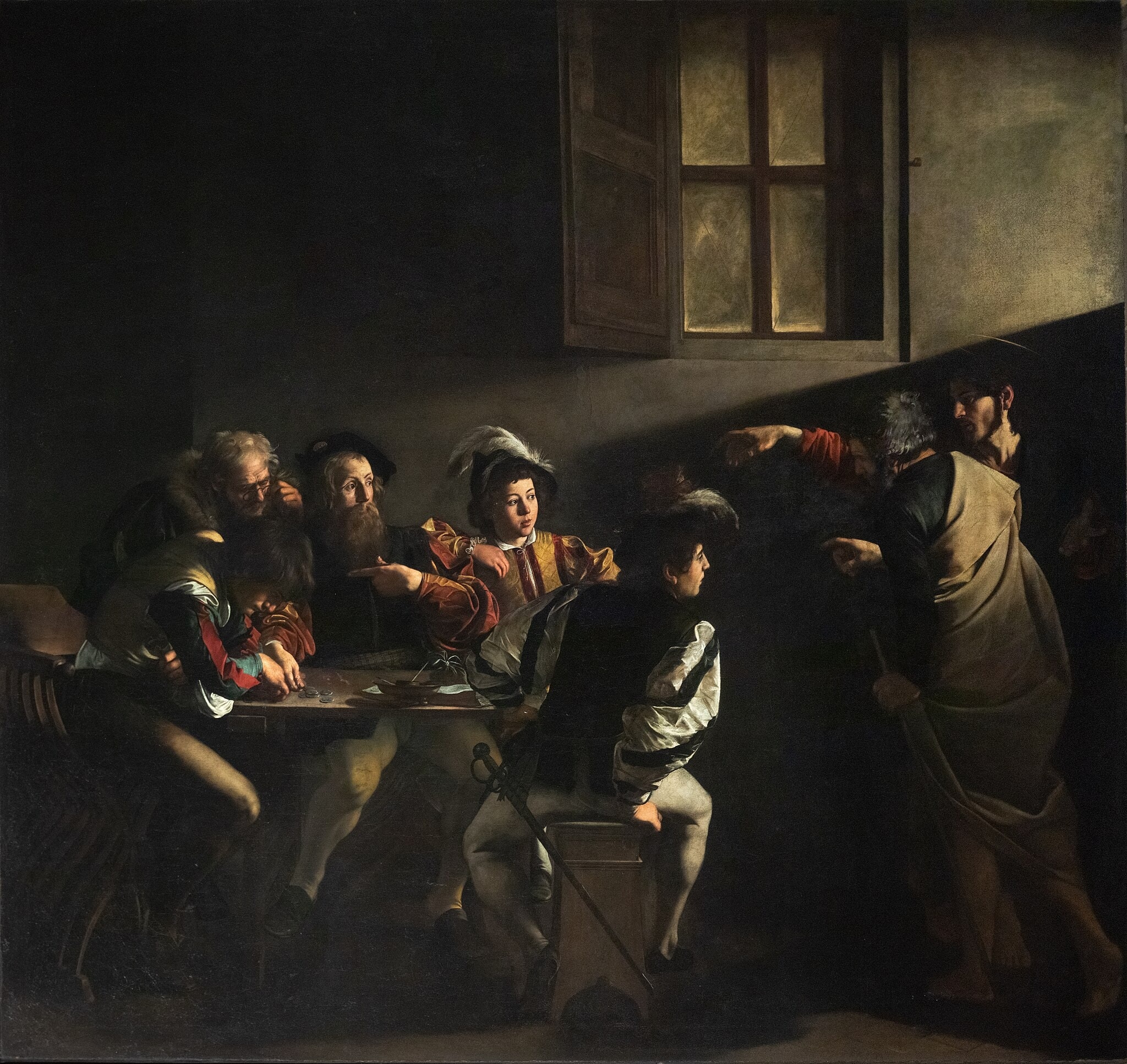
Christ’s pointing hand is the catalyst of The Calling of Saint Matthew: a quiet but sovereign gesture that turns a dim tavern into the stage of conversion. Echoing Michelangelo’s Adam while cutting through shadow with the same diagonal beam of light, the hand makes grace visible and directs the story’s every response.
Historical Context
Caravaggio painted The Calling of Saint Matthew for the Contarelli Chapel in Rome around 1599–1600, when church commissions demanded images that taught doctrine with theatrical clarity. In this setting, a single, readable gesture became the vehicle for the Gospel command “Follow me.” The artist places Christ at the right edge of the scene, his right hand extended toward the tax collector; that motion delivers the moment of vocation in a way any chapel-goer could grasp instantly. Such legibility aligned with Counter‑Reformation priorities for affective, persuasive storytelling in sacred art, a program that shaped the entire Contarelli cycle 1.
Working in Rome, Caravaggio also engaged the city’s visual memory. The delicate contour of Christ’s hand intentionally recalls the most famous hand in Roman art—Adam’s in Michelangelo’s Creation of Adam—so that the new Baroque image conversed with the revered High Renaissance model familiar to clergy and pilgrims alike. Smarthistory highlights how this quotation, set before contemporary costume and a counting table, translated biblical calling into Rome’s present tense while preserving doctrinal clarity 2.
Symbolic Meaning
The pointing hand is more than a directional cue; it is the painting’s theological engine. By visually rhyming with Michelangelo’s Adam, Christ’s gesture frames the scene as an act of new creation: the Second Adam re‑makes a sinner into an apostle. The Visual Commentary on Scripture notes how this echo signals a typology long used by Christian thought—Christ as the New Adam who restores what the first forfeited—thereby casting Matthew’s call as the birth of a new life 3.
Caravaggio also turns gesture into a speech‑act. The Met observes that his religious narratives stage moral drama through hands; here the quiet extension bears authority without words, delivering the command that alters destiny 4. The beam of light that slants across the wall tracks Christ’s arm, so illumination and gesture arrive together, embodying grace that singles Matthew out from the shadowed group 2. Finally, the gesture initiates a chain of pointing—Christ, then Peter, then Matthew touching his chest—that renders a doctrine of mediation and response: divine summons, apostolic church, human assent. This cascade gives spiritual meaning a concrete, bodily grammar that viewers can read at a glance 23.
Artistic Technique
Caravaggio renders the hand with focused chiaroscuro, isolating the pale fingertips and forearm against tenebrous depth so the gesture carries across the canvas. Light falls from high at the right, catching Christ’s wrist and subtly modeling knuckles and tendons; the effect is calm, sovereign precision rather than an emphatic jab 2. The contour itself is slightly relaxed—echoing Adam’s curved fingers—while Peter’s nearer hand repeats the line more firmly to amplify legibility at close range 6. Compositionally, Christ’s arm becomes a right‑to‑left vector that the light reinforces, driving the viewer’s eye toward the table where Matthew sits. Color keeps the focus: Christ’s red‑blue drapery recedes in half‑shadow so that the illuminated hand punctuates the scene like a visual imperative 26.
Connection to the Whole
The pointing hand launches the narrative arc of the entire painting. It sets the chain—Christ to Peter to Matthew—in motion, organizing bodies, gazes, and the raking light into a clear baroque syntax of call, mediation, and response suited to the chapel’s didactic mission 12. As Matthew’s startled self‑point mirrors Christ’s calm extension, the canvas stages vocation as the meeting of grace and freedom. Within the Contarelli cycle, this single gesture is the story’s first cause: from calling here to inspiration and martyrdom in the companion canvases, Matthew’s life unfolds from the moment Christ’s hand breaks the darkness and claims him 5.
Explore More from This Painting
This detail is one part of The Calling of Saint Matthew. Use the links below to return to the full interpretation, browse the full set of details, or view the painting's valuation if available.
Sources
- Britannica — Caravaggio: The Contarelli Chapel and other church commissions
- Smarthistory/Khan Academy — Caravaggio’s Calling of Saint Matthew (video)
- Visual Commentary on Scripture (King’s College London) — The Calling of Matthew
- The Metropolitan Museum of Art — What Is in a Gesture? (on Caravaggio)
- Britannica — The Calling of St. Matthew (overview)
- Smarthistory/Khan Academy — Calling of Saint Matthew and Inspiration of St. Matthew (AP Art History)