Saint Matthew at the Table in The Calling of Saint Matthew
A closer look at this element in Caravaggio's 1599–1600 masterpiece
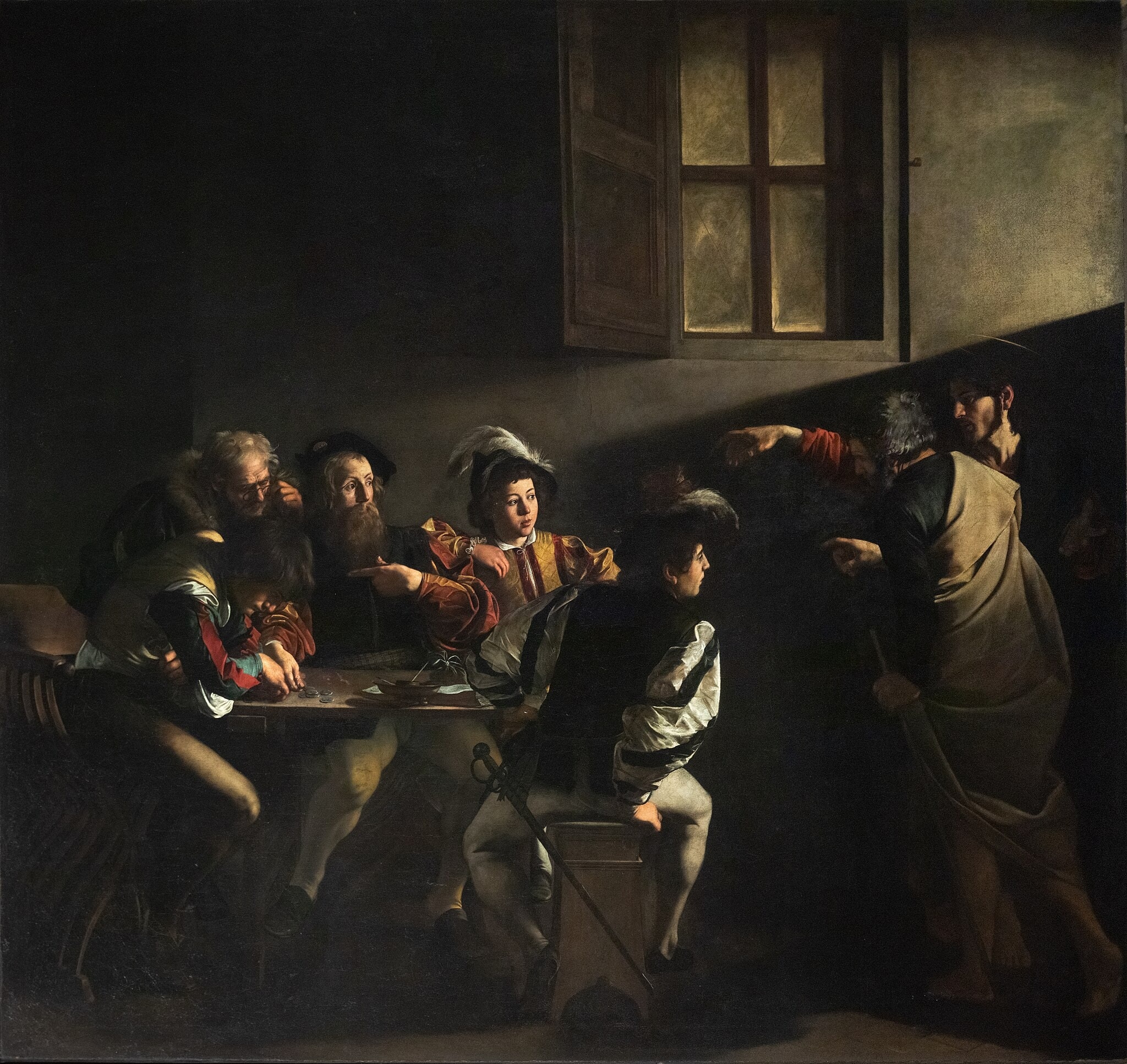
At the tax table, the bearded collector—Saint Matthew—arrests mid‑count, hand to chest, as a raking beam and Christ’s gesture single him out. Caravaggio crystallizes the instant when a worldly bookkeeper becomes an apostle, turning a dim room into a theater of conversion.
Historical Context
In 1599 Caravaggio was contracted to furnish the Contarelli (St. Matthew) Chapel in Rome with scenes from Matthew’s life, beginning with The Calling and The Martyrdom; the altarpiece, The Inspiration of Saint Matthew, followed in 1602. The bearded man at the table embodies the commission’s narrative core: Matthew’s vocation from tax collector to apostle, drawn from Matthew 9:9. Installed by mid‑1600, these pictures formed a three‑part sequence—calling, inspiration to write the Gospel, and martyrdom—honoring both the chapel’s dedicatee and the patron’s namesake, Cardinal Matteo Contarelli 1.
Caravaggio’s solution met Counter‑Reformation demands for clarity and spiritual urgency with startling immediacy. The artist replaced idealization with street‑level naturalism and a high‑contrast stage of light and dark, inviting worshipers to witness conversion as if it unfolded before them. The unveiling of the Matthew cycle established his reputation in Rome and announced a new Baroque language—tenebrism and dramatically legible gesture—perfectly suited to post‑Tridentine aims of moving hearts toward faith 2.
Symbolic Meaning
The figure at the table represents vocation: Matthew’s self‑recognition at the precise moment Christ says, “Follow me.” A diagonal beam isolates his face and pointing hand, reading as a visible sign of grace that pierces habit and habitus alike; AP Art History materials underscore this raking vector as the narrative engine 4. Caravaggio routes that light through a chain of pointing hands—Christ’s extended arm, echoed by Peter’s and answered by Matthew’s—which turns gesture into theology: call, mediation, assent 35.
Christ’s hand reprises, in reverse, the iconic contour of Adam’s in Michelangelo’s Creation, casting Jesus as the New Adam who confers new life at the instant Matthew is reborn as disciple and future evangelist 3. Money, finery, and the abacus‑like scatter of coins mark the old identity bound to revenue and fashion; Matthew’s startled pivot signals rupture with that economy for a new ledger of grace 3. Caravaggio also sustains a flicker of narrative ambiguity—does Matthew point to himself or the youth beside him?—a Baroque tactic that recruits the viewer to complete the recognition and thus participate in the conversion drama 8. The painting’s fictive beam, keyed to the chapel’s real illumination, heightens this symbolism by making light itself the vehicle of election 6.
Artistic Technique
Caravaggio renders Matthew within a crucible of tenebrism: a hard, directional light carves heads and hands from a largely unornamented darkness, fusing naturalism with theatrical focus 2. A right‑to‑left diagonal organizes the scene from Christ’s pointing hand, through Peter’s interposed body, to Matthew’s illuminated face and self‑pointing gesture—composition as storyline 7. Fabrics gleam, coin edges catch highlights, and the rough wood of the table anchors the miracle in the ordinary.
The beam is not generic; it dialogues with the chapel’s single window, so the “theological” light appears to arrive with Christ rather than from the shuttered casement above the table, intensifying the sense of supernatural irruption within a credible room 6.
Connection to the Whole
Matthew at the table is the painting’s hinge. The converging beam and gestures terminate on his awakening, setting him apart from companions still bent over coins. That split second seeds everything that follows: the evangelist’s authorship in the chapel’s altarpiece (Inspiration) and his witness unto death opposite (Martyrdom), so the viewer’s path through the chapel reenacts Matthew’s own passage from call to mission to sacrifice 13.
Within the single canvas, this focal conversion reconciles worldly realism with sacred action. Caravaggio’s choreography—light as summons, gesture as response—binds the composition and clarifies the message: a new identity is born at the very table of account, and the Gospel begins there.
Explore More from This Painting
This detail is one part of The Calling of Saint Matthew. Use the links below to return to the full interpretation, browse the full set of details, or view the painting's valuation if available.
Sources
- Encyclopaedia Britannica. “The Contarelli Chapel and other church commissions.”
- The Metropolitan Museum of Art, Heilbrunn Timeline of Art History. “Caravaggio (Michelangelo Merisi) (1571–1610) and His Followers.”
- Smarthistory. “Caravaggio, Calling of Saint Matthew.”
- College Board AP Art History (2016 Scoring Guidelines) — diagonal beam and narrative clarity.
- The Metropolitan Museum of Art. “What Is in a Gesture?” (on Caravaggio’s use of gesture).
- MDPI. “Sustainable Illumination for Baroque Paintings with Historical Context Considerations” (Contarelli Chapel lighting analysis).
- Khan Academy/Smarthistory. “Caravaggio, The Calling of Saint Matthew.”
- Oxford Academic (Art History). “Caravaggio’s ‘Story of St Matthew’: A Challenge to the Conventions of Painting.”