The Beam of Light in The Calling of Saint Matthew
A closer look at this element in Caravaggio's 1599–1600 masterpiece
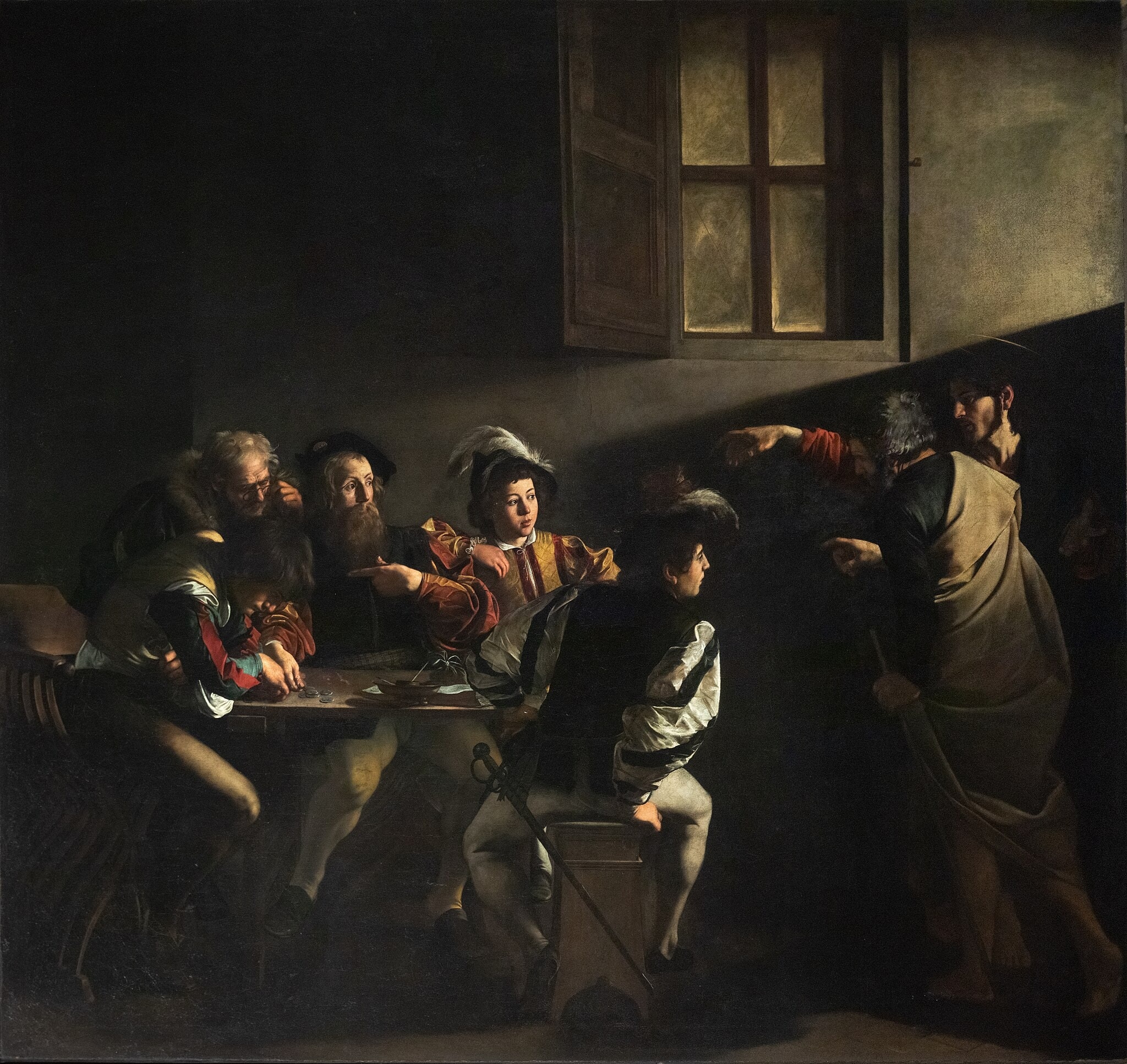
The Calling of Saint Matthew pivots on a single diagonal beam of light that slices in from the upper right, visually echoing Christ’s outstretched hand. More than illumination, this beam is the visible form of the call itself—picking Matthew out of the dim room and binding the painting’s drama to the chapel space it was made to inhabit.
Historical Context
Caravaggio painted The Calling of Saint Matthew in 1599–1600 for the left wall of the Contarelli Chapel in San Luigi dei Francesi, Rome—his first public commission and the work that established his reputation when installed by the Jubilee of 1600. The chapel is relatively dark, and the painting’s lighting scheme was conceived for that precise environment, with the beam entering from above and to the right as visitors stood before the left wall 2.
Within this Counter‑Reformation setting, the Church prized images that were immediately persuasive and legible to worshippers. Caravaggio answered with a concentrated, directional light that functions as a pictorial stand‑in for Christ’s summons, making the moment of vocation instantly readable from the nave. The diagonal beam tracks the line of Christ’s gesture and lands on Matthew’s startled hand and face, turning the dim interior into a clear stage of election and response 1.
Symbolic Meaning
The beam acts as a visible “voice,” the medium through which the call reaches Matthew. Caravaggio mobilizes a Baroque convention in which sudden, directional light signals grace breaking into ordinary time: Matthew is literally drawn from shadow into light, an image of conversion that a churchgoer can grasp at once 14. As the shaft singles out faces and hands—especially Matthew’s "Who, me?" gesture—it also functions as a chooser and revealer, rendering divine election legible in purely visual terms 14.
The beam’s path aligns with Christ’s hand, which consciously echoes Michelangelo’s Creation of Adam; the light thus traces a "new creation," linking Matthew’s call to the genesis of a renewed life 3. Some scholars deepen the metaphor: Britannica reads the diagonal as an abstract "balance," a visual allusion to Matthew’s past as a tax collector and to a weighing by grace that tips him toward discipleship 5. Others frame the light as the vehicle of inspiration itself, the means by which recognition happens in sacred narrative 7. Importantly, symbolism and site are not opposed: studies of the chapel’s real illumination show that Caravaggio keyed the painted beam to the actual window, letting natural light serve a theological end 6.
Artistic Technique
Caravaggio forges the beam through tenebrism: a single, hard, raking light carves figures out of a near-black field. The source is selective and directional—Christ himself remains half veiled behind Peter—so the light, not descriptive detail, carries the narrative weight 1. Contemporary accounts describe the artist working with one strong window and darkened walls, a studio practice that explains the emphatic, theatrical shaft we see here 8.
Compositionally, the beam runs upper right to lower left, aligning with Christ’s pointing hand and striking the table group. Its angle becomes a structural armature that organizes the scene and conducts the eye from the two entrants across to Matthew’s illuminated face and hand 13.
Connection to the Whole
Inside the picture, the beam coordinates with hands and glances—Christ’s extension, Peter’s interposed bulk, Matthew’s startled self‑point—to choreograph the instant of recognition. Without an inscription, the light effectively “names” Matthew and marks the turning point of his life 1.
Across the chapel, the Calling’s right‑to‑left beam is answered by the Martyrdom’s opposed lighting and the Inspiration’s descent from above, creating a unified theology of light that moves from call to witness to inspiration. Caravaggio’s calibration of these directions to the chapel’s real window binds image to architecture, so viewers experience the call not only as a painted event but as something enacted by the very light of the place 36.
Explore More from This Painting
This detail is one part of The Calling of Saint Matthew. Use the links below to return to the full interpretation, browse the full set of details, or view the painting's valuation if available.
Sources
- Smarthistory — Caravaggio, Calling of Saint Matthew
- The Metropolitan Museum of Art, Heilbrunn Timeline — Caravaggio and His Followers
- Wikipedia — Paintings in the Contarelli Chapel
- AP Art History — Scoring guidelines/exemplar on Caravaggio
- Britannica — Caravaggio: The Contarelli Chapel and other church commissions
- MDPI (Sustainability) — Sustainable Illumination for Baroque Paintings with Historical Context Considerations
- Irving Lavin, IAS — Divine Inspiration in Caravaggio’s Two St. Matthews
- Wikipedia — The Lute Player (Caravaggio), citing Giulio Mancini on studio lighting