The Tax Collectors in The Calling of Saint Matthew
A closer look at this element in Caravaggio's 1599–1600 masterpiece
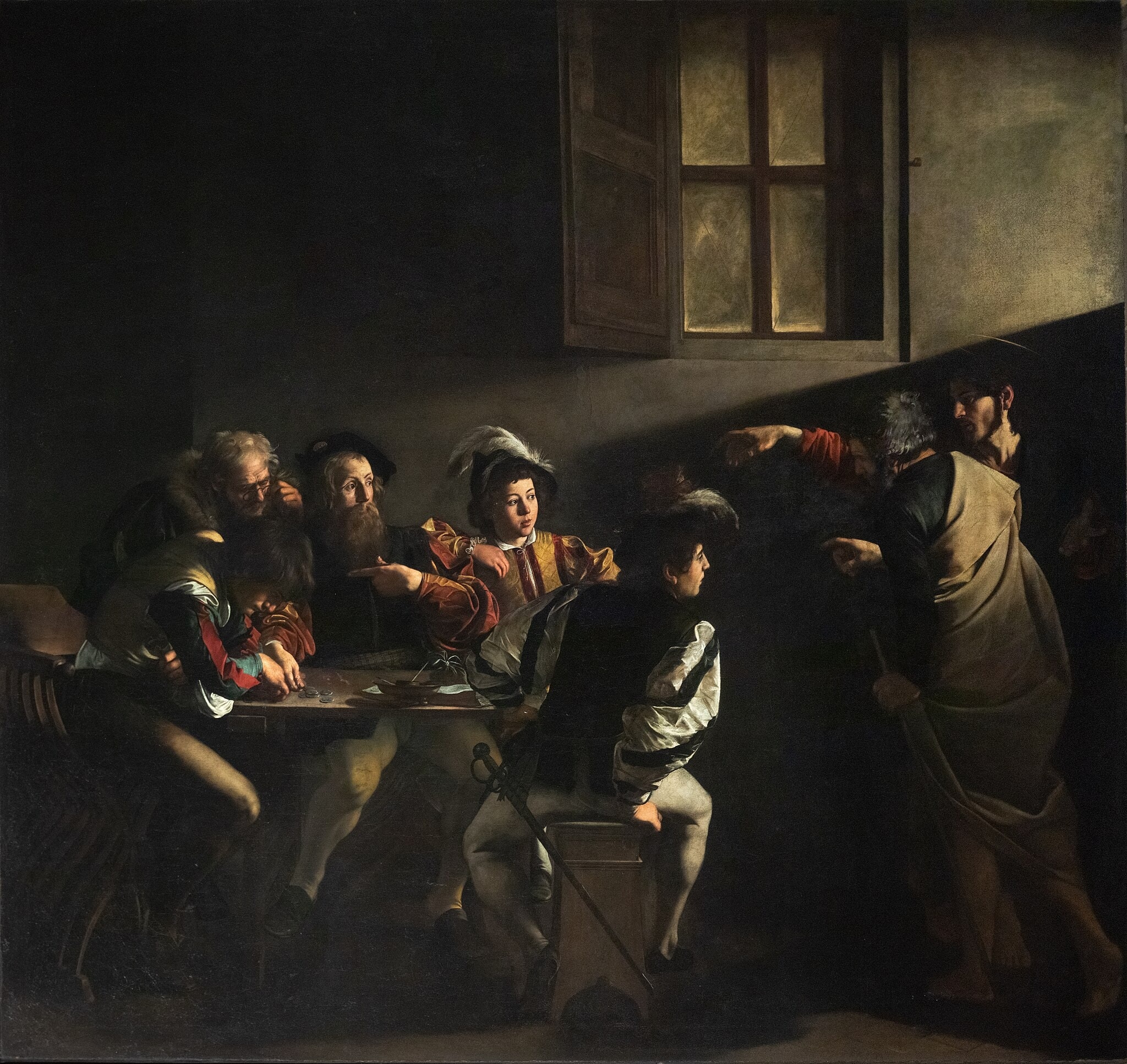
Caravaggio’s left-hand group of “tax collectors” transforms a Gospel moment into a 1590s Roman counting room, strewn with coins, ledgers, and velvet sleeves. This secular bustle becomes the foil for Christ’s irruptive call, as a raking light and a pointed gesture cut across men absorbed in money toward the one about to rise.
Historical Context
Commissioned for the Contarelli Chapel in San Luigi dei Francesi, The Calling of Saint Matthew (1599–1600) required Caravaggio to depict the Gospel scene in which Jesus encounters Matthew “at the tax office.” That narrative necessity explains the seated group at a counting table: a working tax post complete with coins, receipts, and account books. Caravaggio renders the publicani as fashionable contemporaries—hats, feathers, and shot-silk—so the biblical moment unfolds in a familiar Roman interior, collapsing sacred history into present time 1.
Unveiled with its companion canvas in 1600, the painting epitomized Caravaggio’s new naturalism in Counter-Reformation Rome: compressed space, palpable surfaces, and a dramatic, directional light that serves the story. The tax-office setting on the left is not decorative backdrop but the stage of vocation—the everyday workplace interrupted by grace. This immediacy, achieved through contemporary costume and a theatrical yet credible light, helped make the cycle a sensation and marked Caravaggio’s breakthrough in a major Roman church commission 2.
Symbolic Meaning
The counters, cash box, and ledgers form a still-life of worldly attachment. In Baroque visual language they signal avarice and social status, the mundane sphere from which Matthew is summoned. The young men’s glittering fabrics and plumed caps reinforce that identity, while their absorbed gestures—tallying, leaning over coins—embody a life oriented toward accumulation rather than conversion 6.
Across this money world, a diagonal beam of illumination arrives with Christ and Peter. The light functions narratively and theologically as grace: it isolates faces and hands, staging a spectrum of response—from unseeing concentration to startled recognition—precisely at the table’s edge 1. Christ’s extended hand, echoed by Peter’s, underscores vocation mediated “with the Church,” setting ecclesial witness against fiscal preoccupation 1.
Caravaggio also repurposes a Northern genre motif—men gathered around money in a dim interior—turning the familiar image of the moneylender’s table into a drama of calling. By adapting this recognizably secular schema to sacred history, he sharpens the moral contrast: the counting room is not merely where Matthew works; it is what he leaves behind 56.
Artistic Technique
Caravaggio deploys intense tenebrism, channeling a high, focused illumination across the counting table so that faces, fingers, and coins emerge with sculptural clarity while the room dissolves into suspenseful dark. The light’s angle aligns with Christ’s entry, binding source to story rather than to the shuttered window above 21.
Within this beam, Caravaggio paints a tactile secular still-life: cool silvers of coin, creamy papers, quills, and richly textured velvets and striped sleeves. Contemporary costume—feathers, satin, slashed doublets—creates a glinting surface world that visually contrasts with the simpler, unshod figures of Christ and Peter at right, sharpening the painting’s moral axis 6.
Connection to the Whole
The tax collectors’ table is the drama’s engine. Its clustered bodies establish the painting’s left-heavy mass, while Christ’s hand and the raking light drive a diagonal vector through the group toward the bearded man who gestures to himself—an ambiguity that invites viewers to locate Matthew at the very moment of recognition 1.
As the scene that opens the Contarelli Chapel cycle, this worldly corner—coins, colleagues, habit—defines the “old life” against which Matthew’s authorship and later martyrdom will be measured. Caravaggio’s fusion of present-day costume, narrative light, and compressed space makes the call unfold before our eyes, anchoring the composition’s central polarity: absorption in wealth versus the summons of grace 21.
Explore More from This Painting
This detail is one part of The Calling of Saint Matthew. Use the links below to return to the full interpretation, browse the full set of details, or view the painting's valuation if available.
Sources
- The Visual Commentary on Scripture, “The Calling of Matthew”
- The Metropolitan Museum of Art, Heilbrunn Timeline essay (Keith Christiansen), “Caravaggio and his followers”
- Smarthistory, “Caravaggio, Calling of Saint Matthew”
- Britannica, “Caravaggio: The Contarelli Chapel and other church commissions”
- Web Gallery of Art, Caravaggio and Northern precedents
- Pearson Higher Ed, Survey chapter with iconographic and technical notes
- Irving Lavin, “Caravaggio’s Calling of St. Matthew: The Identity of the Protagonist” (PDF)
- Wikipedia, “The Calling of Saint Matthew” (basic data)