How Much Is Lavacourt under Snow Worth?
Last updated: May 12, 2026
Quick Facts
- Methodology
- comparable analysis
Estimated at $25–50 million based on recent prices for Monet’s winter landscapes and the work’s museum-grade quality and provenance. Strong comparables include a closely related 1870s snow scene at $25.5m and an 1893 ice-floes canvas at $23.37m, with upper-band support from Monet’s broader market strength.
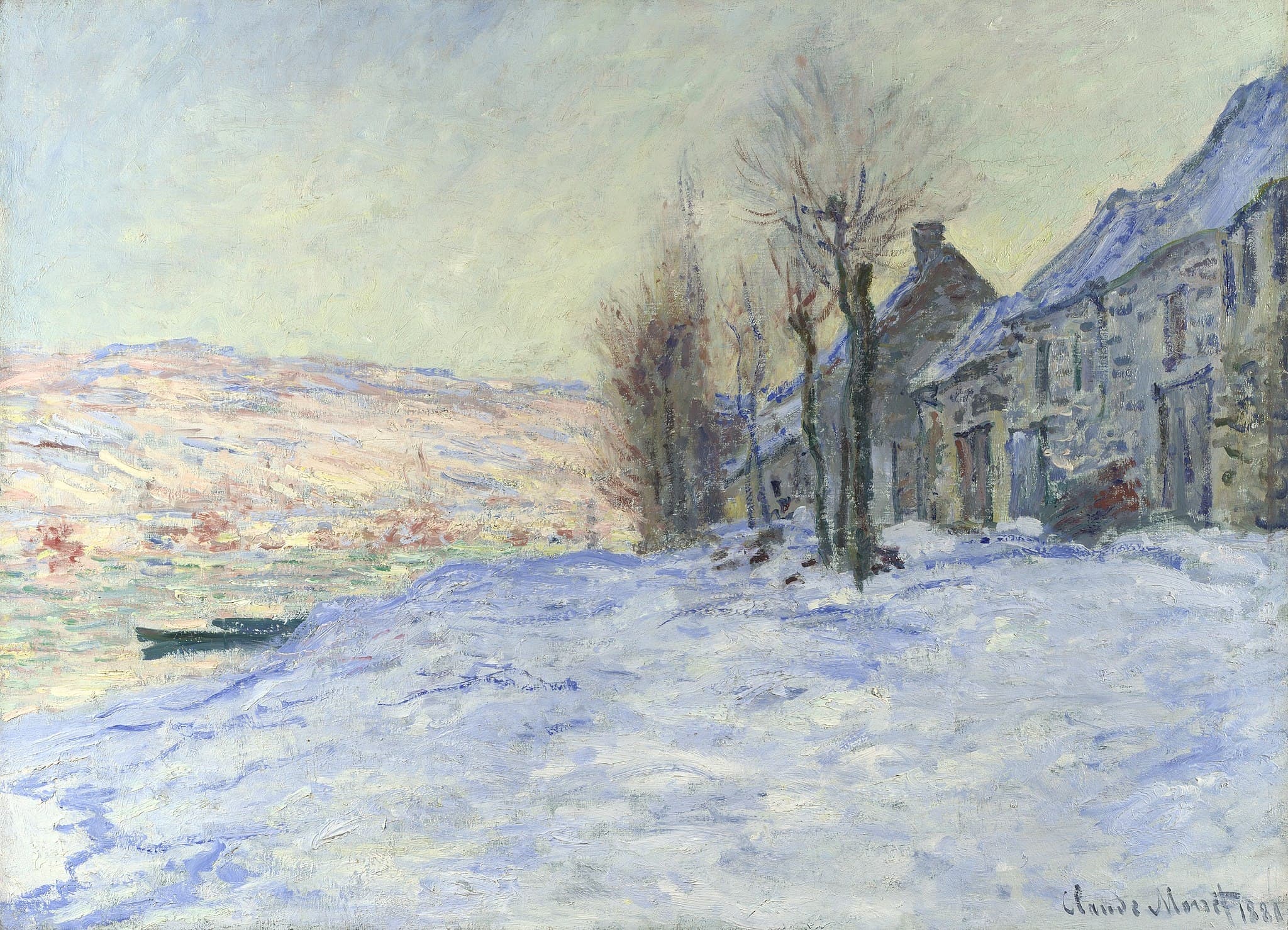
Lavacourt under Snow
Claude Monet, about 1878–81 (probably winter 1879–80; signed 1881) • Oil on canvas
Read full analysis of Lavacourt under Snow →Valuation Analysis
Lavacourt under Snow (National Gallery, London; NG3262) is a mid-size oil from Monet’s Vétheuil/Lavacourt winters, painted circa 1879/80 (later inscribed 1881), measuring 59.7 × 80.6 cm. It carries distinguished provenance from Durand‑Ruel to Sir Hugh Lane, entering the National Gallery via the 1917 Lane Bequest; it has remained off the market for over a century [1].
Estimated value: $25–50 million. This range is anchored by directly relevant winter-scene comparables. Christie’s New York sold La mare, effet de neige (Argenteuil) for $25.5m in 2022, confirming robust demand for high-quality 1870s snow subjects [2]. Sotheby’s New York achieved $23.37m for Les Glaçons, Bennecourt (Ice Floes) (1893), a thematically close winter/ice motif on the Seine [3]. A near‑locale match, La route de Vétheuil, effet de neige (1879), realized $11.45m in 2017, a useful benchmark at a lower level of scale/quality and without the institutional pedigree of NG3262 [7]. Against this backdrop, the National Gallery’s canvas—museum-grade in execution, size and provenance—rationally guides toward the upper mid–eight figures under normal third‑party‑guaranteed sale conditions.
Market positioning within Monet’s oeuvre. While winter Vétheuil/Lavacourt subjects are art‑historically important, the very top pricing in Monet’s market accrues to series like the Nymphéas, Haystacks, and London Thames views. Recent marquee results include $74.01m for Le bassin aux nymphéas (2023) and the standing artist record of $110.7m for Meules (2019), underscoring headroom at the trophy tier [5][4]. In 2025, a Poplars canvas achieved $42.96m, illustrating sustained depth for prime Monet landscapes in New York evening sales [6]. A snow scene of this caliber appropriately prices below those apex categories while still commanding a premium for rarity, quality, and provenance.
Key drivers and sensitivities. The estimate assumes sound condition consistent with National Gallery standards. This mid-size (c. 60 × 80 cm) format is highly exhibitable and liquid. The palette and atmospheric handling are central to demand for Monet’s winter works; crisper chromatic contrasts and strong surface preservation support the higher band. Sale mechanics matter: placement as a featured lot with a well-structured third‑party guarantee in a New York evening sale would optimize competitive depth. Should the work ever be transparently deaccessioned and marketed as a museum “trophy,” a result at or near the top of the $25–50m range is realistic, with selective upside driven by provenance confidence and cross‑category bidding [2][5][6].
Conclusion. Balancing subject-tier positioning with museum-level quality and provenance, $25–50 million is a rigorous, comp‑based valuation for Lavacourt under Snow today, consistent with recent winter-scene outcomes and Monet’s broader blue‑chip market context [2][3][5].
Key Valuation Factors
Art Historical Significance
High ImpactPainted during Monet’s pivotal Vétheuil/Lavacourt years (c. 1878–81), the snow pictures crystallize his investigation of atmosphere, light, and transient effects in austere winter conditions. This period coincides with personal and financial strain, a context that sharpened Monet’s observational rigor and yielded some of his most searching landscapes. Lavacourt lies across the Seine from Vétheuil, providing the elevated, expansive vantage Monet favored for winter effects. Within scholarship, these canvases mark an essential bridge between his 1870s naturalism and the serial, motif-driven explorations that culminate in Haystacks, Poplars, and the Nymphéas. As a refined, museum-held example, NG3262 anchors this critical chapter with strong didactic and exhibition potential.
Subject and Series Positioning
High ImpactMonet’s winter landscapes are coveted but sit a rung below the market’s apex series (Water Lilies, Haystacks, Rouen, and London Thames). The snow motif is admired by connoisseurs for its subtle tonalities and bravura handling, yet its cooler, more restrained palette appeals to a narrower buyer pool than the chromatic fireworks of the Nymphéas or London sunsets. That positioning explains the observed price band: top winter scenes achieve mid‑ to high‑eight figures, while first‑rank series can extend into the $50m–$110m+ zone. For a mid‑size, elegant, and atmospheric Lavacourt/Vétheuil snow canvas with institutional provenance, upper‑mid‑eight‑figure pricing is fully supported by recent comps and current demand.
Provenance and Institutional Ownership
High ImpactDurand‑Ruel handling, acquisition by Sir Hugh Lane in 1905, and entry into the National Gallery via the 1917 Lane Bequest constitute gold-standard provenance. Museum stewardship signals conservation rigor, research depth, and unimpeachable title—attributes that reduce perceived risk and expand the buyer base in a high-stakes evening sale. Works with long public visibility and catalogued histories trade at a premium versus privately held paintings with thinner records. Should the National Gallery ever deaccession (rare in the UK), the institutional imprimatur and exhibition history would be positioned as major value drivers in cataloging and marketing, supporting the top end of the valuation range.
Scale, Palette, and Condition
Medium ImpactAt roughly 60 × 80 cm, the painting sits in a highly liquid, wall-friendly format favored by private buyers and museums alike. Monet’s winter scenes can vary from silvery greys to higher‑key, lavender and blue harmonies; stronger chromatic contrast and crisp atmospheric definition correlate with superior prices. This estimate assumes sound condition consistent with National Gallery care (stable support, legible surface, and no visually disruptive retouching). Any significant condition compromises—wax lining fatigue, discoloration, abrasion, or overpaint—would depress competitiveness and shift the work toward the lower band. Conversely, exceptionally fresh surface quality and rich impasto would justify pricing toward the top.
Sale Mechanics and Timing
Medium ImpactPlacement as a featured lot in a New York marquee evening auction, backed by an intelligently structured third‑party guarantee and pre‑sale global marketing, typically extracts maximum depth for blue‑chip Monets. Timing into seasons with strong Impressionist supply and cross‑category headlines (and around Monet’s 2026 centenary exhibitions) enhances competitive urgency. Currency conditions and buyer geography also matter: US‑dollar strength and live bidding from US, Europe and Asia have historically buoyed Monet prices. These mechanics do not replace core quality factors, but they can swing outcomes by meaningful margins, often determining whether a museum-grade, non‑trophy subject lands mid‑range or pushes to the top of guidance.
Sale History
Lavacourt under Snow has never been sold at public auction.
Claude Monet's Market
Claude Monet is a cornerstone of the global blue‑chip market, with deep private and institutional demand across the US, Europe and Asia. His all‑time auction record stands at $110.7 million for Meules (Haystacks) set in 2019, while recent marquee results for Water Lilies and London series works continue to clear $50–$75 million. Demand concentrates around signature series—Haystacks, Poplars, Rouen Cathedrals, London Thames views, and Nymphéas—where color, scale, and exhibition pedigree drive competition. Liquidity is strong for well‑provenanced, conservationally sound works from the 1870s–1910s, with selective premium for museum-grade pieces. Guarantees and top‑tier evening sale placement remain important to unlock peak pricing.
Comparable Sales
La mare, effet de neige (Argenteuil)
Claude Monet
Best recent Monet winter benchmark: an 'effet de neige' landscape from the 1870s, closely aligned in subject (snow scene), period, and painterly handling to Lavacourt/Vétheuil winters.
$25.5M
2022, Christie's New York
~$27.5M adjusted
Les Glaçons, Bennecourt (Ice Floes)
Claude Monet
Major snow/ice motif on the Seine; later in date (1893) but thematically very close (winter, ice, riverine setting). Useful for gauging demand for Monet’s winter atmospherics.
$23.4M
2017, Sotheby's New York
~$29.7M adjusted
La route de Vétheuil, effet de neige
Claude Monet
Same locale and winter subject (Vétheuil, 1879) as Lavacourt/Vétheuil snows, making it one of the closest like-for-like comps by subject, period and mood.
$11.4M
2017, Christie's New York
~$14.5M adjusted
Vétheuil, effet du matin
Claude Monet
Same site (Vétheuil) and early-period landscape; not a snow scene but a very recent datapoint for Vétheuil canvases in Europe, helpful for location/period calibration.
$12.1M
2026, Sotheby's Paris
~$11.9M adjusted
Peupliers au bord de l’Epte, crépuscule
Claude Monet
Not a snow scene, but a prime, trophy series result that benchmarks current appetite and pricing for top-tier Monet landscapes in the marquee New York evening context.
$43.0M
2025, Christie's New York
Current Market Trends
The Impressionist/Modern segment remains resilient but selective at the top: apex, museum‑quality works attract aggressive bidding, while secondary examples face disciplined estimates and guarantees. Monet continues to headline evening sales, with 2023–2025 results reaffirming depth in the $35–$75m corridor for prime series and mid‑ to high‑eight‑figure pricing for strong, non‑trophy subjects. Buyers prize pristine condition, iconic motifs, and best‑in‑class provenance, and they respond to tightly curated sales in New York and London. Macro volatility in 2024–2025 compressed some ultra‑high results, but momentum stabilized into 2025, and Monet’s centenary year programming sustains curatorial and collector focus into 2026.
Study print
Study this painting as a print
Pair the full artwork with a museum-style study sheet focused on one meaningful detail.
Sources
- National Gallery, London – Claude Monet, Lavacourt under Snow (NG3262)
- The Art Newspaper – Christie’s evening sales hit $831m; includes Monet snow scene at $25.5m (May 12, 2022)
- Artnet News – Sotheby’s Impressionist & Modern Evening Sale: Monet ‘Les Glaçons, Bennecourt’ $23.37m (Nov 14, 2017)
- Sotheby’s – Monet’s Meules sells for $110.7 million, a new artist record (May 14, 2019)
- Christie’s – Le bassin aux nymphéas sells for $74,010,000 (Nov 9, 2023) – 20th Century Evening Sale results
- Christie’s – 20th/21st Century New York Results (May 2025): Monet Poplars $42,960,000
- Art Observed – Christie’s Impressionist & Modern Evening Sale (May 15, 2017): Monet ‘La route de Vétheuil, effet de neige’ $11.45m