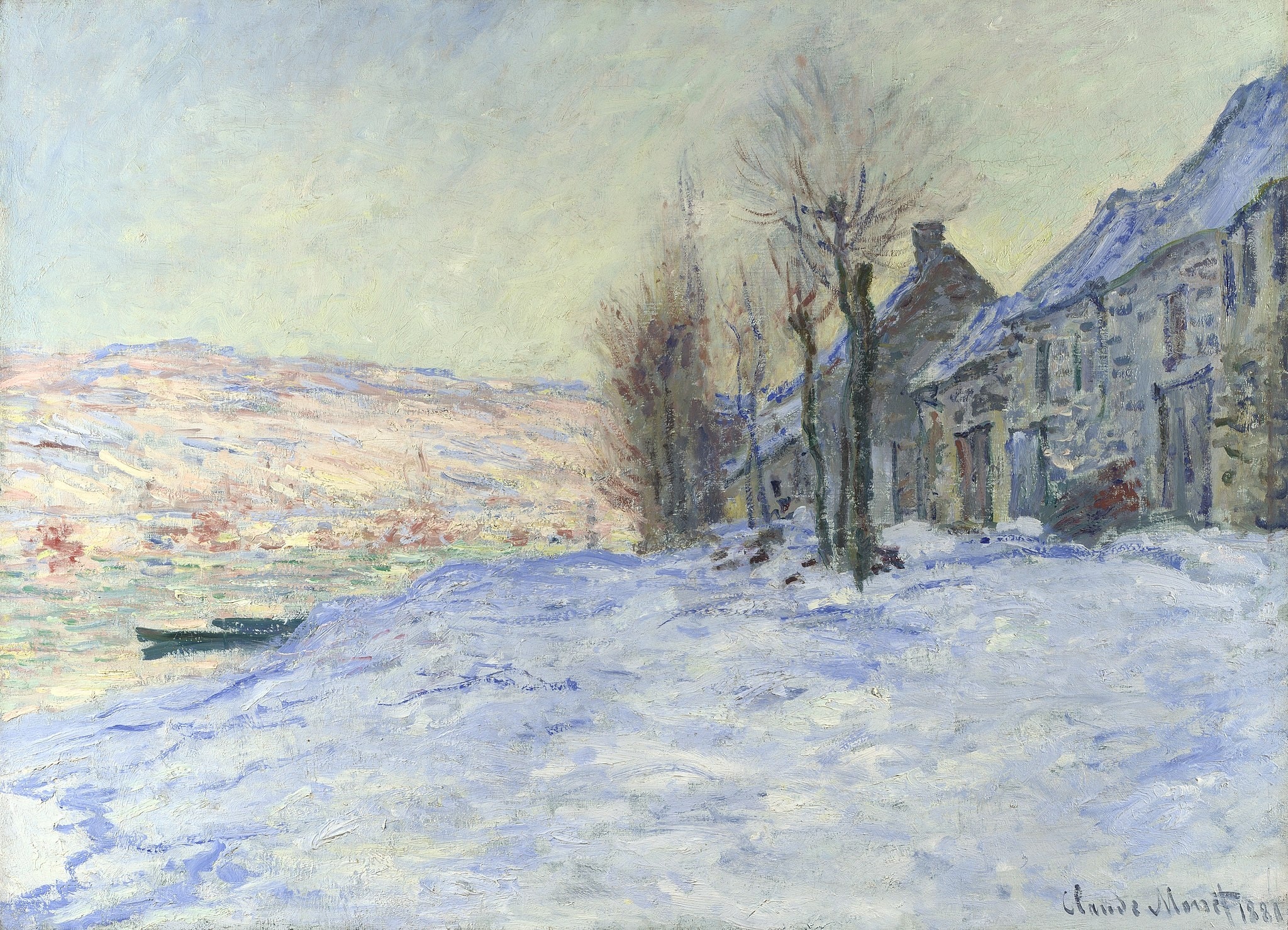
Lavacourt under Snow

by Claude Monet

Claude Monet’s Lavacourt under Snow distills a frozen morning on the Seine into a field of lilac‑blue shadows and a counterglow of rose light across the far bank. A diagonal of cottages and leafless trees holds the right margin while a moored dark boat punctuates the left, turning transience into structure [1].

Study Print Studio

Create a personal study print

Build a companion study sheet around the part of this painting that speaks to you most. Choose a detail, shape an interpretation, and walk away with something personal and display-worthy.

Fast Facts

Year
about 1878–81 (probably winter 1879–80; signed 1881)
Medium
Oil on canvas
Dimensions
59.7 × 80.6 cm
Location
The National Gallery, London
See all Claude Monet paintings in London
Lavacourt under Snow by Claude Monet (about 1878–81 (probably winter 1879–80; signed 1881)) featuring Leafless trees, Riverside cottages, Moored dark boat

Click on any numbered symbol to learn more about its meaning

Meaning & Symbolism

Monet engineers a quiet tension between human settlement and elemental forces. Along the right edge, a tight procession of stone cottages and bare trunks climbs the snow slope, their verticals staking a claim of endurance. Yet the houses yield visually to the dominant plane of snow, a skin of broken strokes laid in cool violets and blues, never pure white. These strokes are not decoration; they are the optical code by which Monet states that shadow is colored and that atmosphere edits every surface. The thick impasto ridges in the nearest drifts catch slivers of green and blue, instructing the eye to blend color on the retina rather than on the palette—an Impressionist axiom made concrete here 19. At left, the Seine is a moving mirror in cool green striations, absorbing the sky while refusing precise reflection; a small, dark boat sits near the bank like a comma in a long sentence, a pause that clarifies scale and human presence without breaking the mood 1. Across the river, the opposite bank glows in pinks and creams under a pale yellow‑green sky, an improbable warmth that balances the shaded foreground. This chromatic counterpoint is the painting’s argument: winter is not monochrome but a dialectic of cold and warm light. The far hillside’s rose hue implies a weak sun just out of frame, a narrative hinge that turns the frozen surface into a promise of thaw. That promise is strengthened by the right‑hand trees—attenuated, leafless, but upright—serving as metronomes of seasonal time. The diagonal that runs from the cottages toward the center channels the viewer’s movement across the canvas, from compact human shelter to open water and onward to light, an arc from endurance to renewal. The National Gallery’s curators note this tight structure and the balancing of cool near‑bank tones with warmth in the distance; Monet’s compositional economy makes the effect incontrovertible 1. Context charges these effects with consequence. In 1878 Monet had retreated from Argenteuil’s urban modernity to Vétheuil, sharing a cramped house with the bankrupt Hoschedé family; his wife Camille died in September 1879. The catastrophic winter of 1879–80 then locked the Seine, later shattering it into dramatic ice flows. Painting outdoors through this sequence, Monet refined a practice of returning to the same reach of river under changing weather—an embryonic series method that would culminate in haystacks, poplars, and cathedrals 136. Lavacourt under Snow, signed 1881 but likely painted that winter, stands at this methodological threshold, transforming historic cold into a program of seeing 145. Even the rural subject has interpretive weight: the picture deliberately foregrounds a traditional riverside hamlet free of factories, a counter‑image to Monet’s earlier Gare Saint‑Lazare works, and thus a meditation on cyclical, preindustrial time rather than mechanical time 1. Technically, the palette aligns with Monet’s late‑1870s practice—ultramarine and cobalt for shadows, viridian and emerald for the river, cadmium and vermilion modulating the distant pinks—supporting the painting’s optical mixtures and cool‑warm opposition 8. But technique serves narrative clarity: the sky’s yellow‑green veil descends toward blue, the snow’s blue‑violet rises toward light, and between them the far bank blushes, a hinge of hope. The work’s early reception history—too radical for some British trustees even by 1905—confirms how decisively it reconceived winter as a spectrum rather than a void 15. In sum, Lavacourt under Snow is not a report of weather; it is a proof that endurance can be seen, measured in color and held, if only for an instant, on canvas.

Explore Deeper with AI

Ask questions about Lavacourt under Snow

Popular questions:

Powered by AI • Get instant insights about this artwork

💬 Ask questions about this artwork!

Interpretations

Environmental History

Read as a micro‑archive of the catastrophic winter of 1879–80, the canvas treats climate as an active historical agent rather than neutral backdrop. The Seine’s "moving mirror" and the snow’s blue‑violet shadows register meteorological extremity—freeze, stasis, and the anticipation of débâcle—that Monet tracked over weeks outdoors 12. This environmental lens clarifies why the far bank’s rosy warmth matters: it is not sentiment but phenological evidence of a low sun and imminent thaw. Framed this way, the work belongs to a cohort of Vétheuil/Lavacourt paintings that document a singular winter event, aligning pictorial experiment with environmental record‑keeping and making the scene a climatic testimony as much as a landscape.

Source: National Gallery, London

Method and Seriality

Lavacourt under Snow sits at the threshold of Monet’s series method, where revisiting the same reach of river under mutable weather becomes a research program in seeing 14. The tight diagonal and calibrated cool–warm counterpoint are not one‑off effects but repeatable variables—angle, hour, cloud cover—waiting to be permuted across canvases. In Vétheuil, economic precarity paradoxically stabilized Monet’s motif, tethering him to the Seine and training attention on temporal micro‑shifts rather than narrative incident 4. Seen through this lens, the painting functions like a data point in an optical sequence: tonal structure is controlled, while atmospheric inputs change, anticipating the later Haystacks/Poplars/Cathedrals logic of controlled motif under changing light.

Source: Studio International (exhibition scholarship)

Reception & Institutional Politics

The painting’s early British reception reveals how Impressionism’s winter reductions challenged institutional canons. In 1905, advocates proposed purchasing this very work for a national fund; trustees declined, preferring Boudin as safer precedent 1. The refusal indexes more than taste—it maps the politics of public collections, where chromatic snow, broken touch, and rural modernity threatened established hierarchies of finish and subject. The episode shows how Monet’s optical grammar (colored shadow, retinal mixture) read as ideological disruption in an academic ecosystem still privileging studio polish. Thus Lavacourt under Snow becomes a case study in how museums negotiate modernism, mediating between radical facture and the pedagogies of national taste.

Source: National Gallery, London

Material/Optical Analysis

Ultramarine and cobalt in the shadows, viridian/emerald in the river, and cadmium/vermilion modulating distant pinks underwrite Monet’s optical mixtures: the snow is never white but a lattice of cool violets and blues that the viewer fuses in sight 16. Impasto on the near drifts catches slivers of green and blue, staging a didactic surface where paint ridges themselves become light‑traps. The Seine’s cool greens, laid in horizontal striations, refuse mirror‑like mimesis in favor of phenomenal equivalence—a surface that reads as water because of its chromatic/gestural behavior, not its outline. Materially, the picture is a laboratory of retinal synthesis, crafting atmospheric truth through calibrated pigment contrasts.

Source: ColourLex (technical palette) + National Gallery, London

Modernity and the Rural Counter‑Image

By foregrounding a "traditional riverside hamlet" as a counter‑image to the Gare Saint‑Lazare works, Monet opposes cyclical, agrarian temporality to the linear tempo of steam and schedules 15. The diagonal of cottages and the modest boat imply local life paused by winter, not obliterated by it; the painting envisions continuity through seasonal labor rather than industrial acceleration. This is not nostalgia but a strategic modernity: the artist modernizes rural vision through radical optics while eschewing urban spectacle. In this synthesis, modern painting and preindustrial subject cohabit, complicating binaries of avant‑garde versus tradition and recoding the countryside as a site for experimental seeing rather than pastoral escape.

Source: The Frick Collection (Vétheuil period)

Psychological/Biographical Lens

Composed in the wake of Camille’s death (September 1879), the work’s disciplined cools and withheld whites can be read as an aesthetics of restraint, where grief sublimates into controlled chroma and measured structure 57. The “hinge of hope” at the warm far bank functions less as sentiment than as affective modulation, balancing austerity with possibility without recourse to narrative. Such biographical inflection does not claim programmatic symbolism; rather it posits that Monet’s attentional rigor—returning outdoors in extreme cold—channels mourning into sustained perception. The painting thus becomes a practice of endurance through looking, where the promise of thaw is both meteorological and quietly existential.

Source: National Galleries of Scotland (biographical context)

Related Themes

About Claude Monet

Claude Monet (1840–1926) led Impressionism’s pursuit of open-air painting and optical immediacy, especially during his Argenteuil years focused on modern leisure and light. He later developed serial studies of changing conditions, culminating in the Water Lilies cycle [2].
View all works by Claude Monet

More by Claude Monet

Haystacks Series by Claude Monet | Light, Time & Atmosphere by Claude Monet

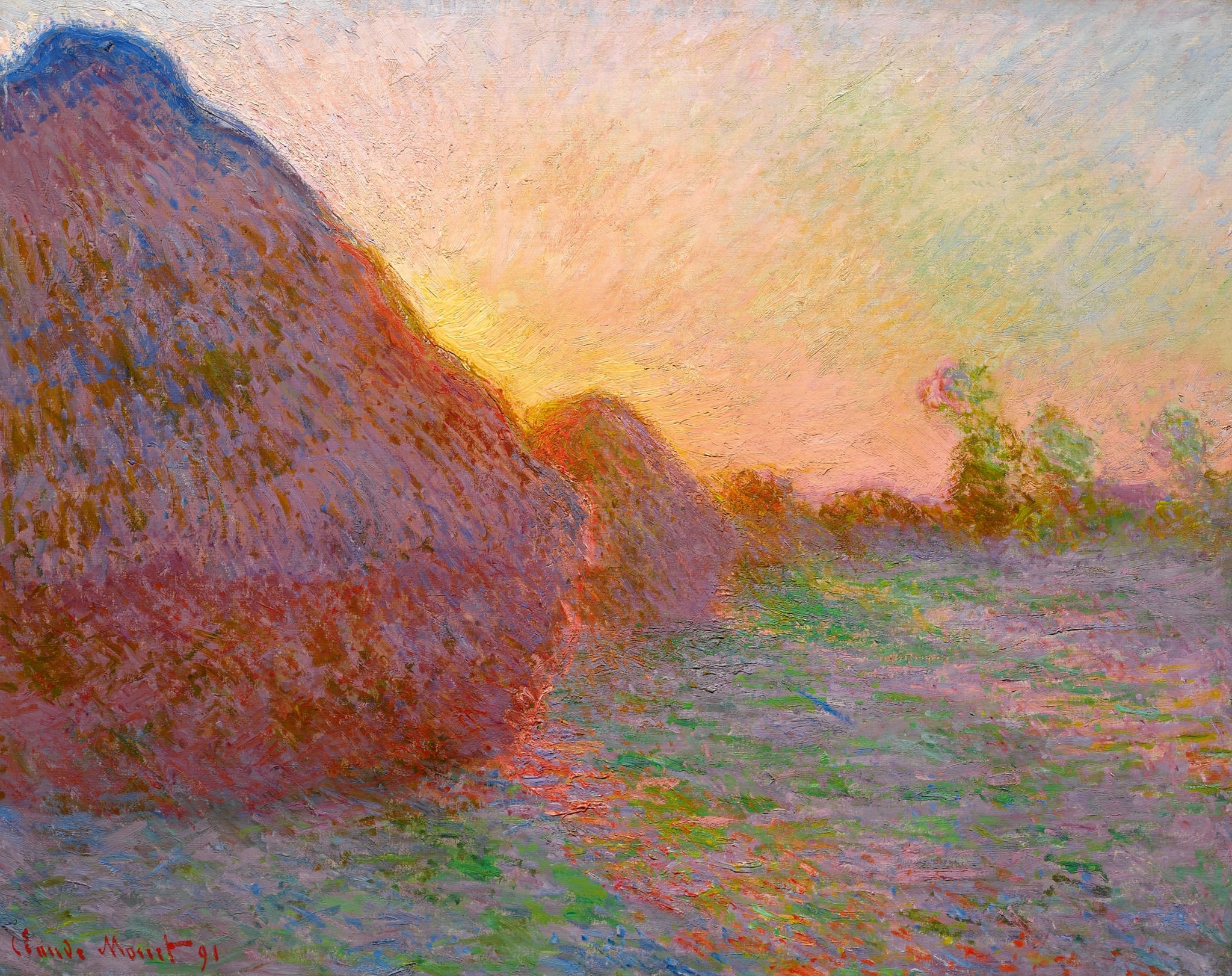
Haystacks Series by Claude Monet | Light, Time & Atmosphere

Claude Monet

Claude Monet’s <strong>Haystacks Series</strong> transforms a routine rural subject into an inquiry into <strong>light, time, and perception</strong>. In this sunset view, the stacks swell at the left while the sun burns through the gap, making the field shimmer with <strong>apricot, lilac, and blue</strong> vibrations.
Women in the Garden by Claude Monet

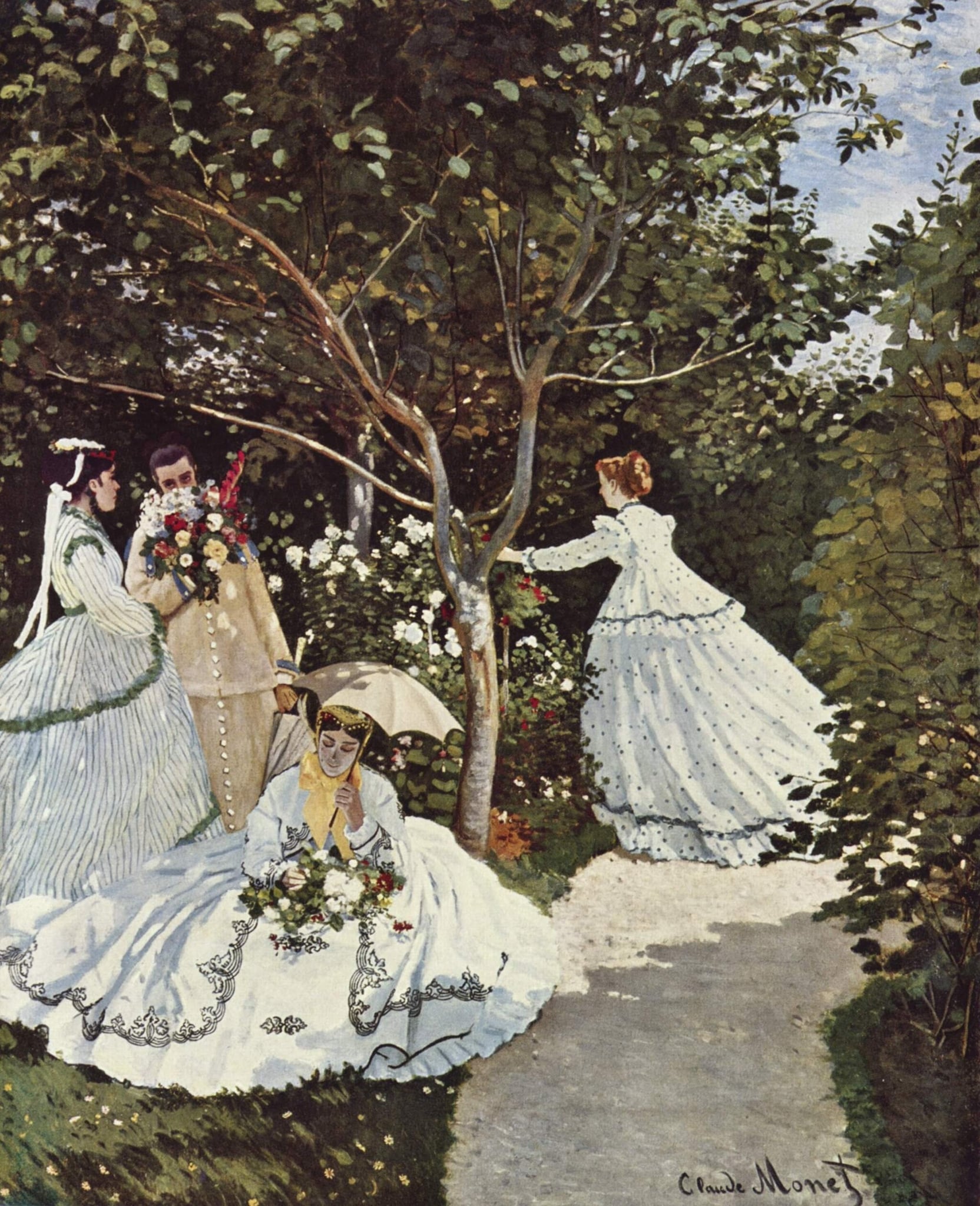
Women in the Garden

Claude Monet (1866–1867)

Claude Monet’s Women in the Garden choreographs four figures in a sunlit bower to test how <strong>white dresses</strong> register <strong>dappled light</strong> and shadow. The path, parasol, and clipped flowers frame a modern ritual of leisure while turning fashion into an instrument of <strong>perception</strong>. The scene reads less as portraiture than as a manifesto for painting the <strong>momentary</strong> outdoors <sup>[1]</sup><sup>[3]</sup>.
The Train in the Snow (The Locomotive) by Claude Monet

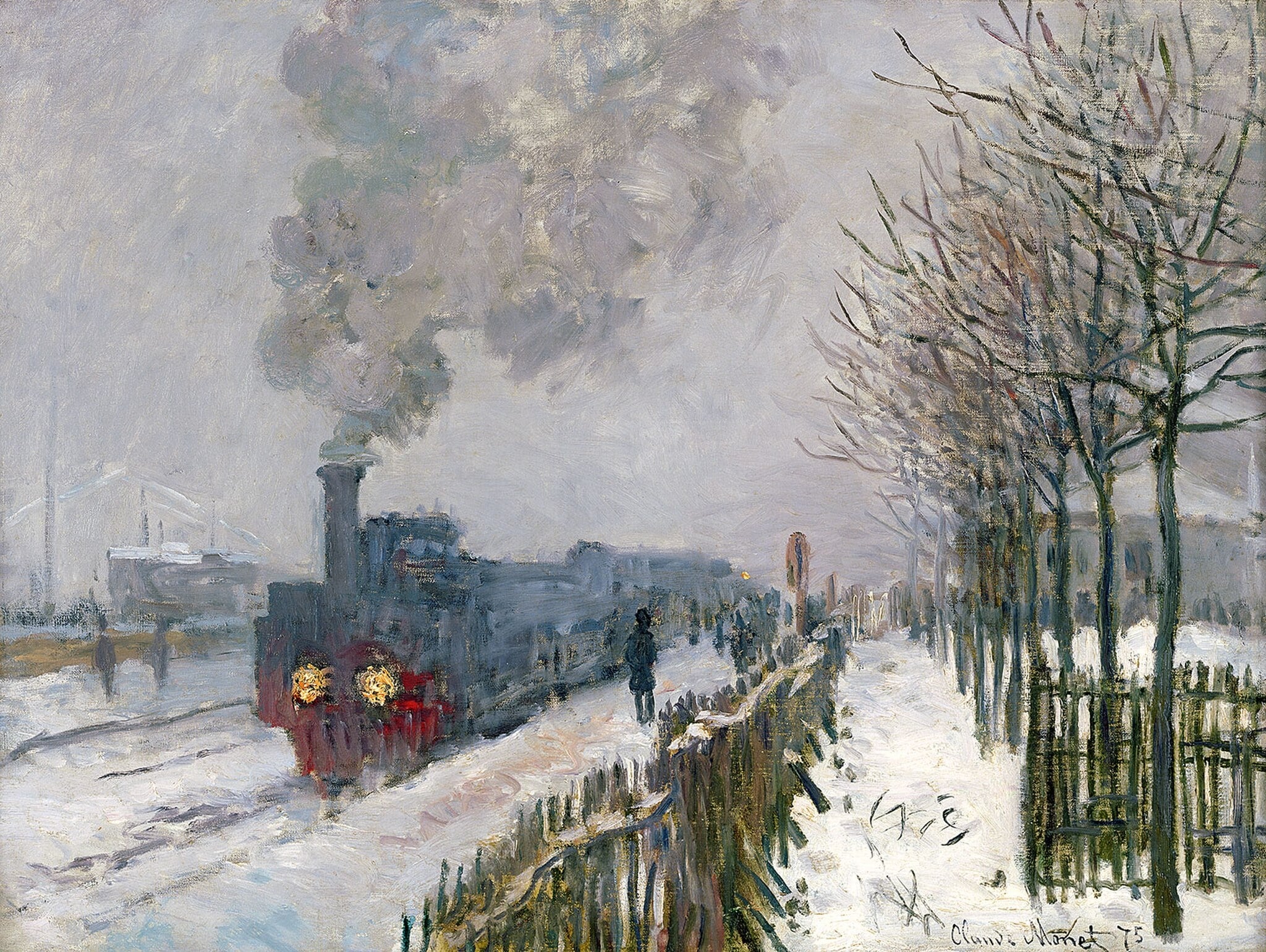
The Train in the Snow (The Locomotive)

Claude Monet (1875)

Claude Monet’s The Train in the Snow (The Locomotive) (1875) turns a suburban winter platform into a study of <strong>modernity absorbed by atmosphere</strong>. The engine’s twin yellow headlights and a smear of red push through a world of greys and violets as steam fuses with the low sky, while the right-hand fence and bare trees drill depth and cadence into the scene <sup>[1]</sup><sup>[4]</sup>. Monet fixes not an object but a <strong>moment of perception</strong>, where industry seems to dematerialize into weather <sup>[1]</sup><sup>[2]</sup>.
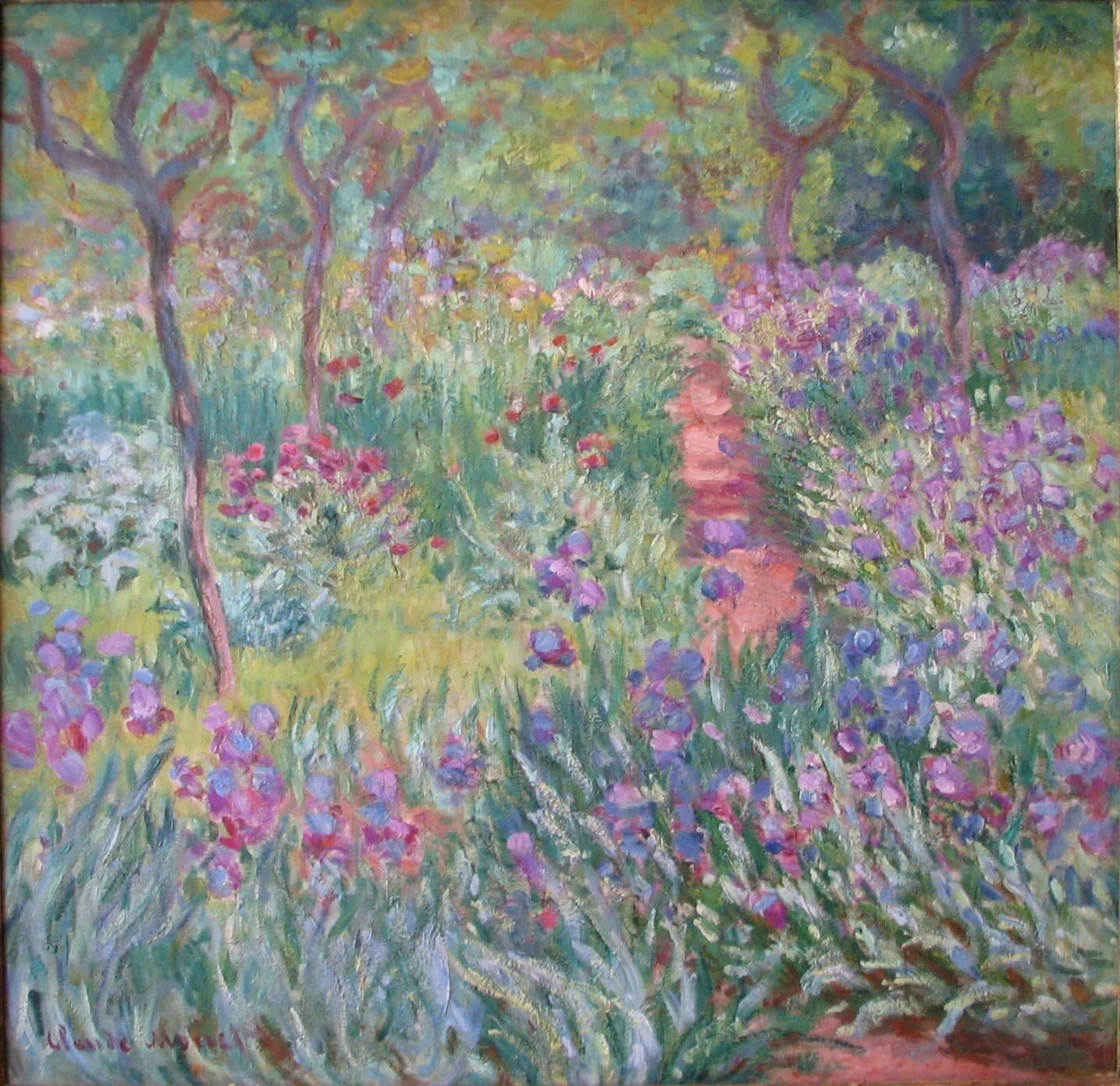
The Artist's Garden at Giverny by Claude Monet

The Artist's Garden at Giverny

Claude Monet (1900)

In The Artist's Garden at Giverny, Claude Monet turns his cultivated Clos Normand into a field of living color, where bands of violet <strong>irises</strong> surge toward a narrow, rose‑colored path. Broken, flickering strokes let greens, purples, and pinks mix optically so that light seems to tremble across the scene, while lilac‑toned tree trunks rhythmically guide the gaze inward <sup>[1]</sup><sup>[3]</sup>.
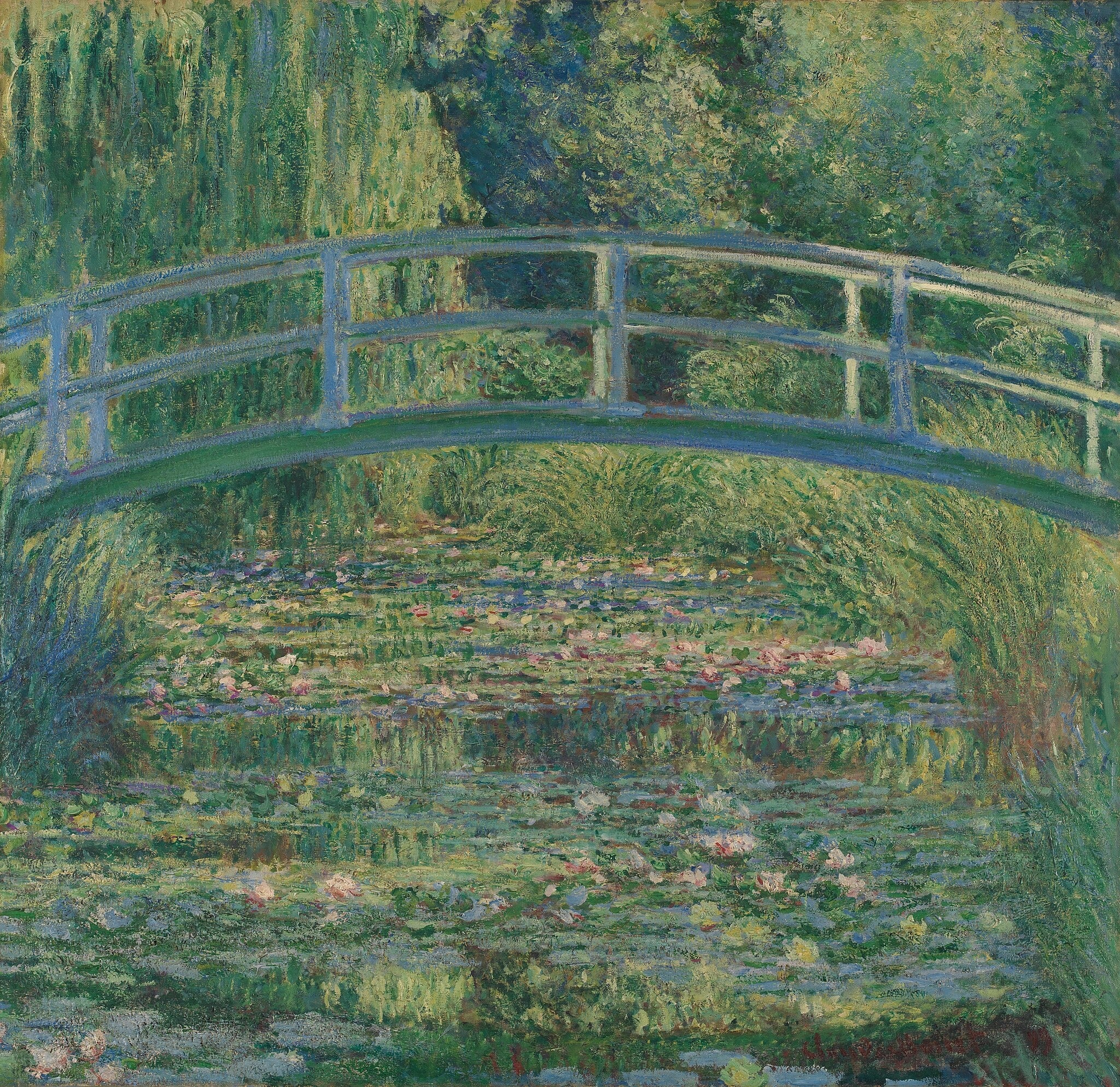
Water Lilies by Claude Monet

Water Lilies

Claude Monet (1899)

<strong>Water Lilies</strong> centers on an arched <strong>Japanese bridge</strong> suspended over a pond where lilies and rippling reflections fuse into a single, vibrating surface. Monet turns the scene into a study of <strong>perception-in-flux</strong>, letting water, foliage, and light dissolve hard edges into atmospheric continuity <sup>[1]</sup><sup>[3]</sup>.
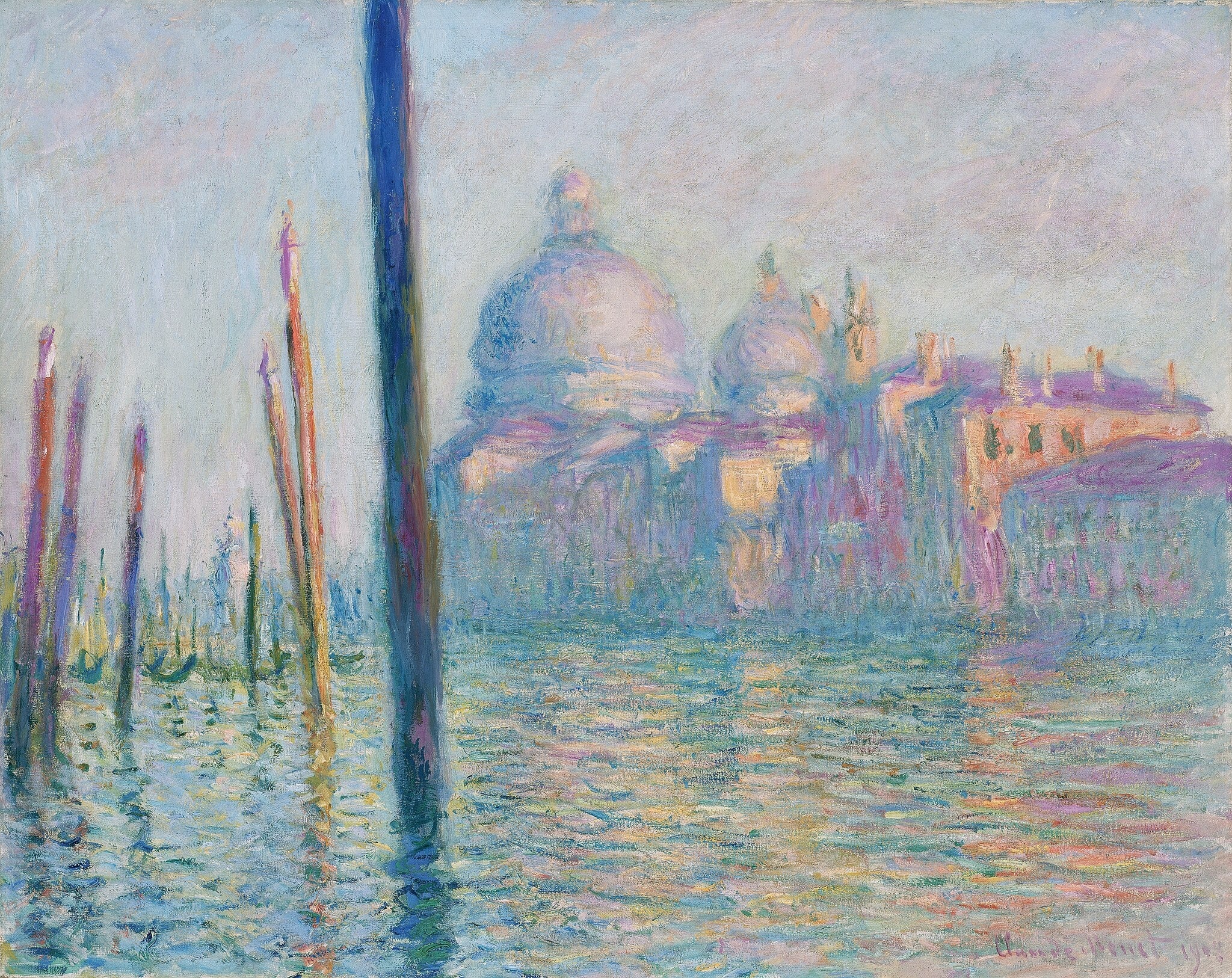
The Grand Canal by Claude Monet

The Grand Canal

Claude Monet (1908)

Claude Monet’s The Grand Canal turns Venice into <strong>pure atmosphere</strong>: the domes of Santa Maria della Salute waver at right while a regiment of <strong>pali</strong> stands at left, their verticals reverberating in the water. The scene asserts <strong>light over architecture</strong>, transforming stone into memory and time into color <sup>[2]</sup><sup>[3]</sup>.