How Much Is The Beach at Trouville Worth?
Last updated: May 12, 2026
Quick Facts
- Methodology
- comparable analysis
Hypothetical open‑market value for Claude Monet’s The Beach at Trouville (1870, NG3951) is estimated at $24–38 million. The range is derived from close Trouville‑series comparables, Monet’s current blue‑chip market, and the work’s exceptional art‑historical standing and long National Gallery provenance.
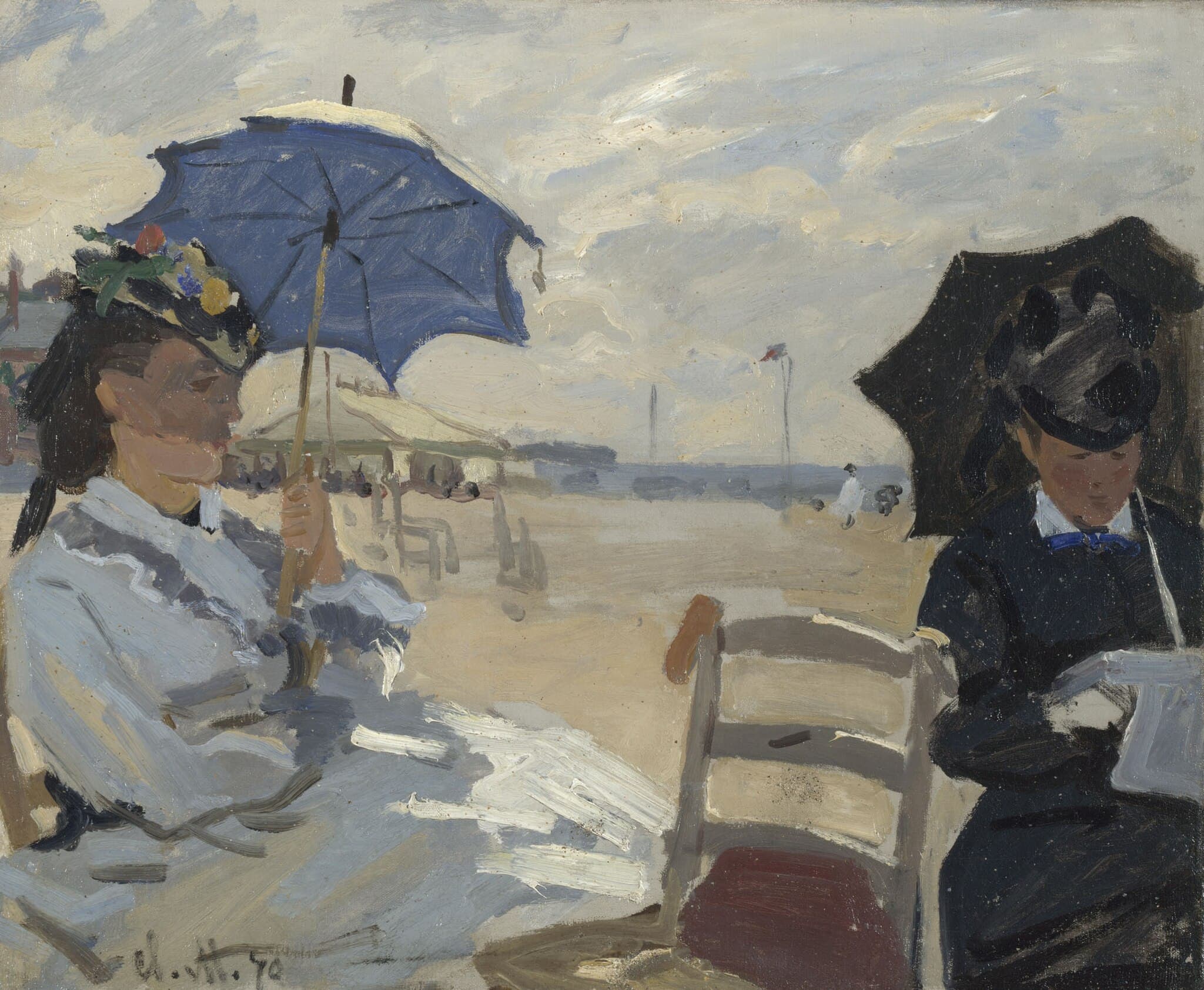
The Beach at Trouville
Claude Monet, 1870 • Oil on canvas
Read full analysis of The Beach at Trouville →Valuation Analysis
Estimate: $24–38 million (hypothetical, USD). This range is grounded in direct comparables from Monet’s 1870 Trouville campaign, adjusted for today’s market depth and the subject’s visibility, and then cross‑checked against Monet’s broader price hierarchy. The work is a canonical early Impressionist canvas, widely cited for its plein‑air execution—complete with wind‑blown sand embedded in the paint—and for its engaging figure subject, likely including Camille Monet [1].
Art-historical and qualitative factors. Painted at Trouville in 1870, the picture exemplifies Monet’s breakthrough language: rapid, wind‑swept brushwork, a luminous coastal palette, and modern leisure as subject. Its moderate easel scale (c. 38 × 46.5 cm) reads as a fully realized painting rather than a fragment or study, and the composition’s immediacy has made it a touchstone in scholarship and museum didactics. The National Gallery’s deep documentation and uninterrupted public ownership since 1924 (acquired via the Courtauld Fund) further reinforce confidence in authorship, dating, and condition stewardship [1].
Comparable sales analysis. The closest market anchors are Monet’s other Trouville‑series works. At Christie’s New York (Rockefeller Collection, 8 May 2018), Camille assise sur la plage à Trouville—very similar in date, size and subject intimacy—realized $12,125,000; indexed to today, that supports a mid‑teens baseline for intimate Trouville figures [3]. A broader beach/boardwalk La Plage à Trouville made £6,820,000 at Sotheby’s London (25 Jun 2008), roughly $13.4m at the time and about c. $20m in today’s dollars [4]. A frequently cited high‑tide Trouville variant sold in London in 2000 around the mid‑teens (USD at the time), implying c. $30m+ inflation‑adjusted. On quality, fame, and institutional cachet, the National Gallery picture would be expected to trade above the 2018 intimate variant and broadly in line with or ahead of the larger 2008 boardwalk scene, situating fair value in the mid‑20s to high‑30s.
Position within Monet’s hierarchy. While Monet’s late “trophy” series—Haystacks, Water Lilies, Rouen Cathedrals—command $50m to $100m+ (record $110.7m for Meules, Sotheby’s, 2019) [2], early coastal and figure subjects form a robust, liquid second tier with deep cross‑category demand. This picture’s art‑historical celebrity and museum provenance justify a premium to standard early coastal scenes, though it remains priced below the late series masterworks.
Sale context and assumptions. The estimate presumes sound condition commensurate with a major museum holding and a fully marketed evening‑sale platform with competitive global bidding. A well‑structured guarantee could reduce downside volatility, with the discretion of a private sale potentially achieving a similar or slightly higher outcome given the picture’s renown. Within this framework, $24–38 million captures current market clearing levels for best‑in‑class early Monets from the Trouville campaign.
Key Valuation Factors
Art Historical Significance
High ImpactPainted in 1870, The Beach at Trouville stands at the inception of Impressionism, encapsulating plein‑air method, modern leisure subject matter, and Monet’s wind‑swept facture. The picture is frequently discussed for the sand embedded in its paint and for the likely inclusion of Camille Monet—elements that have made it a standard‑bearer in textbooks, exhibitions, and museum interpretation. Its compact but complete scale reads as a finished easel painting, not a fragment or preparatory study. Because early, well‑documented canvases that clearly telegraph the movement’s DNA are scarce, this work’s scholarly visibility translates into strong collector resonance, positioning it among the most desirable early‑period Monets outside the late, series‑defining masterpieces.
Provenance and Institutional Standing
High ImpactThe painting’s long tenure in the National Gallery, London (acquired in 1924 via the Courtauld Fund, following Lefevre Gallery and Alphonse Kann) confers unimpeachable pedigree and extensive documentation. Works with century‑long museum ownership enjoy elevated trust in authenticity, conservation standards, and literature/exhibition coverage. If hypothetically deaccessioned or otherwise offered, this provenance would be a material value amplifier, minimizing due‑diligence friction and expanding the global buyer pool. Institutional visibility also compounds fame; thousands of visitors and reproductions have cemented the image in the public imagination. Such museum‑grade credentials typically produce outperformance against period peers of comparable size and subject.
Comparable Sales and Series Positioning
High ImpactDirect Trouville comparables establish a clear pricing corridor. The closely sized, figure‑centric Camille assise sur la plage à Trouville achieved $12.1m in 2018 (Rockefeller), indicating low‑to‑mid teens at that time; a broader boardwalk Trouville scene took £6.82m in 2008 (≈$13.4m then, ≈$20m today). A high‑tide variant reported at mid‑teens USD in 2000 indexes to low‑30s today. Given the National Gallery picture’s superior fame, narrative, and institutional cachet, a premium to these anchors is warranted. These comps support a present‑day $24–38m range for a best‑known example from the 1870 campaign, still well below Monet’s late‑series trophies but solidly within his eight‑figure second tier.
Condition, Scale, and Display Impact
Medium ImpactAt approximately 38 × 46.5 cm, the work has true easel‑painting presence while remaining intimate enough for diversified collections. The visible, wind‑blown surface is integral to its appeal; the embedded sand is both an anecdotal hallmark and a textural asset associated with plein‑air execution. The estimate assumes condition consistent with long‑term museum stewardship (sound structure, balanced surface, and minimal intrusive restoration). Any significant condition issues (lining tensions, discolored varnish, excessive retouching) would compress the range, whereas fresh, well‑preserved paint quality and legible, lively brushwork would justify bidding toward the upper 30s, particularly in a well‑staged evening sale.
Sale History
The Beach at Trouville has never been sold at public auction.
Claude Monet's Market
Claude Monet is a top‑tier, globally collected blue‑chip artist with deep liquidity. His standing auction record is $110.7 million for Meules (Sotheby’s, 2019), and multiple works across his signature series—Water Lilies, Haystacks, Rouen Cathedrals, Poplars, Parliament—have traded between roughly $40 million and $100+ million in the last decade. Demand is truly international, spanning American, European, and Asian buyers. While late, iconic series command the highest prices, earlier coastal, river, and city subjects in strong condition consistently realize mid‑teens to $30+ million, with premiums for great quality, compelling provenance, and publication. Monet’s market exhibits relatively low volatility and dependable season‑to‑season depth.
Comparable Sales
Camille assise sur la plage à Trouville
Claude Monet
Same artist and campaign (Trouville, 1870–71), near-identical size to NG work, intimate figure-on-beach subject; strong single-owner sale context (Rockefeller).
$12.1M
2018, Christie's New York
~$15.7M adjusted
La Plage à Trouville
Claude Monet
Same artist, same 1870 Trouville series, beach/boardwalk subject with multiple figures; larger horizontal format but close in spirit and period.
$13.4M
2008, Sotheby's London
~$20.2M adjusted
La Plage à Trouville (marée haute)
Claude Monet
Same artist and 1870 Trouville beach subject, frequently cited high‑tide variant; comparable scale and ambition within the same campaign.
$16.8M
2000, Sotheby's London
~$31.7M adjusted
Current Market Trends
The Impressionist & Modern category has operated as a selective, two‑speed market: top‑quality, well‑provenanced works continue to sell strongly with competitive bidding, while lesser examples face price sensitivity. Supply of A+ consignments has been tight, making guarantees and single‑owner contexts influential. Monet remains a bellwether; his late series still attracts trophy‑level capital, and best‑in‑class earlier works achieve robust eight‑figure prices. Against this backdrop, an early, museum‑famous Trouville canvas would likely clear comfortably within the proposed range, with upside in a tightly curated evening sale during a Monet‑focused news cycle or institutional programming window.
Study print
Study this painting as a print
Pair the full artwork with a museum-style study sheet focused on one meaningful detail.
Sources
- National Gallery, London – Claude Monet, The Beach at Trouville (NG3951)
- Sotheby’s – Monet’s Meules Sells for $110.7 Million, a New Artist Record (2019)
- Christie’s – The Collection of Peggy and David Rockefeller (2018) Results PDF
- Sotheby’s – Impressionist & Modern Art Evening Sale, London (25 June 2008), Lot 10: La Plage à Trouville