The Beach at Trouville

by Claude Monet

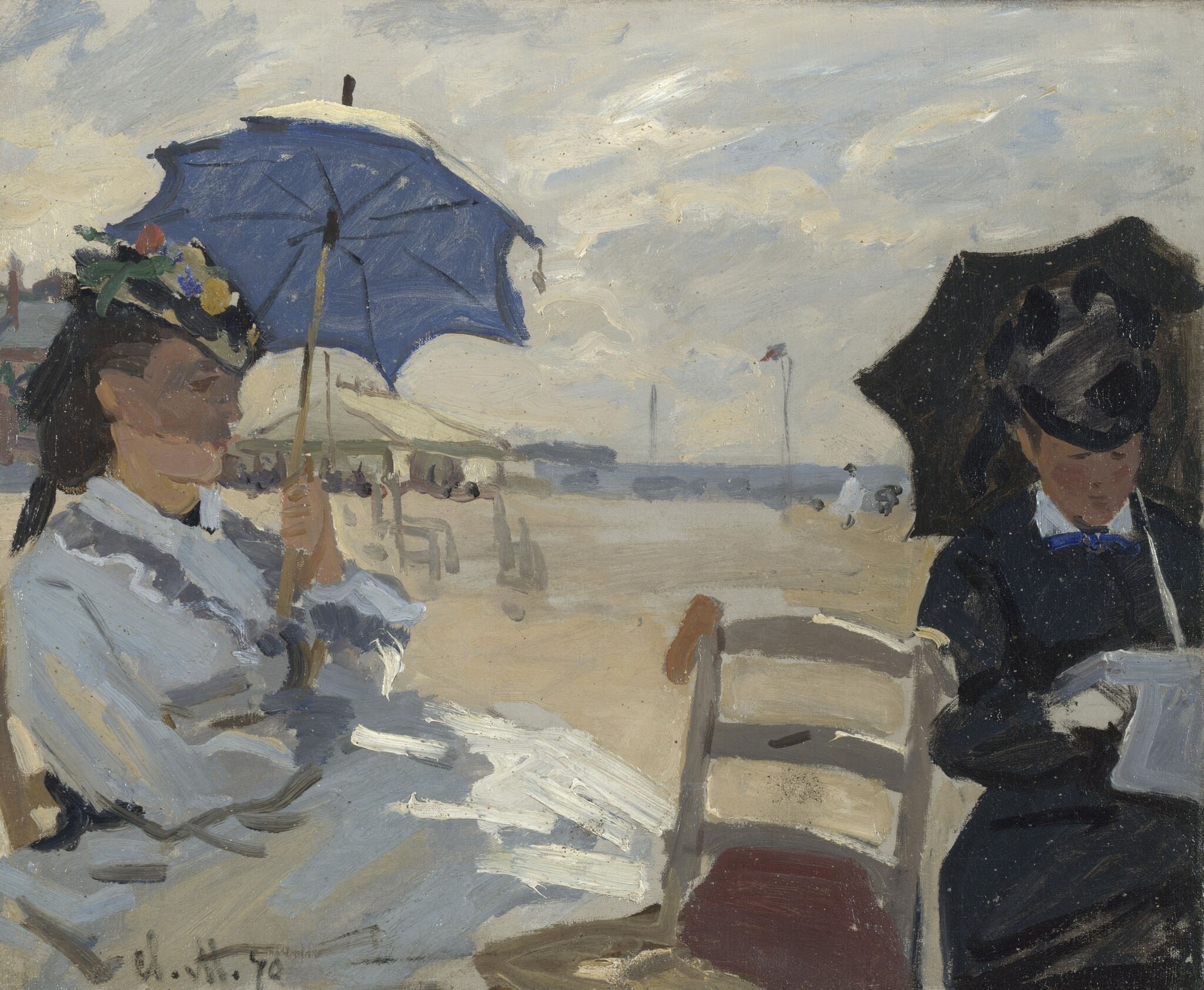
Claude Monet’s The Beach at Trouville captures a wind-bright instant of modern leisure on the Normandy coast. Two women sit close to the viewer beneath a blue and a black parasol, their poses anchored against a hazy horizon where sea and sky fuse. Brisk strokes, embedded grains of sand, and snapshot-like cropping turn weather and time itself into the subject [1].

Study Print Studio

Create a personal study print

Build a companion study sheet around the part of this painting that speaks to you most. Choose a detail, shape an interpretation, and walk away with something personal and display-worthy.

Fast Facts

Year
1870
Medium
Oil on canvas
Dimensions
38 x 46.5 cm
Location
National Gallery, London
See all Claude Monet paintings in London
The Beach at Trouville by Claude Monet (1870) featuring Blue parasol, Black parasol, Newspaper, Child’s shoe

Click on any numbered symbol to learn more about its meaning

Meaning & Symbolism

At the picture’s edge, a woman in pale dress grips a cobalt‑lined blue parasol; opposite her, a companion in dark attire shelters under a black parasol and bends over a newspaper. Between them, an empty chair bears a child’s shoe slung over its rung—an almost offhand sign of family life. Beyond, striped tents, scattered chairs, and a flag snapping in the breeze set the tempo of the day; the horizon dissolves into a silver haze where water and sky are barely parted. Monet’s cropping feels like a candid glance, bringing the sitters so near that the beach becomes a proscenium for modern habits. The parasols do more than shade; they stage vision. Faces are framed, dimmed, or screened—one likely by a delicate veil—so that looking itself is filtered through fabric and fashion. This choreography of shade versus glare lets Monet dramatize the optics of outdoors: modest contrasts of yellowed sand and cool blue‑greys carry the sensation of wind and light, while summary brushwork makes ruffled dresses and scudding clouds read as movement rather than costume or climatology 14. These details fold personal time into public space. The newspaper imports the cadence of the city—headlines, schedules, the very notion of the day’s latest—onto a supposedly carefree shore, embodying a bourgeois identity that can carry information anywhere. The child’s shoe marks domestic presence without narrating it, a tender index that the leisure on display is also family modernity, not solitary retreat. Materially, the painting refuses to be only a view: specks of actual beach sand lodged in the paint collapse representation into site, proof that the wind we read in strokes was stirring the canvas as it was made 1. The motif belongs to a new tourism culture fueled by the railway, which redistributed Parisian weekends to Normandy and made scenes like this common yet newly picturable. In that sense, the painting answers a social invention with a pictorial one: compressing depth, abbreviating form, and privileging weather as event. Against Eugène Boudin’s more distant promenades, Monet’s near-at-hand vantage declares intimacy with the present; the viewer is not a spectator on a pier but a companion among chairs, skirts, and gusts 13. The wider historical weather complicates the calm. Painted in the summer of 1870, just as France went to war with Prussia, the work’s breeziness overlays unease; Monet would soon flee to England. The black‑clad reader’s inwardness, half-shaded beneath the dark parasol, sets a counter‑tone to the pale sitter’s open posture under blue—a duet of withdrawal and exposure that registers mood more than anecdote. That is why The Beach at Trouville is important: it perfects an aesthetics of the provisional, where companionship, news, weather, and class customs meet in a single, passing minute. By making perception and modern life mutually legible, Monet establishes a model for Impressionism in which the subject is not merely the beach, but the experience of being there—filtered, fashionable, and fleeting 1235.

Explore Deeper with AI

Ask questions about The Beach at Trouville

Popular questions:

Powered by AI • Get instant insights about this artwork

💬 Ask questions about this artwork!

Interpretations

Gendered Optics: Privacy in Public

Parasols and a probable veil script how women appear in public space: shaded, filtered, and self‑possessed. The blue parasol frames the pale sitter’s face for display, while the dark parasol shelters the companion’s inwardness as she reads the newspaper—a subtle negotiation of propriety and access to the public sphere. Fashion here is technology: portable screens modulating exposure, glare, and the gaze. Monet’s close vantage amplifies this choreography, staging a duet of revelation and reserve rather than a genre anecdote. The painting thus maps gendered visibility at the beach, where privacy must be engineered within spectacle 12.

Source: National Gallery, London; Robert L. Herbert (Yale)

Formal Analysis: Wind Made Visible

Monet converts weather into structure. The beach reads as a field of vectors: directional strokes in the tents and flag establish wind, while the limited scheme—ochred sand against cobalt‑lined blue and greys—sets crisp value contrasts that let glare and shade interlock without heavy contour. Faces recede beneath parasols and a likely veil, so form is modeled by ambient light rather than drawing. This is not costume description but the optics of outdoors, realized through summary, high‑key touches that dissolve incidentals into atmosphere. The result is a “near” picture whose shallow depth and cropped margins force the eye to parse micro‑shifts of tone—light as the protagonist, weather as event 14.

Source: National Gallery, London; ColourLex (NG Technical findings)

Medium Reflexivity: The Beach Inside the Paint

The canvas does not just depict Trouville; it contains it. Grains of actual beach sand embedded in the paint surface verify plein‑air execution in gusty conditions and collapse the distance between representation and site. This material index turns the work into a kind of documentary trace—an imprint of weather and process—aligning Impressionism with empirical observation while quietly questioning mimesis. The wind that agitates skirts also agitates the paint film, making facture a meteorological record. Such self‑reflexive surface—where matter testifies to place—anticipates later modernist concerns with medium and support while remaining anchored in a recognizable scene 14.

Source: National Gallery, London; ColourLex (NG Technical findings)

Social History: Rail Timetables and Seaside Modernity

Trouville’s beach is a product of infrastructure. The railway redistributed Parisian weekends to Normandy, standardizing leisure as a schedulable commodity; Monet answers with an image calibrated to that tempo—quick, cropped, and keyed to the day’s weather. The newspaper in the black‑clad sitter’s hands imports the city’s cadence (headlines, markets, departures) into a supposedly carefree shore, signaling a class that moves—and reads—on time. Chairs, striped tents, and rented parasols form a ready‑made stage for seeing and being seen, a social theater Robert Herbert links to the rise of bourgeois spectacle in Second Empire leisure 123.

Source: Robert L. Herbert, Impressionism: Art, Leisure, and Parisian Society (Yale)

Historical Context: Calm Before Displacement

Painted in summer 1870, the canvas coincides with France’s declaration of war on Prussia and Monet’s impending flight to England. The picture’s breeziness is therefore not naive but tactical: weather and leisure overlay financial precarity and national anxiety. The black‑clad reader’s partial withdrawal under a dark parasol counterpoints the open, wind‑catching posture of her companion—moods that register unease without overt narrative. Contemporary viewers might have sensed the dissonance between the day’s silver haze and the headlines; later critics have read the surface calm as a fragile membrane stretched over crisis, an archetype of Impressionism’s poised provisionality 15.

Source: National Gallery, London; The Guardian (Jonathan Jones)

Related Themes

About Claude Monet

Claude Monet (1840–1926) led Impressionism’s pursuit of open-air painting and optical immediacy, especially during his Argenteuil years focused on modern leisure and light. He later developed serial studies of changing conditions, culminating in the Water Lilies cycle [2].
View all works by Claude Monet

More by Claude Monet

Haystacks Series by Claude Monet | Light, Time & Atmosphere by Claude Monet

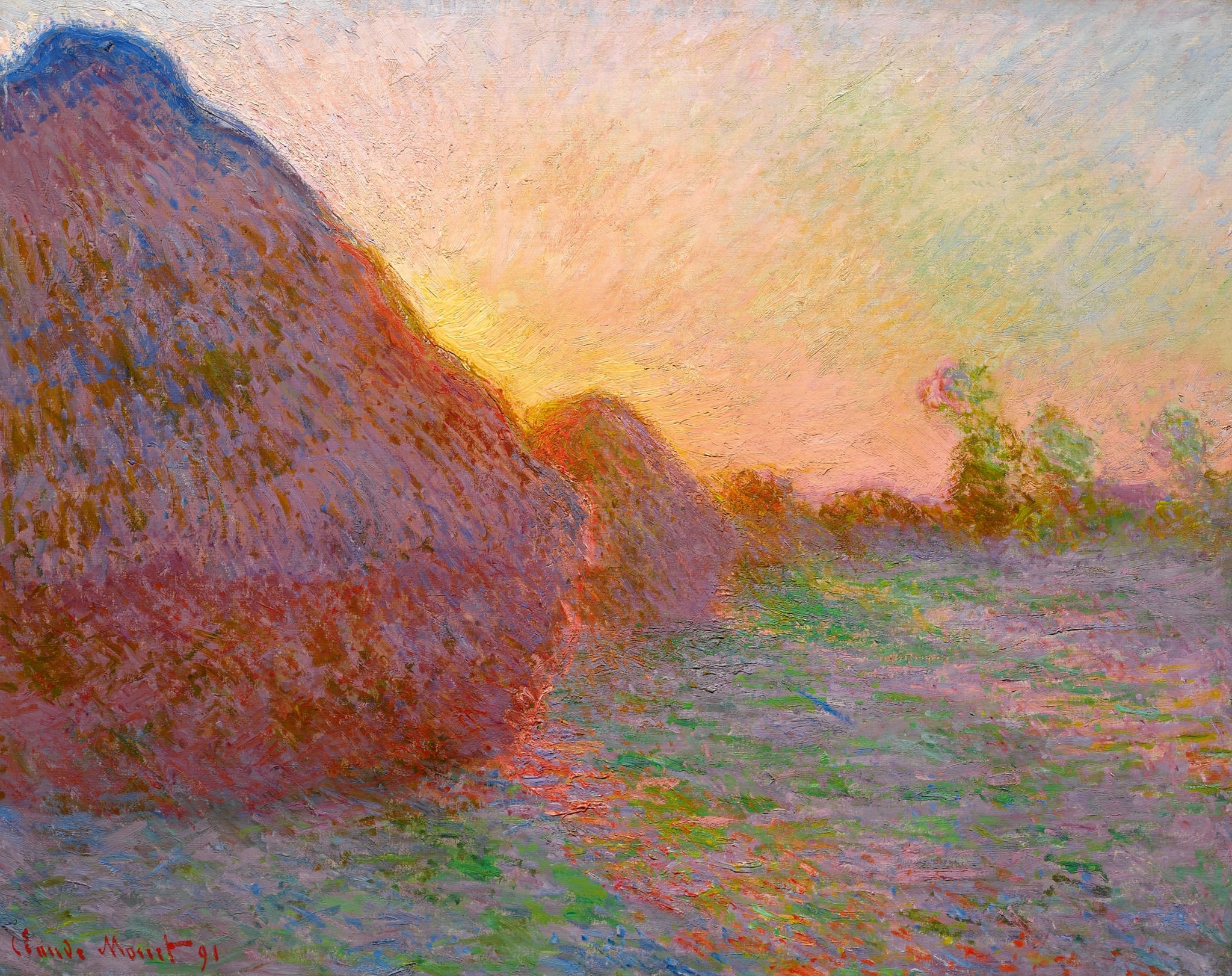
Haystacks Series by Claude Monet | Light, Time & Atmosphere

Claude Monet

Claude Monet’s <strong>Haystacks Series</strong> transforms a routine rural subject into an inquiry into <strong>light, time, and perception</strong>. In this sunset view, the stacks swell at the left while the sun burns through the gap, making the field shimmer with <strong>apricot, lilac, and blue</strong> vibrations.
Women in the Garden by Claude Monet

Women in the Garden

Claude Monet (1866–1867)

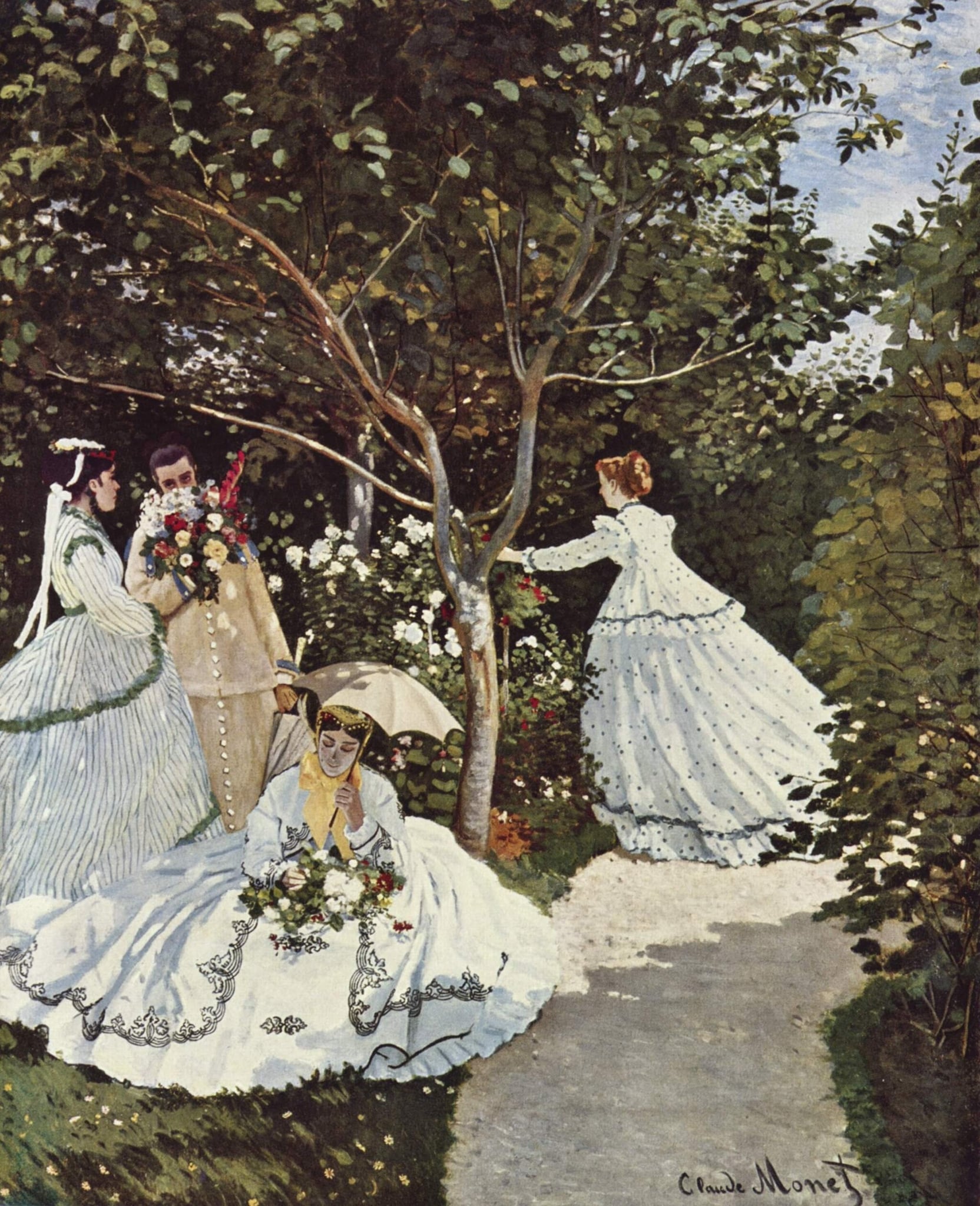
Claude Monet’s Women in the Garden choreographs four figures in a sunlit bower to test how <strong>white dresses</strong> register <strong>dappled light</strong> and shadow. The path, parasol, and clipped flowers frame a modern ritual of leisure while turning fashion into an instrument of <strong>perception</strong>. The scene reads less as portraiture than as a manifesto for painting the <strong>momentary</strong> outdoors <sup>[1]</sup><sup>[3]</sup>.
The Train in the Snow (The Locomotive) by Claude Monet

The Train in the Snow (The Locomotive)

Claude Monet (1875)

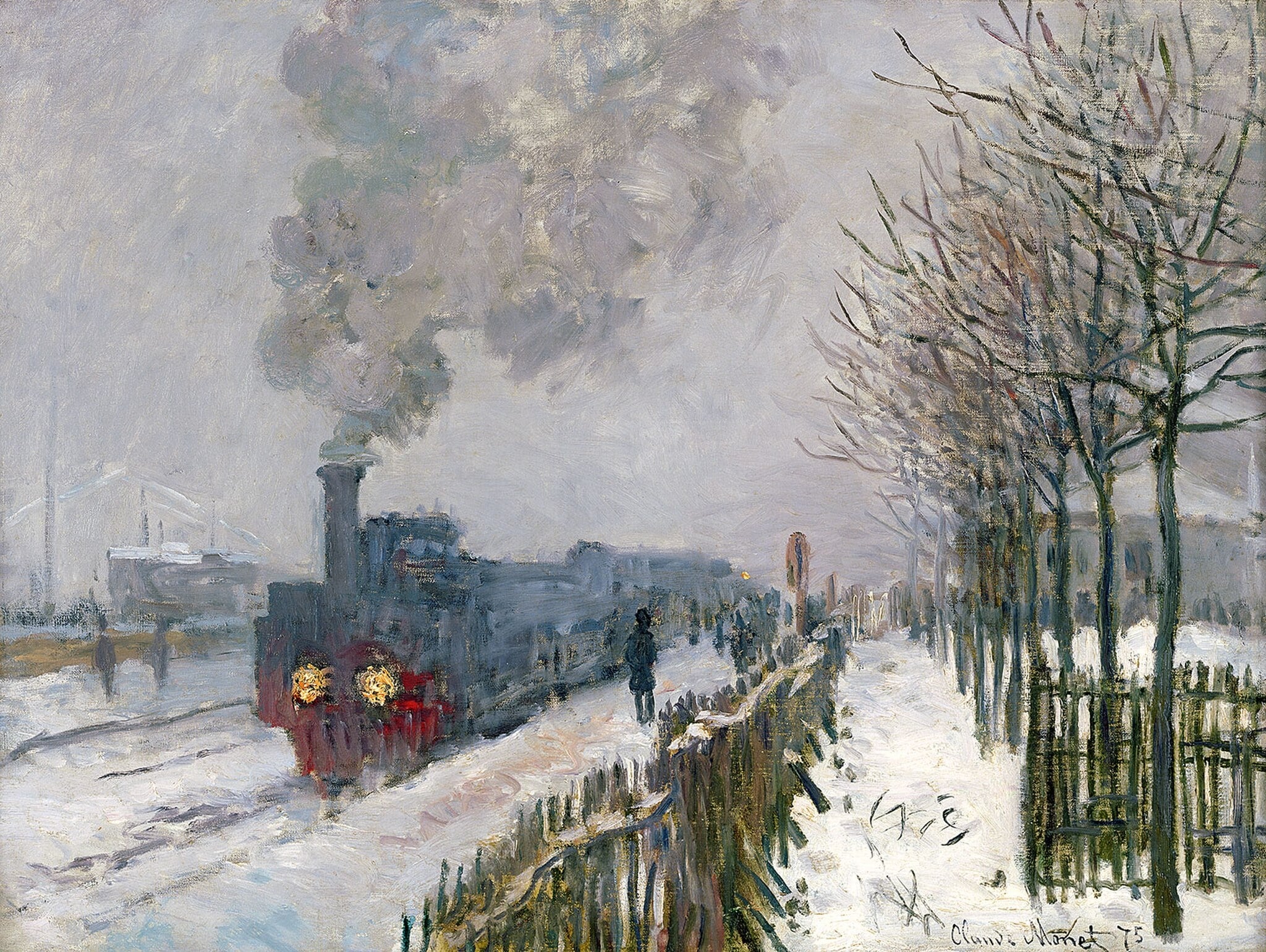
Claude Monet’s The Train in the Snow (The Locomotive) (1875) turns a suburban winter platform into a study of <strong>modernity absorbed by atmosphere</strong>. The engine’s twin yellow headlights and a smear of red push through a world of greys and violets as steam fuses with the low sky, while the right-hand fence and bare trees drill depth and cadence into the scene <sup>[1]</sup><sup>[4]</sup>. Monet fixes not an object but a <strong>moment of perception</strong>, where industry seems to dematerialize into weather <sup>[1]</sup><sup>[2]</sup>.
The Artist's Garden at Giverny by Claude Monet

The Artist's Garden at Giverny

Claude Monet (1900)

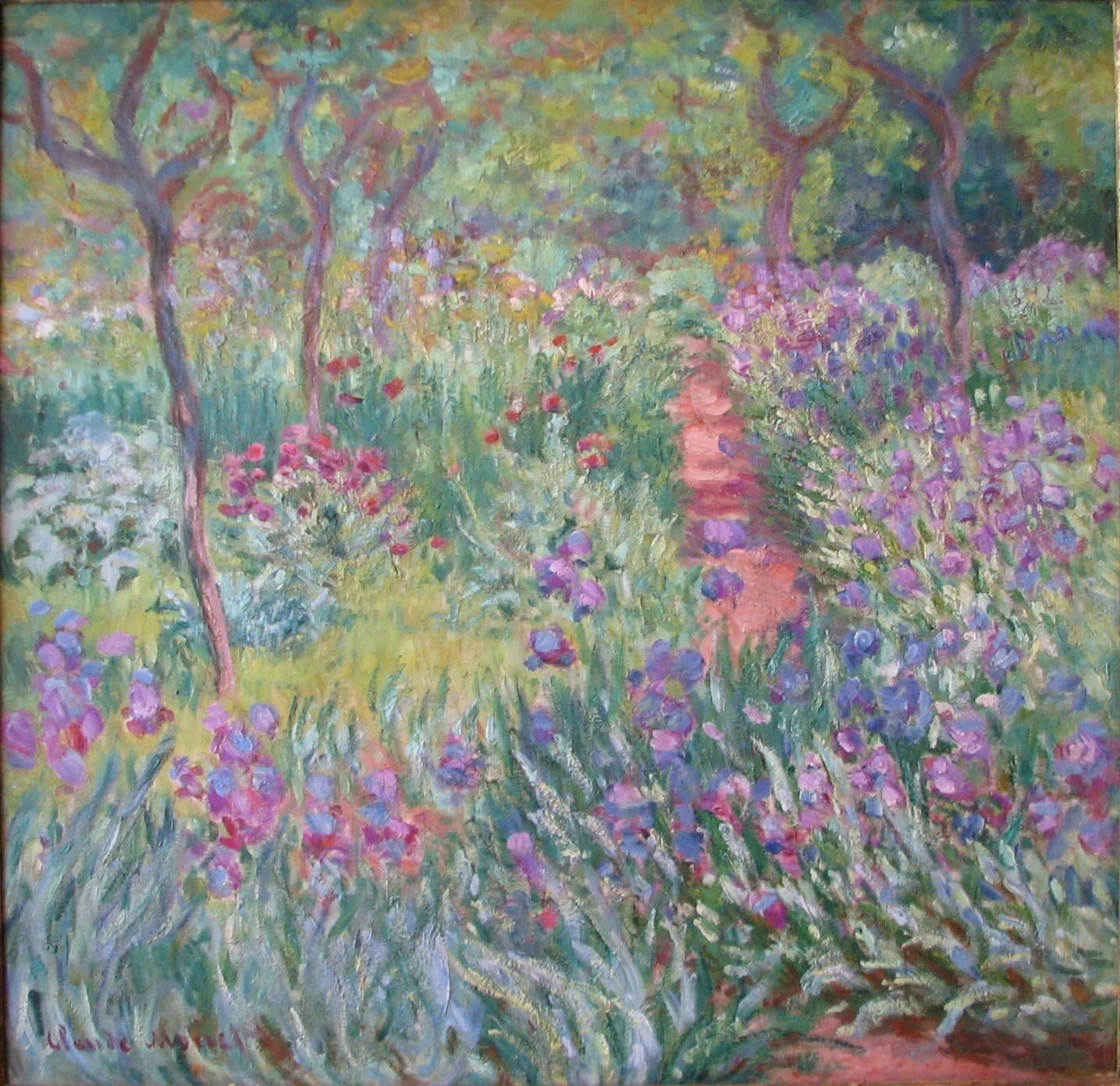
In The Artist's Garden at Giverny, Claude Monet turns his cultivated Clos Normand into a field of living color, where bands of violet <strong>irises</strong> surge toward a narrow, rose‑colored path. Broken, flickering strokes let greens, purples, and pinks mix optically so that light seems to tremble across the scene, while lilac‑toned tree trunks rhythmically guide the gaze inward <sup>[1]</sup><sup>[3]</sup>.
Water Lilies by Claude Monet

Water Lilies

Claude Monet (1899)

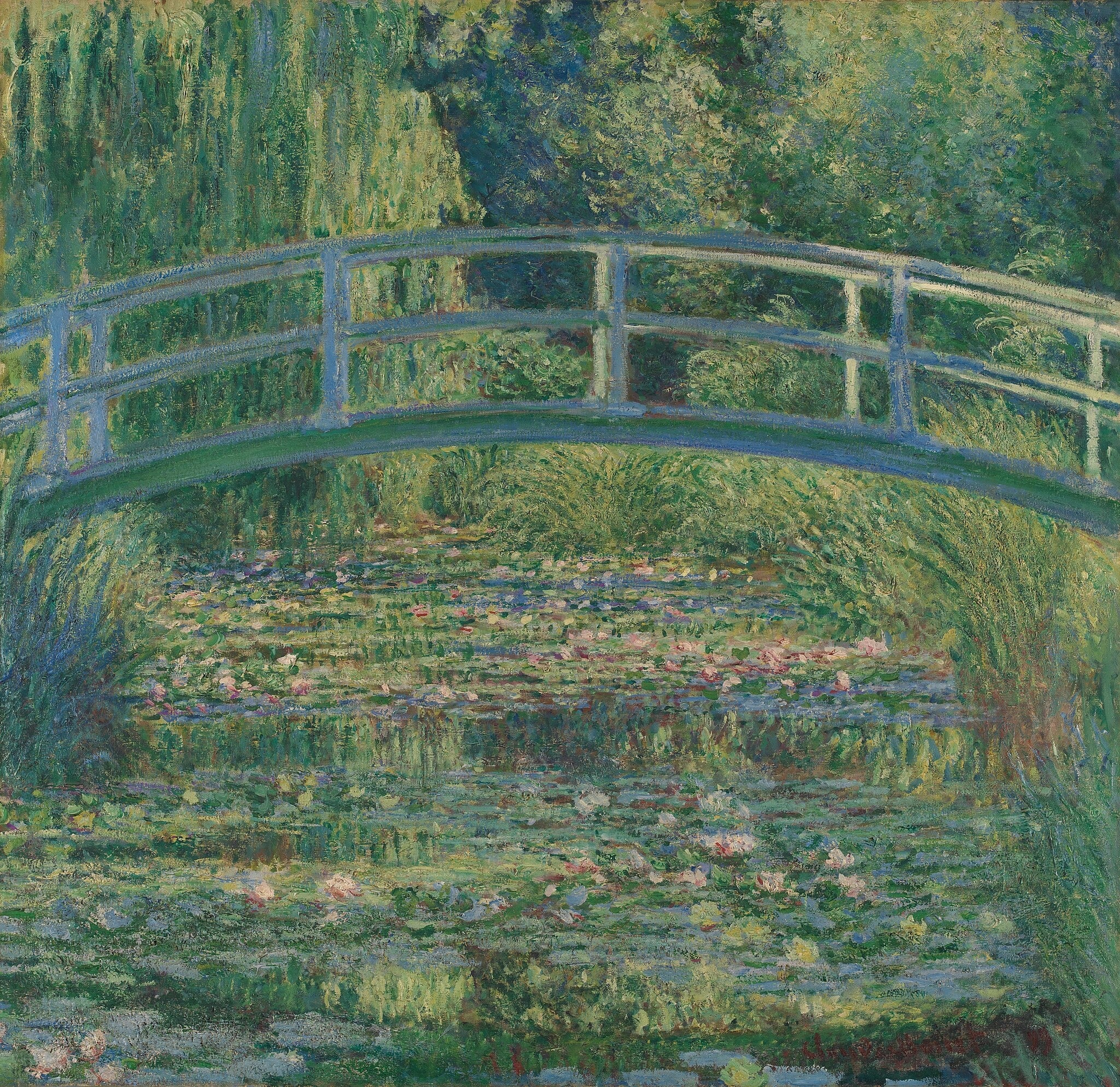
<strong>Water Lilies</strong> centers on an arched <strong>Japanese bridge</strong> suspended over a pond where lilies and rippling reflections fuse into a single, vibrating surface. Monet turns the scene into a study of <strong>perception-in-flux</strong>, letting water, foliage, and light dissolve hard edges into atmospheric continuity <sup>[1]</sup><sup>[3]</sup>.
The Grand Canal by Claude Monet

The Grand Canal

Claude Monet (1908)

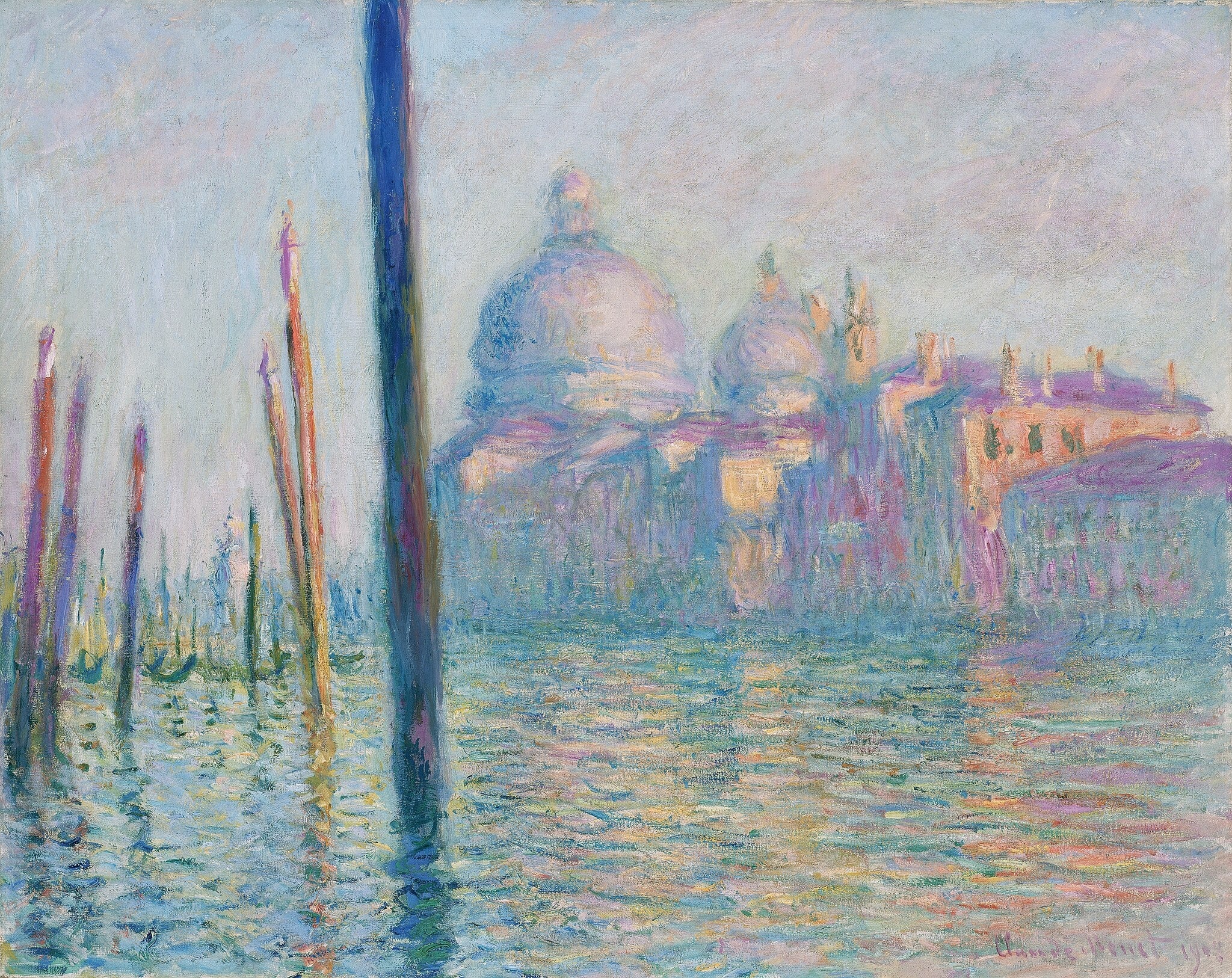
Claude Monet’s The Grand Canal turns Venice into <strong>pure atmosphere</strong>: the domes of Santa Maria della Salute waver at right while a regiment of <strong>pali</strong> stands at left, their verticals reverberating in the water. The scene asserts <strong>light over architecture</strong>, transforming stone into memory and time into color <sup>[2]</sup><sup>[3]</sup>.