The Japanese Bridge Auction History
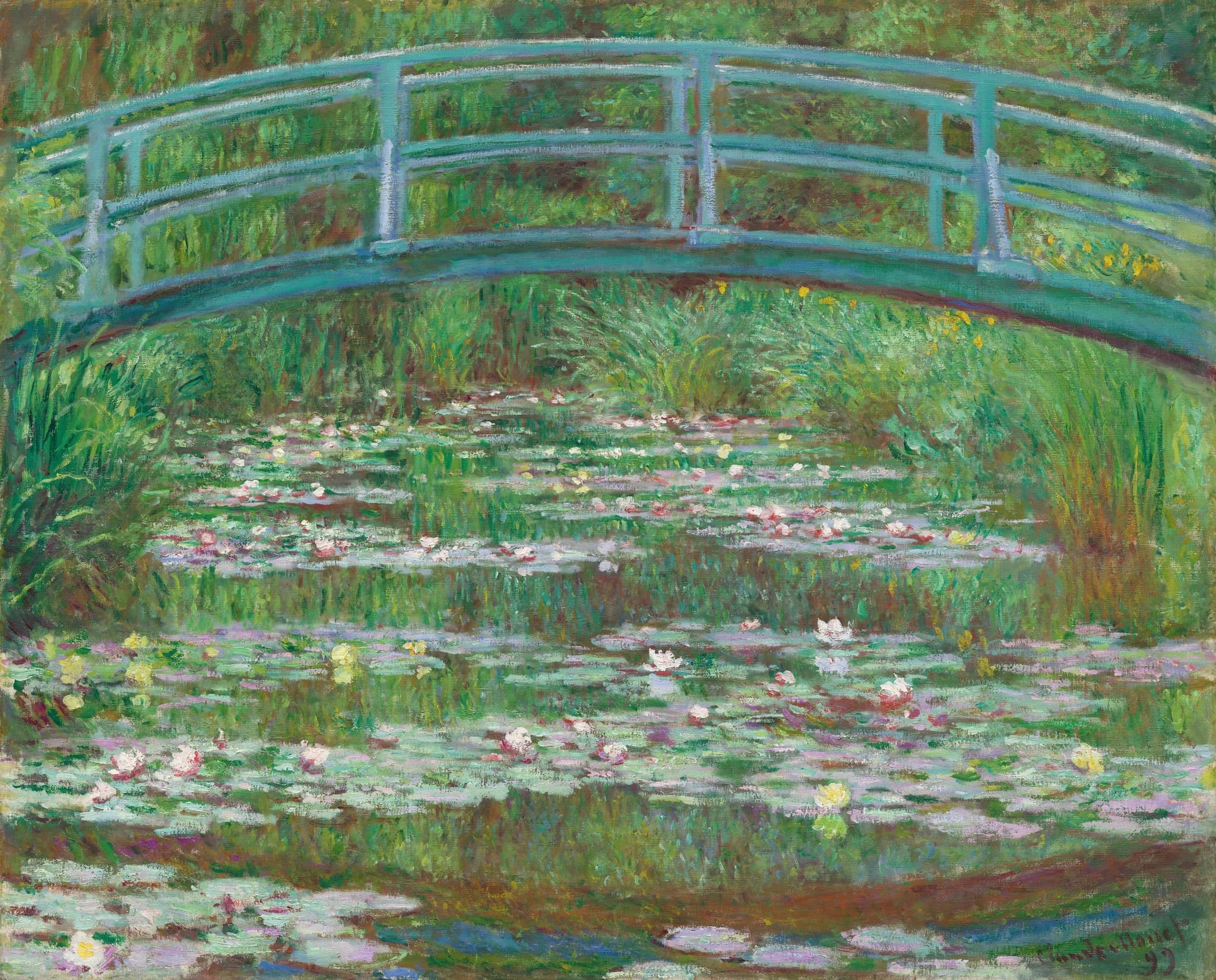
No public auction is recorded for Monet’s 1899 The Japanese Bridge. The work moved from Monet to Durand-Ruel (1900), to the Carnegie Institute (1920), was deaccessioned to Sam Salz and sold to Henry T. Mudd in 1953, and was gifted to the National Gallery of Art in 1992 [1]. Related Japanese Bridge and Water Lily works have achieved major prices, but this canvas is museum-held.
- Artwork
- The Japanese Bridge
- Artist
- Claude Monet
- Best-known sale or transfer
- No public auction; gifted to NGA (1992)
- Sale type
- No known public sale
- Current location / owner
- National Gallery of Art, Washington, DC
Auction and Ownership Timeline
Work created
Giverny, France
Monet painted and signed this view of his Japanese bridge and water‑lily pond in 1899 [1].
Acquired by Durand-Ruel
Galerie Durand‑Ruel, Paris
In January 1900 Durand‑Ruel, Paris, purchased the painting directly from Monet [1].
Exhibited at Galerie Durand-Ruel
Galerie Durand‑Ruel, Paris
Shown in an exhibition of twelve Japanese Bridge canvases at Galerie Durand‑Ruel, November 22–December 15, 1900 [1].
Exhibited at Grafton Galleries
Grafton Galleries, London
Exhibited as "The Water Lily Pond" at the Grafton Galleries, London, in 1905 [1].
Sold to Carnegie Institute
Pittsburgh
Durand‑Ruel sold the work to the Carnegie Institute (now Carnegie Museum of Art), Pittsburgh, in 1920 [1].
Deaccessioned to Sam Salz
Pittsburgh/New York
The Carnegie Institute sold the painting to dealer Sam Salz, New York, in 1953 [1].
Sold to Henry T. Mudd
Los Angeles
Later in 1953, Sam Salz sold it to Henry T. Mudd, Los Angeles [1].
Gift to the National Gallery of Art
National Gallery of Art, Washington, DC
Gift of Victoria Nebeker Coberly (in memory of John W. Mudd) and Walter H. & Leonore Annenberg; accession 1992.9.1 [1].
Current location
Washington, DC
Now in the collection of the National Gallery of Art, Washington, DC [1].
Provenance and Ownership
Provenance: Claude Monet; sold to Durand‑Ruel, Paris (January 1900); sold to the Carnegie Institute, Pittsburgh (1920); deaccessioned to Sam Salz, New York (1953); sold to Henry T. Mudd, Los Angeles (1953); by inheritance to Victoria Nebeker Coberly; gifted to the National Gallery of Art, Washington, DC (1992, accession 1992.9.1) [1].
Today the painting is in the National Gallery of Art. Note: the Musée Marmottan Monet holds the late “Japanese Bridge” canvases (1918–24), not this 1899 version [2].
Quick Facts
- Last known sale
- 1953
- Known sale price
- Not publicly reported
- Sale type
- No known public sale
- Venue / institution
- Sam Salz (dealer), New York
- Current owner or location
- National Gallery of Art, Washington, DC
- Publicly viewable?
- Yes
Why This Sale Matters
The 1899 Japanese Bridge motif sits at the heart of Monet’s Giverny project, inaugurating a sequence that he began exhibiting in 1900 at Galerie Durand‑Ruel [1]. This specific canvas has never appeared at public auction; its ownership moved privately through Durand‑Ruel to the Carnegie Institute (1920), was deaccessioned to dealer Sam Salz and sold to Henry T. Mudd in 1953, and later entered the National Gallery of Art as a 1992 gift [1]. Because all transfers were private or institutional, no public prices are recorded for this work [1].
Market evidence from closely related subjects demonstrates the motif’s desirability. A different Japanese Bridge (dated 1900) achieved $33 million at Sotheby’s London in 1998, a landmark result at the time and a clear signal of demand for this subject [3]. Monet’s broader market has since reached even higher levels: the artist’s auction record stands at $110.7 million for Meules (1890) in 2019 [4]. Water-lily canvases comparable in theme to the bridge series have also led evening sales: Le bassin aux nymphéas made $74,010,000 in 2023 [5], and another Nymphéas sold for $65.5 million in 2024 [6]. Beyond Giverny, major cityscapes such as Houses of Parliament, Westminster realized $75,960,000 in 2022 [7], while Nymphéas en fleur brought $84,687,500 in 2018 [8].
In short, while this National Gallery of Art painting lacks a public sale record, its early date (1899), inclusion in the inaugural 1900 Durand‑Ruel showing, and alignment with Monet’s most coveted Giverny subjects position it among the series that drives the artist’s market [1]. Note also that the Musée Marmottan Monet’s celebrated group relates to the late bridge pictures (1918–24), underscoring that the NGA canvas represents the earlier, foundational phase of the theme [2].
Related Pages
Other auction histories by Claude Monet
Sources
- The Japanese Footbridge — Object page — National Gallery of Art
- Collections highlights — Monet — Musée Marmottan Monet
- Monet’s Bridge Fetches $33 Million — The Washington Post
- Claude Monet’s Record and Market — Sotheby's
- Marquee Week sale results — November 2023 — Christie's
- Sotheby’s Fall 2024 Auction Results — Sotheby's
- Marquee Week sale results — May 2022 — Christie's
- Rockefeller Collection Final Report — Christie's