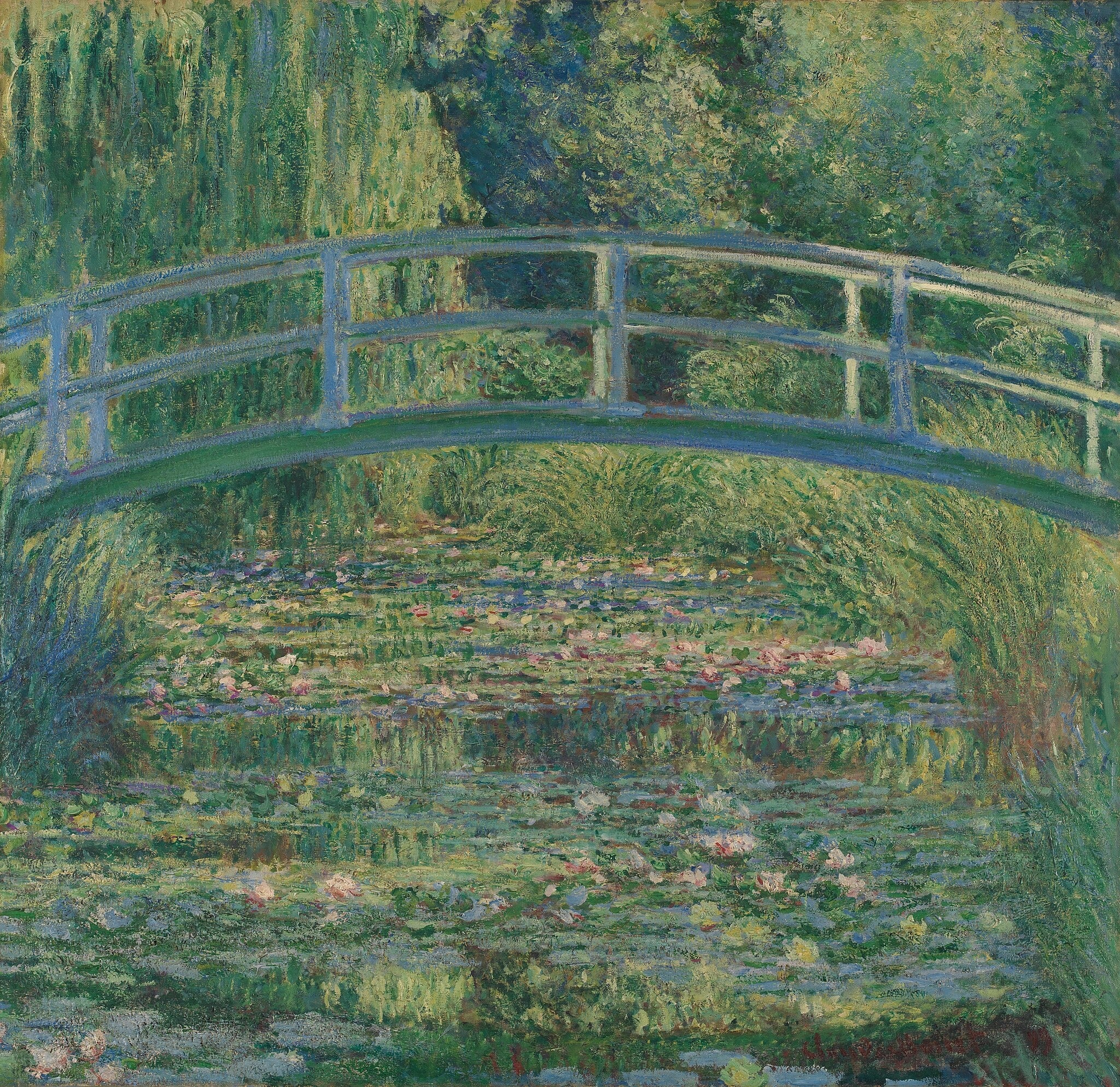
The Japanese Bridge

by Claude Monet

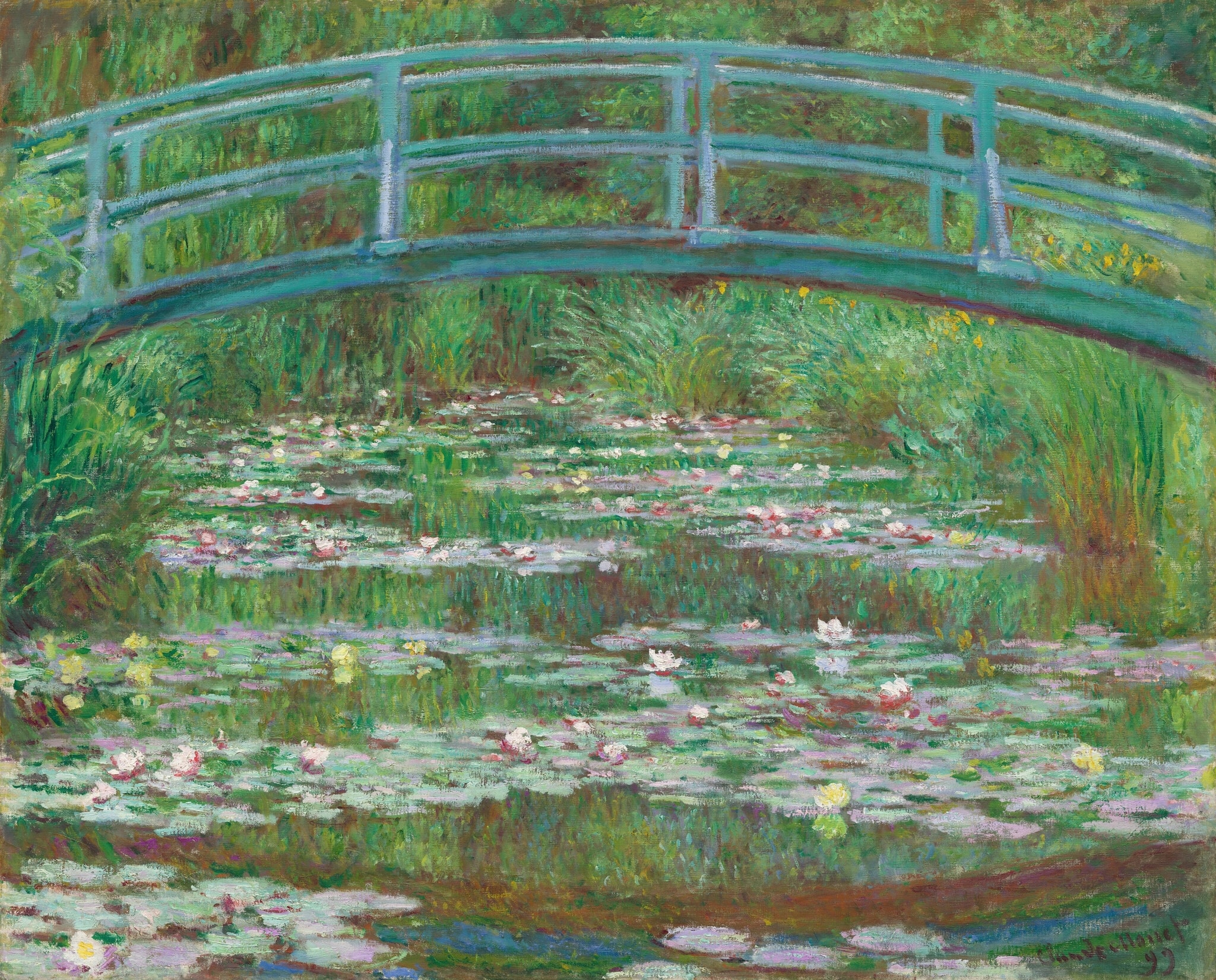
Claude Monet’s The Japanese Bridge centers a pale blue‑green arch above a horizonless pond, where water‑lily pads and blossoms punctuate a field of shifting reflections. The bridge reads as both structure and contemplative threshold, suspending the eye between surface shimmer and mirrored depths [1][2].

Fast Facts

Year
1899
Medium
Oil on canvas
Dimensions
81.3 × 101.6 cm
Location
National Gallery of Art, Washington, DC
The Japanese Bridge by Claude Monet (1899) featuring Japanese bridge (blue‑green arch), Water Lilies and Blossoms, Reflections on the water, Enclosing greenery (grasses and drooping foliage)

Click on any numbered symbol to learn more about its meaning

Meaning & Symbolism

Monet builds meaning by collapsing distance. The canvas withholds a sky or far bank; instead, the bridge rides high across the picture, its blue‑green rail catching light like a calm breath above the pond. Below, pads scatter in clusters of white, pink, and pale yellow, flickering where strokes of lilac and rose glance off the water. The surface never settles; ripples shear reflections into bands of viridian, emerald, and turquoise. In this shallow, sealed world, the bridge becomes a pause—a deliberate stay against the current of time. The viewer is not asked to cross but to dwell, to recognize that the “scene” is an event of seeing, where reflection rivals object and where light edits the world into transient harmonies 12. The composition asserts enclosure as a state of mind. Grasses surge up the banks in quick, vertical touches; drooping greenery drapes the upper field, and the bridge’s gentle arc holds the center like a harp. This hortus conclusus—an inward garden—aligns with Symbolist ideas of contemplative retreat noted by curators, but Monet grounds such reverie in optics: color, not contour, carries the message 1. Blue‑green of the span plays against warm greens of the foliage; pinks and whites of the lilies punctuate like held notes in a slow melody. The effect is musical and cyclical, implying renewal as blossoms open across the pond. The lilies are not botanical trophies; they are instruments for testing how radiance cleaves to matter. The bridge, meanwhile, articulates a threshold between realms—land and water, object and echo—without privileging either, a proposition that nourishes Monet’s later, horizonless panels where structure almost disappears 23. Historical circumstance deepens the stakes. Monet engineered this waterscape at Giverny—diverting a stream, planting exotics, and erecting a Japanese‑style footbridge—explicitly to create motifs to paint and a place for looking 1. The picture belongs to around a dozen bridge canvases he produced in the summer of 1899, a serial method that let him chart how light and season recompose a constant motif 2. The Japanese Bridge thus functions as a hinge in his practice: it retains recognizable armature yet already privileges reflection and near‑allover patterning, anticipating the vast decorative cycles of the 1910s and 1920s. In that later work, forms dissolve and color orchestrates the whole field, a development museums link both to Monet’s experimental ambition and to the physiological trials of aging eyes 4. The present image shows the seed of that transformation: a measured arc, a flooded foreground, a world where depth yields to presence, and where the union of Western oil technique with Japanese design principles—cropping, asymmetry, and an emphasis on seasonal change—becomes a modern way of seeing 135.

Explore Deeper with AI

Ask questions about The Japanese Bridge

Popular questions:

Powered by AI • Get instant insights about this artwork

💬 Ask questions about this artwork!

Interpretations

Cross-Cultural Design as Modern Authorship

Monet’s footbridge is not mere décor; it is a curated import that operationalizes Japonisme. By adopting Japanese principles—cropped vistas, asymmetry, and seasonal attentiveness—within Western oil technique, Monet claims originality through synthesis rather than invention ex nihilo. The bridge’s high placement and compressed depth echo ukiyo‑e strategies, translating them into a painterly field where color carries structure. This is authorship as selection and recombination: a cultivated garden staged to generate motifs and a pictorial grammar attuned to transience. Rather than exoticism for its own sake, the Japanese idiom becomes a working method for modern perception, legitimized by Monet’s extensive collecting and domestic display of prints at Giverny 42.

Source: Musée de l’Orangerie; National Gallery of Art

Seriality and the Mechanics of Time

The 1899 bridge canvases exemplify Monet’s serial practice as a device for temporal analysis. Holding the motif constant, he varies hour, weather, and season so that color and value map time’s passage onto the surface. This is not narrative time but phenomenological duration—a record of how moments accrue as chromatic difference. Scholars place the bridge series within the broader logic of Haystacks and Poplars, yet here the near-horizonless field intensifies the allover weave that will culminate in the Grandes Décorations. The series thus functions as a hinge: a repeatable laboratory setup where perception discloses structure, anticipating later panels in which motif yields to rhythm and interval 15.

Source: The Metropolitan Museum of Art; Paul Hayes Tucker (via Art History journal review)

Engineered Nature and the Ethics of Looking

Giverny’s pond was an act of environmental engineering: diverting a stream, importing plants, and erecting a Japanese-style bridge to fabricate an optical theater. The painting, then, documents not untouched nature but curated ecology, raising questions about authorship that extend from canvas to landscape. Monet openly framed this as “for the pleasure of the eye and also for motifs to paint,” collapsing horticulture and pictorial design into one creative enterprise. The resulting enclosure brackets the viewer’s attention, substituting depth with attenuated surface where reflections carry meaning. Nature here is medium—managed, staged, and optimized for visual research—prefiguring modern installation-like control of environment to shape perception 21.

Source: National Gallery of Art; The Metropolitan Museum of Art

Toward Abstraction: Vision Under Pressure

Read alongside Monet’s later, near-abstract bridge (c. 1920–22), the 1899 image already tests legibility by letting reflection rival object. The bridge’s arc stabilizes a field otherwise prone to dissolution, previewing the late canvases where warm tonalities, scumbled pigment, and broad strokes unsettle form. MoMA frames this evolution through a double lens: formal experiment and the physiological cataract debate. Whatever the etiology, the bridge motif becomes a crucible for threshold seeing—how color and light undermine contour while preserving experiential coherence. The 1899 work is thus a prologue to the late panels’ radical surface, where the security of structure thins and the act of looking becomes the subject 34.

Source: MoMA; Musée de l’Orangerie

Symbolist Enclosure and the Secular Sacred

Critics have linked the painting’s “impenetrable green enclosure” to the medieval hortus conclusus, reframing Monet’s garden as a contemplative precinct within modern life. The bridge operates less as passage than as pause, a liturgical-like interval that suspends worldly time in favor of interior attention. NGA curators note Symbolist resonances in contemporary poetry; here, lilies punctuate the surface like icons of epiphany, not trophies of botany but markers of presence. Monet, however, grounds this reverie in optics: reflection, not allegory, generates the sacred mood. The result is a secular devotion—perception as ritual—where sustained looking transfigures an engineered pond into a site of quietist intensity 21.

Source: National Gallery of Art; The Metropolitan Museum of Art

Related Themes

About Claude Monet

Claude Monet (1840–1926) led Impressionism’s pursuit of open-air painting and optical immediacy, especially during his Argenteuil years focused on modern leisure and light. He later developed serial studies of changing conditions, culminating in the Water Lilies cycle [2].
View all works by Claude Monet

More by Claude Monet

Haystacks Series by Claude Monet | Light, Time & Atmosphere by Claude Monet

Haystacks Series by Claude Monet | Light, Time & Atmosphere

Claude Monet

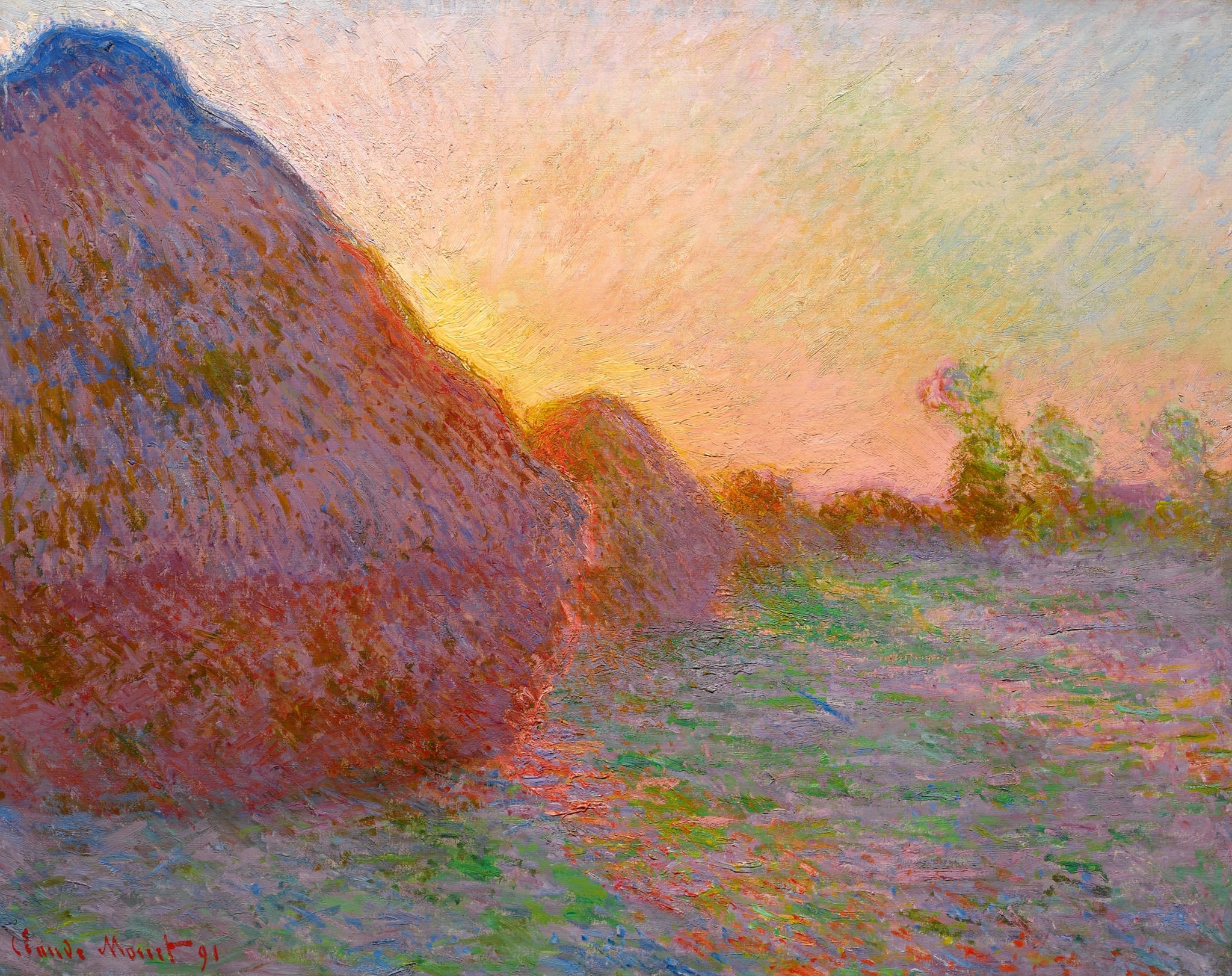
Claude Monet’s <strong>Haystacks Series</strong> transforms a routine rural subject into an inquiry into <strong>light, time, and perception</strong>. In this sunset view, the stacks swell at the left while the sun burns through the gap, making the field shimmer with <strong>apricot, lilac, and blue</strong> vibrations.
The Artist's Garden at Giverny by Claude Monet

The Artist's Garden at Giverny

Claude Monet (1900)

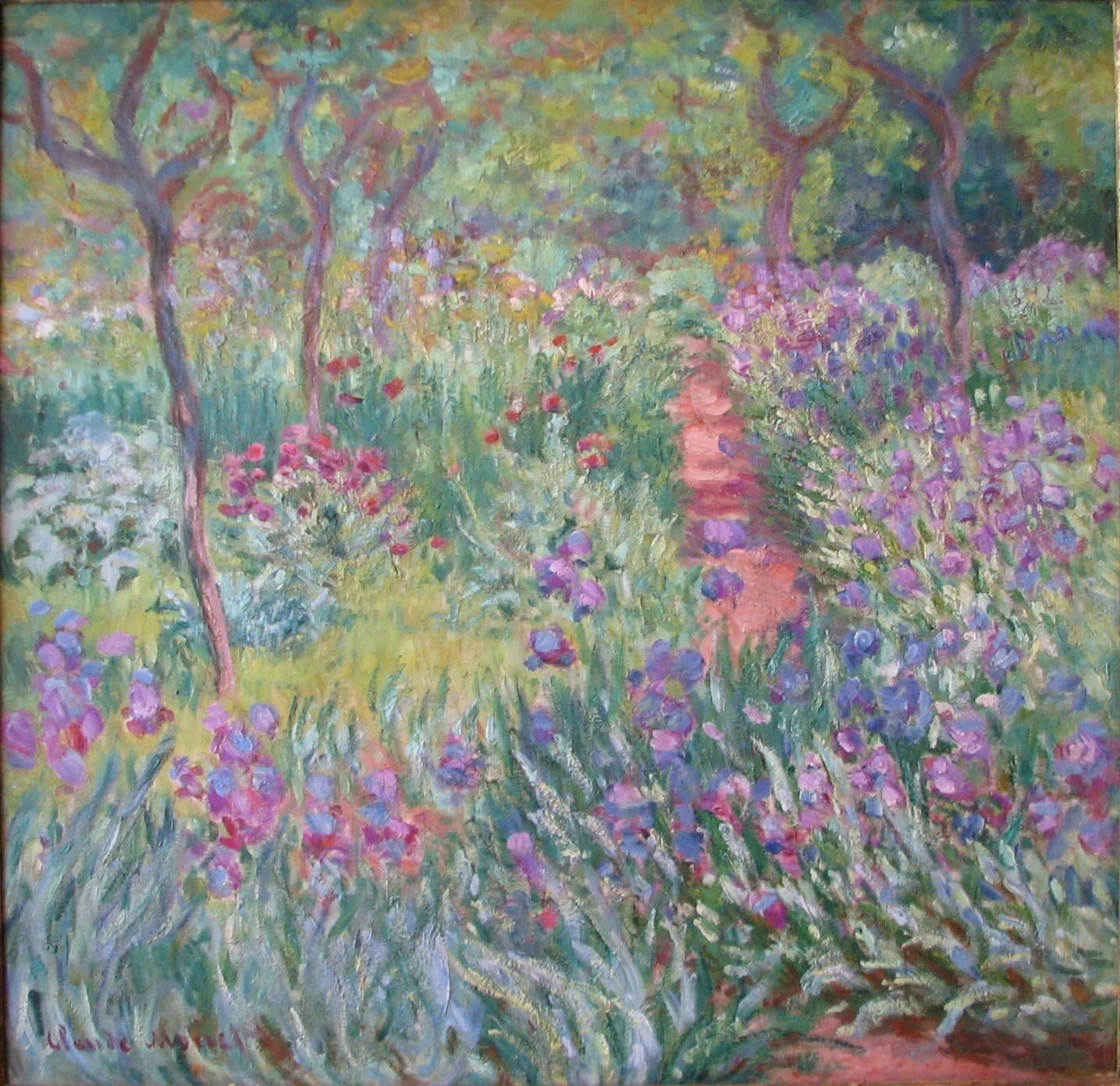
In The Artist's Garden at Giverny, Claude Monet turns his cultivated Clos Normand into a field of living color, where bands of violet <strong>irises</strong> surge toward a narrow, rose‑colored path. Broken, flickering strokes let greens, purples, and pinks mix optically so that light seems to tremble across the scene, while lilac‑toned tree trunks rhythmically guide the gaze inward <sup>[1]</sup><sup>[3]</sup>.
The Water Lily Pond by Claude Monet

The Water Lily Pond

Claude Monet (1899)

Claude Monet’s The Water Lily Pond transforms a designed garden into a theater of <strong>perception and reflection</strong>. The pale, arched <strong>Japanese bridge</strong> hovers over a surface where lilies, reeds, and mirrored willow fronds dissolve boundaries between water and sky, proposing <strong>seeing itself</strong> as the subject <sup>[1]</sup><sup>[3]</sup>.

Waterloo Bridge, Sunlight Effect by Claude Monet

Waterloo Bridge, Sunlight Effect

Claude Monet (1903 (begun 1900))

Claude Monet’s Waterloo Bridge, Sunlight Effect renders London as a <strong>lilac-blue atmosphere</strong> where form yields to light. The bridge’s stone arches persist as anchors, yet the span dissolves into mist while <strong>flecks of lemon and ember</strong> signal modern traffic crossing a city made weightless <sup>[1]</sup><sup>[2]</sup>. Vertical hints of chimneys haunt the distance, binding industry to beauty as the Thames shimmers with the same notes as the sky <sup>[1]</sup><sup>[3]</sup>.

Morning on the Seine (series) by Claude Monet

Morning on the Seine (series)

Claude Monet (1897)

Claude Monet’s Morning on the Seine (series) turns dawn into an inquiry about <strong>perception</strong> and <strong>time</strong>. In this canvas, the left bank’s shadowed foliage dissolves into lavender mist while a pale radiance opens at right, fusing sky and water into a single, reflective field <sup>[1]</sup><sup>[2]</sup>.

Woman with a Parasol by Claude Monet

Woman with a Parasol

Claude Monet (1875)

Claude Monet’s Woman with a Parasol fixes a breezy hillside instant in high, shifting light, setting a figure beneath a <strong>green parasol</strong> against a vast, vibrating sky. The low vantage and <strong>broken brushwork</strong> merge dress, clouds, and grasses into one atmosphere, while a child at the rise anchors depth and intimacy <sup>[1]</sup>. It is a manifesto of <strong>plein-air</strong> perception—painting the sensation of air in motion rather than the contours of things <sup>[2]</sup>.