Water Lilies Auction History
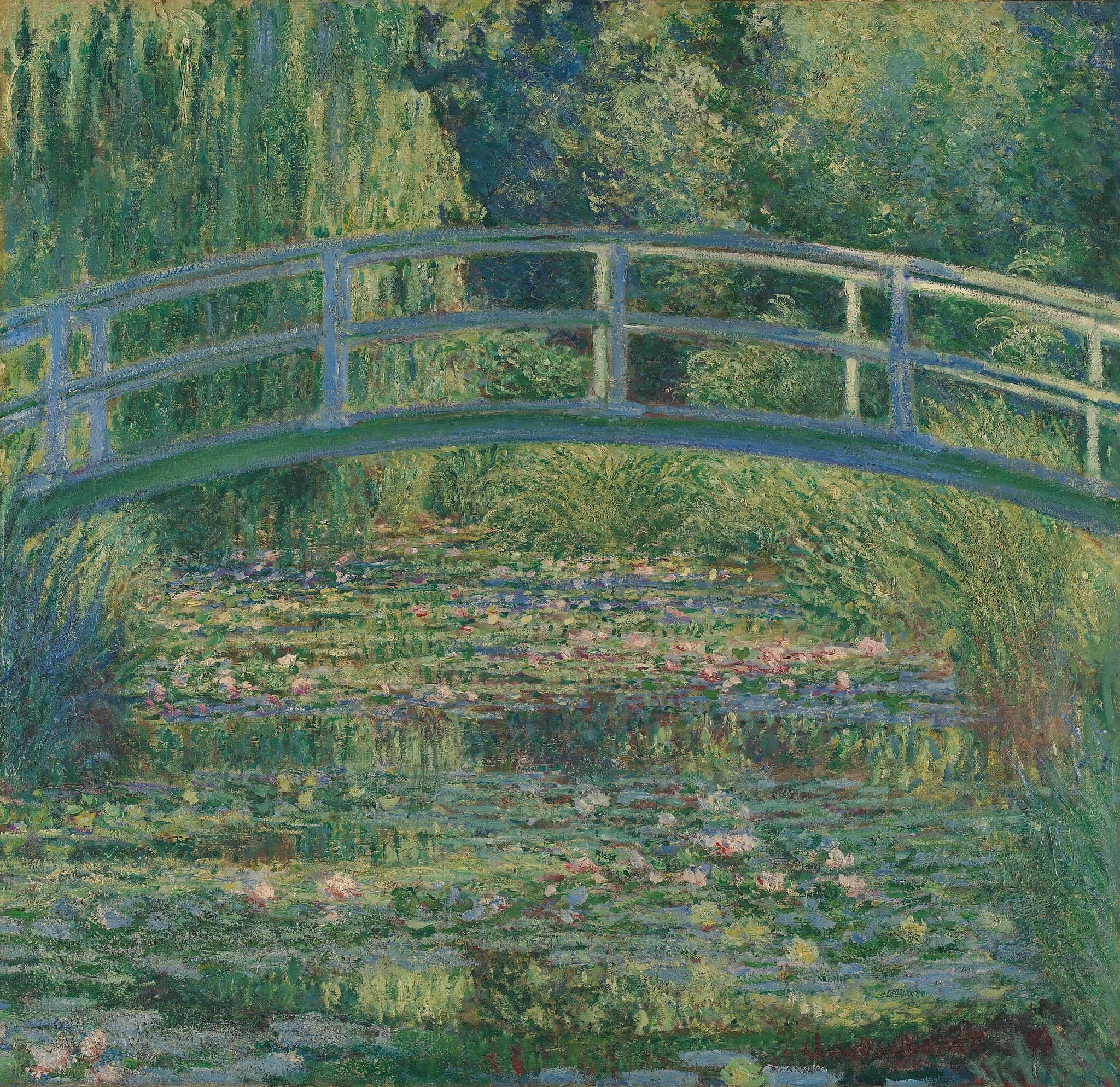
There is no public auction record for Monet’s 1899 Water Lilies (bridge-over-pond composition). It entered The Metropolitan Museum of Art via the Havemeyer bequest in 1929 and remains in the collection, on view in Gallery 819. Earlier transactions are not published online.
- Artwork
- Water Lilies
- Artist
- Claude Monet
- Sale type
- No known public sale
- Current location / owner
- The Metropolitan Museum of Art, New York
Auction and Ownership Timeline
Painted at Giverny
Giverny, France
Monet created this vertical-format bridge-over-pond composition in 1899 as part of his celebrated "Japanese bridge" series [1][2].
Bequeathed to The Met
New York
From the collection of H. O. and Louisine W. Havemeyer; bequeathed to The Metropolitan Museum of Art in 1929 (H. O. Havemeyer Collection) [1].
Provenance and Ownership
1899: Painted at Giverny as part of Monet’s Japanese bridge and water-lily campaign; the Met record confirms date, dimensions, and title variant for this composition [1][2].
By 1929: In the collection of H. O. and Louisine W. Havemeyer, New York; bequeathed to The Metropolitan Museum of Art (H. O. Havemeyer Collection, Bequest of Mrs. H. O. Havemeyer, 1929). The work is recorded as on view in Gallery 819 [1].
The Met’s online entry does not publish a step-by-step pre‑Havemeyer provenance for this canvas; comparable 1899 bridge pictures show Durand‑Ruel involvement before entering American collections, but this is context and not a confirmed chain for this object [2][3].
Note: This 1899 canvas is distinct from the Museum of Fine Arts, Boston’s Water Lilies of 1907 [5].
Quick Facts
- Last known sale
- Not publicly reported
- Known sale price
- Not publicly reported
- Sale type
- No known public sale
- Venue / institution
- The Metropolitan Museum of Art, New York
- Current owner or location
- The Metropolitan Museum of Art, New York
- Publicly viewable?
- Yes
Why This Sale Matters
This painting did not circulate at public auction; instead it entered The Metropolitan Museum of Art via the Havemeyer bequest in 1929, a landmark transfer that helped define America’s early institutional embrace of Impressionism [1][4]. Its significance lies not in a sale result but in authorship, date, and series: Monet’s focused 1899 campaign around the Giverny footbridge produced a pivotal body of images that crystallized the water-lily motif’s critical reception and collecting appeal [2]. Works from this bridge group are cornerstones of museum collections, and the Met’s example—long in the Havemeyers’ renowned collection—has been canonized through its continuous public access [1][4].
The 1899–1900 bridge-and-pond pictures were central to Monet’s late-career strategy and to dealers’ promotion of his work; a Durand‑Ruel show in late 1900 presented a dozen water-lily/bridge paintings, consolidating attention on the motif and shaping demand that would endure in the market [2]. Although the Met’s object lacks a published pre‑1929 chain, comparable 1899 bridge canvases document pathways through leading dealers such as Durand‑Ruel before entering prominent American collections, illustrating the transatlantic network that supported Monet’s rise [3].
While this specific canvas has no public price history, broader market benchmarks underscore the strength of Monet’s late landscapes: the artist’s overall auction record stands with Meules (Haystacks) at $110.7m (Sotheby’s, 2019) [6]. Large water-lily works continue to command major results, including Nymphéas en fleur at $84.7m (Christie’s, 2018) [7], Le bassin aux nymphéas at $74.01m (Christie’s, 2023) [8], and Nymphéas at $65.5m with fees (Sotheby’s, 2024) [9]. These comparables, though from later series and often larger formats, demonstrate sustained, top-tier demand for Monet’s water-lily imagery. The Met’s permanent ownership of the 1899 bridge composition effectively removes a prime example from the market, contributing to scarcity and supporting high valuations for comparable works when they do appear [1][2].
For clarity, this 1899 painting at The Met is distinct from the Museum of Fine Arts, Boston’s later Water Lilies (1907) [5].
Related Pages
Other auction histories by Claude Monet
Sources
- Bridge over a Pond of Water Lilies (The Met object page) — The Metropolitan Museum of Art
- Monet Paintings and Drawings at the Art Institute of Chicago – Cat. 37 Water Lily Pond, 1900 (series discussion) — Art Institute of Chicago
- Water Lilies and Japanese Bridge (1899) – provenance — Princeton University Art Museum
- Splendid Legacy: The Havemeyer Collection — The Metropolitan Museum of Art
- Water Lilies (1907) – MFA Boston — Museum of Fine Arts, Boston
- Monet’s ‘Meules’ Sells for $110.7 Million, A New Artist Record — Sotheby's
- Live Like a Rockefeller: Claude Monet, Nymphéas en fleur — Christie's
- 20th Century Evening Sale totals $640,846,000 (includes Le bassin aux nymphéas) — Christie's
- Sotheby’s New York white-glove auctions: Sydell Miller Collection & Modern Evening Sale — The Art Newspaper