How Much Is Water Lilies Worth?
Last updated: February 26, 2026
Quick Facts
- Current Location
- Museum of Fine Arts, Boston
- Methodology
- comparable analysis
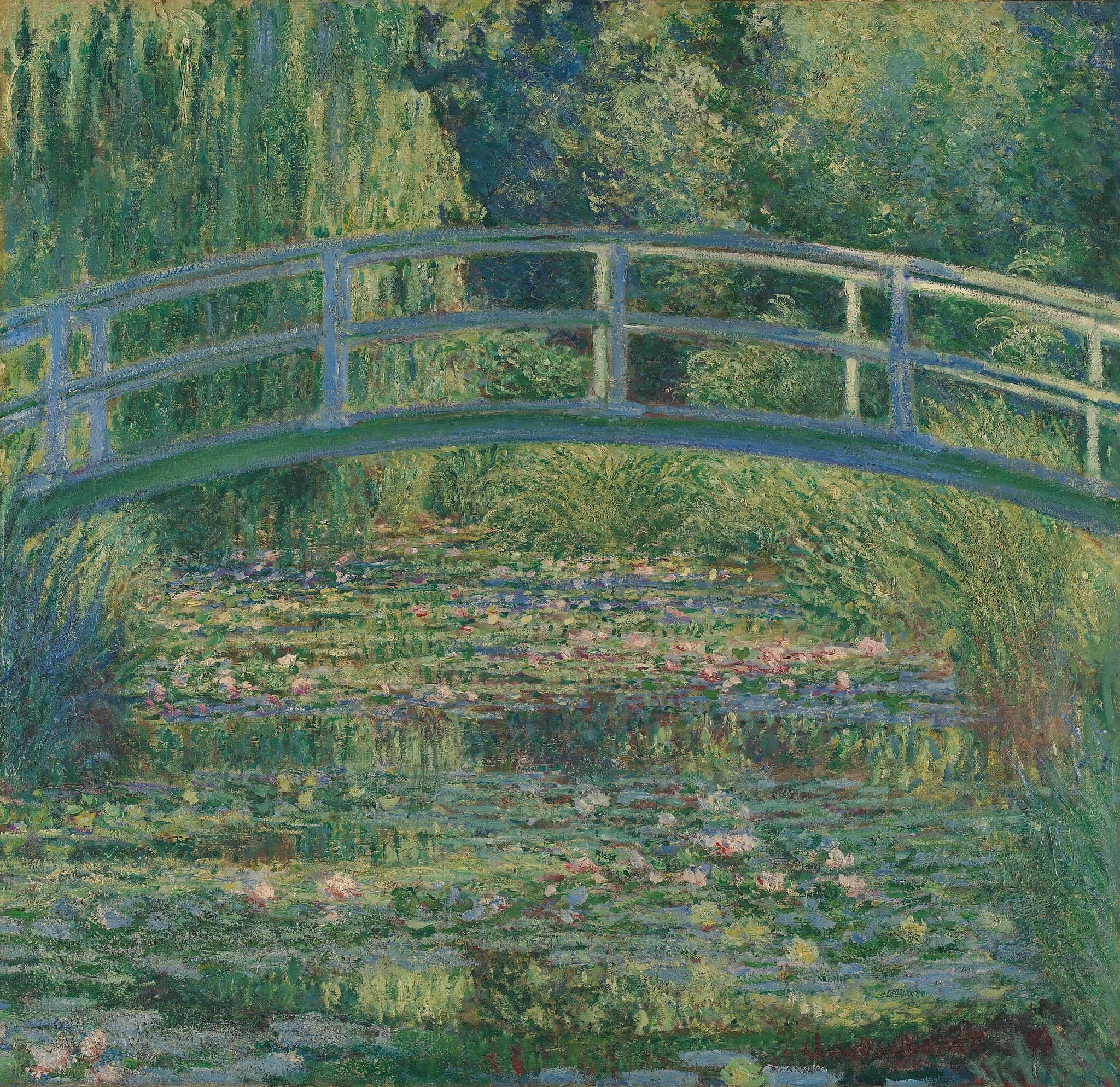
Based on recent top-tier Water Lilies auction results, subject primacy, and The Met/Havemeyer provenance, Monet’s 1899 Bridge over a Pond of Water Lilies is estimated at $100–150 million. This reflects an expected auction outcome around $90–120 million under current conditions, with museum-grade stature and motif/date premiums lifting the overall band.
Valuation Analysis
Conclusion: A prudent current valuation for Claude Monet’s Bridge over a Pond of Water Lilies (1899, The Metropolitan Museum of Art, Acc. 29.100.113) is $100–150 million on a hypothetical open‑market basis. The work is a cornerstone image from Monet’s first mature Giverny water‑lily campaign—the celebrated Japanese Bridge composition—coupled with the Havemeyer/Met pedigree and near-universal recognizability that drive competition at the very top of Monet’s market [1].
Market comparables: Over the past several seasons, prime single‑panel Water Lilies have consistently realized exceptional prices: $74.01 million at Christie’s New York in 2023 for Le bassin aux nymphéas (c.1917–19) and $65.5 million at Sotheby’s New York in November 2024 for a large late vertical (1914–17) with active Asian bidding—clear signals of deep global demand for best‑in‑class Nymphéas [3][4]. Earlier marquee outcomes—including the £40.9 million 1919 panorama in London (2008) and the 2018 Rockefeller Nymphéas en fleur at $84.7 million—frame the trophy band for single‑panel works under optimal conditions [6][7]. Monet’s all‑time auction record, Meules (Haystacks), stands at $110.7 million (2019), anchoring an upper boundary for top single‑panel pictures by the artist [2].
Subject/date premium: Within the Nymphéas corpus, the 1899 Japanese Bridge canvases carry special art‑historical and iconographic weight—arguably the series’ most reproduced and instantly legible motif, and the seminal moment in Monet’s lifelong engagement with the pond. Even a later Japanese Bridge (1900) brought $33 million as far back as 1998, underscoring the enduring premium for this subject [5]. While late, wall‑dominant panoramas can command scale premiums, the early date and emblematic composition of the 1899 bridge works are widely viewed as offsetting factors, often elevating these pictures to the very top of single‑panel valuations.
Range rationale: Recent late‑period Water Lilies clustering at $65–74 million, together with the subject/date uplift, blue‑chip provenance, and museum‑caliber stature, support an auction‑context expectation around $90–120 million today. A scheduling/insurance lens typically sits above auction, and the institutional aura of a Met‑held icon can justify further headroom. Normalized across these contexts, $100–150 million is a defensible headline range contingent on excellent condition and thoughtful sale orchestration (venue, guarantee/irrevocable bid, and global outreach).
Key sensitivities: Condition (surface freshness, varnish/retouching history) can materially shift outcomes; a pristine, unreduced canvas with strong color saturation would support the high end. Macro conditions and supply of directly comparable Monets at the time of sale also matter. That said, recent bidding patterns—especially renewed Asian participation—suggest resilient depth for the best examples of Monet’s signature subjects [4].
Key Valuation Factors
Art Historical Significance
High ImpactThe 1899 Japanese Bridge paintings inaugurate Monet’s mature Water Lilies project and represent one of the most iconic images in Impressionism. As a foundational moment in the Nymphéas cycle, the composition encapsulates Monet’s synthesis of observation and abstraction, uniting the bridge, reflective water, and floating blooms into a modern emblem. The Met’s canvas has long been a touchstone for scholarship and public engagement, amplifying its cultural resonance. That centrality in the artist’s oeuvre—and in the broader canon—typically commands a significant premium over more peripheral motifs, ensuring the work competes at the very top of any Monet pricing framework when hypothetically brought to market.
Subject and Date (Japanese Bridge, 1899)
High ImpactSubject primacy and early date are core value drivers here. Collectors prize the Japanese Bridge as the definitive gateway into Monet’s lily‑pond universe. Works from 1899, the first mature campaign, are rarer and more symbolically charged than later, often larger, but more abstract panels. The subject’s public familiarity increases cross‑category demand, including from new buyers seeking a canonical Monet. Historically, Japanese Bridge examples have outperformed relative to many contemporaneous subjects, reflecting a motif premium that, when combined with the 1899 date, can lift this painting above strong late Water Lilies benchmarks—particularly if color, composition, and surface quality are first‑rate.
Condition and Scale
Medium ImpactWhile the canvas’s scale (approx. 36.5 × 29 in.) is not panoramic, early‑series scarcity and the subject’s renown offset the absence of wall‑dominating dimensions. That said, a nine‑figure result relies on strong physical condition. Varnish clarity, minimal retouching, and intact impasto/brushwork sustain chromatic vibrancy and optical depth—critical attributes for Water Lilies. Any structural issues, reductions, discoloration, or restoration campaigns that dull the surface could compress the range. Conversely, a fresh, unrestored appearance with saturated color and crisp drawing supports the high end. A recent independent condition report would be decisive in fine‑tuning the estimate upward or downward within the stated band.
Provenance and Institutional Stature
High ImpactThe Havemeyer lineage and long-term residence at The Metropolitan Museum of Art confer exceptional validation. Works selected by leading early American collectors—and subsequently enshrined in major museums—often serve as quality benchmarks. Museum-held icons of this caliber seldom reach market; if hypothetically deaccessioned, their rarity and institutional aura typically attract broad, trophy‑level bidding. The Met’s global platform also enhances the painting’s fame, ensuring instant recognition among top private and institutional buyers. While museum provenance is not a legal guarantee of condition or originality, in practice it correlates with careful stewardship and scholarly attention—both of which support premium pricing and robust demand.
Sale History
Water Lilies has never been sold at public auction. It has been held by Museum of Fine Arts, Boston.
Claude Monet's Market
Claude Monet remains a blue‑chip market leader with a global collector base spanning the U.S., Europe, and Asia. His auction record stands at $110.7 million (Meules, 2019), and series pictures—Water Lilies, Haystacks, Poplars, Parliament, and London/ Venice views—regularly headline marquee evening sales. In the last few years, top single‑panel Water Lilies have clustered in the $65–74 million range, with standout trophies pushing higher when provenance, scale, palette, and condition align. Supply is sporadic, and competition is fiercest for instantly recognizable, museum‑caliber examples. Private‑sale activity remains active at the high end, with guarantees and irrevocable bids often underpinning confidence for eight‑ and nine‑figure offerings.
Comparable Sales
Le bassin aux nymphéas (c. 1917–19)
Claude Monet
Top-tier single-panel Water Lilies from Monet’s late Giverny period; a marquee benchmark for prime Nymphéas pricing in today’s market.
$74.0M
2023, Christie's New York
~$78.8M adjusted
Le Bassin aux nymphéas (1917–19)
Claude Monet
Major late lily-pond canvas closely aligned with the best-performing Water Lilies at auction; sets a strong contemporary comp for quality and demand.
$70.4M
2021, Sotheby's New York
~$84.4M adjusted
Nymphéas (c. 1914–17)
Claude Monet
Large, late single-panel Water Lilies; shows active 2024 demand (Asian buyer) and provides a live anchor for pricing of prime series works.
$65.5M
2024, Sotheby's New York
~$66.9M adjusted
Nymphéas en fleur (c. 1914–17)
Claude Monet
Blockbuster late Water Lilies with Rockefeller provenance; a peak result for the series and a clear benchmark for trophy-level demand.
$84.7M
2018, Christie's New York
~$109.6M adjusted
Le bassin aux nymphéas (1919)
Claude Monet
Museum-grade 1919 lily-pond panorama; long-cited record-setting example that establishes nine-figure replacement context when adjusted.
$80.5M
2008, Christie's London
~$121.6M adjusted
Japanese Bridge (1900)
Claude Monet
Closest motif to The Met’s 1899 Japanese Bridge composition; demonstrates the longstanding premium for this iconography despite the older sale date.
$33.0M
1998, Sotheby's London
~$65.8M adjusted
Current Market Trends
The 2024–2025 market showed a selective, two‑speed dynamic: overall softness in the $10m+ tier by volume, but resilient demand for true masterpieces with rarity, prestige provenance, and brand‑name recognition. Within that context, blue‑chip Impressionists—especially Monet—proved durable when best‑in‑class works surfaced, aided by global bidding and continued Asian participation at the top end. Auction houses emphasized connoisseurship, tighter estimates, and strategic guarantee placement to de‑risk consignments. While macro uncertainty tempers exuberance, the combination of constrained supply and deep collector appetite supports nine‑figure outcomes for canonical images. In short, quality, subject primacy, and presentation are decisive, and Monet’s top series works fit that brief.
Study print
Study this painting as a print
Pair the full artwork with a museum-style study sheet focused on one meaningful detail.

Sources
- The Met: Bridge over a Pond of Water Lilies (1899)
- Sotheby’s: Monet’s Meules sells for $110.7 million — artist record (2019)
- Christie’s: 20/21 Nov 2023 Marquee Week sale results (incl. $74,010,000 Le bassin aux nymphéas)
- The Art Newspaper: Sotheby’s New York sale; Monet Water Lilies at $65.5m (Nov 2024)
- The Washington Post: Monet’s Japanese Bridge fetches $33 million (1998)
- The Independent: Monet masterpiece sells for nearly £41m (2008)
- Christie’s: Rockefeller Collection final report (incl. Nymphéas en fleur at $84,687,500, 2018)