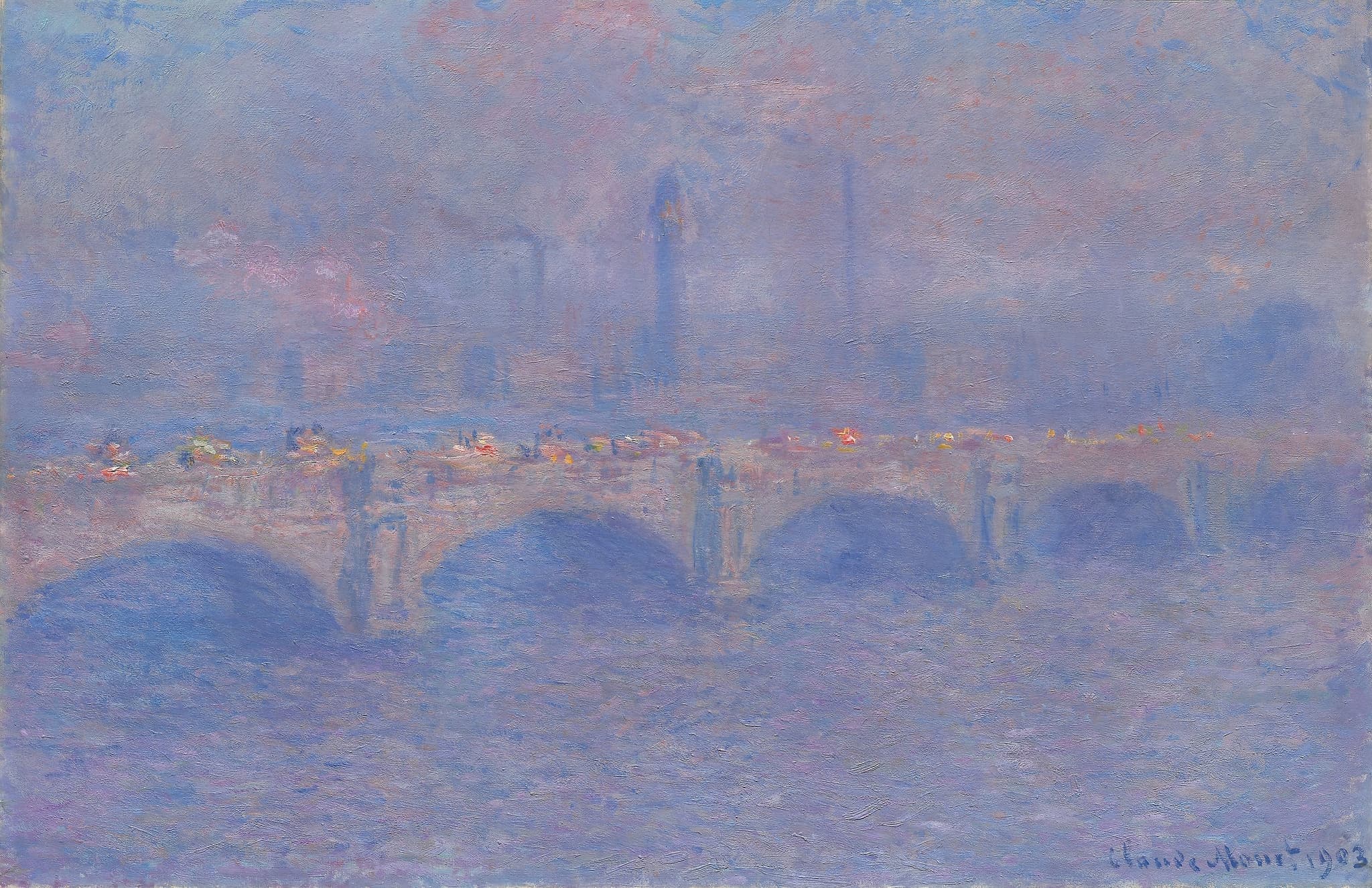
Waterloo Bridge, Sunlight Effect Auction History
No public auction records exist for Monet’s Waterloo Bridge, Sunlight Effect. The painting moved through Durand-Ruel via private transactions from 1904 to 1914, then entered Martin A. Ryerson’s collection and was bequeathed to the Art Institute of Chicago in 1933. Documented prices include 9,000 francs (1904), $4,000 (1905), and $7,500 (1914).
- Artwork
- Waterloo Bridge, Sunlight Effect
- Artist
- Claude Monet
- Best-known sale or transfer
- Sold to Martin A. Ryerson for $7,500 (1914)
- Sale type
- No known public sale
- Current location / owner
- The Art Institute of Chicago
Auction and Ownership Timeline
Work begun
The Art Institute of Chicago notes the canvas was begun around 1900 as part of Monet’s London series before later reworking [2].
Sold by Monet to Durand-Ruel, Paris
9,000 francs · Durand-Ruel, Paris
Durand-Ruel, Paris acquired the painting from Monet for 9,000 francs (DR Paris stock book no. 7641) [1].
Durand-Ruel, New York sells to W. A. Putnam
US$4,000 · Durand-Ruel, New York
Durand-Ruel, New York sold the painting to W. A. Putnam for $4,000 (DR NY stock book no. 2965) [1].
Repurchased by Durand-Ruel, New York
25,000 francs · Durand-Ruel, New York
Durand-Ruel, New York repurchased the work from W. A. Putnam for 25,000 francs (DR NY stock book no. 3646) [1].
Sold to Martin A. Ryerson, Chicago
US$7,500 · Durand-Ruel, New York
Durand-Ruel, New York sold the painting to Martin A. Ryerson for $7,500, documented by a receipt dated February 10, 1914 [1].
Loan to the Art Institute of Chicago
Art Institute of Chicago
By 1921, Ryerson intermittently loaned the painting to the Art Institute of Chicago, as noted in the object file [1].
Provenance and Ownership
Claude Monet retained the painting until selling it to Durand-Ruel, Paris on May 11, 1904, for 9,000 francs [1]. It was with Durand-Ruel, New York by early 1905 and sold to W. A. Putnam on January 10, 1905, for $4,000 [1]. Durand-Ruel, New York repurchased it from Putnam on May 22, 1913, for 25,000 francs and sold it to Martin A. Ryerson on February 10, 1914, for $7,500 [1]. Ryerson intermittently lent the work to the Art Institute of Chicago by 1921 and bequeathed it to the museum in 1933 (Ryerson Collection, acc. no. 1933.1163) [1][2].
Quick Facts
- Last known sale
- 1914-02-10
- Known sale price
- US$7,500
- Sale type
- Private sale
- Venue / institution
- Durand-Ruel, New York
- Current owner or location
- The Art Institute of Chicago
- Publicly viewable?
- Yes
Why This Sale Matters
This painting has no recorded public auction history; its movements are documented entirely through dealer and private transactions before entering a museum in 1933 [1][2]. The sequence—artist to Durand-Ruel (Paris and New York), to an American private collector (Putnam), then to the influential Chicago patron Martin A. Ryerson—exemplifies how Durand-Ruel cultivated Monet’s market in the United States in the early 20th century [1]. The documented prices (9,000 francs in 1904, $4,000 in 1905, 25,000 francs in 1913, and $7,500 in 1914) offer rare primary benchmarks for Monet’s transatlantic pricing in this period [1].
Although this specific canvas has not reappeared on the market since its 1933 bequest to the Art Institute of Chicago, auction results for related works show the enduring demand for Monet’s London views. Notable same-series sales include Waterloo Bridge canvases realizing $48.45 million (Christie’s New York, 2021) and £30,059,500 (Christie’s London, 2022) [3][4]. Across Monet’s broader market, record-setting prices such as Meules at $110.7 million (Sotheby’s, 2019) and continued strength in the Water Lilies series (e.g., a $65.5 million result in 2024) underscore sustained global appetite for his most iconic motifs [5][6].
Within this context, Waterloo Bridge, Sunlight Effect’s early dealer-led sales and subsequent long-term museum ownership mean it functions more as a reference point for historical pricing and provenance than as a tradable asset today. Its placement at the Art Institute of Chicago secures the work outside the market while reinforcing the critical role American institutions and collectors played in establishing Monet’s reputation and value trajectory [1][2].
Related Pages
Other auction histories by Claude Monet
Sources
- AIC Online Scholarly Catalogue: Monet, Waterloo Bridge, Sunlight Effect (Cat. 39) — Art Institute of Chicago
- Art Institute of Chicago collection entry: Waterloo Bridge, Sunlight Effect — Art Institute of Chicago
- Christie’s press: Waterloo Bridge, effet de brouillard achieves $48.45m (2021) — Christie’s
- Christie’s press: London/Paris sale totals; Waterloo Bridge, effet de brume (2022) — Christie’s
- Sotheby’s: Monet’s Meules sells for $110.7 million (2019) — Sotheby’s
- Wall Street Journal: November 2024 art sales (Water Lilies $65.5m) — Wall Street Journal