How Much Is Black Iris Worth?
Last updated: May 16, 2026
Quick Facts
- Methodology
- comparable analysis
Fair‑market auction value for Georgia O’Keeffe’s Black Iris (1926) is estimated at $45–60 million. This range is anchored to the artist’s $44.4m auction record and recent marquee results for closely comparable large flower canvases, while recognizing Black Iris’s singular canonical status and prime 1920s date.
Valuation Analysis
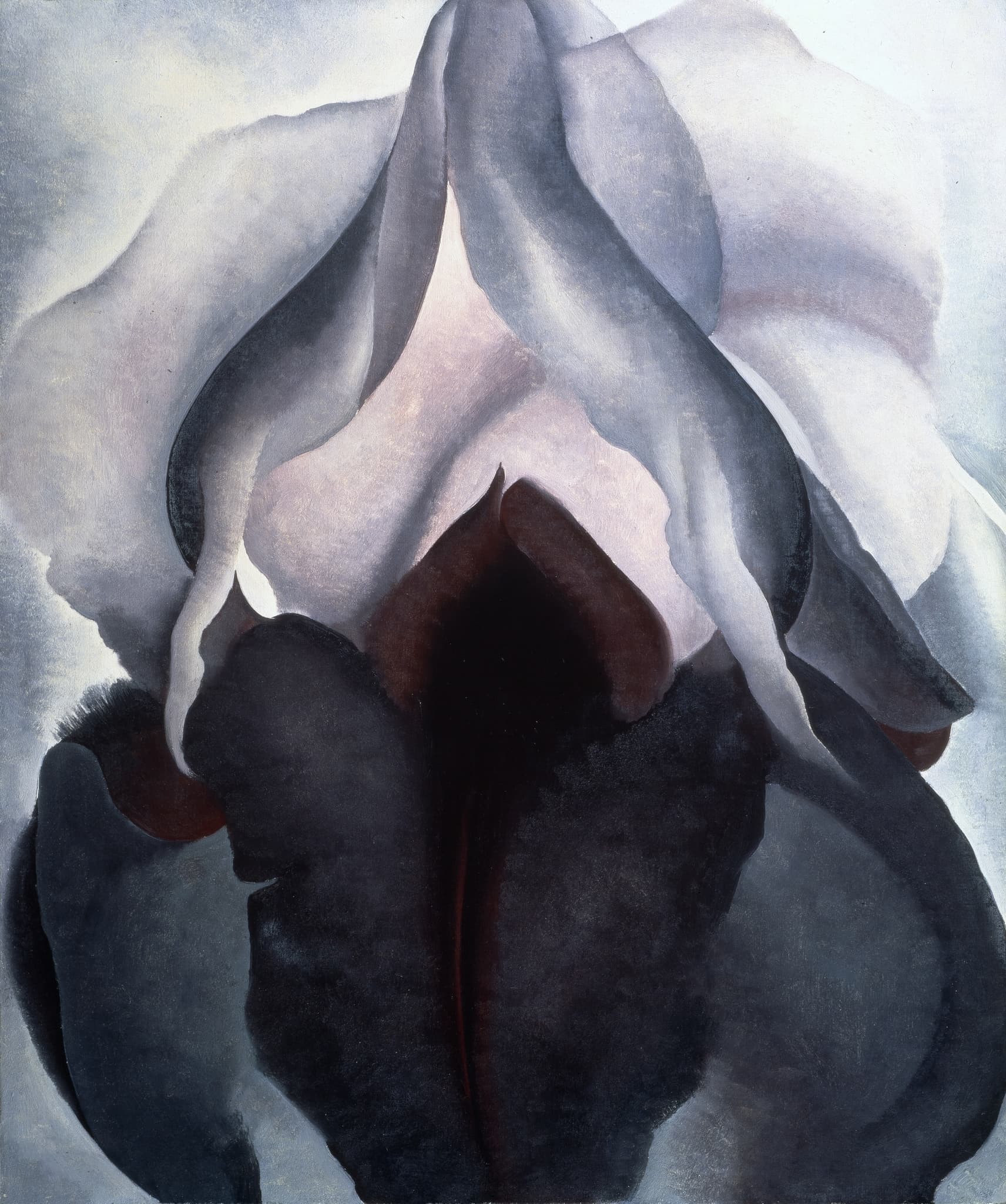
Conclusion: Black Iris (1926) would carry a fair‑market auction estimate of $45–60 million if privately held and offered today. It is one of Georgia O’Keeffe’s most canonical images—an oil on canvas from her prime floral period at 36 x 29 7/8 in.—and a cornerstone of American Modernism. The work is held by The Metropolitan Museum of Art as part of the Alfred Stieglitz Collection, with no public sale history, so this valuation is an informed market synthesis rather than a record of prior transactions [1].
How the estimate was derived: The anchor for pricing remains O’Keeffe’s standing auction record, Jimson Weed/White Flower No. 1 (1932), which realized $44.4 million at Sotheby’s in 2014, the only O’Keeffe to breach $30 million publicly to date [2]. Since then, top‑tier, large‑scale flower canvases have sold in the mid‑teens to high‑twenties: Black Iris VI (1936) brought $21.11 million at Christie’s in 2023 [3]; White Rose with Larkspur No. I (1927) achieved $26.725 million from the Paul G. Allen Collection in 2022 [4]; and Red Poppy (1928) realized $16.5 million in 2024 [5]. Black Iris (1926) outranks these comparables in art‑historical stature and period importance, justifying a premium over the recent $16–27 million cluster and an estimate explicitly calibrated to challenge—and potentially exceed—the $44.4 million artist record.
Positioning and scarcity: Black Iris is not merely a prime “flower” work; it is a defining emblem of O’Keeffe’s practice and a fixture in scholarship and reproduction. Its 1926 date places it squarely within the most coveted phase of her magnified floral imagery, and its composition is among the most recognizable in the oeuvre [1]. Supply at this level is exceptionally tight: the most significant early flowers reside in museums and foundations, and true masterpieces appear at market only rarely. That scarcity supports step‑change pricing when a trophy example surfaces, especially with deep global demand for blue‑chip American Modernism and major works by women artists.
Market context: Recent marquee seasons have rewarded museum‑quality Modern pictures with top‑tier provenance. Against that backdrop—and given Black Iris’s canonical status, prime period, and direct comparability to the artist’s record‑setting subject/format—the $45–60 million range reflects where competitive bidding would likely concentrate today. While a record‑breaking outcome is plausible in a headline sale, the estimate presented here is disciplined, evidence‑based, and consistent with the upper bound indicated by the established O’Keeffe benchmarks [2–5]. For an institutional, replacement‑cost context, stakeholders often use higher figures, but such insurance values for this specific painting are not public [1].
Key Valuation Factors
Art Historical Significance
High ImpactBlack Iris (1926) is one of O’Keeffe’s most reproduced and discussed paintings, emblematic of her exploration of magnified floral forms that shaped public and scholarly understanding of American Modernism. Executed in the artist’s prime 1920s period and frequently cited in textbooks and exhibitions, it functions as a signature image for O’Keeffe’s approach to abstraction and perception. Its prominence within the canon distinguishes it from strong but less defining floral variants, supporting a valuation premium. In short, Black Iris is not just a representative flower picture; it is a benchmark work that many consider among the handful that define O’Keeffe’s achievement, placing it at the top end of her market’s price spectrum.
Comparables and Record Benchmarking
High ImpactThe pricing spine is O’Keeffe’s $44.4m auction record for Jimson Weed/White Flower No. 1 (2014), coupled with a recent band of $16–27m for large floral canvases: Black Iris VI (1936) at $21.11m (2023), White Rose with Larkspur No. I (1927) at $26.725m (2022), and Red Poppy (1928) at $16.5m (2024). Black Iris (1926) is earlier, more canonical, and at a comparable scale. A fair-market estimate above the recent cluster and oriented to challenge the artist record is therefore justified. The $45–60m range reflects that hierarchy, setting a disciplined floor above recent marquee comparables while acknowledging the market’s current, publicly evidenced ceiling for O’Keeffe.
Scarcity and Provenance
High ImpactThe most significant O’Keeffe flower paintings are concentrated in institutions. Black Iris is in The Metropolitan Museum of Art via the Alfred Stieglitz Collection, following a long loan and 1969 accession. Works with equivalent canonicity and provenance almost never reach the open market, creating scarcity that supports step‑up pricing when truly top examples appear. While museum deaccession is unlikely, the provenance underscores the painting’s status. In a hypothetical offering, that stature—combined with exhaustive exhibition and publication history—would amplify bidder confidence and trophy demand, a well‑established dynamic in Modern evening sales that tends to push exceptional works to the top of their artist’s range.
Subject, Period, and Scale
High ImpactThe subject (a single, magnified iris) is among O’Keeffe’s most coveted motifs, executed in 1926—squarely within her prime floral decade. At 36 x 29 7/8 in., the canvas has the presence associated with her top results. Collectors place a premium on large, iconic flowers from the mid‑to‑late 1920s, especially those central to scholarship and widely reproduced. Against closely related sales—where slightly later or less canonical examples achieved $16–27m—the combination of subject, date, and size in Black Iris argues for a valuation that sits above that band and targets a new artist benchmark, aligning with behavior seen when a market’s most emblematic image surfaces at auction.
Sale History
Black Iris has never been sold at public auction.
Georgia O’Keeffe's Market
Georgia O’Keeffe is a blue‑chip pillar of American Modernism with sustained global demand and a tightly held supply of top‑tier works. Her auction record stands at $44.4 million for Jimson Weed/White Flower No. 1 (Sotheby’s, 2014), while other major flower canvases have recently sold between roughly $16 million and $27 million in marquee evening sales. Demand concentrates on large, emblematic subjects—especially 1920s flowers, Lake George landscapes, and skulls—backed by strong provenance and exhibition histories. Most masterpieces reside in institutions, so when a top example appears, competitive dynamics can produce step‑change pricing. Overall, the market is deep, international, and relatively less volatile than ultra‑contemporary segments.
Comparable Sales
Jimson Weed/White Flower No. 1
Georgia O’Keeffe
Same artist; monumental single-flower oil on canvas; most famous market benchmark for O’Keeffe. Serves as the top-of-market reference for large, iconic floral subjects closely aligned with Black Iris.
$44.4M
2014, Sotheby's New York
~$60.2M adjusted
White Rose with Larkspur No. I
Georgia O’Keeffe
Same artist; 1927 date (near-contemporary to 1926); large single-flower subject; strong provenance (Paul G. Allen Collection). Very close period/subject comp to Black Iris.
$26.7M
2022, Christie's New York
~$29.3M adjusted
Black Iris VI
Georgia O’Keeffe
Same artist and same subject series; later variant (1936) of the Black Iris motif; large-format flower canvas sold in a marquee evening sale. A direct subject-matter benchmark for Black Iris (1926).
$21.1M
2023, Christie's New York
~$22.2M adjusted
Red Poppy
Georgia O’Keeffe
Same artist; 1928 single-flower canvas from O’Keeffe’s prime floral period; sold recently in a top-tier evening sale, giving a current-market read for major flower subjects.
$16.5M
2024, Christie's New York
~$17.0M adjusted
White Calico Rose
Georgia O’Keeffe
Same artist; 1930 single-flower oil on canvas; prime subject matter (large, close-up bloom) and very recent sale result. Useful as a mid-tier floral benchmark under the most iconic images.
$13.1M
2023, Christie's New York
~$13.7M adjusted
Pink Spotted Lily
Georgia O’Keeffe
Same artist; 1936 single-flower canvas; marquee-evening context. A lower bound within the iconic flower motif set—smaller and less canonical than Black Iris, but directly on-theme.
$6.8M
2021, Sotheby's New York
~$8.1M adjusted
Current Market Trends
Marquee auction weeks since 2022 have favored museum‑quality Modern works, with notable depth for historically important women artists. Within this environment, O’Keeffe’s best large‑scale flowers and prime‑period canvases have drawn competitive bidding, while estimate discipline remains crucial. The top end of the women‑artist segment has advanced in recent years, reframing the headline context in which a trophy O’Keeffe would compete. With Modern regaining share in mixed‑category evening sales and collectors prioritizing brand‑name quality with impeccable provenance, conditions are supportive for a canonical O’Keeffe to test or reset the artist’s price ceiling in a well‑staged New York evening sale.
Study print
Study this painting as a print
Pair the full artwork with a museum-style study sheet focused on one meaningful detail.
Sources
- The Metropolitan Museum of Art – Black Iris (1926)
- CNBC – Georgia O’Keeffe painting sets record for female artist (2014)
- Christie’s – Black Iris VI (1936), 20th Century Evening Sale, May 11, 2023
- Christie’s Press – Visionary: The Paul G. Allen Collection (Nov 9, 2022) results
- The Art Newspaper – Christie’s Modern evening sale recap (Red Poppy result, May 16, 2024)
- Wikipedia – The Dream (The Bed), auction record reference