Black Iris

by Georgia O’Keeffe

In Black Iris, Georgia O’Keeffe enlarges a single bloom to monumental scale, transforming it into luminous gradients and architectural folds. The pale, misted upper petals frame a velvety, wine‑black center, turning a familiar flower into an immersive field of abstraction and depth [1][3].

Study Print Studio

Create a personal study print

Build a companion study sheet around the part of this painting that speaks to you most. Choose a detail, shape an interpretation, and walk away with something personal and display-worthy.

Fast Facts

Year
1926
Medium
Oil on canvas
Dimensions
91.4 x 75.9 cm
Location
The Metropolitan Museum of Art, New York
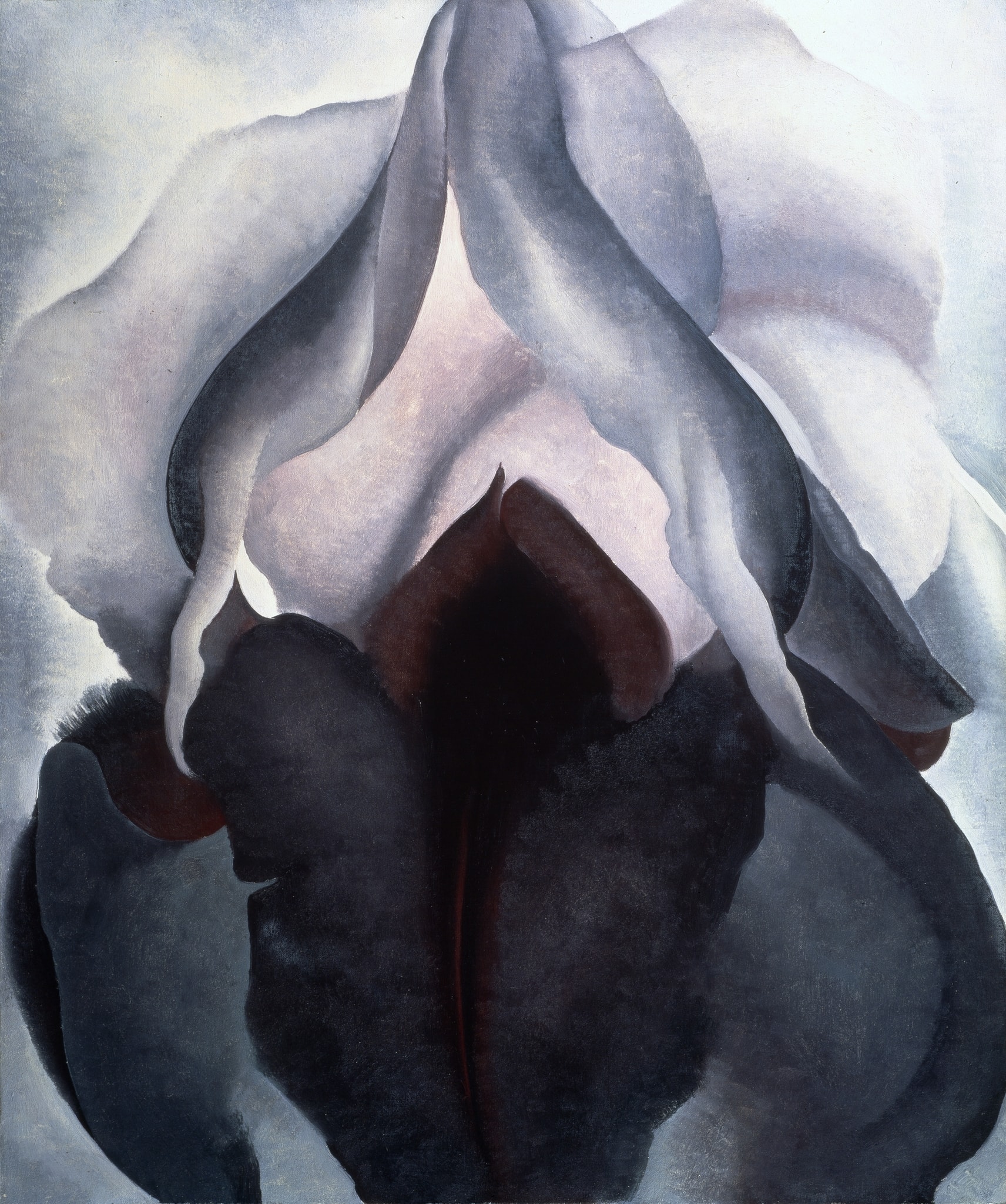
Black Iris by Georgia O’Keeffe (1926) featuring Abyssal Center (Dark Throat), Wine-Red Seam, Pale Upper Petals (Halo), Glowing Rims

Click on any numbered symbol to learn more about its meaning

Meaning & Symbolism

O’Keeffe drives the eye from the cool, breath‑light upper petals—silvered grays flushed with lavender—down into the dark throat built of velvety blacks and wine reds. That engineered plunge is not merely descriptive; it is a compositional device that enacts inwardness, a controlled fall from radiance to opacity. By cropping the iris so it exceeds lifesize and nearly fills the frame, she cancels the usual cues of stem, ground, and scale, forcing the bloom to read as a landscape of edges: scalloped ridges like eroded cliffs, soft rims that glow as if backlit, and shadowed hollows suggesting caverns. The result is an image that holds two truths at once—botanical specificity and abstract structure—so that recognition and unknowing alternate with each glance 13. This double action is central to the meaning of Black Iris. O’Keeffe uses magnification to slow time: her continuous gradients create a tactile, almost breathlike tempo that compels the viewer to inhabit the act of seeing. The painting proposes that attention is transformative—that in looking hard enough, form loosens from name. Early viewers often translated that intimacy into sexual analogy, a reading amplified in the interwar climate and by some feminist critiques that took the inward fold as a morphological metaphor. But the work resists reduction. O’Keeffe’s own 1939 statement rejects projected eroticism—“you hung all your own associations… and I don’t”—and museums now underscore the broader modernist project at stake: to make small things monumental and reveal essential structures in nature without fixing them to one code 4513. In this sense, the soft, pale cuffs that drape over the darker center do not illustrate a body so much as stage a drama of light meeting depth, vitality encountering gravity. The iris becomes a portal and a surface, a threshold between the seen and the felt. Why Black Iris is important follows from that stance. Painted in 1926 within O’Keeffe’s pioneering series of magnified flowers, it helped redefine American modernism’s language by proving that radical abstraction could grow from the most familiar subjects. Its audacious scale and close focus—“far beyond lifesize,” as The Met notes—confront viewers with details typically overlooked, insisting that the mysteries of perception reside in the ordinary 13. The painting also charts a path beyond the binary of symbol and thing: the pale, glowing rims assert presence; the obsidian core with its slim wine‑red seam asserts abyss. Between them, O’Keeffe composes a living equilibrium, a vitalism many scholars observe in her work—form animated from within rather than decorated from without 3. That is the enduring achievement of Black Iris: not an answer about what a flower “really means,” but a precise instrument for re‑training how we see.

Explore Deeper with AI

Ask questions about Black Iris

Popular questions:

Powered by AI • Get instant insights about this artwork

💬 Ask questions about this artwork!

Interpretations

Reception History & Feminist Reframing

From the 1920s onward, close-up flowers like Black Iris were read by many critics—famously echoed by Linda Nochlin—as morphological metaphors for female sexuality. O’Keeffe’s own 1939 statement, however, explicitly rejects such projections: viewers had “hung” their associations on her flowers, which was not her aim. Recent curators have followed her lead, foregrounding form, scale, and perception over reductive iconography. The Tate’s retrospective took this further, challenging “conservative male” clichés and emphasizing a broader modernist project. Today’s consensus treats erotic analogy as a historically significant but non-exclusive lens—one interpretive current among others, rather than the painting’s fixed meaning 456.

Source: National Gallery of Art; The Metropolitan Museum of Art (1984 Bulletin); Tate Modern (via The Guardian)

Phenomenology of Looking

Black Iris operationalizes a slowed gaze: magnification, continuous gradients, and soft-value transitions coax the viewer into dwelling on edges and tonal breath, where recognition dissolves into sheer seeing. Rather than symbolize, the painting stages perception—the eye descends from crisp, cool rims into a velvety center, enacting a felt passage from clarity to opacity. This is less an emblem than a phenomenological device that asks how attention transforms objects. Museum scholarship frames this as O’Keeffe’s modernist wager: to locate abstraction within observation so that form emerges from looking itself, not from imposed allegory 124.

Source: The Metropolitan Museum of Art (object entry; Heilbrunn Timeline); National Gallery of Art

Formalism: Petal-as-Terrain

O’Keeffe’s cropping and scale convert the iris into a macro-architecture of ridges and hollows. Petal edges glow as if backlit, a value-contrast that flattens and deepens the surface at once; the descent into the dark throat produces a controlled chiaroscuro that reads like a cavern. By editing out stem and ground, she suspends the bloom in an abstract field where contour, temperature shifts, and edge-conditions become primary actors. The effect exemplifies interwar American modernism’s preference for essentialized form and ambiguity between object and abstraction—an art of structure rather than anecdote 12.

Source: The Metropolitan Museum of Art (object entry; Heilbrunn Timeline)

Iconographic Baggage of the Iris

Though O’Keeffe disavowed fixed symbolism, the iris arrives with centuries of cultural freight that colored early reception. In European Christian art, sword-like iris leaves index Marian sorrow; the heraldic fleur-de-lis derives from the yellow iris and signals purity and rule. Such associations—devotional and courtly—prime viewers to read heightened emotion or sanctity into any iris image, even when leaves or emblems are absent. A responsible reading holds these histories as contextual echo, not program: they explain critical overreach without binding O’Keeffe’s modernist aims, which major museums present as primarily formal and perceptual 7894.

Source: Warburg Institute; Museo del Prado; Getty Museum; National Gallery of Art

Title, Provenance, and the Politics of Numbering

Originally cataloged as Black Iris III, the work’s later retitling to Black Iris at The Met subtly shifts emphasis from series iteration to singular icon. Numbering foregrounds process and serial variation—key to O’Keeffe’s method—while the unnumbered title invites canonical status and stand-alone reading. Documented by the O’Keeffe Museum’s catalogue raisonné, the change (formalized in 1991) also intersects with the painting’s provenance: its long loan from the Stieglitz Collection and ultimate 1969 gift cemented its place in American modernism’s public narrative. Titles, here, are not neutral labels but frames of interpretation 31.

Source: Georgia O’Keeffe Museum (Access O’Keeffe, Catalogue Raisonné); The Metropolitan Museum of Art

Related Themes

About Georgia O’Keeffe

Georgia O’Keeffe (1887–1986) emerged within the Stieglitz Circle and became a defining voice of American modernism, using magnification, cropping, and distilled color to bind nature to abstraction. Beginning in the mid‑1920s she painted large‑scale flowers, later expanding to bones, cliffs, and New Mexico landscapes, sustaining a practice devoted to the essential structures of perception [3].
View all works by Georgia O’Keeffe

More by Georgia O’Keeffe