Jimson Weed/White Flower No. 1
Study Print Studio
Create a personal study print
Build a companion study sheet around the part of this painting that speaks to you most. Choose a detail, shape an interpretation, and walk away with something personal and display-worthy.
Fast Facts
- Year
- 1932
- Medium
- Oil on canvas
- Dimensions
- 121.9 x 101.6 cm
- Location
- Crystal Bridges Museum of American Art, Bentonville, Arkansas
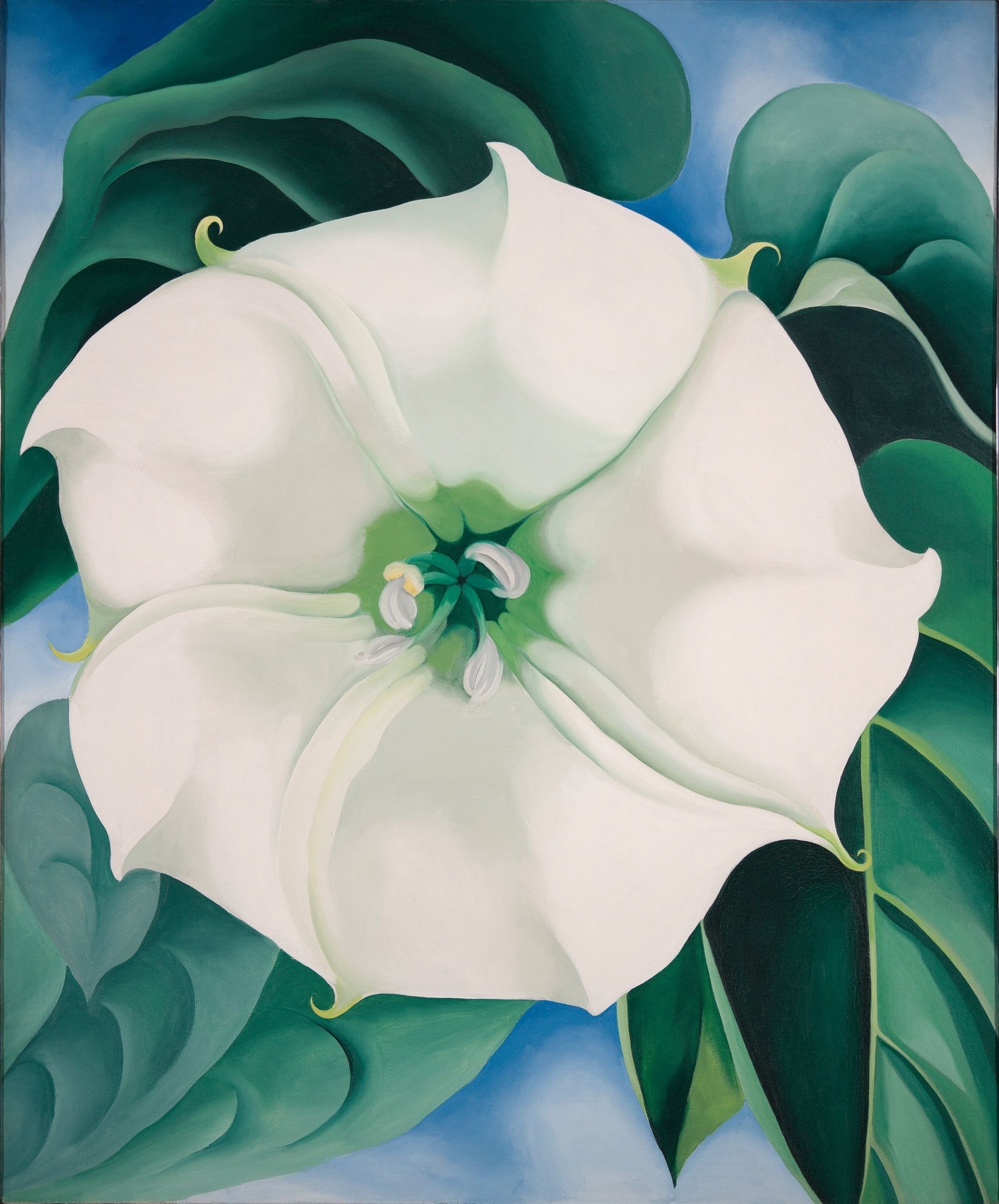
Click on any numbered symbol to learn more about its meaning
Meaning & Symbolism
Explore Deeper with AI
Ask questions about Jimson Weed/White Flower No. 1
Popular questions:
Powered by AI • Get instant insights about this artwork
Interpretations
Formal Analysis: Calibration at the Edge of Abstraction
Source: Whitney Museum; North Carolina Museum of Art
Botanical Lens: Purity, Peril, and Vespertine Morphology
Source: Encyclopaedia Britannica (botany); Georgia O’Keeffe Museum
Gendered Readings Contested: Reframing the Flower
Source: Georgia O’Keeffe Museum; National Gallery of Art; Tate Modern (via The Guardian)
American Modernism: Monumentality Without Allegory
Source: Whitney Museum; Georgia O’Keeffe Museum
Phenomenology of Attention: Devotion as Method
Source: Georgia O’Keeffe Museum (“In Her Words”); North Carolina Museum of Art
Reception & Canon Formation: From Gallery Wall to Record Price
Source: Sotheby’s; TIME; Crystal Bridges Museum of American Art
Related Themes
About Georgia O’Keeffe
More by Georgia O’Keeffe
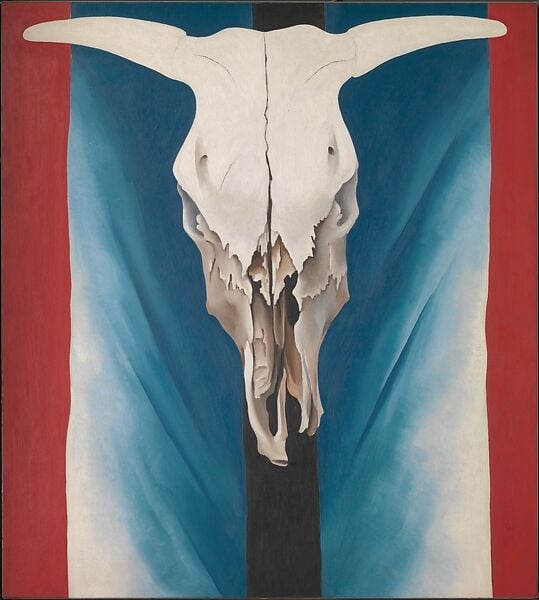
Cow’s Skull: Red, White, and Blue
Georgia O’Keeffe (1931)
Georgia O’Keeffe’s Cow’s Skull: Red, White, and Blue (1931) turns a sun‑bleached bovine skull into a <strong>modern American emblem</strong>, set against a tricolor field that quietly evokes the flag. The skull’s chalky surface becomes the composition’s <strong>white</strong>, framed by red side bands and a folded blue ground cleaved by a dark vertical bar, asserting <strong>resilience</strong> rather than morbidity <sup>[1]</sup><sup>[2]</sup>.
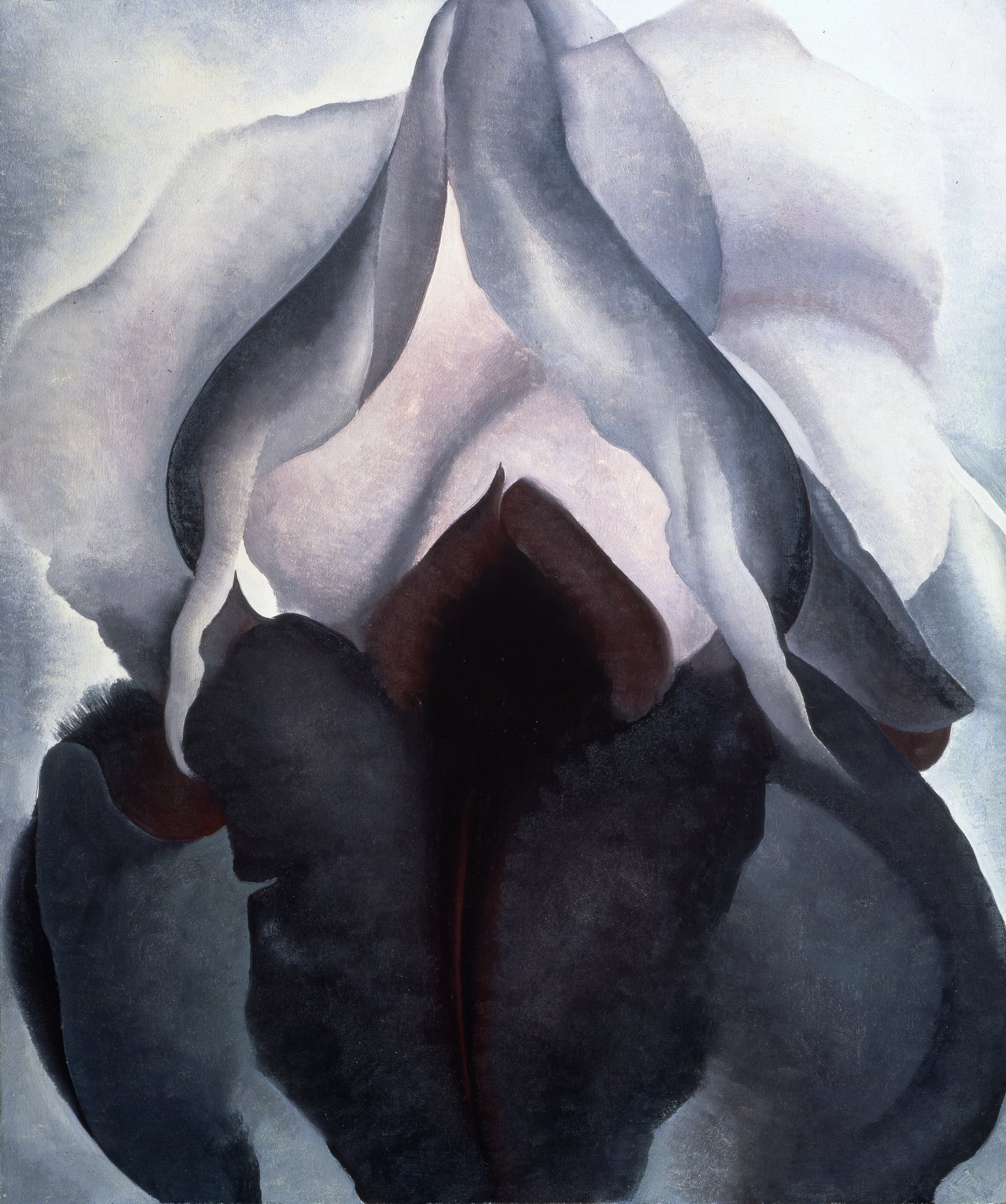
Black Iris
Georgia O’Keeffe (1926)
In Black Iris, Georgia O’Keeffe enlarges a single bloom to monumental scale, transforming it into <strong>luminous gradients</strong> and <strong>architectural folds</strong>. The pale, misted upper petals frame a velvety, wine‑black center, turning a familiar flower into an immersive field of <strong>abstraction and depth</strong> <sup>[1]</sup><sup>[3]</sup>.
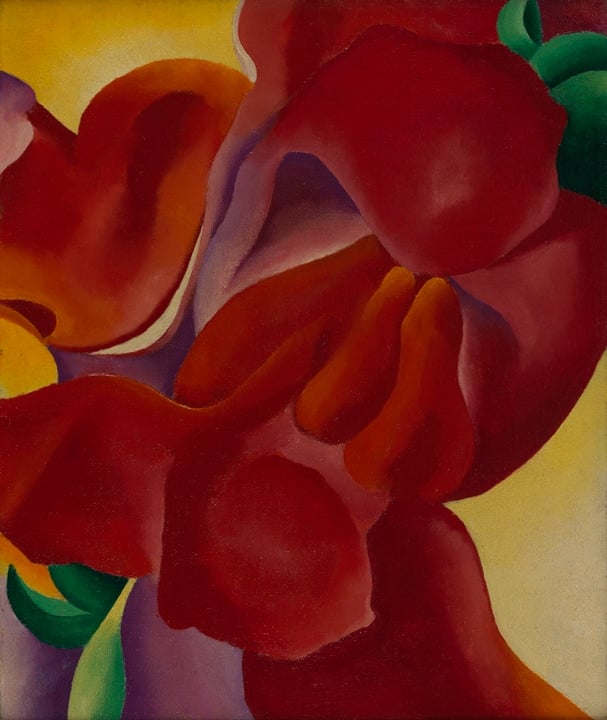
Red Canna
Georgia O’Keeffe (1925–1928)
Georgia O’Keeffe’s Red Canna turns a single bloom into an immersive field of <strong>magnified color and form</strong>. Swelling crimson petals edged with violet ride against a <strong>sunlit yellow</strong> ground, while small <strong>green flickers</strong> punctuate the heat, converting a garden flower into a modern emblem of <strong>vitality and perception</strong> <sup>[1]</sup><sup>[2]</sup>.