How Much Is The Meeting (La Rencontre / Bonjour, Monsieur Courbet) Worth?
Last updated: May 22, 2026
Quick Facts
- Methodology
- comparable analysis
The Meeting (La Rencontre / Bonjour, Monsieur Courbet), 1854, is a museum‑quality, canonical Courbet in the Musée Fabre with no modern public sale history. If hypothetically placed on the open market today, a realistic preliminary valuation is USD 10–35 million, most likely toward the mid/upper part of that band given its significance, provenance and rarity.
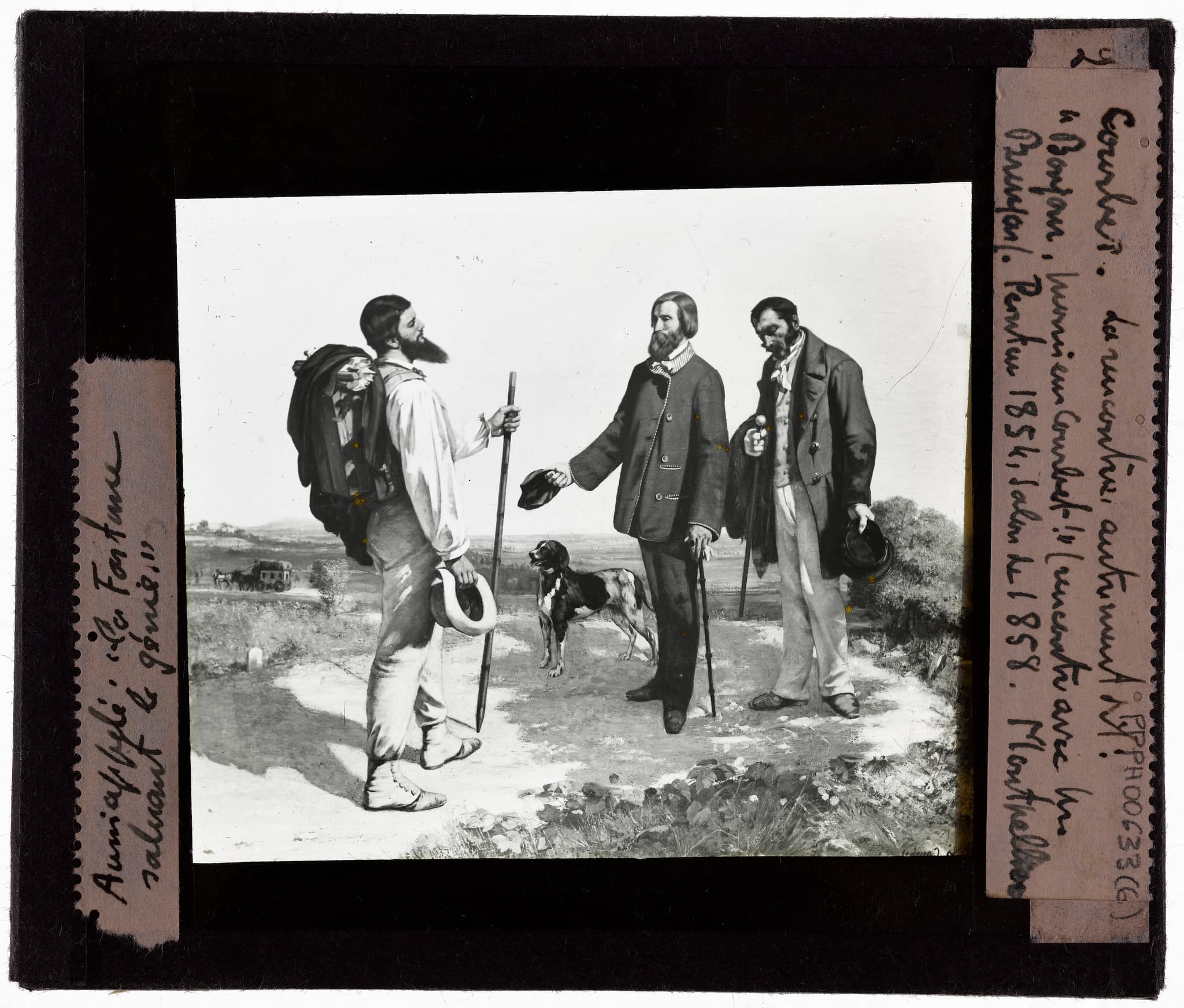
The Meeting (La Rencontre / Bonjour, Monsieur Courbet)
Gustave Courbet, 1854 • Oil on canvas
View more by Gustave Courbet →Valuation Analysis
Valuation conclusion: The Meeting (La Rencontre / Bonjour, Monsieur Courbet), 1854, is a large, museum‑quality, canonical work by Gustave Courbet in the Musée Fabre’s Bruyas collection and has not appeared on the modern international secondary market. Based on a comparable‑led assessment anchored to the artist’s auction ceiling and adjusted for museum provenance, rarity and market dynamics, I place a hypothetical market band at USD 10,000,000 to USD 35,000,000. This range reflects both likely outcomes in a competitive sale and the practical limits imposed by institutional ownership and patrimonial controls [1].
Comparable anchors and market logic: The artist’s public auction high—Christie’s 2015 sale of Femme nue couchée (realized USD 15,285,000)—functions as an important anchor for a top‑tier Courbet offered on the open market, and supports the mid‑to‑upper portion of the band proposed here [2]. Other high‑profile French‑school masterpieces sold in Paris illustrate that exceptional circumstances can push prices above a normal Courbet ceiling; conversely, routine Courbet offerings continue to trade in the mid‑to‑high six‑figure range (a recent Sotheby’s example demonstrates current mid‑market liquidity), which validates a broad band that captures both ordinary and exceptional realizations [3].
Provenance, condition and exhibition premium: The painting’s direct commission for Alfred Bruyas and continuous museum custody at Musée Fabre confer a strong provenance premium and scholarly validation. That pedigree increases buyer confidence and often elevates realized prices when museum works are legitimately offered, but it also reduces the probability of frequent market appearances. A firm valuation would require a current, formal condition and conservation report together with a full exhibition and publication history; these technical factors can move a final number materially in either direction.
Practical/legal constraints and marketability: French patrimonial protections, museum deaccession norms and export‑licensing can make an actual international sale complicated or unlikely; these constraints influence buyer composition (institutional vs private/sovereign) and the choice of sale mechanism (private treaty, Paris sale, or exceptional international auction), which in turn affects achievable price [4]. In short, scarcity driven by institutional custody typically supports premiums, but legal friction can both limit bidder pools and, in some circumstances, concentrate competition among a few deep‑pocketed buyers.
Next steps to refine the estimate: To convert this hypothetical band to a formal appraisal I recommend: (1) obtain the Musée Fabre accession/provenance file; (2) secure a current conservation/condition report; (3) confirm any patrimonial classification or export restrictions; (4) assemble firm auction comparables (hammer + buyer’s premium converted to present USD); and (5) verify catalogue‑raisonné and exhibition citations. With those documents the estimate can be tightened into a defensible insured or sale valuation.
Key Valuation Factors
Art Historical Significance
High ImpactLa Rencontre / Bonjour, Monsieur Courbet is widely recognized as one of Courbet’s important mid‑1850s canvases: large in scale, self‑referential (the artist depicted with patron Alfred Bruyas), and frequently cited in scholarship on Realism and artist‑patron dynamics. That cultural and art‑historical weight drives institutional interest and confers a premium relative to unattributed or studio works. The painting’s centrality in Courbet studies and its regular appearance in exhibition catalogues raise buyer confidence in attribution and provenance—two of the strongest price multipliers in the historical market. In short, the work’s scholarly prominence elevates its market standing and potential sale ceiling.
Provenance & Institutional Ownership
High ImpactExecuted for Alfred Bruyas and given into the Bruyas donation to the Musée Fabre, the painting’s uninterrupted museum custody is a major value driver. Well‑documented provenance and the imprimatur of a respected regional French museum reduce attribution risk and typically enhance competition among institutional and private buyers should the work ever be legitimately released. However, long museum ownership also suppresses the probability of market appearance, creating rarity that can either inflate a one‑off price (if sold) or practically exclude the work from sale altogether. This provenance profile is therefore both a price enhancer and a liquidity limiter.
Comparables & Auction Record
High ImpactComparable evidence anchors the band: Courbet’s auction record (Christie’s 2015 Femme nue couchée, realized USD 15.285M) sets a practical anchor point; multiple high‑quality Courbet canvases have realized seven‑figure results while a larger number trade in mid‑to‑high six‑figures. High‑end French‑school sales in Paris indicate a materially higher ceiling for rare masterpieces, informing the upper bound of the band. Given this dispersion, a museum‑quality Courbet offered under optimal marketing could plausibly reach the mid/upper tens of millions, while routine market conditions could keep realizations toward the lower part of the band.
Condition & Conservation
Medium ImpactCondition is a decisive, technical determinant of value. A pristine, original surface with minimal intervention increases buyer confidence and supports the top of the estimate; conversely, heavy restorations, overpainting or structural weakness can reduce marketability and lower realizations materially. For a museum work, documented conservation history—restoration records, stabilizing interventions, and recent condition reports—will enable buyers and insurers to quantify treatment risk and adjust bids accordingly. A formal, up‑to‑date condition report is therefore required to translate the hypothetical band into a firm figure.
Legal/Export Constraints & Marketability
High ImpactFrench patrimonial law, export‑licensing and standard museum deaccession policies create important practical barriers to sale. Works in French public collections may be subject to export refusals or require complex permissions; these constraints shape potential sale venues (national sale, private treaty in France, or heavily restricted international transfer) and affect buyer appetite. The legal status can therefore both depress the pool of bidders and, paradoxically, concentrate demand among a few well‑resourced institutions or sovereign buyers willing to negotiate complex acquisitions—each outcome having opposite impacts on realized price.
Sale History
The Meeting (La Rencontre / Bonjour, Monsieur Courbet) has never been sold at public auction.
Gustave Courbet's Market
Gustave Courbet is a central figure of 19th‑century French Realism with steady collector and institutional demand. The market is segmented: many works trade in the mid‑to‑high six‑figure band, while a limited number of museum‑quality canvases achieve seven or low‑to‑mid eight‑figure prices. The artist’s public auction high (Christie’s 2015) remains the benchmark and underscores both the upside for high‑quality material and the relative illiquidity at the top. Provenance, catalogue‑raisonné status and exhibition history are primary drivers of variance in realized prices for Courbet works.
Comparable Sales
Femme nue couchée
Gustave Courbet
Same artist and one of Courbet's highest-quality canvases to reach the open market; represents the public auction ceiling for Courbet (artist auction record) and therefore anchors the upper end of a market band for a museum-quality Courbet.
$15.3M
2015, Christie's New York
~$19.1M adjusted
Le Melon entamé
Jean-Baptiste-Siméon Chardin
Different artist but a high-profile sale of a canonical French-school masterpiece in a Paris sale; useful cross-reference for demand and price ceilings for rare, museum-quality French works offered on the market.
$28.8M
2024, Christie's Paris
~$29.4M adjusted
La Trombe
Gustave Courbet
Recent mid-market Courbet sale (small/medium work) providing a current-market datapoint for Courbet liquidity and typical realized prices for works that circulate; useful to set the market floor for non-masterpiece Courbets.
$965K
2025, Sotheby's New York
Current Market Trends
Since 2023 the overall market has been selective: liquidity at the ultra‑top contracted, but quality‑led demand recovered in 2025–2026. Younger collectors and institutional interest have revived appetite for historically significant works; nevertheless, legal/political factors and macroeconomic caution continue to constrain cross‑border high‑value transactions, favoring well‑provenanced museum pieces for resale or acquisition.
Sources
- Musée Fabre — La Rencontre / Bonjour, Monsieur Courbet (object page and Bruyas collection information)
- Christie’s press / sale documentation — Femme nue couchée (artist auction record, 2015)
- Sotheby’s lot page — recent Courbet example (La Trombe, 2025) illustrating mid‑market liquidity
- Légifrance — Code du patrimoine (French patrimonial/expor t control framework)