How Much Is The Painter's Studio (The Artist's Studio) Worth?
Last updated: May 22, 2026
Quick Facts
- Methodology
- comparable analysis
The canonical L’Atelier du peintre (1854–55) by Gustave Courbet is a Musée d’Orsay masterpiece and is effectively not for sale. If hypothetically transferable and clear of French patrimony restrictions, a reasoned, high‑uncertainty market estimate is USD 25–75 million, reflecting its singular art‑historical status, Courbet’s public auction ceiling, and substantial legal/market constraints.
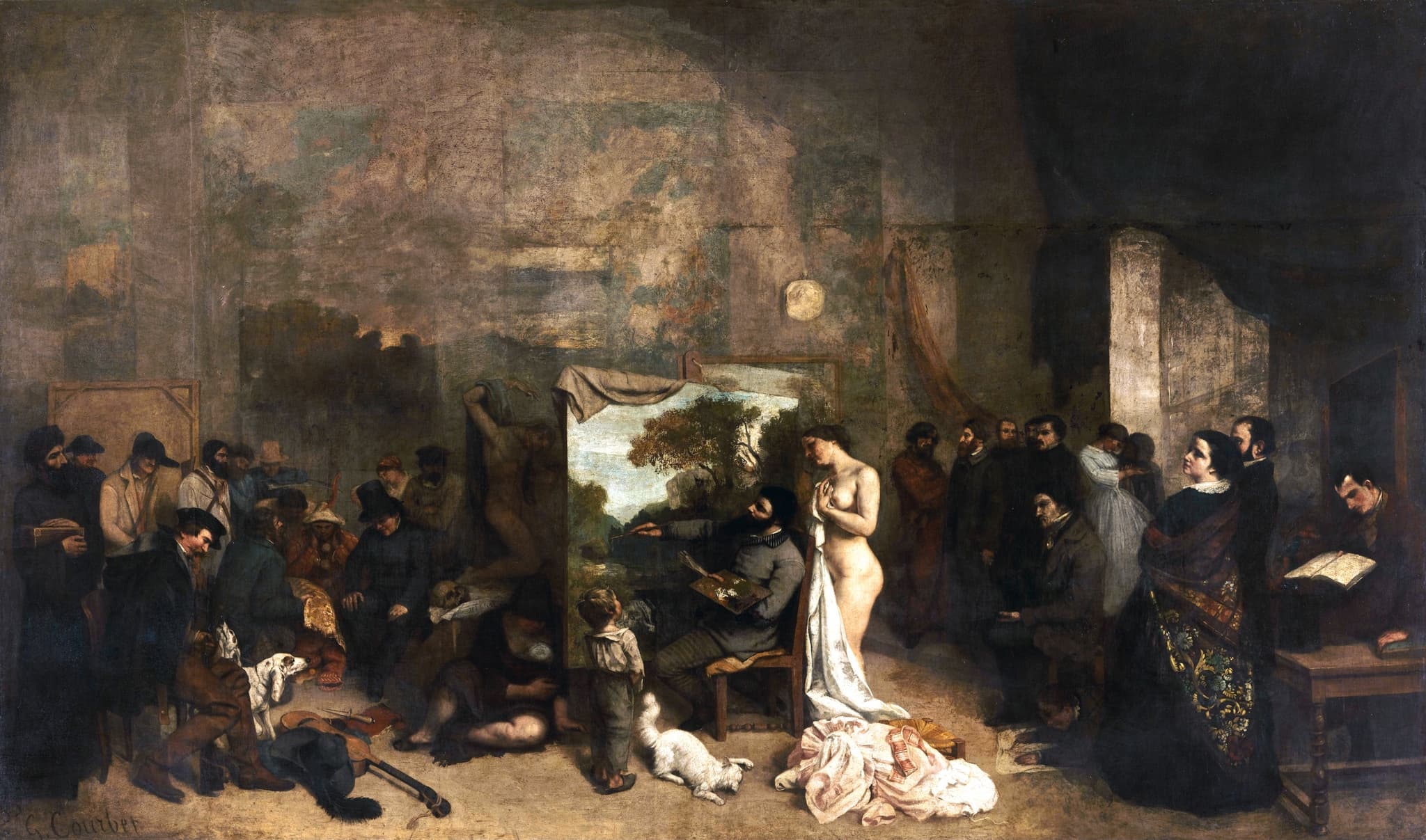
The Painter's Studio (The Artist's Studio)
Gustave Courbet • Oil on canvas
View more by Gustave Courbet →Valuation Analysis
Overview and current status. Gustave Courbet’s L’Atelier du peintre (1854–55) is held by the French national collection and is on display at the Musée d’Orsay; it was acquired for the nation in 1920 and is treated as a museum masterpiece, not a market lot [1]. That institutional ownership and public provenance are primary determinants of market availability: the work is not a typical sellable asset.
Comparable market context. The public auction ceiling for Courbet in the modern secondary market is materially lower than the very top Impressionist names: Christie’s 2015 sale of Femme nue couchée realised USD 15,285,000 and remains the artist’s auction record [2]. Most high‑quality Courbet canvases have traded in the single‑ to low‑millions, with many lots in the mid‑to‑high six‑figure band. These comparables set a practical baseline for extrapolating value for an iconic work.
Why USD 25–75M (hypothetical). Were L’Atelier transferable, its unparalleled art‑historical significance, monumental scale, and global recognition would justify a significant premium above Courbet’s normal auction outcomes. Translating that cultural premium into dollars entails judgment: a conservative uplift above the modern record (1.5x–5x) accommodates both the uniqueness of the work and the fact that Courbet’s broader market ceiling is historically well below the top Impressionists. The lower bound (≈USD 25M) reflects constrained buyer liquidity and Courbet’s demonstrated auction ceiling; the upper bound (≈USD 75M) represents an aggressive, trophy‑market scenario in which multiple deep‑pocket private buyers or a sovereign/museum compete in a controlled private treaty or deaccession context.
Legal, institutional and practical caveats. French patrimony and museum practice are decisive: export restrictions, state acquisition priority and the rarity of deaccessioning major national works significantly limit the possibility of an open‑market sale and therefore the pool of legitimate buyers [3]. Those constraints both reduce transactional probability and inject price uncertainty. Condition, conservation history and proven exhibition/publication pedigree would further modulate realized value.
Conclusion and recommended next steps. The USD 25–75M bracket is a reasoned, high‑uncertainty estimate that balances the painting’s exceptional cultural value against Courbet’s secondary‑market history and the formidable legal/institutional barriers to sale. For any real valuation or attempted market placement, confirm attribution and dimensions, obtain a full provenance and condition report, and consult heritage authorities and specialist dealers before assuming transferability.
Key Valuation Factors
Art Historical Significance
High ImpactL’Atelier du peintre is one of Courbet’s signature, manifesto‑scale works: large, narrative, and foundational to his reputation as leader of Realism. Its iconographic centrality to 19th‑century French art and frequent citation in scholarship and exhibition histories make it a top‑tier cultural asset. For collectors and institutions alike, a single painting that anchors scholarly narratives and can headline exhibitions commands a pronounced premium relative to more typical artist canvases. That premium arises from rarity (few works of comparable documentary weight exist), curatorial value (the painting’s ability to drive loans and attendance), and cultural capital—factors that outweigh routine market metrics for less consequential works.
Provenance & Ownership
High ImpactThe painting’s acquisition history—purchased for the French national collection in 1920 and held by the Musée d’Orsay—dramatically reduces market availability and elevates institutional value. Public ownership provides incontestable provenance and exhibition history, which are strong positive price drivers when a work is tradeable. However, ownership by a national museum also makes an open sale exceptionally unlikely and typically subjects any movement to strict governmental oversight and political scrutiny. For valuation, immaculate provenance increases theoretical price but simultaneously complicates practical monetization.
Market Comparables & Auction Record
High ImpactCourbet’s public auction record (USD 15.285M, Christie’s 2015) sets the observed market ceiling for freely tradable works in the modern secondary market. Most high‑quality Courbets, however, trade materially below that mark—commonly in the single‑ to low‑millions—and many lots realise in the mid‑to‑high six‑figures. These comparables anchor a conservative appraisal framework: an icon like L’Atelier should be valued above typical comparables, but the scaling is constrained by the rarity of precedent sales for artworks of equivalent institutional importance in Courbet’s oeuvre.
Legal & Export Controls
High ImpactFrench patrimony rules, export‑certificate requirements and the state’s right of pre‑emption are decisive. Major museum objects are frequently designated as national treasures, and the French state or national museums commonly block export or exercise acquisition priority, which can prevent market transactions outright. These legal mechanisms reduce the effective buyer pool (often leaving only French public bodies or state‑sanctioned transfers) and add procedural uncertainty and delay—factors that suppress realistic market values relative to hypothetical, frictionless sale scenarios.
Physical Attributes & Condition
Medium ImpactThe painting’s monumental dimensions (361 × 598 cm) and complex multi‑figure composition both enhance its exhibition value and raise practical handling, conservation and installation costs. Large format increases desirability for major institutions but simultaneously narrows the list of buyers able to accommodate, transport and display the work. Conservation history, structural condition, and any restorations materially affect insurability and buyer confidence; in museum‑held works these tend to be well documented, which supports value, but any significant conservation risk would reduce realizable price.
Sale History
Christie's New York
Sotheby's New York
Sotheby's New York
Gustave Courbet's Market
Gustave Courbet is a major 19th‑century French realist whose market is stable but polarized. He commands institutional respect and consistent collector interest, with the modern auction record at USD 15.285M (Christie’s, 2015). Most important Courbet canvases trade in the single‑ to low‑millions; many works realise in the mid‑to‑high six‑figure band. Courbet lacks the consistent trophy‑lot frequency of Monet or Renoir, so even exceptional works are priced against a historical market that rarely reaches very high multi‑tens‑of‑millions without unique circumstances.
Comparable Sales
Femme nue couchée
Gustave Courbet
Same artist; large, high‑quality Courbet that set the modern auction record and therefore establishes the public‑market ceiling for Courbet.
$15.3M
2015, Christie's New York
~$19.9M adjusted
Étretat: Les Falaises
Gustave Courbet
Same artist; a sizeable landscape sale in the low‑millions that illustrates typical pricing for museum‑grade Courbet works below the record level.
$3.7M
2013, Sotheby's New York
~$5.1M adjusted
La Trombe
Gustave Courbet
Recent 2025 sale showing current market demand and pricing for mid‑quality Courbet canvases (mid‑to‑high six‑figures).
$965K
2025, Sotheby's New York
Le Ruisseau de Puits Noir
Gustave Courbet
Recent lower‑tier sale that demonstrates the breadth of the Courbet market and that many works sell in the low six‑figure range.
$105K
2024, Christie's London
~$108K adjusted
Current Market Trends
The current market is polarized: top museum‑quality works still attract serious buyers, while the mid‑market is more price‑sensitive. Institutional exhibitions, major loans, and strong provenance continue to be the most reliable demand drivers. For 19th‑century Realism, sell‑through and price levels are selective: condition, exhibition history and timing with institutional interest strongly influence outcomes.