How Much Is The Painter’s Studio Worth?
Last updated: May 27, 2026
Quick Facts
- Methodology
- comparable analysis
The Painter’s Studio (1854–55) is a canonical, manifesto-scale masterpiece by Gustave Courbet, housed at the Musée d’Orsay and inalienable under French law. Using peer benchmarks for museum‑grade 19th‑century masterpieces and extrapolating above Courbet’s auction record, we estimate a hypothetical insurance/benchmark value of $150–250 million. This range reflects the work’s singular art‑historical stature, rarity, and global cultural importance.
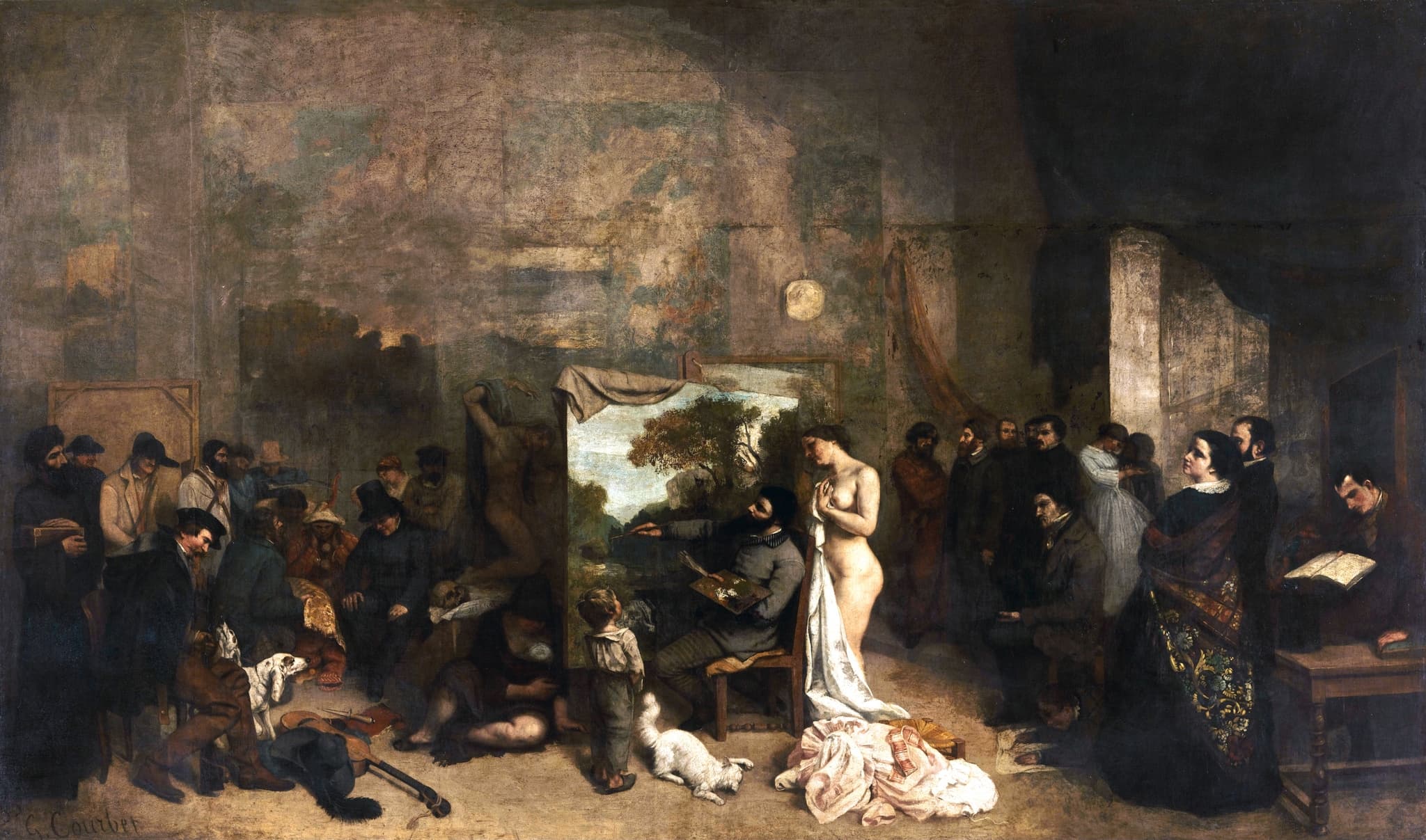
The Painter’s Studio
Gustave Courbet, 1854–1855 • Oil on canvas
Read full analysis of The Painter’s Studio →Valuation Analysis
Conclusion: We estimate a hypothetical benchmark/insurance value of $150–250 million for Gustave Courbet’s The Painter’s Studio (1854–55). The painting is held by the Musée d’Orsay and forms part of France’s inalienable national collections; it is therefore not marketable in a conventional sense, and this valuation is for indemnity/benchmarking only [1][2].
Significance and uniqueness: The Painter’s Studio is universally regarded as one of Courbet’s defining masterpieces—often bracketed with A Burial at Ornans and The Origin of the World—as a monumental, programmatic statement of Realism and the artist’s self-conception. Its scale, complexity, and centrality to 19th‑century modernity make it effectively irreplaceable within the oeuvre; there is no true substitute work by Courbet [1].
Method and benchmarks: With no public sale history for this object, we anchor the estimate to observable prices for museum‑grade 19th‑century French masterworks and to Courbet’s own market. Courbet’s standing auction record is $15.285 million (Christie’s New York, 2015, Femme nue couchée), which defines the public ceiling for non‑trophy Courbets but is not probative for a singular, manifesto‑level canvas like The Painter’s Studio [3]. For peer benchmarks, Monet’s Meules realized $110.7 million at Sotheby’s in 2019, confirming persistent nine‑figure demand for canonical 19th‑century pictures [4]. Manet’s Le Printemps achieved $65.125 million in 2014 (acquired by the Getty), and Caillebotte’s Young Man at His Window made $53 million in 2021—both museum‑grade, signature works from the immediate milieu [5][6]. Private‑sale precedent for uniquely canonical pictures in the period can exceed $200 million (e.g., Gauguin’s Nafea faa ipoipo? widely reported around $300 million) [7].
Positioning the range: The Painter’s Studio sits at the apex of Courbet’s achievement and is a touchstone of Realism. That canonical status justifies a meaningful step‑up over any same‑artist auction evidence and situates the work squarely in the nine‑figure trophy cohort. At the same time, Courbet commands a narrower contemporary collector base than the most commercially dominant Impressionists, which argues for a ceiling below Monet’s very top tier. Balancing these forces, we bracket $150–250 million as the level at which institutions, foundations, or ultra‑high‑net‑worth collectors would rationalize a once‑in‑a‑generation placement were such a transaction conceivable.
Key sensitivities: Large‑scale mid‑19th‑century canvases carry structural/condition considerations and high logistics/insurance loads; however, for a work of this renown, such factors typically influence indemnity mechanics more than intrinsic valuation. Legal inalienability is a structural constraint on saleability, not on cultural or replacement value; the estimate should be read as a robust insurance/indemnity benchmark consistent with peer trophies in the category [2][4][5].
Key Valuation Factors
Art Historical Significance
High ImpactThe Painter’s Studio is a programmatic, manifesto‑scale painting that defines Courbet’s Realism and his vision of the artist’s role in society. Alongside A Burial at Ornans, it is one of the most cited 19th‑century French works in art‑historical literature and a cornerstone of the Musée d’Orsay’s identity. Its cultural visibility, scholarly centrality, and pedagogic use drive demand among institutions and top collectors for any hypothetical placement or loan. This level of significance typically commands nine‑figure valuations when analogously canonical works by peers surface, as it captures not just aesthetic merit but also intellectual and historical primacy within the period.
Rarity and Substitutability
High ImpactThere is no meaningful substitute for The Painter’s Studio within Courbet’s oeuvre: it is uniquely large, densely populated, autobiographical, and thematically definitive. Monumental, multi‑figure 19th‑century pictures of manifesto importance are extraordinarily scarce on the market because the best examples are museum‑enshrined. Extreme rarity amplifies value in trophy segments, where buyers compete for singular cultural assets rather than for decorative or subject‑driven comparables. This scarcity premium underpins a valuation well above Courbet’s normal auction band and supports a nine‑figure benchmark aligned with peer masterpieces by Manet, Monet, and Caillebotte.
Market Benchmarks Across 19th‑Century Masters
High ImpactObservable prices for museum‑grade 19th‑century French masterworks establish the nine‑figure context: Monet’s Meules achieved $110.7m in 2019, Manet’s Le Printemps sold for $65.125m in 2014 to the Getty, and Caillebotte’s Young Man at His Window realized $53m in 2021. Private‑sale benchmarks for uniquely canonical works (e.g., Gauguin) have reportedly surpassed $200m. While Courbet’s collector base is narrower than Monet’s, The Painter’s Studio’s canonical status justifies extrapolation far beyond the artist’s $15.285m auction record, positioning the work credibly in the $150–250m bracket on a replacement‑value basis.
Ownership and Legal Status
Medium ImpactThe painting belongs to the French national collections at the Musée d’Orsay and is inalienable under the Code du patrimoine. This eliminates conventional sale scenarios and frames the figure as a hypothetical insurance or state‑indemnity benchmark. While inalienability restricts marketability, it does not diminish cultural or replacement value; if anything, museum enshrinement affirms the work’s primacy and helps justify a robust indemnity value. For risk management, declared values for such loans typically align with peer trophy benchmarks from the same period and adjust for condition, scale, and exhibition demand.
Sale History
The Painter’s Studio has never been sold at public auction.
Gustave Courbet's Market
Gustave Courbet is a blue‑chip 19th‑century master whose public market is selective and subject‑sensitive. His standing auction record is $15.285 million (Christie’s New York, 2015, Femme nue couchée), with strong figure paintings and major landscapes typically trading in the mid‑seven to low‑eight figures, and broader liquidity in the mid‑six figures for authenticated works. Courbet’s market is smaller than that of the marquee Impressionists, but the very best examples—especially core‑period Realist subjects—remain highly coveted by connoisseurs and institutions. Because many of his most important works reside in museums, true “trophy” opportunities are exceedingly rare, and hypothetical valuations for canonical pieces must be extrapolated from peer benchmarks.
Comparable Sales
Femme nue couchée (Reclining Nude)
Gustave Courbet
Same artist; core-period figure painting and standing auction record for Courbet—sets an empirical ceiling for the artist’s public market despite being far smaller and not manifesto-scale.
$15.3M
2015, Christie's New York
~$20.2M adjusted
Le Printemps (Spring)
Édouard Manet
Canonical 19th‑century French masterwork acquired by a major museum; shows pricing for blue‑chip, museum‑grade paintings from Courbet’s immediate circle and era.
$65.1M
2014, Christie's New York
~$86.6M adjusted
Jeune homme à sa fenêtre (Young Man at His Window)
Gustave Caillebotte
Museum‑grade, signature painting by a peer in 19th‑century French modernism; demonstrates current appetite and pricing for landmark works from the period.
$53.0M
2021, Christie's New York
~$61.0M adjusted
Meules (Haystacks)
Claude Monet
Trophy‑level, canonical 19th‑century painting with global demand; frames the modern auction market’s nine‑figure territory for museum‑quality pictures of this era.
$110.7M
2019, Sotheby's New York
~$136.2M adjusted
Nafea faa ipoipo (When Will You Marry?)
Paul Gauguin
Widely reported (though private) nine‑figure benchmark for a museum‑caliber, once‑in‑a‑generation 19th‑century masterwork; provides an upper‑bound reference for unique, canonical statements.
$210.0M
2015, Private sale (reported)
~$277.2M adjusted
Current Market Trends
The 19th‑century European segment has been more selective amid 2024–2025 market caution, with buyers rewarding freshness, condition, and institutional caliber. While mid‑tier works face tighter pricing, true trophies remain resilient, as demonstrated by sustained nine‑figure results for canonical Impressionist and related masterworks. Supply scarcity—especially for manifesto‑level, museum‑grade pictures—continues to be the defining driver of value. In this context, hypothetical or indemnity valuations for singular, enshrined masterpieces like Courbet’s The Painter’s Studio are best positioned by reference to peer trophies rather than to the artist’s routine auction band.
Study print
Study this painting as a print
Pair the full artwork with a museum-style study sheet focused on one meaningful detail.
Sources
- Musée d’Orsay – L’Atelier du peintre (The Painter’s Studio) collection entry
- Code du patrimoine (France), Art. L451-5 – Inalienability of public museum collections
- Christie’s – The Artist’s Muse Evening Sale (New York, 9 Nov 2015) post‑sale release (includes Courbet record)
- Sotheby’s – Record‑breaking $110.7m Monet ‘Meules’ article (14 May 2019)
- J. Paul Getty Museum – Acquisition announcement for Manet’s ‘Jeanne (Spring)’ at $65m
- The Art Newspaper – Getty acquires Caillebotte for $53m (Nov 2021)
- The Guardian – Paul Gauguin painting ‘Nafea faa ipoipo?’ sold to Qatar (Feb 2015)