How Much Is The Peasants of Flagey Returning from the Fair Worth?
Last updated: May 22, 2026
Quick Facts
- Insurance Value
- $20.0M (Estimated replacement value — independent appraisal proxy)
- Methodology
- comparable analysis
Les Paysans de Flagey (a.k.a. The Peasants of Flagey Returning from the Fair) is a large, well‑documented Gustave Courbet in the French national collection (Musée d'Orsay) and is not on the market. Hypothetically, based on comparable Courbet sales, proven provenance and scale, a realistic auction-market range today would be approximately USD 8,000,000–18,000,000, subject to condition, deaccession/legal constraints and formal technical/authorship confirmation.
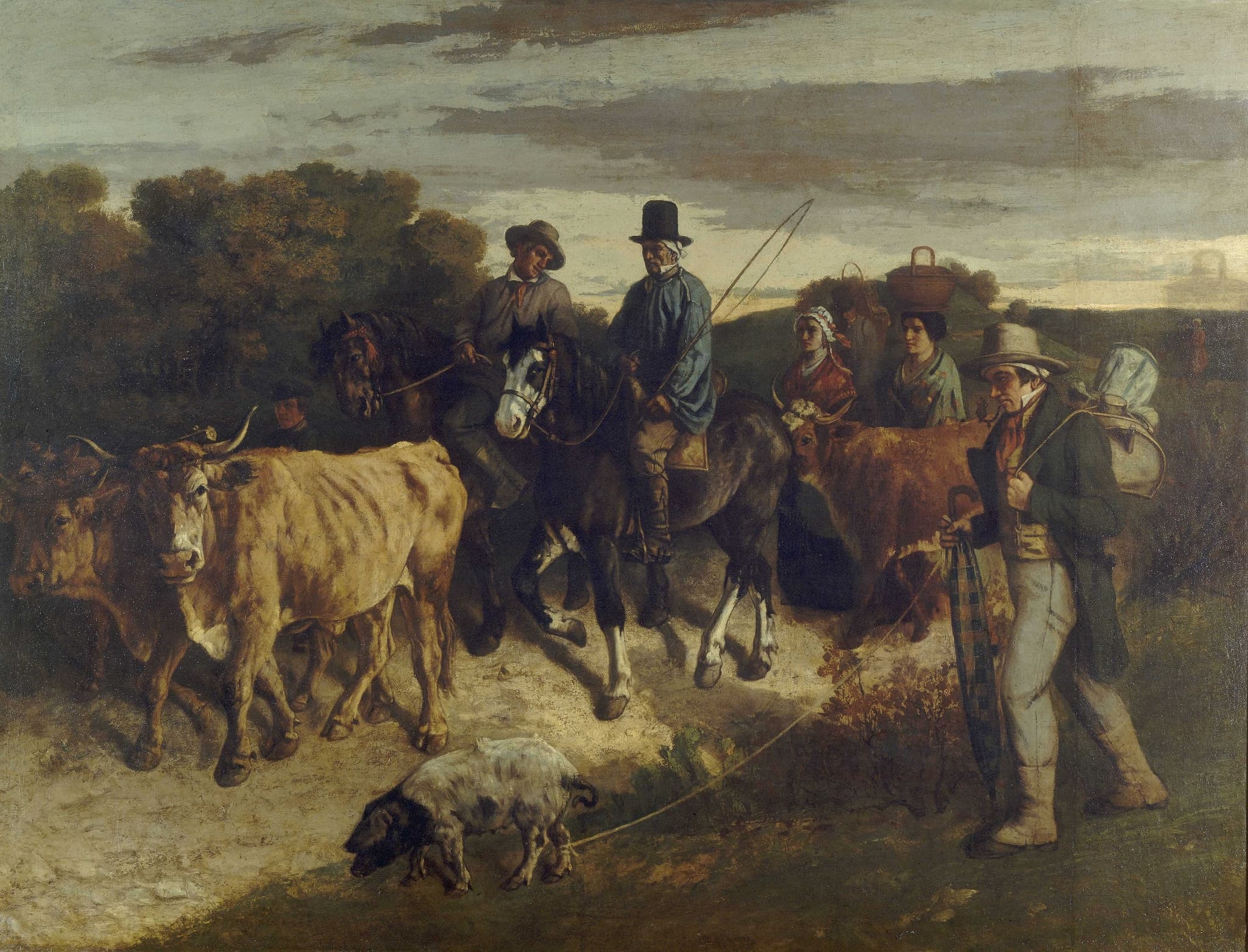
The Peasants of Flagey Returning from the Fair
Gustave Courbet • Oil on canvas
View more by Gustave Courbet →Valuation Analysis
Object and status: Les Paysans de Flagey (1850), oil on canvas, 206 × 275 cm, is held by the Musée d'Orsay and carries a continuous, well‑documented provenance and catalogue‑raisonné references — see the Musée d'Orsay object entry for basic documentation and provenance summary [1]. Because it is in France’s national collection the work has never appeared in the modern market; any price given here is therefore a hypothetical market valuation assuming legitimate sale or deaccession.
Method and comparables: This estimate uses a comparable‑analysis approach: I reviewed Courbet auction performance (including the artist’s auction high and representative recent results), adjusted for scale, provenance, exhibition history and rarity. The artist’s public auction record (Femme nue couchée, Christie’s, 2015) sets an empirical ceiling for single‑owner, trophy Courbets in recent market history [2]. Mid‑market Courbets and high‑quality examples that have changed hands in the last few seasons provide lower anchors; these comparables show an active band in the mid‑six‑figure to low‑seven‑figure range for many works and multi‑million results for the rare, museum‑quality examples [3].
Rationale for the USD 8–18M band: The painting’s very large format (206 × 275 cm), early date and inclusion in museum and catalogued literature materially increase its theoretical value relative to ordinary Courbet genre scenes. Large canvases by Courbet are scarce and attract institutional collectors and foundations; consistent gallery provenance (Durand‑Ruel, Bernheim‑Jeune, Kojiro Matsukata) further reduces attribution/provenance risk and supports a premium. Against those positives, the market ceiling is constrained by the artist’s known auction record and by the general market dynamics for 19th‑century Realism: exceptional works can reach into the low‑to‑mid double‑millions, but prices above the artist’s established record are possible only under exceptional competitive circumstances. The USD 8–18M range therefore reflects a reasoned midpoint between a conservative market expectation for a museum‑quality Courbet and the ceiling implied by past trophy sales.
Key caveats: The painting’s museum ownership, national deaccession rules and any wartime provenance complexities (Matsukata sequestration history) materially affect marketability; these legal and practical constraints would likely limit any sale options and could reduce realized price or complicate disposal. Condition and conserved state (backing, prior restorations) are unknown from here; a formal condition report could move the estimate significantly. Finally, institutional or diplomatic contexts — if the painting were transferred via state channels rather than a normal market sale — would change price mechanics.
Recommended next steps: If a formal market or insurance valuation is required, obtain high‑resolution recto/verso images, an up‑to‑date conservation report, and a formal appraisal from a major house (Christie’s/Sotheby’s) or independent 19th‑century specialist; consult the Institut Gustave Courbet for catalogue‑raisonné confirmation. These steps will allow conversion of this hypothetical range into a defensible, actionable estimate.
Key Valuation Factors
Art Historical Significance
High ImpactLes Paysans de Flagey is an early large‑scale Courbet peasant scene that exemplifies his realist program and regional subject matter. Large, early works that are included in standard scholarship and museum collections carry a premium because they are demonstrably part of the critical narrative that underpins the artist’s market. The painting’s catalogue‑raisonné and exhibition citations increase buyer confidence and institutional interest, making it more likely to attract competitive bidding from museums, foundations or blue‑chip private collectors. This historiographical weight is a primary driver of value for Courbet works and justifies a substantial uplift compared with unprovenanced studio pieces.
Provenance & Exhibition History
High ImpactThe documented ownership chain (notably early Durand‑Ruel representation, collection of Auguste Dreyfus, Bernheim‑Jeune and acquisition history involving Kojiro Matsukata before acceptance by the French state) materially reduces provenance risk. Well‑documented dealership provenance and presence in museum/public catalogues are money‑multipliers at auction because they lower attribution dispute risk and increase institutional confidence. Exhibition history and catalogue illustrations further increase market desirability by providing comparators and bibliographic anchors that underwriters, buyers and curators rely on when valuing or acquiring major 19th‑century works.
Size & Quality
High ImpactAt 206 × 275 cm this is a very large Courbet canvas; size frequently creates a scarcity premium because monumental works by the artist are uncommon and have greater visual presence for museums and public collections. Large format also increases perceived importance and typically commands a higher price multiple than small studies or sketches. Quality — judged by composition, handling and paintcraft — must be confirmed in person, but the combination of scale and museum acceptance implies a high execution standard and corresponding market uplift compared with routine genre pictures.
Market Liquidity & Comparables
Medium ImpactCourbet is a market‑established artist: typical auction outcomes are mid‑five to mid‑six figures, with exceptional canvases reaching into the low to mid millions. The artist’s auction record (c. $15.3M) provides an empirical ceiling for trophy sales; recent high‑quality lots show that institutional quality works can trigger multi‑million results. Liquidity for very large single‑owner museum‑quality works is limited — there are few buyers with both the appetite and budget — which can compress or expand realized prices depending on competitive interest and timing relative to institutional programming.
Legal & Ownership Constraints
High ImpactThe painting is part of the French national collection; deaccessioning a nationally held piece involves strict legal, ethical and political constraints. Wartime sequestration history (Matsukata) creates potential provenance complexities and additional due diligence needs. These ownership and legal factors are decisive: even if the painting is intrinsically worth more, practical marketability is sharply curtailed unless the work is legitimately exportable or sold under exceptional state processes. Such constraints both reduce the likelihood of sale and introduce execution risk that affects price realization.
Sale History
The Peasants of Flagey Returning from the Fair has never been sold at public auction.
Gustave Courbet's Market
Gustave Courbet is a major 19th‑century realist whose best works command institutional interest and strong prices. The auction record sits in the mid‑double‑millions (c. $15.3M, 2015) and the bulk of Courbet material trades in the mid‑five to mid‑six figures. Market performance is driven by subject (large history or striking figure/nude works fetch premiums), provenance and catalogue‑raisonné status. Institutional programming and scholarly activity periodically lift demand for canonical works; conversely, the market is relatively mature and less speculative than contemporary segments, so price appreciation is steady but dependent on scarcity and provenance.
Current Market Trends
The mid‑2020s market for 19th‑century Realism is mature: top‑end trophy works are infrequent and the ultra‑high tier has been static since mid‑decade, while well‑provenanced museum‑quality pieces remain desirable. Institutional retrospectives and high‑profile loans in 2025–26 have increased visibility for Courbet, supporting demand for strong examples. Liquidity is selective; timing around exhibition windows can materially influence realized prices.