How Much Is Portrait of Christina of Denmark Worth?
Last updated: May 8, 2026
Quick Facts
- Methodology
- extrapolation
The canonical 1538 autograph Portrait of Christina of Denmark (National Gallery NG2475) is museum‑held and effectively off‑market; a hypothetical market range if it ever appeared is USD 10–40 million, depending on attribution certainty, condition, and buyer competition. Workshop or later copies typically command far lower sums (mid‑five figures to low‑seven figures).
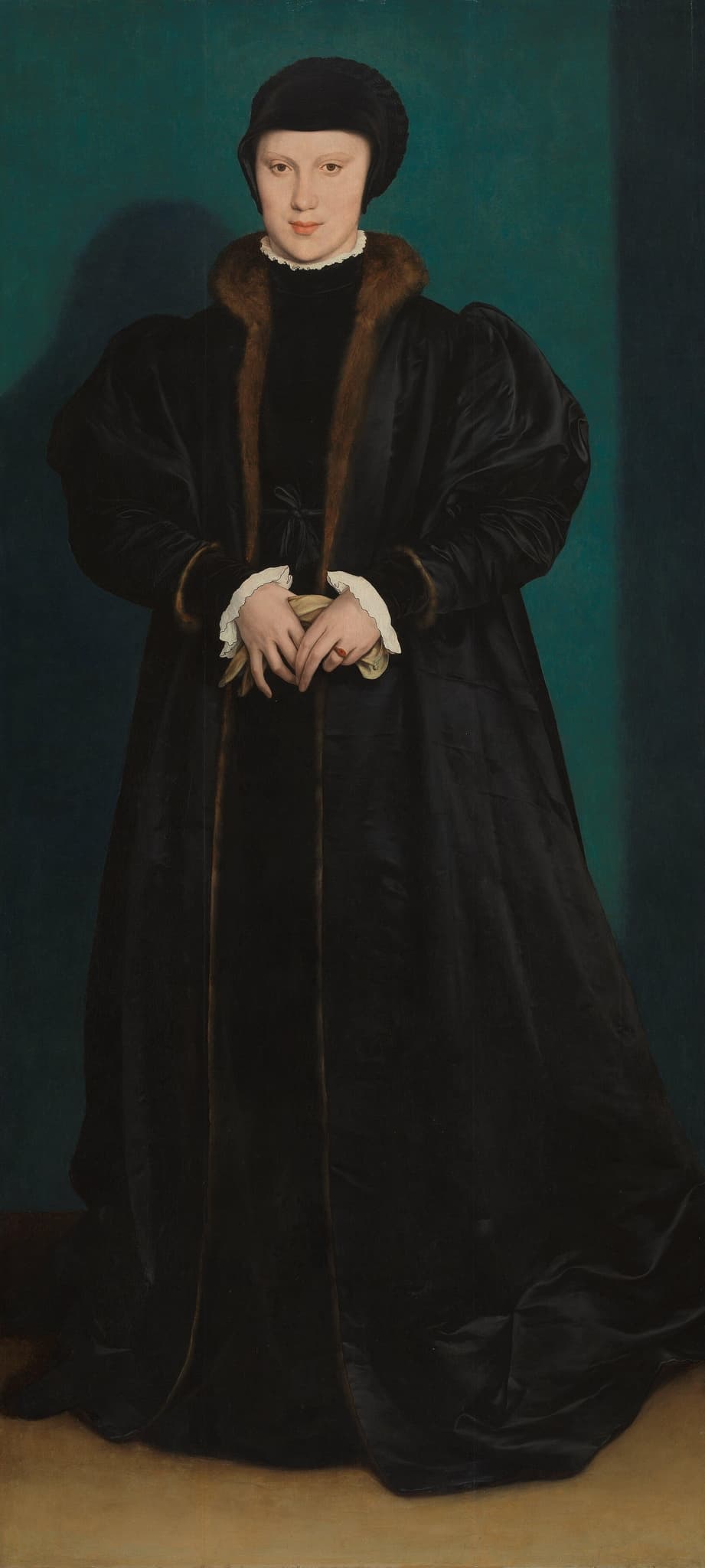
Portrait of Christina of Denmark
Hans Holbein the Younger, 1538 • Oil and tempera on oak
View more by Hans Holbein the Younger →Valuation Analysis
Bottom line: The autograph 1538 Portrait of Christina of Denmark by Hans Holbein the Younger is part of an institutional/royal holding and is effectively not salable in normal market channels; if it were to appear on the open market a reasoned hypothetical range for a secure, exhibition‑quality autograph is approximately USD 10,000,000–40,000,000. The lower–upper band reflects variable buyer competition, condition, and degree of scholarly consensus.
The primary factual anchor is that the canonical Christina portrait is in the National Gallery (NG2475) and has not been offered in the modern auction market [1]. Public auction evidence for securely attributed Holbein oils is very thin; the clearest recent public benchmark is Christie's December 2022 sale of a Holbein‑attributed portrait of Erasmus (a verifiable public result of ≈ GBP 1.12M / ~USD 1.37M), which demonstrates a conservative transparent auction reference point but does not capture private, institutional ceilings [2]. Reported private treaty acquisitions of major Holbeins suggest that private‑sale ceilings can be an order of magnitude higher, though such reports should be treated cautiously.
The USD 10–40M hypothetical interval is an extrapolation built from three forces: (1) extreme rarity of autograph Holbein portraits on the market (scarcity premium); (2) the Christina portrait's high art‑historical significance and Tudor diplomatic provenance; and (3) precedent of strong private/institutional willingness to pay materially above modest public auction tallies for trophy Old Masters. A firmly authenticated, well‑conserved Holbein portrait that can be exhibited and published will command a premium toward the top of the band; any remaining doubts about autograph status, compromised condition or incomplete provenance would push realized value toward the lower end or below.
For non‑autograph objects (workshop variants, later copies, followers) realistic market values fall sharply: well‑executed workshop pieces commonly trade in the mid‑five‑figure to low‑seven‑figure range depending on condition and documented hand involvement; crude later copies are priced in the thousands to low tens of thousands. Practical next steps for any owner seeking to refine this estimate are clear: obtain high‑resolution photography, IRR/UV/X‑ray imaging, dendrochronology (if panel), pigment/binder analysis, and a conservator’s condition report; then seek formal opinions from Holbein specialists and pre‑sale estimates from major Old Masters departments.
Conclusion: Treat the USD 10–40M figure as a well‑reasoned hypothetical ceiling for a canonical, museum‑quality, undisputed autograph Christina — realistic only under exceptional market circumstances and institutional/private bidder competition. For workshop or later copies expect values to be orders of magnitude lower. For provenance, technical data and images I can prepare a tighter, evidence‑based valuation and a recommended market route (auction vs private treaty).
Key Valuation Factors
Art Historical Significance
High ImpactHolbein’s 1538 portrait of Christina of Denmark is one of the most widely recognized Tudor‑court images; its diplomatic context (a bridal portrait made during Henry VIII’s marriage negotiations) and the anecdotal notoriety of Christina’s reply give the work disproportionate cultural resonance. That historical importance elevates institutional demand: museums prioritize such works for permanent collections and exhibitions. Because the strongest Holbeins are already in public collections, any autograph Christina would carry a trophy‑level institutional and private premium. In market terms, historical prominence translates into higher willingness to pay and a greater chance of inter‑institutional interest and long holding periods, which supports a multi‑million dollar valuation.
Attribution / Authenticity
High ImpactWhether a given picture is indisputably autograph Holbein is the single most decisive driver of price. Secure attribution requires confluence of stylistic connoisseurship and technical evidence (infrared reflectography, X‑ray, microscopic paint analysis, dendrochronology if panel). A confirmed autograph status can lift value exponentially relative to a workshop or follower label. Conversely, any lingering doubts depress marketability and reduce the buyer pool to dealers and lower‑tier collectors. Auction houses and museums pay premiums only when scholarly consensus and technical data firmly support an autograph designation, so attribution risk maps directly to valuation uncertainty.
Provenance / Ownership
High ImpactProvenance for the canonical Christina portrait ties to high‑status Tudor and aristocratic collections and eventual public acquisition; such an unbroken, well‑documented chain materially supports both attribution and insurance/risk assumptions. Works with clear royal or notable collection provenance are easier to sell to institutions and command higher prices. By contrast, gaps, undocumented ownership or suspect restitutions complicate export and sale (national treasure rules, export licenses) and can deter bidders or reduce prices. Provenance clarity therefore strengthens a high‑value outcome; murky records do the opposite.
Condition, Technical State and Exhibition History
Medium ImpactCondition and conservation are vital. A painting with original ground and paint, minimal invasive restoration, stable panel support and strong legibility will attract institutional and collector interest; heavy overpainting, structural instability or extensive later retouching reduce value and may trigger attribution doubts. Proven technical reports, a high‑quality conservation history, and a track record of lending/exhibition and scholarly citation all add measurable premium by lowering buyer risk and increasing exhibition utility. Thus, condition and documentation are medium‑to‑high impact levers on final price.
Sale History
Portrait of Christina of Denmark has never been sold at public auction.
Hans Holbein the Younger's Market
Hans Holbein the Younger is one of the pre‑eminent Northern Renaissance portraitists and a central figure in Tudor court imagery. Market dynamics are dominated by extreme scarcity of securely attributed autograph oils—many of the best examples are in national or royal collections—so public auction frequency is low and realized prices are episodic. When high‑quality Holbeins do appear they attract substantial institutional and high‑net‑worth interest, but the public auction record remains modest compared with top Italian Renaissance names. The market rewards secure attribution, strong provenance, and exhibition potential.
Comparable Sales
Portrait of Desiderius Erasmus
Hans Holbein the Younger (and workshop)
Same artist and period; small panel portrait and one of the very few Holbein-attributed oils to reach the open market. Widely reported as the recent public auction benchmark/world auction record for Holbein, so directly relevant as the clearest public-price comparator for a secure Holbein portrait.
$1.4M
2022, Christie's, London (Old Masters Evening Sale)
~$1.5M adjusted
Portrait of Sir Thomas Wyatt the Younger (Follower of Holbein)
Follower of Hans Holbein the Younger
Follower/workshop portrait in the Tudor-portrait genre; shows typical realised prices for strong workshop or follower Holbein portraits and is therefore instructive for valuing copies/less-certain attributions of the Christina composition.
$446K
2024, London day sale (reported; follower/workshop lot)
~$455K adjusted
Meyer/Darmstadt Madonna (reported private sale)
Hans Holbein the Younger
Widely reported private treaty acquisition of a major Holbein composition; not an open-market auction precedent but indicative of private/institutional willingness to pay high sums for top-tier Holbeins. Use cautiously — unverified and materially different in scale/subject (devotional altarpiece vs single portrait).
$40.0M
2011, Reported private acquisition into the Würth circle (press reports, 2011)
~$52.0M adjusted
Current Market Trends
The Old Masters market is currently niche and supply‑constrained: institutional holdings and episodic private treaties dominate top‑end activity. Recent Holbein interest has been episodically stimulated by exhibitions and rediscoveries, but overall liquidity for autograph Holbeins remains low. Workshop and follower works trade more frequently at mid‑five to low‑seven figures; genuine autograph pieces, when available, can command substantially higher private treaty prices than public auction records suggest.
Sources
- National Gallery, London — Hans Holbein the Younger: Portrait of Christina of Denmark (NG2475)
- Christie's press release / sale report — Old Masters Evening Sale, 9 Dec 2022 (Portrait of Desiderius Erasmus)
- Royal Collection Trust — Holbein material and workshop variants (catalogue/PDF references)
- MutualArt — Artist page and auction aggregations for Hans Holbein the Younger