How Much Is Portrait of the Merchant Georg Giese (The Merchant Georg Gisze) Worth?
Last updated: May 8, 2026
Quick Facts
- Methodology
- comparable analysis
If legitimately marketable, the Gemäldegalerie’s Portrait of the Merchant Georg Giese (Hans Holbein the Younger, 1532) would likely sell in the range USD 30,000,000–100,000,000. This is an indicative, low‑confidence band: the work is museum‑held, has not appeared at modern auction, and the final price would be driven by deaccessionability, condition, attribution confirmation and whether institutions compete.
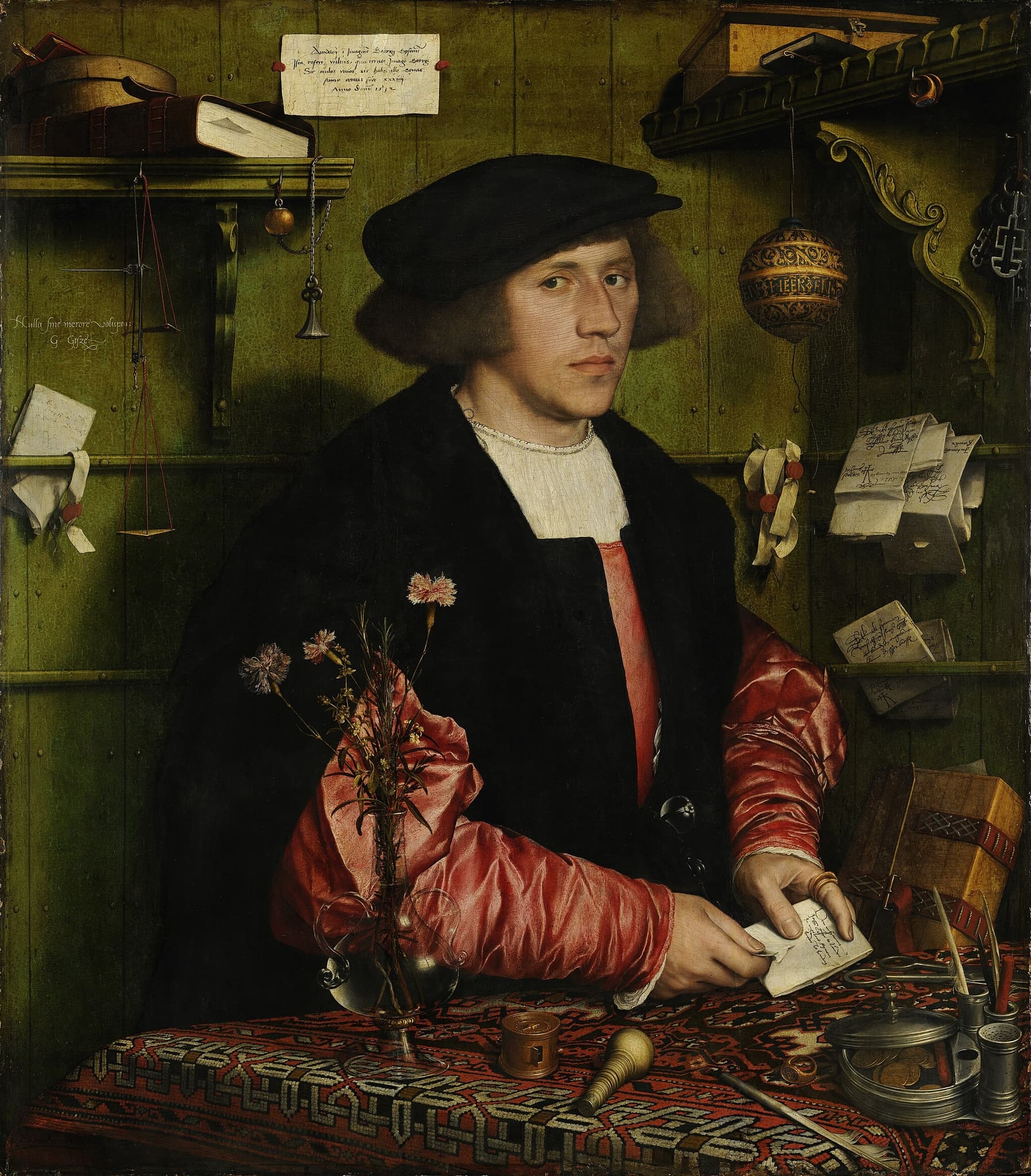
Portrait of the Merchant Georg Giese (The Merchant Georg Gisze)
Hans Holbein the Younger, 1532 • Oil and tempera on oak
View more by Hans Holbein the Younger →Valuation Analysis
Valuation conclusion: Based on scarcity, art‑historical importance and trophy‑market precedents, the authenticated Portrait of Georg Giese (1532) is assessed at approximately USD 30,000,000–100,000,000 if it were to come to a transparent market. The band is deliberately broad because the work is held by the Gemäldegalerie (Staatliche Museen zu Berlin) and has no modern auction history; legal and practical barriers to sale materially widen pricing uncertainty [1].
Methodology: This estimate is a comparative‑analysis synthesis. Direct public auction comparables for autograph Holbein oil panels are essentially absent; consequently the band is informed by (a) reported private/treaty Holbein transactions (the closest direct Holbein benchmark), (b) high‑end public auction results for museum‑quality Renaissance portraits that establish trophy‑market ceilings (for example the Botticelli portrait sold at Sotheby’s), and (c) the observable gulf between workshop/attributed Holbeins at public sale and undisputed autograph panels held by institutions [2]. I weighted Holbein‑specific precedents most heavily, and cross‑checked against recent top Old Master trophy sales to set an upper scenario.
Value drivers and directional logic: The lower bound (≈USD 30M) reflects a conservative outcome where deaccession constraints, export controls and a limited buyer pool (national museums or a single private buyer) cap competitive bidding despite the work’s importance. The mid/high end (approaching USD 100M) is a reachable outcome only if: the museum were willing and able to sell; export permits allowed international bidding; the panel is in excellent condition with secure attribution; and multiple deep‑pocket institutions or private collectors entered a contest for the work, as has happened for other trophy Old Masters. The existence of a reported high‑seven/low‑eight‑figure private Holbein benchmark supports the mid‑range; cross‑artist nine‑figure trophy sales demonstrate the theoretical upper bound.
Caveats and next steps: This estimate is conditional and low‑confidence. Key unknowns that could move value by tens of millions are: (1) deaccession/export legality and political will; (2) a full conservation/condition report including dendrochronology and technical imaging; (3) any latent attribution disputes or provenance gaps; and (4) the competitive set of potential buyers (domestic government, museum consortium, or private collector). To refine this opinion to high confidence: obtain the museum’s deaccession/export status, a full conservation/technical dossier, and confidential market feedback from major Old Master specialists at Christie’s/Sotheby’s/Bonhams. If you want, I can compile those documents and draft a formal request to an auction‑house specialist.
Key Valuation Factors
Art Historical Significance
High ImpactThe Portrait of Georg Giese is a canonical Holbein work that documents the international mercantile class and exemplifies Holbein’s precise portrait technique, iconography and material culture detail. It is frequently reproduced in scholarship and exhibition literature and is recognized as a major example of Northern Renaissance civic/merchant portraiture. While not the single most universally iconic Holbein composition (e.g., The Ambassadors or major Tudor court portraits), its scholarship value, didactic use and visual recognizability make it a major work in his oeuvre. That status elevates collector and institutional interest and underpins a substantial rarity premium if the panel were saleable.
Rarity and Market Supply
High ImpactAutograph Holbein oil panels of museum quality almost never reach the open market; most are held in major national and royal collections. This extreme supply constraint creates a volatility/illiquidity premium: when an undisputed masterpiece does appear, demand among institutions and ultra‑high‑net‑worth collectors can push prices well above typical Old Master levels. The rarity factor therefore exerts strong upward pressure on valuation, but it also creates a practical ceiling because many collector types (national museums) will resist export or deaccession, limiting buyer competition and making outcomes highly case‑specific.
Provenance and Museum Ownership
High ImpactThe painting’s permanent presence in the Gemäldegalerie (a German state museum) is a double‑edged market factor. Secure institutional provenance and long‑standing public custodianship enhance scholarly attribution and market credibility, which supports a higher valuation if sale is permitted. Conversely, state ownership triggers legal protections, likely export restrictions and extremely strict deaccession policies—any transaction would be complex, politically sensitive and possibly blocked. These constraints materially reduce the number of eligible bidders and introduce transactional friction that suppresses open‑market competition unless a national purchaser steps in.
Condition and Technical Attribution
High ImpactCondition, conservation history and technical‑scientific verification (dendrochronology of the oak panel, infrared reflectography, x‑radiography, pigment analysis) are decisive. A pristine, well‑documented panel with unambiguous autograph attribution supports top‑end pricing; conversely, significant restoration, later overpainting or any unresolved attribution issues would reduce marketability and value, potentially by tens of millions. A contemporary and transparent conservation report is therefore essential to finalize any firm market figure and to present confidently to institutional buyers or auction houses.
Comparables and Institutional Demand
High ImpactDirect public‑sale comparables for autograph Holbein panels are lacking, so valuation relies on (a) reported private/treaty Holbein sales at high seven/low eight figures and (b) trophy sales of other Renaissance masterpieces (examples reaching high eight to nine figures). The gulf between small workshop Holbeins that sell for low millions and undisputed museum masterpieces is large; institutions have demonstrated willingness to spend extraordinary sums for national‑icon Old Masters. The presence or absence of institutional bidders (national museums, state purchases) will therefore swing the outcome dramatically toward the upper or lower part of the estimate range.
Sale History
Portrait of the Merchant Georg Giese (The Merchant Georg Gisze) has never been sold at public auction.
Hans Holbein the Younger's Market
Hans Holbein the Younger is a top‑tier Northern Renaissance master whose autograph oil paintings are exceptionally scarce on the market. Most of his major works are retained in national and royal collections, and when Holbein material does appear publicly it is frequently drawings or workshop/attributed pieces rather than undisputed autograph panels. The scarcity of primary Holbein panels, combined with strong institutional and scholarly interest, means that authenticated museum‑quality Holbeins command significant premiums in confidential treaty sales or when institutions intervene; however, transparent auction comparables are few and prices are therefore driven by isolated trophy outcomes and private negotiations.
Comparable Sales
Portrait of a Young Man Holding a Roundel
Sandro Botticelli
Museum‑quality Italian Renaissance portrait sold as a trophy example; a cross‑artist benchmark for top‑end prices for rare, museum‑quality Renaissance portraits at public auction.
$92.2M
2021, Sotheby's New York
~$103.3M adjusted
The Standard Bearer
Rembrandt van Rijn
High‑profile institutional purchase of a national‑icon Old Master establishing an upper bound for what institutions/governments will pay for uniquely important works.
$197.8M
2022, Dutch State / Rijksmuseum (reported purchase)
~$217.5M adjusted
Darmstadt Madonna (Meyer Madonna)
Hans Holbein the Younger
Reported private/treaty sale of a major Holbein work and the closest direct Holbein market benchmark available in modern times.
$70.0M
2011, Private/treaty sale (reported; Germany, 2011)
~$94.5M adjusted
Portrait of Erasmus (small portrait) — Hans Holbein the Younger and workshop
Hans Holbein the Younger (and workshop)
Public auction result for a small‑format Holbein/workshop portrait; demonstrates the sharp value gap between workshop/attributed Holbein material and autograph masterpieces.
$1.4M
2022, Christie's London (Old Masters sale)
~$1.5M adjusted
The Return of the Bucintoro (Venice) — record Canaletto sale
Canaletto (Giovanni Antonio Canal)
Recent high‑end Old Master auction result (July 2025) illustrating contemporary market appetite for trophy Old Masters; useful as a contemporaneous sector indicator.
$43.9M
2025, Christie's London
Current Market Trends
The contemporary Old Masters market is bifurcated: exceptionally rare, museum‑quality masterpieces continue to attract strong demand and record prices, while mid‑ and lower‑tier works show uneven performance. Recent years have produced headline trophy purchases and auctions that illustrate institutional appetite for national‑icon works, but Holbein remains supply‑constrained—only isolated private/treaty transactions and cross‑artist trophy sales provide pricing guidance. This two‑speed environment amplifies both upside (competitive bidding for singular works) and downside (limited buyer pool and regulatory friction).
Sources
- Gemäldegalerie (Staatliche Museen zu Berlin) — Favourite pieces: The Merchant Georg Gisze
- Sotheby’s press — Sandro Botticelli: Portrait of a Young Man Holding a Roundel (sale context for trophy Renaissance portrait pricing)
- The Art Newspaper — Dutch government agrees to buy Rembrandt painting for €175m (context for institutional trophy purchases)
- Press/market reporting on reported private Holbein transactions and workshop sale performance (representative market context)