How Much Is Fight Between a Tiger and a Buffalo (Combat de tigre et de buffle) Worth?
Last updated: March 30, 2026
Quick Facts
- Methodology
- comparable analysis
Based on its large scale, direct provenance (Vollard → Quinn → Pierre Matisse → Cleveland Museum of Art), exhibition history and the Rousseau market anchor set by Christie’s 2023 sale, Fight Between a Tiger and a Buffalo (1908) would most plausibly realize in the range of $10,000,000–$45,000,000 at a major‑house public sale. The high end assumes pristine condition, catalogue‑raisonné confirmation and a marquee evening sale; condition, attribution or deaccession constraints would materially reduce that outcome.
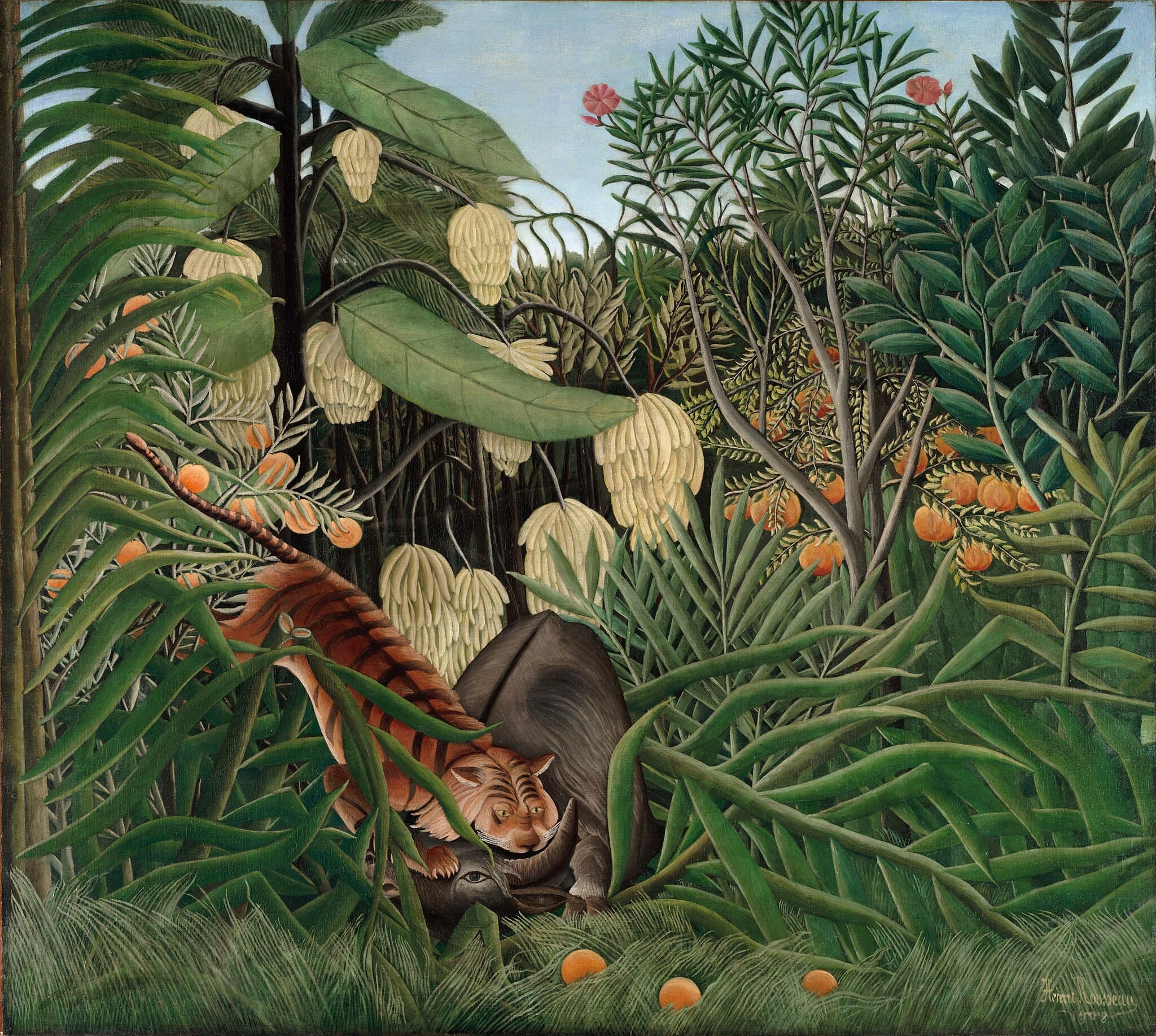
Fight Between a Tiger and a Buffalo (Combat de tigre et de buffle)
Henri Rousseau, 1908 • Oil on canvas
View more by Henri Rousseau →Valuation Analysis
Suggested market range: I estimate that Henri Rousseau’s Fight Between a Tiger and a Buffalo (1908) would most plausibly realize between $10,000,000 and $45,000,000 if offered at a leading auction house under ideal selling circumstances (clear catalogue‑raisonné entry, excellent condition and guaranteed/underwritten placement). This range is rooted in the painting’s scale and provenance and is anchored by the artist’s recent top‑market benchmark in 2023 [2].
Object and provenance considerations: The Cleveland Museum of Art records the work as an unframed 170 × 189.5 cm oil on canvas and documents a strong, continuous provenance: bought from the artist by Ambroise Vollard (1909), later in the collections of John Quinn and Mrs. John Alden Carpenter, passed through Pierre Matisse Gallery (1948) and acquired by Cleveland in 1949 (Hanna Fund) [1]. That chain, together with exhibition history beginning at the Salon des Indépendants (1908) and subsequent inclusions in Rousseau monographs and retrospectives, places the work squarely within the artist’s canonical late “jungle” production and materially supports a top‑tier valuation if the museum were to release it.
Market comparables and scarcity: Christie’s May 11, 2023 sale of Les Flamants (1910) for $43.535M reset the market ceiling for Rousseau and demonstrates that exceptionally rare, museum‑quality jungle canvases can command tens of millions of dollars [2]. Combat de tigre et de buffle is large, well‑provenanced and arguably of comparable institutional importance, so its upside is tied to that precedent. That said, Les Flamants was an extraordinary outlier: not every major Rousseau will reach that exact level. The practical expectation is therefore a lower bound reflecting established mid‑market comparables (low‑to‑mid eight figures) and an upper bound capped by the 2023 trophy sale (high tens of millions).
Caveats and recommended next steps: This estimate assumes no unresolved attribution, no major restorative intervention, and clear deaccession/ownership/licensing to allow public sale. Condition reports, technical imaging, and an explicit catalogue‑raisonné entry are essential to support the high end; conversely, structural damage, overpainting, or provenance gaps could collapse value to well below the lower bound. Recommended next steps: obtain high‑res images and a conservator’s condition report, secure catalogue‑raisonné confirmation, and request confidential market guidance from major auction departments before any deaccession consultation. Institutional and legal considerations (museum deaccession policy, donor restrictions) will also strongly influence realizable value [1][2][3].
Key Valuation Factors
Art Historical Significance
High ImpactFight Between a Tiger and a Buffalo is a mature example of Rousseau’s late ‘jungle’ repertoire, dated 1908. The subject — a dramatic animal confrontation set within stylized tropical foliage — is emblematic of the themes that established Rousseau’s reputation and later influenced modernist and primitivist discourse. Its exhibition at the Salon des Indépendants and repeated inclusion in Rousseau literature position it as a work of curatorial and scholarly interest rather than a workshop or minor variant. High art‑historical significance translates to strong institutional demand and collector competition, supporting the upper tier of the valuation range.
Provenance & Exhibition History
High ImpactThe painting’s documented chain — sold by the artist to Ambroise Vollard (1909), in the John Quinn collection, represented by Pierre Matisse, and acquired by the Cleveland Museum of Art in 1949 — provides robust provenance that materially improves market confidence. Early dealer ownership (Vollard) and prominent 20th‑century collectors (Quinn, Matisse gallery) substantially reduce attribution risk and attract institutional buyers. Extensive exhibition and bibliographic presence further enhance marketability: works with this level of provenance and literature typically command premiums at auction.
Size & Condition
High ImpactAt approximately 170 × 189.5 cm unframed, this is a large Rousseau oil; such large, intact canvases are scarce on the market. Size itself increases desirability for museums and high‑end collectors, but condition is critical. Museum ownership suggests professional conservation care, which supports top valuations, yet any undisclosed structural issues or major restorations would reduce buyer confidence and price substantially. A professional condition and conservation report (including technical imaging) is therefore necessary to validate the upper bound estimate.
Market Comparables & Scarcity
High ImpactThe 2023 Christie’s sale of Les Flamants for $43.535M established a new ceiling and demonstrated that high‑quality Rousseau jungle canvases can reach the high tens of millions. Because many of Rousseau’s best oils are museum‑held, supply of comparable masterpieces is extremely limited; scarcity supports strong prices when a canonical work appears. However, the 2023 outcome is a marquee outlier—realizable prices depend on auction context, guarantees, and competitive bidding dynamics. For this work, comparables justify a high‑end estimate tied to that benchmark while acknowledging dispersion beneath it.
Sale History
Fight Between a Tiger and a Buffalo (Combat de tigre et de buffle) has never been sold at public auction.
Henri Rousseau's Market
Henri Rousseau is a well‑established market name: his major ‘jungle’ oils are held by leading museums worldwide and are actively sought by collectors of late 19th/early 20th‑century modernism and naïve art. Before 2023, top Rousseau prices traded in the low millions; Christie’s Les Flamants (2023) reset the top end to over $43M, creating a new benchmark for the very best, museum‑quality canvases. The broader Rousseau market remains bifurcated — a small, trophy segment commands exceptional prices while the mid‑market for smaller or less‑documented works continues to trade at substantially lower levels.
Comparable Sales
Les Flamants (The Flamingos)
Henri Rousseau
Major, museum-quality late 'jungle' canvas by Rousseau; same artist, same period and exotic-animal/jungle subject matter; serves as the market high-water mark (anchor) for top-tier Rousseau works.
$43.5M
2023, Christie's New York
~$45.7M adjusted
Historic Rousseau auction benchmark (1993 — title unspecified in cited press)
Henri Rousseau
Represents the pre-2023 market benchmark often quoted for Rousseau; useful to show market step-change after the 2023 top result. Less documentation in the quick research excerpt (title/house not specified).
$4.4M
1993, Historic auction (pre-2023 benchmark cited in Christie’s materials)
~$8.6M adjusted
Press-reported small/medium Rousseau oil (unspecified regional lot)
Henri Rousseau
Example of a mid-market, smaller/typical Rousseau oil offering reported in press (reported €2.6M converted to USD); useful as a lower-bound / mid-market comparator versus trophy works.
$3.0M
2019, Regional European auction (press report)
~$3.5M adjusted
Current Market Trends
The market was re‑anchored by a 2023 trophy sale, but overall activity softened in 2024 and recovered selectively in 2025. Major scholarly exhibitions (e.g., significant Rousseau retrospectives in 2025–26) increase institutional interest and can lift demand for top examples, yet supply of comparable museum‑quality canvases remains extremely limited—supporting trophy prices but leaving mid‑market results variable.
Sources
- Cleveland Museum of Art — Combat de tigre et de buffle (1908), accession 1949.186 (object record, provenance and dimensions)
- Christie’s press release and sale materials — Les Flamants (Henri Rousseau), Christie’s New York, 11 May 2023 (market benchmark)
- Barnes Foundation — Henri Rousseau: A Painter’s Secrets (major 2025–26 exhibition and catalogue boosting institutional interest)