How Much Is The Sleeping Shepherdess Worth?
Last updated: March 7, 2026
Quick Facts
- Last Sale
- $20K (1926, Hôtel Drouot, Paris (John Quinn Estate))
- Methodology
- comparable analysis
This valuation addresses Henri Rousseau’s The Sleeping Gypsy (La Bohémienne endormie, 1897) at MoMA—often mistranslated as “The Sleeping Shepherdess.” Anchored by Rousseau’s 2023 record ($43.5m) and cross-artist trophy benchmarks for singular icons, we estimate a fair-market value of $120–180 million under unrestricted sale conditions. The work’s unique icon status, museum provenance, and extreme scarcity warrant a substantial premium over all recorded Rousseau sales.
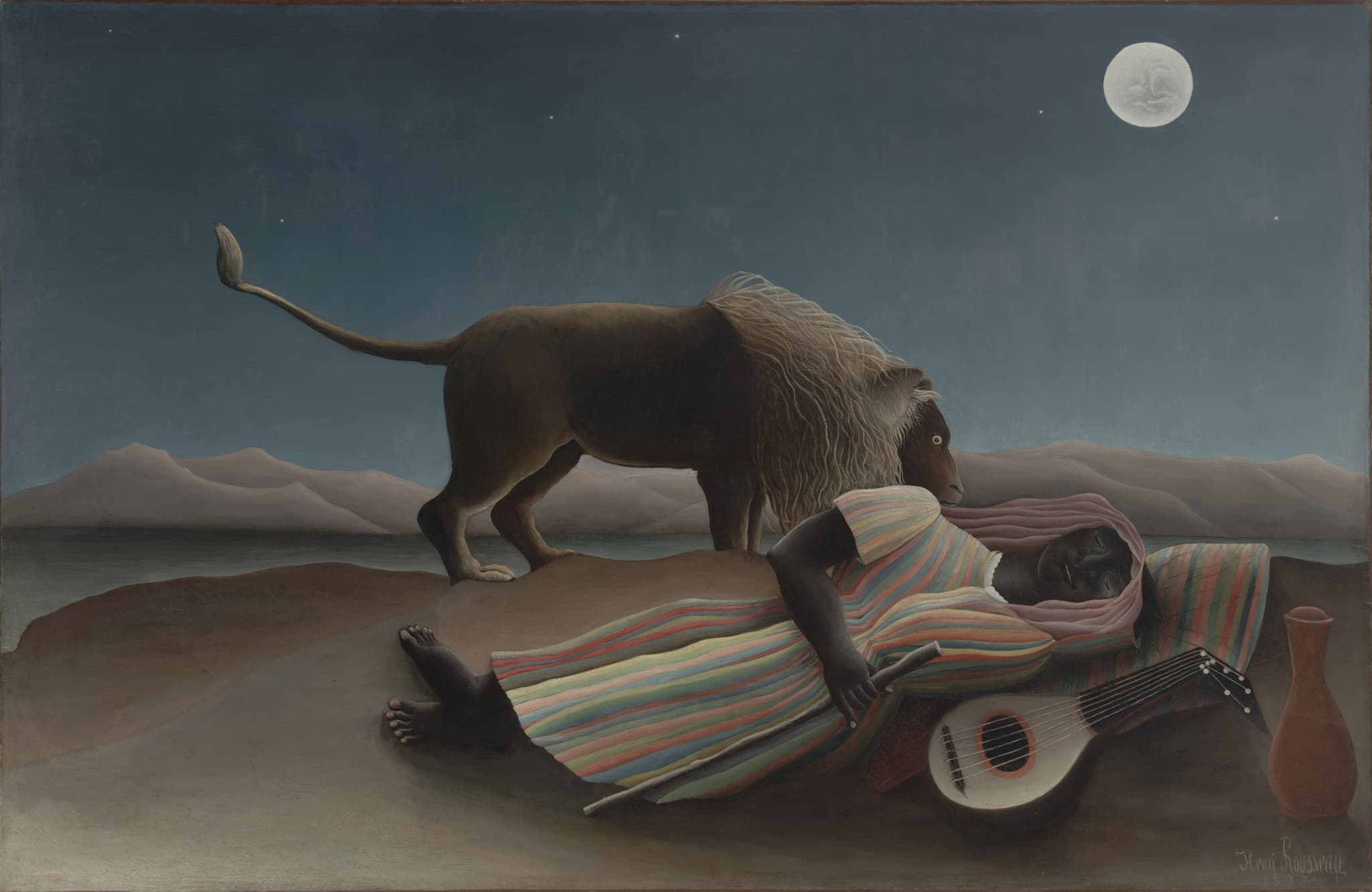
The Sleeping Shepherdess
Henri Rousseau, 1897 • Oil on canvas
Read full analysis of The Sleeping Shepherdess →Valuation Analysis
Work identified: This valuation refers to Henri Rousseau’s The Sleeping Gypsy (La Bohémienne endormie, 1897), the canonical oil on canvas in the collection of The Museum of Modern Art, New York—occasionally mistranslated in the market as “The Sleeping Shepherdess.” MoMA’s record confirms authorship, dimensions, and the painting’s long institutional holding since 1939, along with its early 20th‑century provenance and a single known public auction in 1926 before it entered the museum’s collection [1].
Significance and scarcity: The Sleeping Gypsy is universally regarded as a top‑tier Rousseau masterpiece—one of the artist’s most reproduced and culturally resonant images. Its singular, dreamlike composition sits at the heart of Symbolism/Naïve Modernism and is instantly recognizable far beyond art‑historical circles. Masterpieces of this stature by Rousseau almost never test the market; supply is effectively fixed, with major oils concentrated in museums [1].
Within‑artist anchor: In May 2023, Rousseau’s Les Flamants (The Flamingos) sold for $43,535,000 (with fees) at Christie’s New York, establishing a new artist record and resetting expectations for high‑quality late oils [2]. While an important work, Les Flamants does not carry the same global icon weight or institutional pedigree as The Sleeping Gypsy. The latter’s fame, scale, and museum-grade provenance justify a significant premium above the 2023 record.
Cross‑artist trophy benchmarks: Pricing for singular, globally recognized early‑Modern icons (even when an artist’s normal record sits much lower) routinely extends into nine figures. Edvard Munch’s The Scream (1895 pastel) realized $119.9m at Sotheby’s in 2012—despite being a work on paper—because of its unparalleled cultural ubiquity [3]. Gustav Klimt’s Lady with a Fan achieved $108.4m at Sotheby’s London in 2023, reinforcing the strength of demand for museum-caliber, instantly recognizable images from this era [4]. These comps calibrate the premium collectors pay for icons with near‑zero substitution.
Deriving the estimate: Starting from the Rousseau anchor at $43.5m [2], we apply an “icon premium” reflecting The Sleeping Gypsy’s unique cultural status, outstanding provenance (MoMA since 1939), and extreme supply scarcity. Cross‑artist evidence indicates that such premiums can be multiples of an artist’s standard record when a singular masterpiece emerges. This supports a fair‑market estimate of $120–180 million today, assuming unrestricted, properly marketed sale conditions. Notably, the painting’s only known public auction occurred in 1926 (John Quinn Estate, Hôtel Drouot), reported contemporaneously at c. 500,000 French francs, with no modern auction since [1][6].
Positioning and outlook: The 2025–26 transatlantic exhibitions centered on Rousseau (Barnes Foundation and Musée de l’Orangerie) enhance scholarly and public visibility, a constructive tailwind for top-tier demand [5]. While MoMA deaccessions of icons are extraordinarily rare, the pricing framework above reflects where this picture would likely clear if it ever reached the market: the low‑to‑mid nine figures, in line with peer‑era trophies and materially above Rousseau’s existing auction benchmarks.
Key Valuation Factors
Art Historical Significance
High ImpactThe Sleeping Gypsy is a cornerstone of Rousseau’s oeuvre and of early Modernism, frequently ranked alongside The Dream and Tiger in a Tropical Storm. Its distilled symbolism, nocturne atmosphere, and uncanny stillness make it a paradigmatic image for Naïve/Self‑Taught Modernism and a touchstone in 20th‑century art history. The work’s inclusion in a premier institutional collection (MoMA) for over eight decades has cemented its scholarly profile, bibliography, and exhibition record, elevating it from a ‘great example’ to a canonical masterpiece that sets the standard for the artist’s market.
Iconicity and Cultural Recognition
High ImpactBeyond connoisseur circles, The Sleeping Gypsy is widely known to the general public—an image that appears in textbooks, posters, and popular media. Works with this level of cultural penetration command significant ‘icon premiums’ because demand extends far beyond the narrow set of artist-specific collectors. This same dynamic has propelled other early‑Modern icons into the nine figures. The painting’s instant recognizability and ubiquity make it a magnet for top-tier private buyers, museums, and foundations seeking universally legible trophies.
Provenance and Exhibition History
High ImpactThe painting’s provenance traces from leading early 20th‑century dealers and collectors (including Daniel‑Henry Kahnweiler and John Quinn) to its 1926 Drouot appearance and subsequent 1939 gift to MoMA. Decades of publication and exhibition have produced deep scholarly consensus around the work’s importance and authenticity. This record reduces transaction risk and underwrites confidence at the top end of the market, where vetted, museum‑grade histories can add substantial value relative to comparable works with thinner or more complex chains of ownership.
Rarity and Substitutability
High ImpactAutograph oils by Rousseau are scarce, with many of the defining jungle and dream compositions locked in institutions. Among those, The Sleeping Gypsy occupies an especially rarefied tier: large in scale, emblematic in subject, and the very image many associate with the artist. There is essentially no close substitute available to collectors. In market terms, this ‘zero‑substitute’ situation intensifies bidding for the one object that fully satisfies demand, enabling prices to break far beyond the artist’s normal record parameters when—if ever—such a painting were available.
Sale History
Hôtel Drouot, Paris (John Quinn Estate)
Contemporary reporting cited a hammer around 500,000 French francs (≈$19,900 at late-1926 FX); some sources later cite 800,000 FF (≈$31,800). Purchased by Henri Bing; subsequently via Mme E. Rockstuhl; gifted to MoMA in 1939.
Henri Rousseau's Market
Henri Rousseau’s market is blue‑chip but thinly traded, reflecting extreme supply scarcity and the concentration of prime works in museums. A major reset occurred in May 2023, when Les Flamants (1910) fetched $43.5 million at Christie’s New York, multiplying the artist’s historical ceiling and demonstrating depth for late, ambitious oils. Subsequent offerings have shown selective demand—buyers will pay for best‑in‑class subjects, scale, and provenance, but are discriminating with secondary‑tier material. The pool of privately held, museum‑level jungle compositions is tiny, magnifying the premium for canonical images. Rousseau is collected across categories—from Modernist connoisseurs to trophy‑hunters—supporting strong competition when significant works appear.
Comparable Sales
Les Flamants (The Flamingos)
Henri Rousseau
Same artist; late jungle-period oil with emblematic animal subject and large-format ambition; best recent public price anchor for top-tier Rousseau.
$43.5M
2023, Christie's New York
~$46.3M adjusted
Vase de fleurs à la branche de lierre, première version
Henri Rousseau
Same artist; early-1900s oil; sets a baseline for smaller, non-jungle subjects and underscores the scarcity premium for Rousseau masterpieces.
$1.3M
2022, Sotheby's New York
~$1.4M adjusted
Lady with a Fan (Dame mit Fächer)
Gustav Klimt
Cross-artist trophy benchmark; late, emblematic masterpiece by an early-Modern icon; demonstrates nine-figure demand for singular, museum-grade images.
$108.4M
2023, Sotheby's London
~$115.7M adjusted
The Scream (1895 pastel)
Edvard Munch
Cross-artist, universally iconic image from the same broad early-Modern era; calibrates the pricing of singular, culturally ubiquitous masterpieces.
$119.9M
2012, Sotheby's New York
~$170.0M adjusted
Portrait of Adele Bloch-Bauer I
Gustav Klimt
Cross-artist apex masterpiece with extraordinary cultural recognition and museum destination; illustrates nine-figure pricing for canonical images.
$135.0M
2006, Private sale (Neue Galerie New York)
~$218.0M adjusted
Portrait of Dr. Gachet
Vincent van Gogh
Cross-artist, top-of-oeuvre early-Modern icon with a storied market history; signals depth of demand for universally recognized masterpieces.
$82.5M
1990, Christie's New York
~$205.0M adjusted
Current Market Trends
The broader Impressionist/Post‑Impressionist and early‑Modern segment saw softer auctions in 2024, with high‑end buyers increasingly selective. By late 2025, marquee sales rebounded on the back of top‑quality consignments, reaffirming that masterpiece‑grade works can still unlock robust global demand. In this climate, canonical, museum‑provenanced images outperform, while mid‑tier material can struggle. Major institutional exhibitions and scholarship (notably the 2025–26 Rousseau shows in Philadelphia and Paris) further support demand and narrative strength. For singular icons such as The Sleeping Gypsy, these conditions favor sustained nine‑figure pricing even as the broader category remains quality‑driven.
Study print
Study this painting as a print
Pair the full artwork with a museum-style study sheet focused on one meaningful detail.
Sources
- MoMA Collection Record: Henri Rousseau, The Sleeping Gypsy (1897)
- Christie’s: May 2023 Marquee Week – Sale Results (includes Rousseau’s Les Flamants at $43.5m)
- Sotheby’s: Press release – Edvard Munch, The Scream sells for $119,922,500 (2012)
- BBC News: Klimt’s Lady with a Fan sells for £85.3m ($108.4m), a European auction record (2023)
- Barnes Foundation: Henri Rousseau—A Painter’s Secrets (2025–26 exhibition press release)
- The New Yorker: Janet Flanner, ‘Letter from Paris’ (Nov. 13, 1926) – reporting on the Quinn sale