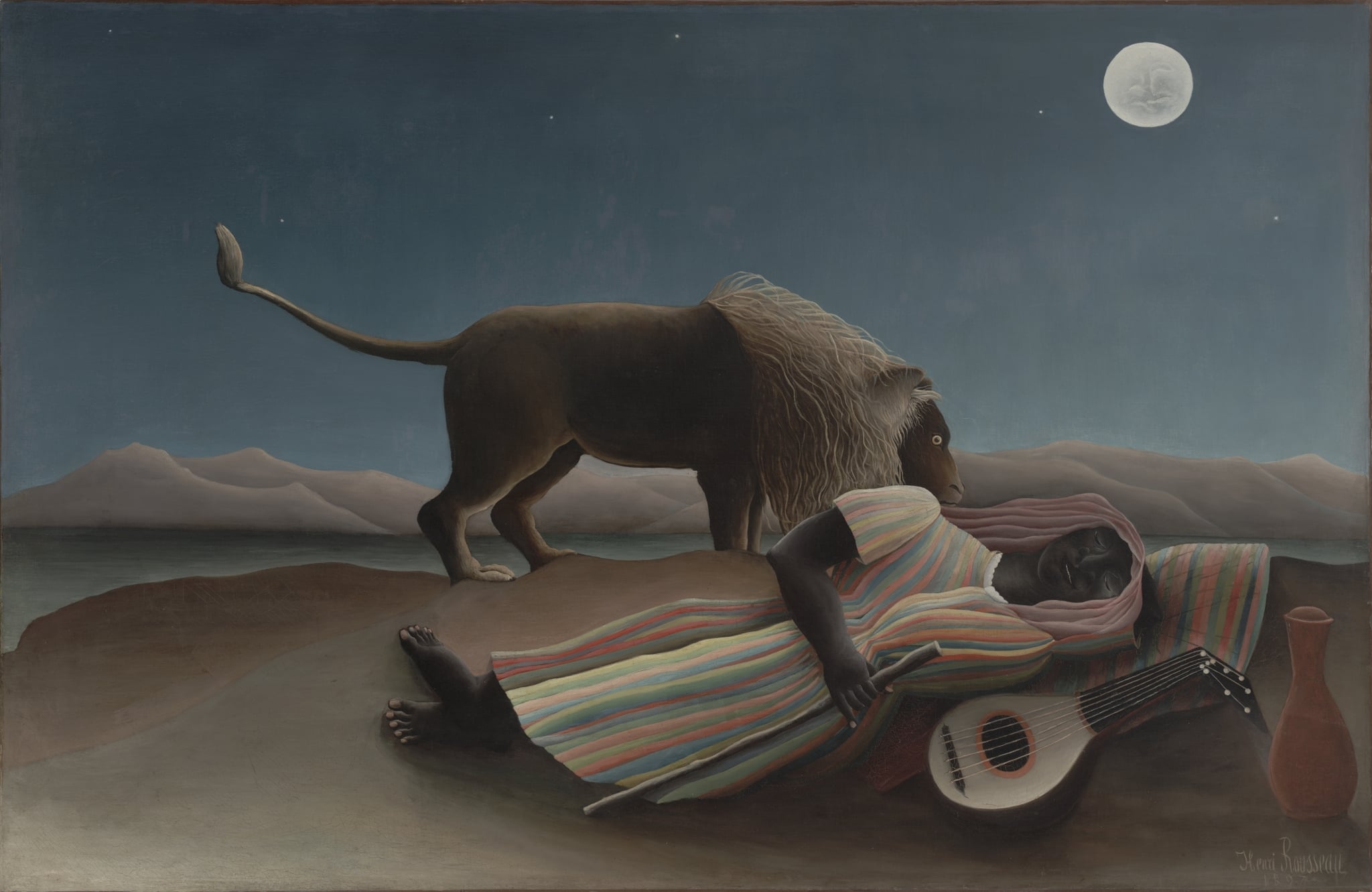
The Sleeping Shepherdess
In The Sleeping Shepherdess, a moonlit desert holds a poised balance between vulnerability and watchful restraint. A striped‑clad traveler sleeps on a matching cushion, a mandolin and water jar at her side, while a lion, paw raised and eye wide, draws close yet does not strike. Rousseau’s flattened forms and echoing stripes create a hypnotic dream logic that turns danger into a guarded calm [1][2].
Study Print Studio
Create a personal study print
Build a companion study sheet around the part of this painting that speaks to you most. Choose a detail, shape an interpretation, and walk away with something personal and display-worthy.
Fast Facts
- Year
- 1897
- Medium
- Oil on canvas
- Dimensions
- 129.5 × 200.7 cm
- Location
- The Museum of Modern Art (MoMA), New York
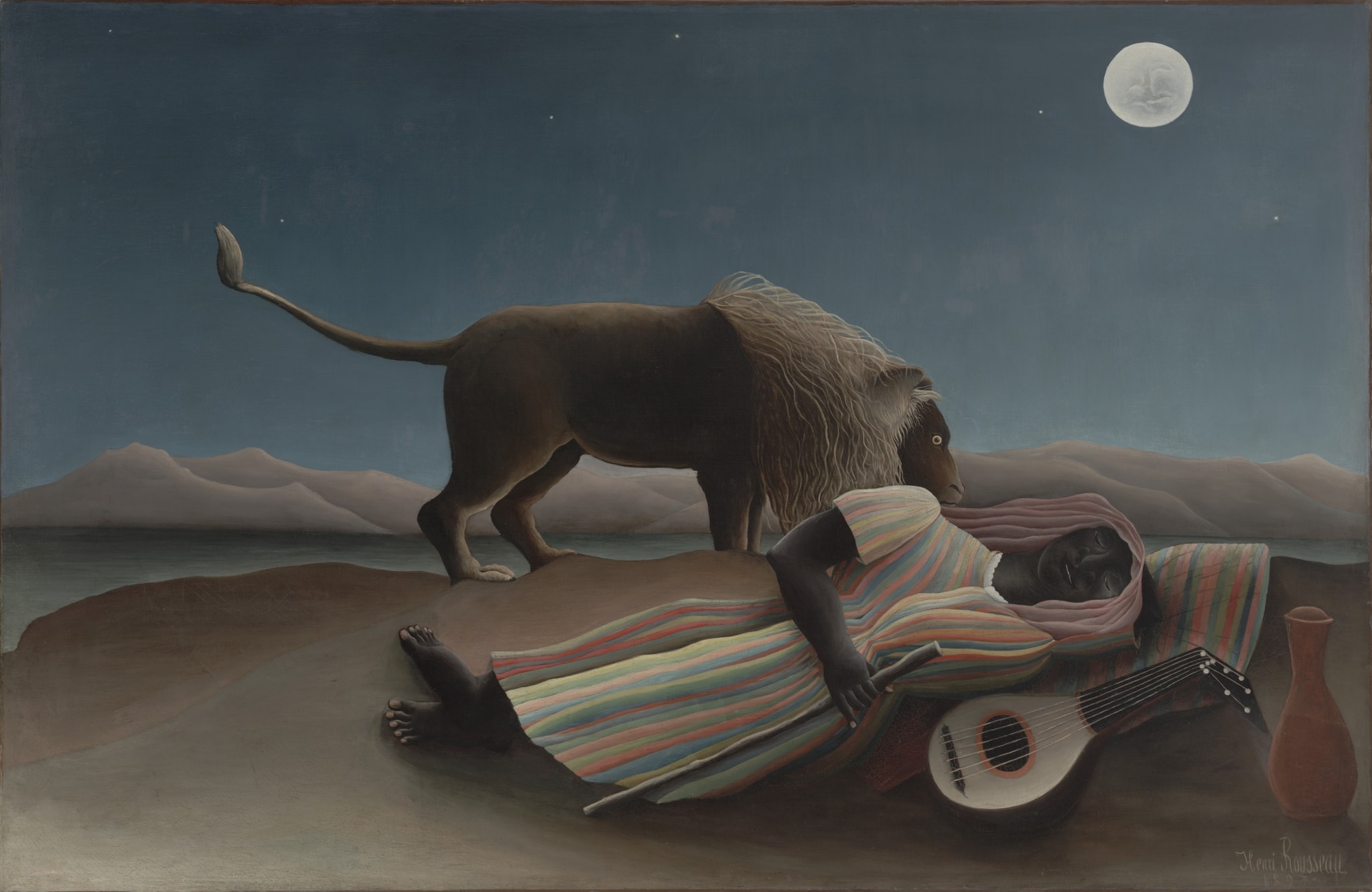
Click on any numbered symbol to learn more about its meaning
Meaning & Symbolism
Rousseau composes The Sleeping Shepherdess as a thesis on containment. The desert is reduced to bands—pale sand, dark water, rose‑gray hills, deep blue sky—so that landscape becomes a set of measured tones. Within this ordered stage, the traveler’s striped dress and cushion repeat the desert’s banding, visually binding culture to nature through pattern. Her body forms a calm diagonal, eyes closed, one hand resting on a pipe, the other near the mandolin. These implements of music and breath stand for art as regulation—meter, scale, pulse. Opposite this hush, the lion advances: tail horizontal, paw lifted mid‑step, nostrils flared. Yet its great, circular eye mirrors the white disk of the moon above, suggesting a celestial supervision that converts appetite into attention. The beast’s mane, rendered as disciplined curls, echoes the instrument’s strings; instinct is literally coiffed to the logic of music. Threat is not denied but suspended, held in a frame of patterned restraint 12.
Rousseau’s facture enforces the argument. He rejects deep perspective for a shallow, stage‑like plane; lines are hard‑edged, shadows minimal, and textures simplified to emblematic clarity. Such exactness—what curators describe as precise contour and crystalline color—replaces narrative action with formal inevitability 1. The result is a world governed less by naturalism than by symbol: the water jar, precariously upright in an arid expanse, signals survival secured by modest means; the mandolin’s immaculate ellipse advertises harmony as an attainable order; the moon, intensely legible, acts as a cool adjudicator rather than a mystical blur. Even the lion’s path is arrested at the boundary where sand meets sleeper, as if the score of the night had reached a rest. Rousseau’s own note that the passerby lion “does not devour” the figure establishes this paradox outright, but the painting clinches it visually through repetitions—the mandolin’s round sound hole rhymes with the moon; the stripes run like musical staves across cloth and cushion; the still water repeats the lion’s back in a low, undulant arc 1.
In this grammar of echoes, the desert becomes an inward landscape. The Shepherdess is not simply unafraid; she is the axis around which the scene’s rhythm coheres. Music, temporarily paused in sleep, still organizes the night: the pipe set along her forearm like a baton, the mandolin angled toward the lion as if offering a chord. This logic of composed tranquility explains why the work resonated with later modernists and Surrealists, who recognized in Rousseau’s naiveté a deliberate strategy for contacting the unconscious without resorting to sensationalism 23. The painting argues that culture’s gentlest tools—song, pattern, measure—can domesticate violent possibility without erasing it. That is why The Sleeping Shepherdess remains urgent: it proposes a politics of form, where careful design converts fear into vigilance, and where the most fragile objects—an instrument, a jar, a pillow—become technologies of peace under a benevolent, all‑seeing moon 12.
Explore Deeper with AI
Ask questions about The Sleeping Shepherdess
Popular questions:
Powered by AI • Get instant insights about this artwork
💬 Ask questions about this artwork!
Interpretations
Historical Context & Reception
Shown at the Salon des Indépendants in 1897, The Sleeping Gypsy appeared when Rousseau—derided as “naïve”—was courting modernist attention. Early critics mocked his flatness, but avant‑garde artists recognized the work’s precise contours and crystalline color as a deliberate alternative to academic finish. The subject—an itinerant musician in an “arid desert” under a “very poetic” moon—offered a portable myth rather than reportage. By the time of its 1939 gift to MoMA, the painting had migrated from curiosity to canonical modernism, prized for subordinating realism to imagination and for its poised contradiction of danger and calm. Its Surrealist afterlife stems from this reception history: a self‑taught method revalued as a modern path to invention 123.
Source: MoMA; Encyclopaedia Britannica
Formal Analysis: Design as Agency
Rousseau builds the image from horizontal bands—sand, water, hills, sky—then binds figure and ground with rhymed stripes and ovoids (moon, mandolin sound hole, jar). This visual prosody arrests narrative in favor of pictorial causality: edges are clean, space is shallow, shadows minimal. The lion’s lifted paw meets the sand–sleeper boundary like a barline in music, a formal “rest” that halts action. Such exacting contour and planar color exemplify a modernist wager that form can legislate affect, making fear legible, containable, even contemplative. Rather than illustrate a tale, the canvas proposes how repetition, symmetry, and measured interval can produce tranquility—an ethics of looking embedded in design 1.
Source: MoMA (Highlights)
Postcolonial/Primitivism Lens
Rousseau’s own description names a “wandering Negress…in oriental costume,” locating the scene within fin‑de‑siècle French Orientalist fantasy and the era’s primitivist appetite for the “exotic.” Modernists later recoded such motifs as sources of formal renewal, yet the painting still stages asymmetries of power—ethnographic labeling, displaced geography—beneath its calm surface. Reading the work today means holding its aesthetic radicality alongside its participation in racialized and Orientalist imaginaries. The figure’s artistry and poise complicate stereotype, while the lion’s restraint shifts the axis of danger away from the human subject. The canvas thus reveals how modernism could both exploit and transvalue the “exotic,” turning contested signs into vehicles of design and dream 134.
Source: MoMA (Highlights); TheArtStory; Encyclopaedia Britannica
Psychological/Oneiric Reading
The painting’s magnetism lies in its oneiric economy: immobile bands, lunar spotlight, arrested predator. Rousseau calls the effect “very poetic,” and later Surrealists prized exactly this dream logic—the improbable coexistence of vulnerability and safety, threat and lullaby. Music drives the psyche here: the mandolin and pipe imply a trance that lingers after performance, as if rhythm persists to pacify the lion. The moon’s cool witness replaces dramatic chiaroscuro with a detached, supervisory glow, trading fear’s adrenaline for vigilant absorption. In this view, the canvas models how imagination externalizes inner regulation, projecting psychic defense mechanisms—repetition, pattern, symbolic substitution—onto the night 14.
Source: MoMA (Highlights); TheArtStory
Iconography: Sustenance, Sound, and Stay
Rousseau itemizes his props: a jar of drinking water, the mandolin, and moonlight. In an arid setting, the upright jar signifies precarious sufficiency; the mandolin and pipe mark the figure as a professional maker of measure. The lion—explicitly said to “not devour”—is transvalued from appetite to attention, a watcher held by pattern and tone. Circular forms rhyme (moon, jar mouth, sound hole), while stripes operate like musical staves across cloth and cushion. Iconographically, these ordinary objects become technologies of peace: portable water, portable rhythm, portable light—minimal means that secure maximal calm, compressing survival, art, and night into a single system of restraint 15.
Source: MoMA (Highlights); Google Arts & Culture (MoMA partner record)
Institutional/Provenance Perspective
The work’s path—from the 1897 Indépendants to private collections and its 1939 entry into MoMA as a gift of Mrs. Simon Guggenheim—tracks its reclassification from eccentricity to touchstone. Within MoMA’s narrative of modernism, The Sleeping Gypsy exemplifies the museum’s valuation of invention over imitation, using ownership, display histories, and cataloging to canonize Rousseau’s “naïve” facture as foundational. This institutional framing amplifies certain readings (formal purity, dream logic) while muting others, showing how museums act as ideological filters that consolidate style histories and redistribute cultural capital around objects once considered marginal 2.
Source: Museum of Modern Art (Collection record)
Related Themes
About Henri Rousseau
Henri Rousseau (1844–1910) was a self‑taught French painter and former customs clerk whose precise contours, polished surfaces, and imagined ‘exotic’ scenes drew on zoos, botanical gardens, and illustrated sources rather than travel. Mocked in his lifetime, he was later championed by the avant‑garde, and works like The Sleeping Gypsy became touchstones for modern art’s dream imagery [2][5].
View all works by Henri Rousseau →