How Much Is Scouts Attacked by a Tiger (Éclaireurs attaqués par un tigre) Worth?
Last updated: March 30, 2026
Quick Facts
- Methodology
- comparable analysis
Scouts Attacked by a Tiger (Henri Rousseau, 1904, Barnes Foundation, BF584) is an authenticated, museum-held large jungle canvas. If consigned today and assuming clean condition and catalogue‑raisonné documentation, a market orientation based on auction comparables and institutional provenance is US$2,000,000–12,000,000.
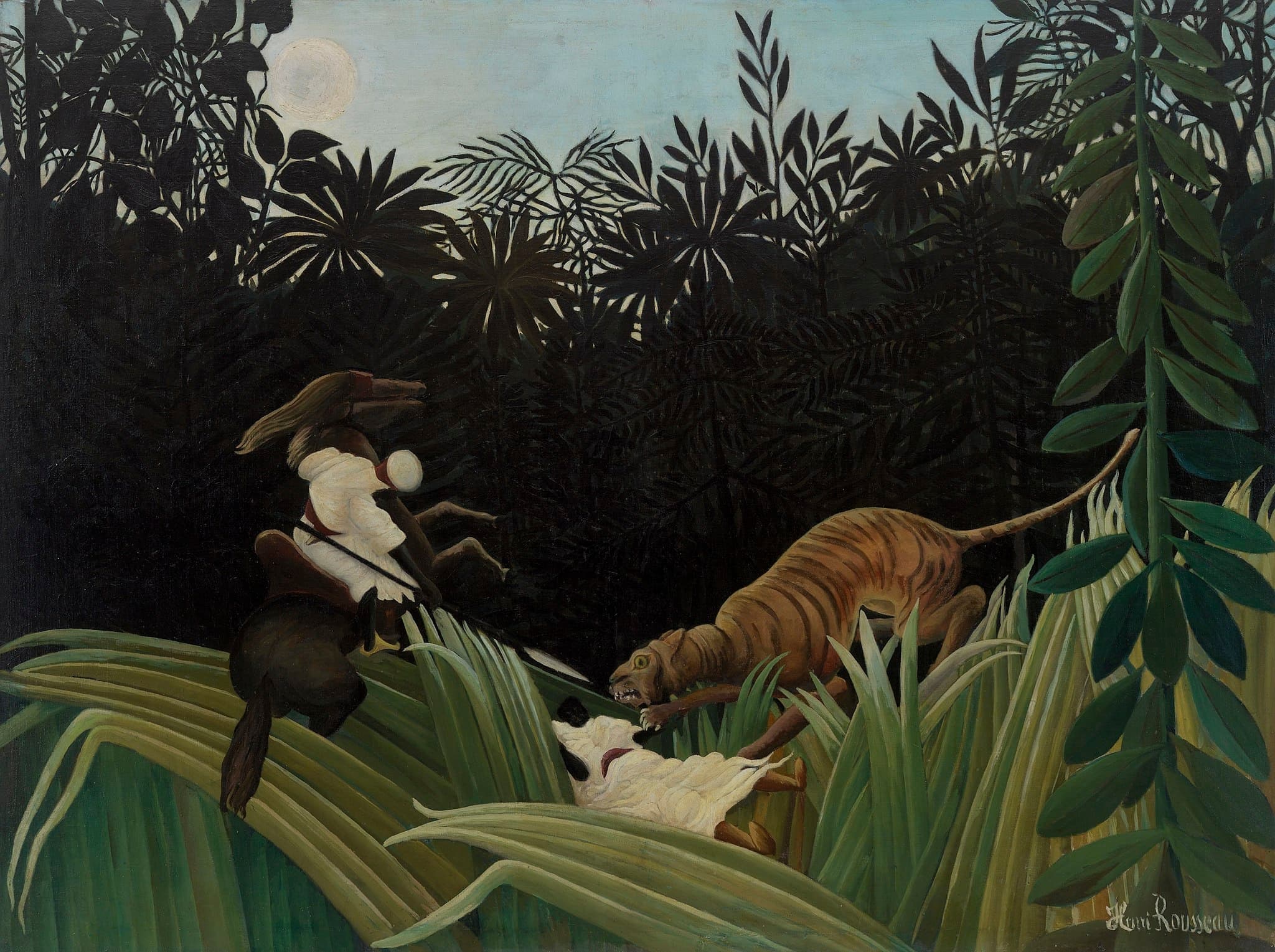
Scouts Attacked by a Tiger (Éclaireurs attaqués par un tigre)
Henri Rousseau, 1904 • Oil on canvas
View more by Henri Rousseau →Valuation Analysis
Valuation conclusion: Scouts Attacked by a Tiger (1904), accession BF584 at the Barnes Foundation, is an authenticated, large Rousseau jungle canvas. Based on a comparable‑driven analysis that weights the artist’s recent auction benchmarks, the work’s size (~121.6 × 161.9 cm), and its institutional provenance and exhibition history, a commercial market orientation if the painting were consigned today is US$2,000,000–12,000,000. This range presumes the painting is fully autograph, in sound condition, and documented in the accepted catalogue raisonné [2].
This estimate is derived from direct comparable analysis anchored to two market facts: (1) the extraordinary Christie’s sale of Les Flamants in May 2023, which reset the top of Rousseau’s auction market and establishes an upper ceiling for exceptionally rare, museum‑quality jungle tableaux [1]; and (2) the cluster of authenticated Rousseau oils that have historically realised in the high six‑figure to low seven‑figure band. Combining those anchors, and applying downward adjustments for the fact that most museum holdings have not been market‑tested, yields the stated mid‑to‑upper single‑digit‑million orientation.
Museum ownership (Barnes accession BF584) materially strengthens provenance and scholarly validation, which typically supports higher buyer confidence and price expectations. At the same time, being institutional means the work lacks a recent public hammer price; prospective buyers will therefore compare it to recorded auction lots and apply premiums for rarity and documentation while pricing in the uncertainty of a first‑time offering [2].
Condition and technical authentication are the decisive variables that will move the price within this band. A clean conservation history, favourable X‑ray/infrared findings and confirmation in the catalogue raisonné will support the higher end of the estimate; major restorations, relining or unresolved attribution questions would materially reduce buyer appetite and push results toward the lower end or below the stated range.
Practically, to refine this orientation into a formal market valuation or pre‑sale estimate the necessary next steps are: obtain the Barnes provenance and loan/insurance file, secure high‑resolution front/reverse/signature photography, commission a current condition report, and complete targeted technical testing. With those materials in hand, major houses (Christie’s, Sotheby’s) can issue pre‑sale estimates and consignment recommendations; with robust documentation and condition the painting should attract international institutional and private interest and be likely to realise within the US$2–12M orientation provided here. This bracket is intentionally conservative relative to the single outlier Les Flamants and reflects tiered market pricing and the sensitivity of results to condition and catalogue confirmation [1][2].
Key Valuation Factors
Art Historical Significance
High ImpactHenri Rousseau’s jungle paintings are among his most iconic works and carry considerable cultural capital in modern‑art history. A mature 1904 jungle tableau such as Scouts Attacked by a Tiger participates in the artist’s principal theme set that curators and scholars most frequently cite. If the painting is included in the standard catalogue raisonné and has documented exhibition history, that increases its scholarly standing and market desirability. Artistic significance translates to commercial value because collectors and institutions prize canonical subject matter with demonstrable placement in an artist’s key production period. Conversely, if scholarship treats the canvas as a minor variant, the market discounts it accordingly.
Provenance & Institutional Ownership
High ImpactBeing accessioned by the Barnes Foundation (BF584) is a major provenance asset: institutional ownership signals verifiable provenance, curatorial vetting, and likely inclusion in exhibition and publication records. These elements reduce buyer risk and generally support premium pricing if the work is offered. That said, museum ownership reduces market liquidity (the work has not been subject to competitive bidding), so a first‑time market appearance will be judged against auction comparables rather than prior hammer results. Clear transfer history, documented loans and any deaccession protocols will materially affect buyer confidence and the work’s final realisation.
Condition & Technical Authentication
High ImpactA detailed condition report and technical examination (infrared reflectography, X‑ray, pigment analysis) are essential. Autograph attribution, dating and integrity of the paint surface are determinative: clean original paint, stable canvas and minimal invasive restoration support upper‑end pricing, whereas relining, severe overpainting or structural issues lead to substantial discounts. Technical confirmation that pigments and ground correspond to Rousseau’s known practice and that no major later interventions exist is frequently required by top buyers and specialists before bidding into the multi‑million bracket.
Comparables & Auction Record
High ImpactAuction comparables set the market frame: the 11 May 2023 Christie’s sale of Les Flamants (record Rousseau result) establishes the high ceiling for exceptional jungle tableaux [1]. Historical mid‑tier Rousseau sales and pre‑2023 benchmarks (e.g., important works sold in the single‑ to low‑seven‑figure band) provide the market floor for strongly documented but non‑canonical canvases. Realisation outcomes are sensitive to scale, subject, provenance and condition; therefore this painting’s market value is derived by calibrating its attributes against that tiered set of comparables.
Rarity & Collector Demand
High ImpactLarge, museum‑quality Rousseau canvases rarely appear for sale, creating scarcity that can drive competitive bidding among institutions and deep‑pocketed private collectors. High‑profile exhibitions and new scholarship increase demand for well‑documented examples. However, the overall market has shown selective appetite since the 2023 record—buyers prioritise the best‑provenanced and best‑documented works. The confluence of rarity plus recent institutional attention to Rousseau supports robust interest but also means results will cluster towards well‑substantiated works and fall back for pieces with provenance or condition questions.
Sale History
Scouts Attacked by a Tiger (Éclaireurs attaqués par un tigre) has never been sold at public auction.
Henri Rousseau's Market
Henri Rousseau (1844–1910) occupies a secure position in modern art: a self‑taught, celebrated figure whose jungle scenes are widely recognized and museum‑collected. Supply of top‑quality Rousseau oils is limited—many key canvases reside in major institutions—so authentic works that reach the market can command strong prices. The 2023 Christie’s sale of Les Flamants reset the public auction ceiling and highlighted the rarity premium; however, most authenticated Rousseau oils continue to trade in a tiered market where documentation, size and condition drive whether a lot realises in the high six figures, low millions, or (rarely) multiple millions.
Comparable Sales
Les Flamants
Henri Rousseau
Artist, large museum-quality jungle tableau; direct auction benchmark and the artist's public-record high (sets the market ceiling for top-tier Rousseau jungle paintings).
$43.5M
2023, Christie's New York
~$46.8M adjusted
Portrait of Joseph Brummer (1909)
Henri Rousseau
Historically the pre-2023 auction benchmark for Rousseau; important authenticated work that illustrates mid-to-high market expectations for the artist before the 2023 record.
$4.4M
1993, Christie's London
~$9.7M adjusted
Representative mid-tier Rousseau jungle canvas (aggregated example)
Henri Rousseau
Proxy for authenticated, non-masterpiece Rousseau oils of comparable size/subject that historically realise in the high six-figure to low seven-figure band; useful to set a realistic mid-market expectation.
$1.3M
2019, Various (Christie's / Sotheby's - aggregated example)
~$1.5M adjusted
Representative lower-tier Rousseau/atelier work (aggregated example)
Henri Rousseau
Proxy for works with attribution questions, heavy restoration or weaker provenance; indicates downside pricing and buyer sensitivity to condition/attribution issues.
$300K
2016, Various (smaller auction houses - aggregated example)
~$375K adjusted
Current Market Trends
Post‑2023 the Rousseau market shows a bifurcation: a new high‑end benchmark for exceptional canvases and a cautious, selective demand pattern across the remainder of the catalogue. Broader Impressionist/Modern market softness in 2024–2025 makes provenance, condition and exhibition history more decisive. High‑profile institutional shows and fresh scholarship can lift demand for specific works, while uncertain attribution or heavy restoration materially reduces buyer appetite.
Sources
- Christie’s — 20th Century Evening Sale: Les Flamants (Henri Rousseau) results, 11 May 2023
- Barnes Foundation / Wikimedia Commons — Henri Rousseau, Scouts Attacked by a Tiger (Éclaireurs attaqués par un tigre), BF584 (image/accession reference)
- Barnes Foundation press release — Henri Rousseau: A Painter’s Secrets (exhibition and conservation research)