How Much Is The Dream Worth?
Last updated: July 29, 2026
Quick Facts
- Methodology
- comparable analysis
Henri Rousseau’s The Dream (1910) is a canonical, museum-held masterpiece and the culminating work of his jungle series at MoMA. Using the 2023 record-setting sale of Rousseau’s Les Flamants at $43.5 million as an anchor and cross-artist trophy benchmarks for early modern icons, a prudent hypothetical valuation is $120–180 million. Extreme scarcity and the painting’s iconic status support a firmly nine-figure estimate.
Valuation Analysis
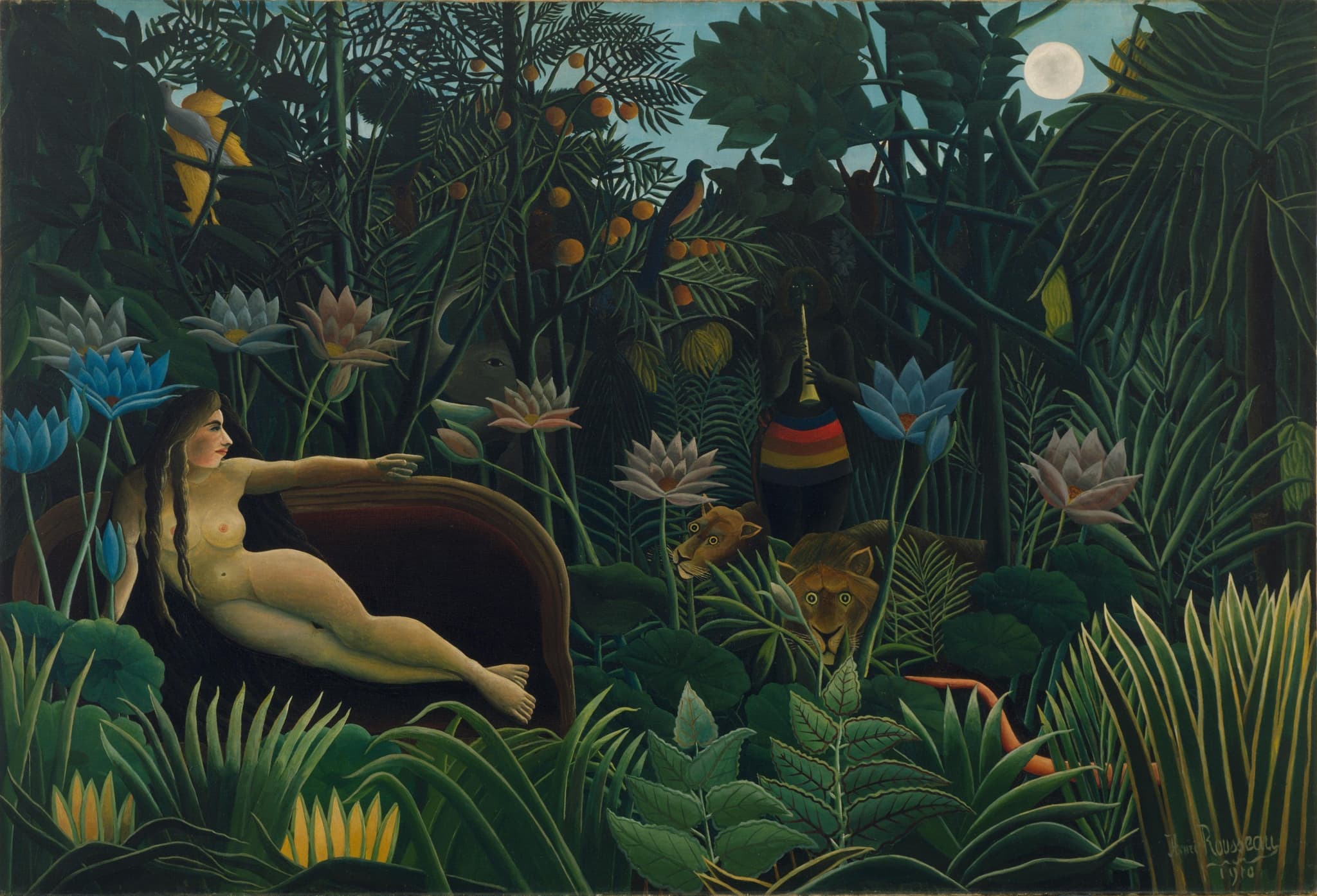
Work and status. The Dream (1910) is widely acknowledged as Henri Rousseau’s culminating jungle masterpiece—his largest and most complex composition, completed the year he died. It entered the Museum of Modern Art’s collection in 1954 as a gift from Nelson A. Rockefeller and has never been publicly auctioned. MoMA’s object record and early press describe it as the capstone of Rousseau’s oeuvre, underscoring its central place in the museum’s modernist narrative [1][3].
Methodology and key anchor. With no modern sale history for The Dream, valuation relies on comparable analysis. The primary same-artist anchor is Les Flamants (1910), which sold at Christie’s New York on May 11, 2023, for $43.535 million with fees, resetting Rousseau’s market an order of magnitude higher than its prior record. Les Flamants is a late, major jungle subject from the same year, but it is less iconic and less culturally pervasive than The Dream; as such, it serves as a conservative floor for masterpiece-level Rousseau pricing [2].
Cross-artist trophy benchmarks. Pricing for universally recognized early modern icons routinely achieves nine figures at auction, establishing a relevant frame for The Dream. Notable precedents include Edvard Munch’s The Scream (1895 pastel) at $119.9 million (2012), and Gustav Klimt’s Birch Forest at $104.6 million (2022, Paul G. Allen Collection). These results demonstrate the depth of demand for best-of-category, museum-caliber images from the 1890–1915 period—precisely the echelon in which The Dream resides [4][5].
Scarcity, demand, and positioning. The very top Rousseau jungle paintings are almost entirely institutionally held, making true substitutes effectively unavailable. The Dream’s scale (approximately 204.5 × 298.5 cm), condition stewardship within a leading museum, and mythic status in art history and popular culture position it as a once-in-a-generation trophy. In a hypothetical sale—most plausibly a tightly brokered private treaty—the buyer pool would include top private collectors and major institutions competing across category lines, justifying a valuation well beyond the artist’s solo record and consistent with nine-figure early modern icons.
Conclusion. Synthesizing the same-artist record (Les Flamants) with proven, cross-artist trophy outcomes, and weighting The Dream’s undisputed primacy and extreme scarcity, a disciplined hypothetical range is $120–180 million. The work’s museum-held status means an open-market sale is highly unlikely, but if it were offered, competition at this level would be well supported by both art-historical significance and established market precedents [1][2][4][5].
Key Valuation Factors
Art Historical Significance
High ImpactThe Dream is broadly regarded as Rousseau’s late magnum opus and the culminating statement of his jungle series. Its 1910 date (the year of the artist’s death), monumental scale, and complex, dreamlike iconography make it one of the most reproduced and taught images of early modernism. Its art-historical weight extends beyond Naïve art into the development of Surrealism and modern fantasy, and it has long served as a signature painting within MoMA’s narrative of modern art. This exceptional status places it in the small cohort of works where cultural recognition, scholarly consensus, and public familiarity converge to support a trophy-level valuation.
Scarcity and Market Supply
High ImpactThe great Rousseau jungle canvases are almost entirely in museums, creating near-zero substitution risk. Only one late, top-tier jungle subject—Les Flamants (1910)—has tested the public market recently, and it set a step-change artist record. The Dream’s unique scale and fame amplify this scarcity: there is no realistic pipeline of like-for-like Rousseau masterpieces. In markets defined by rarity, the absence of alternatives concentrates demand and supports premium pricing. This factor is decisive here: collectors seeking a definitive Rousseau jungle icon have virtually no other options, pushing the likely clearing price well into the nine-figure range.
Provenance and Institutional Status
High ImpactThe Dream’s provenance—from Ambroise Vollard through Sidney Janis to Nelson A. Rockefeller—culminates in its 1954 gift to MoMA. Such a chain of blue-chip ownership confers maximum credibility, while decades of museum care and scholarship enhance confidence regarding authenticity, condition, and significance. Although deaccession is extraordinarily unlikely, the institutional imprimatur strengthens value in any hypothetical scenario. In practice, a work of this stature would transact (if ever) via private treaty, potentially with mission-driven considerations. Even so, the pedigree and institutional stewardship underpin a valuation at the very top of the artist’s category.
Scale, Condition Stewardship, and Visual Impact
Medium ImpactAt roughly 204.5 × 298.5 cm, The Dream is a commanding, wall-filling picture whose intricate foliage, animals, and reclining nude produce a uniquely immersive effect. The format and ambition outstrip most of Rousseau’s oeuvre, reinforcing its ‘magnum opus’ status. While a current, independent condition report would be needed for transactional due diligence, long-term care within MoMA typically implies conscientious conservation and stability. Monumental scale and celebrated imagery reliably correlate with premium pricing in the trophy segment, and here both attributes are present in their most emphatic form.
Market Benchmarks and Cross-Category Demand
High ImpactRousseau’s Les Flamants (1910) achieved $43.5 million in 2023, re-basing the artist’s market at a higher order of magnitude. Across adjacent early modern masters, established icons regularly exceed $100 million (e.g., Munch’s The Scream; Klimt’s Birch Forest), confirming robust global demand for museum-caliber trophies. The Dream sits comfortably within this cohort by recognition and quality. Given its status and the near absence of substitutes, it would attract intense competition from the same buyer universe that pursues blue-chip Impressionist/Modern masterpieces, supporting a $120–180 million range in a hypothetical sale.
Sale History
The Dream has never been sold at public auction.
Henri Rousseau's Market
Henri Rousseau’s market is defined by extreme scarcity at the top and an outsized art-historical reputation. For decades, public auction prices lagged his influence due to the absence of great canvases. That changed in May 2023 when Les Flamants (1910) sold for $43.535 million at Christie’s New York, resetting the artist’s benchmark and demonstrating deep bidding for a late, major jungle subject. Since then, no comparable masterpiece has surfaced, and most key works remain in institutions. The buyer base for a prime Rousseau cuts across leading Modern and Post‑Impressionist collectors and institutions, implying strong latent demand should another iconic painting become available.
Comparable Sales
Les Flamants
Henri Rousseau
Same artist, same year (1910), and a late, major jungle subject—one of the very few top-tier Rousseau canvases to trade publicly. It is the closest market anchor for valuing The Dream.
$43.5M
2023, Christie's New York
~$46.1M adjusted
Portrait of Joseph Brummer
Henri Rousseau
Same artist, very late date (1909). Long-standing Rousseau record until 2023; shows historical pricing and how dramatically the market re-rated when a masterpiece (Les Flamants) surfaced. Not a jungle scene and of lesser scale/impact.
$4.4M
1993, Christie's London
~$9.9M adjusted
The Scream (1895 pastel)
Edvard Munch
Cross-artist, early modern icon with unmatched cultural recognition. Though a pastel (not oil), it demonstrates what the market pays for a canonical, museum-level image—useful for calibrating The Dream’s trophy potential.
$119.9M
2012, Sotheby's New York
~$168.6M adjusted
Birch Forest
Gustav Klimt
Cross-artist, pre‑war masterwork (1903) with a nine‑figure 2022 result. Forest subject resonates thematically (immersive, all‑over nature) and evidences deep bidding for blue‑chip early modern icons.
$104.6M
2022, Christie's New York
~$115.5M adjusted
Les femmes d’Alger (Version "O")
Pablo Picasso
Cross-artist, blockbuster modern icon. Establishes the upper bound of what the market will pay for an indisputable masterpiece with global recognition—relevant to positioning The Dream in a trophy context.
$179.4M
2015, Christie's New York
~$244.3M adjusted
Nu couché
Amedeo Modigliani
Cross-artist, archetypal early‑20th‑century masterpiece (1917) with a nine‑figure result. Demonstrates depth of demand for single-picture icons from the same broad era as Rousseau’s late work.
$170.4M
2015, Christie's New York
~$232.1M adjusted
Current Market Trends
The broader early modern category has been selective but robust for best-in-class works. Public auction volumes contracted in 2024, with fewer top consignments and greater estimate discipline; nevertheless, blue‑chip, museum‑grade icons continued to command premium prices. By 2025, buyer preference consolidated around proven historical masters, and nine‑figure results for canonical pre‑war masterpieces reaffirmed the depth of global trophy demand. Against this backdrop, the combination of The Dream’s canonical status and the scarcity of top Rousseau paintings supports a firmly nine‑figure valuation, even in a disciplined, highly selective market environment.
Sources
- MoMA collection record: Henri Rousseau, The Dream (1910)
- Christie’s: Spring Marquee Week totals $922m (includes Rousseau’s Les Flamants at $43.5m)
- MoMA press release (1954): Nelson A. Rockefeller gift of Rousseau’s The Dream
- ABC News: Munch’s The Scream sells for $119.9m (2012)
- Christie’s: The Paul G. Allen Collection results (includes Klimt’s Birch Forest at $104.6m)