How Much Is The Hungry Lion Throws Itself on the Antelope Worth?
Last updated: March 30, 2026
Quick Facts
- Methodology
- comparable analysis
If authenticated as the Fondation Beyeler canvas in museum‑quality condition, The Hungry Lion Throws Itself on the Antelope is preliminarily valued at approximately USD 8,000,000–20,000,000. This range reflects the work’s canonical status in Rousseau’s ‘jungle’ corpus, its museum provenance (Fondation Beyeler), and market comparables including Rousseau’s 2023 trophy sale that set a new top benchmark.
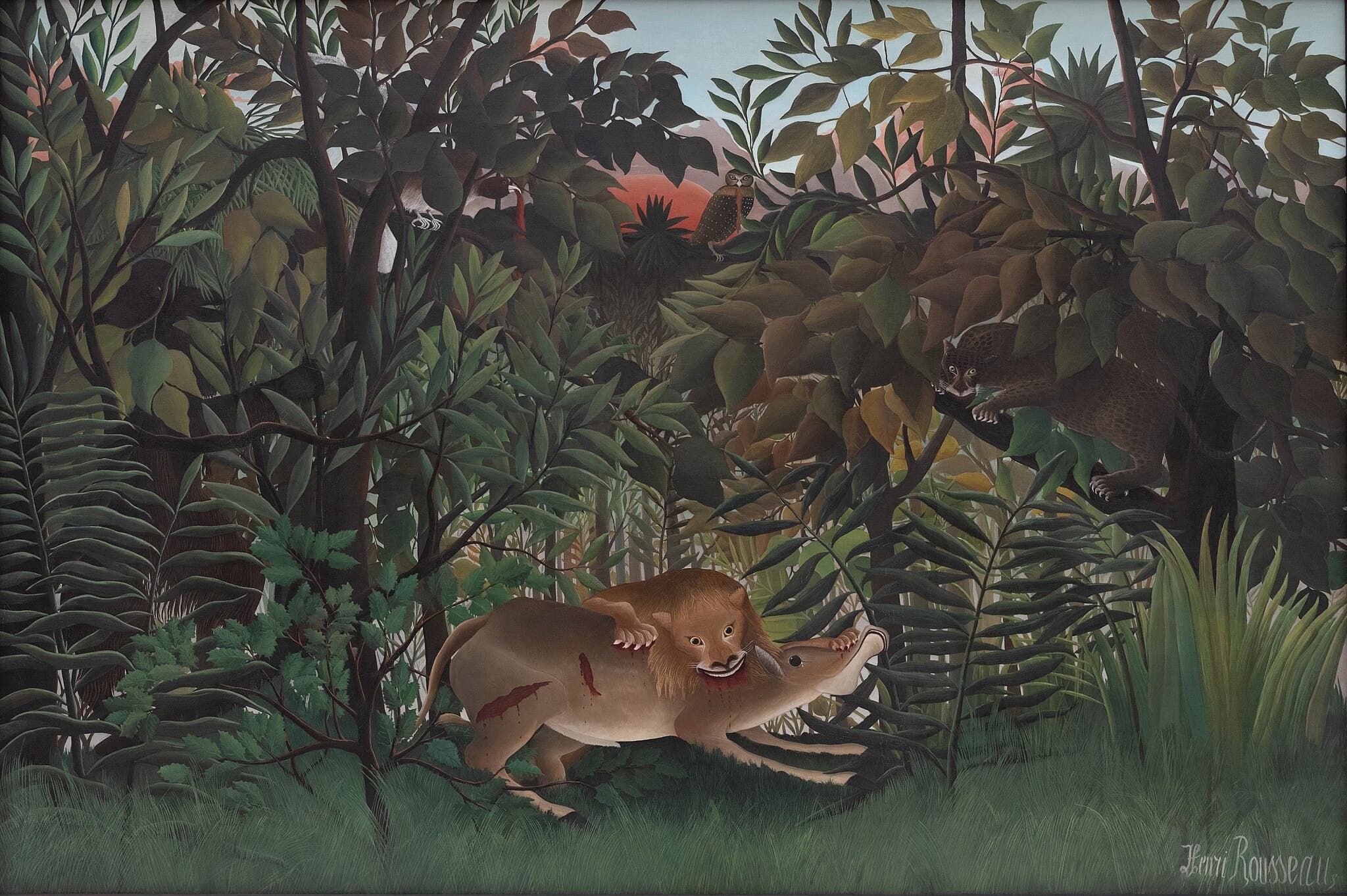
The Hungry Lion Throws Itself on the Antelope
Henri Rousseau, 1905 • Oil on canvas
View more by Henri Rousseau →Valuation Analysis
Conclusion and headline valuation. Based on comparable sale evidence, institutional provenance and the painting’s place in Rousseau’s late 'jungle' production, a reasonable preparatory market range for an authenticated, museum‑quality The Hungry Lion Throws Itself on the Antelope is USD 8,000,000–20,000,000. The lower bound assumes a strong but non‑record competitive environment; the upper bound assumes an evening‑sale placement or a high‑value private treaty supported by institutional interest and exhibition placement.
Provenance and market context. The work is held by Fondation Beyeler and has a long, well documented ownership history (dealer Ambroise Vollard; Franz Meyer family; long institutional loans), which removes substantial attribution risk but also makes it effectively off‑market absent a de‑accession or private sale [1]. Market comparables are thin but decisive: Rousseau’s Les Flamants (Christie’s NY, May 2023) established a new trophy ceiling at USD 43.5M; that result demonstrates capacity at the very top but should be treated as an outlier benchmark rather than a blanket re‑rating of every Rousseau jungle canvas [2].
How the range is derived. The USD 8–20M bracket is a calibrated comparable analysis: it places a canonical, museum‑quality Hungry Lion above typical mid‑market Rousseau offerings (high six figures to low millions) while below the unique circumstances that produced the $43.5M trophy outcome. Adjustments between low and high reflect condition (and any conservation needs), the depth of exhibition/publication backing, and sale channel (major evening sale and pre‑sale publicity versus day sale or private treaty).
Downside and upside scenarios. If the canvas were a study, of uncertain attribution, or in compromised condition, market value could contract markedly to a preliminary secondary range of roughly USD 500,000–5,000,000. Conversely, if offered fresh with a planned institutional loan/exhibition, premium competitive bidding could lift the result above the stated upper bound—potentially materially—depending on buyer overlap and sale dynamics [2].
Recommended next steps. For any transactional or insurance purpose: (1) obtain a full technical/condition report and catalogue‑raisonné confirmation; (2) compile a complete provenance and exhibition bibliography; (3) solicit written interest/estimates from Impressionist & Modern specialists at Christie’s / Sotheby’s / major dealers; and (4) if selling, pursue pre‑sale institutional loan commitments to maximize realized value.
Key Valuation Factors
Art Historical Significance
High ImpactThe Hungry Lion Throws Itself on the Antelope is a canonical example of Rousseau’s late ‘jungle’ paintings and is widely reproduced in scholarship and exhibition narratives. Works of this compositional type are central to the artist’s market identity and to institutional narratives that drive collector demand. Because canonical subjects attract both museums and high‑net‑worth collectors, art‑historical prominence creates a persistent premium. The painting’s iconography, scale and maturity of style make it more valuable than studies or minor motifs; institutional recognition amplifies buyer willingness to pay in the multi‑million dollar band.
Provenance & Exhibition History
High ImpactLong, reputable provenance materially increases value and reduces buyer risk. This canvas’ documented route—early dealer acquisition, ownership by the Meyer family, long loans to Swiss institutions, and current custody at Fondation Beyeler—provides institutional validation and a publication/exhibition record that supports the higher end of the estimate. Museum ownership also makes the work unlikely to come to market, which increases scarcity but can complicate liquidity and pricing if the work must be deaccessioned. A well‑documented exhibition record will justify premiums in either public or private sale contexts.
Condition & Conservation
High ImpactCondition is a principal value driver: original paint surface integrity, presence/absence of major relining, extent of inpainting, and structural canvas stability determine market confidence and pricing. For museum‑held works, conservation records are often strong, but any found intervention or loss can require substantial downward adjustment. A formal technical and conservation report can either validate a high‑end estimate or materially reduce it. Buyers at the top end expect a clean technical history; discovered issues are often negotiated as price reductions or sale withdrawals.
Market Comparables & Scarcity
High ImpactComparable sales for Rousseau are sparse but instructive. The 2023 Christie's Les Flamants result (USD 43.5M) establishes an extreme top ceiling and shows that museum‑quality Rousseau jungle canvases can reach trophy prices; earlier historical sales and more recent unsold high‑estimate lots demonstrate wide dispersion and volatility. Because fresh museum‑quality Rousseaus seldom reach the secondary market, scarcity alone supports strong prices for top examples, but the realized price depends on matching supply with concentrated buyer demand.
Sale Channel & Market Timing
Medium ImpactSale venue (major evening auction vs private treaty vs museum deaccession) and timing (concurrent major exhibitions, market liquidity) have meaningful effect. An evening sale with pre‑sale publicity, catalogue essay and institutional loan commitments will trend toward the upper estimate; a private sale with discreet marketing or a sale during a softer market window will likely land nearer the low estimate. Recent exhibition cycles (large Rousseau retrospectives) can temporarily increase demand and pricing power.
Sale History
The Hungry Lion Throws Itself on the Antelope has never been sold at public auction.
Henri Rousseau's Market
Henri Rousseau is a firmly established, canonical figure in late 19th–early 20th century art markets, prized for his idiosyncratic ‘naïve’ style and iconic jungle paintings. Institutional holdings of key works are concentrated, so museum‑quality canvases infrequently reach the secondary market. The 2023 Les Flamants sale established a new headline record and re‑focused attention on Rousseau’s scarcity value; nonetheless, realized prices remain highly example‑specific, with major premiums reserved for works that combine canonical subject matter, pristine condition, and strong provenance.
Comparable Sales
Les Flamants (1910)
Henri Rousseau
Same artist and a canonical large-scale Rousseau 'jungle' masterpiece sold in a marquee evening sale; sets the contemporary trophy ceiling for Rousseau works and demonstrates top-end demand for museum-quality jungle canvases.
$43.5M
2023, Christie's New York
~$45.7M adjusted
Portrait of Joseph Brummer (1909)
Henri Rousseau
Same artist but a portrait rather than a jungle composition; historical auction record (1993) that provides a prior market baseline for high-quality Rousseau works before the trophy-sale era.
$4.4M
1993, Christie's London
~$9.7M adjusted
Femme en rouge dans la forêt
Henri Rousseau
Offered with a high pre-sale estimate (USD 10–20M) but was bought-in/unsold; illustrates market volatility at the high end and the importance of provenance, condition and sale context even for high-estimate Rousseau works.
Price unknown
2024, Christie's New York (20th Century sale)
0Current Market Trends
The top end of the Impressionist/early‑Modern market has shown selective strength: trophy masterpieces with clean provenance continue to draw competitive bids, while mid‑market lots are more price‑sensitive. Recent high‑profile exhibitions and the 2023 Rousseau record have increased interest in museum‑quality examples, but market volatility means each lot must be assessed on its own merits and sale preparation.