How Much Is The Repast of the Lion (Le Repas du Lion) Worth?
Last updated: March 30, 2026
Quick Facts
- Methodology
- comparable analysis
The Repast of the Lion (ca. 1907), oil on canvas (113.7 × 160 cm), is held in the Metropolitan Museum of Art (acc. no. 51.112.5) and therefore has no modern auction record [1]. Based on direct comparables for museum‑quality Rousseau jungle canvases and the 2023 Christie’s record sale for Les Flamants as an upper bound, a reasoned market estimate for a hypothetical sale is approximately $5–20 million, contingent on condition, catalogue acceptance, provenance detail and sale venue [2].
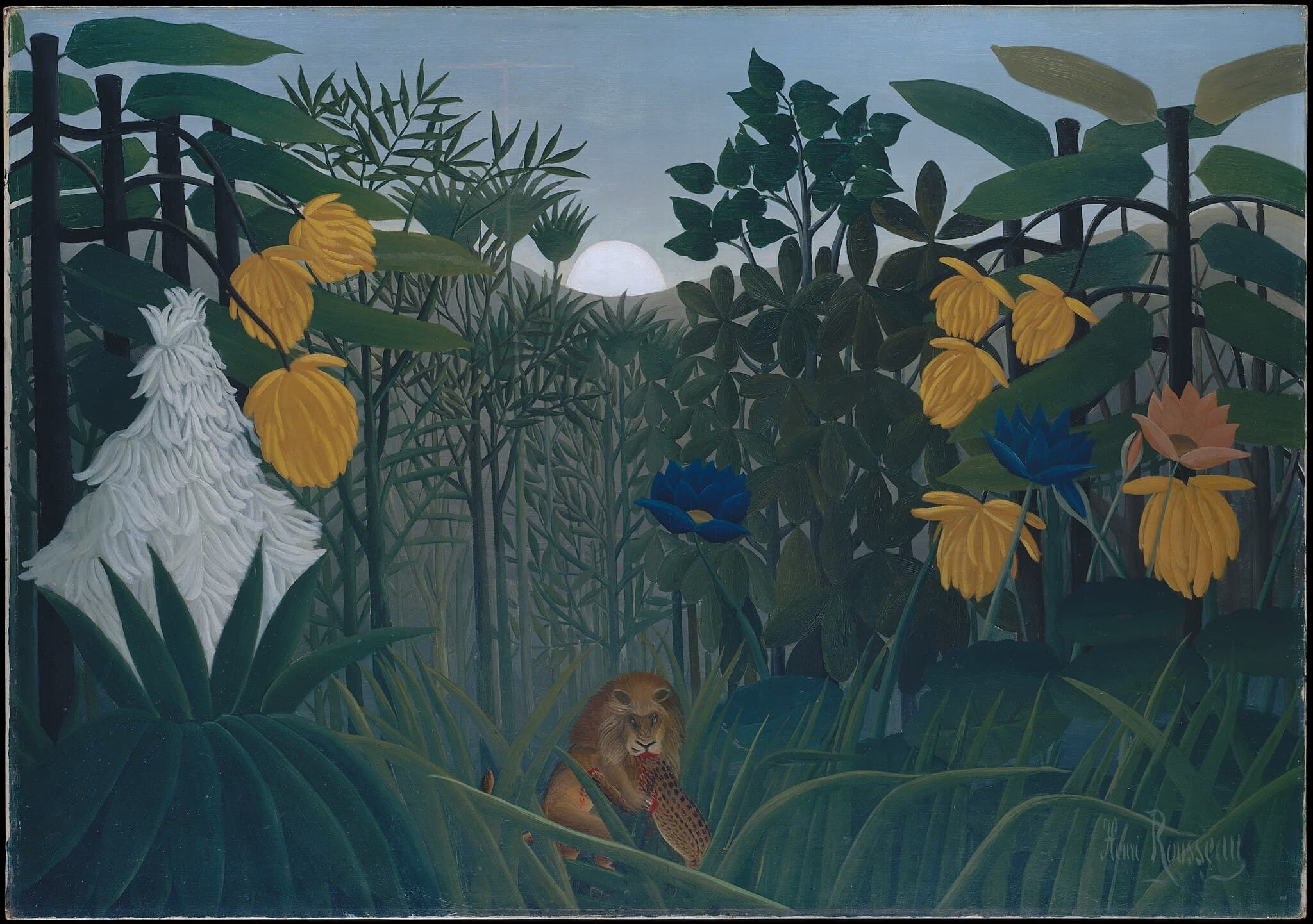
The Repast of the Lion (Le Repas du Lion)
Henri Rousseau • Oil on canvas
View more by Henri Rousseau →Valuation Analysis
Context and starting point. The Repast of the Lion (ca. 1907) is a substantial Rousseau canvas in the Metropolitan Museum of Art (object no. 51.112.5; bequest of Sam A. Lewisohn), and as such it has not circulated in the modern auction market [1]. Because there is no public auction history for this specific canvas, the valuation must be built from: (a) auction comparables for Rousseau’s large jungle works, (b) institutional holdings that establish qualitative benchmarks, and (c) an assessment of condition, provenance and literature.
Comparable anchor and market ceiling. The most important market anchor for Rousseau in recent years is Christie’s sale of Les Flamants (May 11, 2023), which realised US$43.5M (with premium) and demonstrably reset the artist’s auction ceiling for an exceptional masterpiece [2]. That result establishes what the market is capable of paying for a canonical Rousseau in optimal sale circumstances; it is the appropriate upper‑bound comparator rather than a routine price expectation for every large Rousseau canvas.
Why $5–20M for a hypothetical market value. The low end ($5M) reflects the floor for large, authenticated Rousseau jungle canvases of solid quality that are not judged to be the single most iconic or rare masterwork; while many Rousseau works trade at appreciably lower figures, museum ownership and strong provenance push a work into the multi‑million band. The high end ($20M) recognises that the painting is substantial in scale and museum‑validated, and that well‑executed Rousseau jungle canvases with strong literature/exhibition records have previously attracted high‑value buyers — however, only a very small number of works approach the $30–40M+ bracket and those are considered unequivocal masterpieces with exceptional sale narratives. Therefore $5–20M is a defensible, comparables‑based band pending in‑person condition and catalogue confirmation.
Key contingencies and recommended next steps. This estimate is conditional. Important value drivers that could move the work outside this band are: documented exhibition and catalogue raisonné inclusion (would increase value), significant conservation issues or major overpainting (would reduce value), or discovery of a superior provenance/exhibition history (could increase value materially). Because the painting is in the Met’s permanent collection, a sale is unlikely; for insurance or hypothetical market testing obtain: (1) the Met curatorial provenance and exhibition dossier; (2) a current conservation/technical report; and (3) formal market advice from an Impressionist/Modern specialist at Christie’s or Sotheby’s using that documentation. These steps will narrow the band and convert this conditional estimate into a formal appraised value.
Key Valuation Factors
Art Historical Significance
High ImpactHenri Rousseau’s jungle paintings are the most sought‑after segment of his oeuvre because they crystallize his distinct, self‑taught vision that influenced later modernists. The Repast of the Lion, dated ca. 1907 and of substantial dimensions, sits within Rousseau’s mature jungle phase and therefore carries considerable art‑historical weight. A canvas that demonstrably embodies Rousseau’s characteristic composition, palette and thematic richness will command a premium compared with studies or derivative works. Scholarly recognition (citations in catalogs, major exhibition inclusion) elevates market desirability because institutions and deep‑pocket collectors pay for canonical examples that illustrate an artist’s primary contributions to 20th‑century art.
Provenance & Museum Ownership
High ImpactThis painting’s bequest to the Metropolitan Museum of Art (Sam A. Lewisohn, 1951) is a strong provenance element: institutional ownership confirms authenticity and scholarly acceptance, which normally supports higher valuations. At the same time, museum ownership removes the work from the active market, so there is no prior auction price to test buyer appetite; that scarcity can both increase hypothetical market value (premium for rare, museum‑quality offerings) and decrease sale feasibility. If the Met were ever to consider deaccessioning, the institutional provenance would likely make the work highly attractive to top collectors and museums, but legal/ethical constraints and institutional policy often preclude or limit such sales.
Market Comparables & Price Ceiling
High ImpactThe Christie’s 2023 Les Flamants sale (US$43.5M) establishes the recent public ceiling for Rousseau and is the most direct auction benchmark for an exceptional jungle masterpiece [2]. Most other canonical Rousseau canvases are museum‑held and therefore lack sale records, producing a stratified market: mid‑quality signed canvases trade in the mid‑six‑figures to low‑millions, while the very best examples can climb into the tens of millions. Because only a few lots have ever tested the $20M+ threshold publicly, comparable analysis must be conservative and factor in rarity, literature and exhibition history when positioning a single work within that spectrum.
Condition & Saleability
Medium ImpactCondition is a material value driver. A painting in museum‑grade conservation with only routine studio‑period retouching will preserve value; conversely, structural issues, extensive relining, significant overpainting, or evidence of later non‑period materials can materially reduce market price. The Met’s conservation records (if accessible) will be determinative for insurance or sale valuation. For a hypothetical sale, obtain a current condition report and technical imaging (X‑ray/IRR/pigment analysis) to quantify restoration history and to support a firm reserve or insured value.
Sale History
The Repast of the Lion (Le Repas du Lion) has never been sold at public auction.
Henri Rousseau's Market
Henri Rousseau occupies a strong position in the market for early 20th‑century 'naïve' and post‑Impressionist painting: institutional adoption (major museum holdings), steady collector interest, and a scarcity of large, high‑quality canvases at auction create a highly stratified market. The May 2023 Christie’s record (Les Flamants) demonstrated the top‑end appetite for a canonical Rousseau and re‑set the ceiling, but most Rousseau works continue to trade at much lower levels (from mid‑six‑figures to low millions) depending on size, subject and provenance. In short, the market rewards rarity, provenance and literature — and penalizes uncertain attribution or poor condition.
Comparable Sales
Les Flamants
Henri Rousseau
Direct, high‑quality Rousseau jungle canvas (1910). Closest public‑auction benchmark for museum‑quality, large jungle works; establishes the current market ceiling for Rousseau.
$43.5M
2023, Christie's New York
~$46.1M adjusted
The Sleeping Gypsy
Henri Rousseau
One of Rousseau's most canonical, museum‑held jungle works; similar subject/scale and top institutional provenance. No recent public sale, but useful as a qualitative comparable for significance and rarity.
Price unknown
1970, Museum of Modern Art, New York (collection)
Representative Barnes Foundation Rousseau (museum‑quality jungle canvas)
Henri Rousseau
Barnes holds multiple major Rousseau canvases; a comparable museum holding that illustrates institutional demand and the scarcity of market supply for such works.
Price unknown
1970, Barnes Foundation (collection) — representative example
Representative mid‑market Rousseau (aggregated auction cohort)
Henri Rousseau
Aggregated example of recent mid‑quality/signature Rousseau canvases that have appeared at auction (small to mid‑sized works). Provides a floor/median context (typically mid‑six‑figures to low millions depending on size/condition/provenance). Not a single lot but useful to gauge the broader market band.
Price unknown
1970, Various auction houses (aggregated mid‑market results)
Current Market Trends
After the 2023 record for Rousseau, the market showed renewed institutional interest and a higher ceiling for exceptional works, but broader art‑market caution at the ultra‑high end in 2024 tempered immediate follow‑through. Major exhibitions and curatorial attention (which raise visibility) tend to support higher valuations for canonical works, while provenance scrutiny and provenance‑related legal/ethical considerations can complicate sales. Overall the environment favors a cautious, evidence‑driven approach to pricing museum‑quality Rousseau canvases.