How Much Is The Snake Charmer (La Charmeuse de serpents) Worth?
Last updated: March 30, 2026
Quick Facts
- Methodology
- comparable analysis
The Musée d’Orsay’s La Charmeuse de serpents (1907) is a canonical, museum‑quality Rousseau jungle canvas; were it ever offered on the open market a realistic auction or private‑treaty range is $30–50M. This range is anchored to the 2023 Christie’s Rousseau record and adjusted for the painting’s excellent provenance, size and rarity.
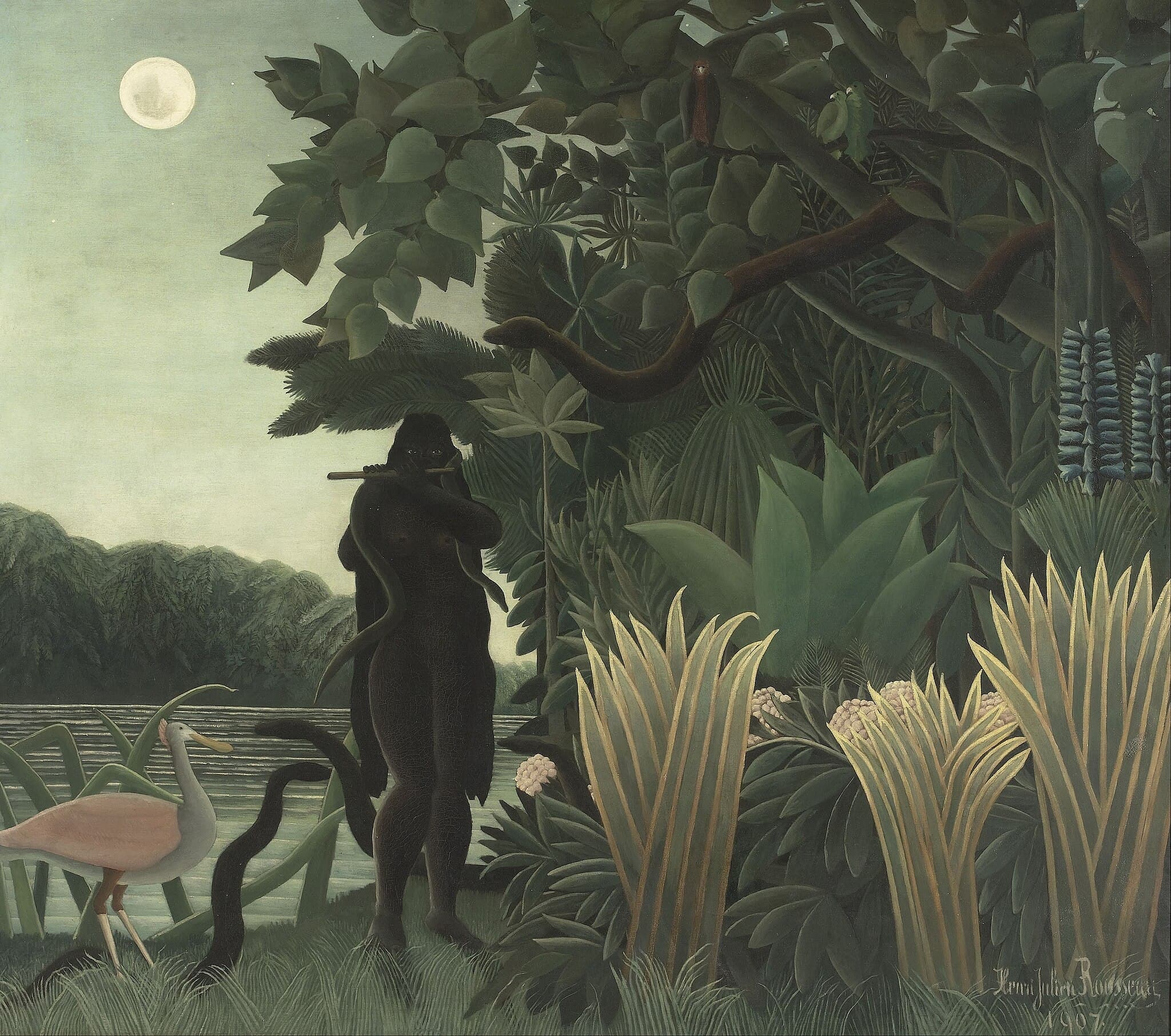
The Snake Charmer (La Charmeuse de serpents)
Henri Rousseau, 1907 • Oil on canvas
View more by Henri Rousseau →Valuation Analysis
Valuation conclusion: Based on a comparable‑analysis anchored to recent trophy‑level Rousseau transactions, the Musée d’Orsay’s La Charmeuse de serpents (1907) would command a hypothetical market value in the range of $30,000,000–$50,000,000 if offered on the open market. The painting is accessioned in the French national collection (Musée d’Orsay) and therefore has no sale history; this estimate is a theoretical market valuation rather than a reflection of any past transaction [1].
Comparative anchor and rationale: The upper market for Rousseau was demonstrably reset by Les Flamants (1910), which realized $43,535,000 at Christie’s New York on 11 May 2023; that sale establishes a clear contemporary ceiling for the artist’s best late “jungle” canvases and is the primary anchor for this estimate [2]. La Charmeuse de serpents is a large (167 × 189.5 cm), mature jungle composition that is well documented in institutional cataloguing and scholarship; its pictorial ambition and museum provenance place it within the same trophy category as Les Flamants.
Why $30–50M: The lower bound ($30M) reflects a conservative auction outcome—moderate bidding, market caution or seller reserve pressure—while the upper bound ($50M) represents a highly competitive scenario (major‑house evening sale, multiple deep‑pocket private collectors and potential institutional interest). The most probable outcome in a well‑executed marquee sale would be a price clustered near the mid‑point of the range (~$40–45M), given the 2023 comparable and ongoing institutional appetite for canonical Rousseau canvases.
Key value drivers considered: undisputed authenticity and catalogue references; exemplary provenance (Berthe and Robert Delaunay; Jacques Doucet bequest to the French State in 1936); large scale and museum‑quality condition; extreme scarcity of top‑tier Rousseau jungle canvases at auction; and the post‑2023 two‑tier market dynamic that propels trophy works. Each of these drivers reinforces a high valuation relative to lesser or attribution‑uncertain Rousseau pictures.
Practical caveat and route to market: Because the work is part of France’s national collection, it is not available under ordinary market conditions—any sale would entail exceptional legal and ethical considerations, so this valuation is hypothetical. For a privately held Rousseau of equal quality and provenance, the recommended sale route to maximize price would be a top‑house evening sale (Christie’s or Sotheby’s) with a pre‑sale scholarly and exhibition program, or a negotiated private treaty with institutional parties. Final proceeds would be affected by buyer’s premium, taxes and sale costs.
Closing: In short, La Charmeuse de serpents is a trophy‑grade Rousseau: anchored to recent market evidence, the realistic open‑market valuation today is $30–50M, with the most likely realized result near the lower‑to‑mid‑$40M zone under optimal sale conditions [1][2].
Key Valuation Factors
Art Historical Significance
High ImpactLa Charmeuse de serpents (1907) sits in Rousseau’s mature ‘jungle’ period and is a fully realized, large‑scale composition representative of his late oeuvre. Its subject matter, scale (167 × 189.5 cm) and pictorial ambition place it among Rousseau’s most important non‑portrait works; such canonical status elevates both cultural and market value. Collectors and institutions prize works that illustrate an artist’s defining moment—this painting does so—and that premium is reflected in the valuation because provenance and scholarship leave little doubt about authenticity and attribution.
Provenance & Exhibition History
High ImpactProvenance is exemplary: the work passed from Berthe Delaunay (mother of Robert Delaunay) to Robert Delaunay and entered Jacques Doucet’s collection before being bequeathed to the French State in 1936 and allocated to national museums. Museum accession and continuous institutional custody substantially reduce title risk and increase buyer confidence. This clear, illustrious provenance not only enhances marketability but also tends to expand the bidder pool—curators, foundations and trophy collectors are more willing to compete for works with uncontested, well‑documented histories.
Rarity & Market Scarcity
High ImpactMany of Rousseau’s most important jungle canvases are held permanently by major museums (Musée d’Orsay, Barnes, MoMA, etc.), which removes supply from the market and creates scarcity when an authentic top‑tier canvas does appear. The resulting supply squeeze is a primary reason why a single marquee example can command outsized sums. The rarity of museum‑quality late Rousseau canvases is therefore a structural upward pressure on price, and scarcity was a decisive element in the 2023 record sale.
Condition & Technical Authentication
Medium ImpactAs a museum‑held work La Charmeuse de serpents will have benefited from professional conservation and documentation; technical studies and catalogue entries typically exist for such holdings. Excellent condition and full technical provenance (conservation reports, IR/X‑ray, pigment analysis where done) reduce buyer risk and support a higher price. Nonetheless, precise condition and any historic restoration can shift value materially, so pre‑sale conservation reporting would be required to lock the top estimate.
Market Comparables & Buyer Appetite
High ImpactThe contemporary auction ceiling for Rousseau was reset by Les Flamants (1910), which sold for $43,535,000 at Christie’s NY in May 2023—this single comparandum establishes market appetite and the plausible top of the range. Post‑2023 the market is bifurcated: top‑tier trophies attract intense capital while mid‑market works face greater selectivity. The painting’s ability to reach the upper range depends on competitive bidding (private collectors, institutions and foundations) and marketing/exhibition build‑up ahead of a major sale.
Sale History
The Snake Charmer (La Charmeuse de serpents) has never been sold at public auction.
Henri Rousseau's Market
Henri Rousseau (1844–1910) occupies a strong position in the market as the leading figure of French 'naïve' painting; his major oils are culturally significant and highly collectible. Prior to 2023 his market peaked in the low‑to‑mid millions for marquee lots; the May 2023 Christie’s sale of Les Flamants reset the top tier into the tens of millions. Today Rousseau’s market is bifurcated: trophy, museum‑quality canvases can command auction records and attract institutional interest, while lesser works and attributions trade more modestly, with buyer selectivity and provenance driving large realized‑price dispersion.
Comparable Sales
Les Flamants
Henri Rousseau
Same artist; large, mature 'jungle' canvas and a canonical Rousseau late work — directly establishes the contemporary auction ceiling for top-tier Rousseau canvases.
$43.5M
2023, Christie's New York
~$46.1M adjusted
Portrait of Joseph Brummer (representative pre-2023 benchmark)
Henri Rousseau
Mentioned in market reporting as one of the stronger pre-2023 Rousseau results; used here as a proxy for the older 'single‑millions' benchmark that prevailed before the 2023 record. Useful to gauge how much the market was reset by Les Flamants.
Price unknown
1970, Various (pre-2023 auction benchmark)
Representative mid‑tier Rousseau auction lot (aggregated sample)
Henri Rousseau
Aggregated category representing the common marketplace outcome for smaller, less‑provenanced or workshop/variant Rousseau canvases and works on paper (market commentary and databases indicate many such lots realize mid‑six to low‑seven figures). Useful as a lower-tier comparable when the object is not a museum‑quality canonical canvas.
Price unknown
1970, Multiple auction houses (various dates)
Current Market Trends
Current market dynamics favor extremely scarce, museum‑quality examples—these trophies continue to draw competitive bids—while mid‑tier works face tighter scrutiny and selective buying. The 2023 record created a new ceiling for Rousseau; since then, sellers of top lots prefer discreet private placements or well‑staged marquee auctions. Short‑term volatility remains, but institutional exhibitions and scholarship (which increase confidence) will sustain demand for the best Rousseau canvases.