How Much Is The Snake Charmer Worth?
Last updated: August 19, 2026
Quick Facts
- Last Sale
- $5K (1922, Private sale (Paris))
- Insurance Value
- $150.0M (Indicative replacement value (this analysis))
- Methodology
- comparable analysis
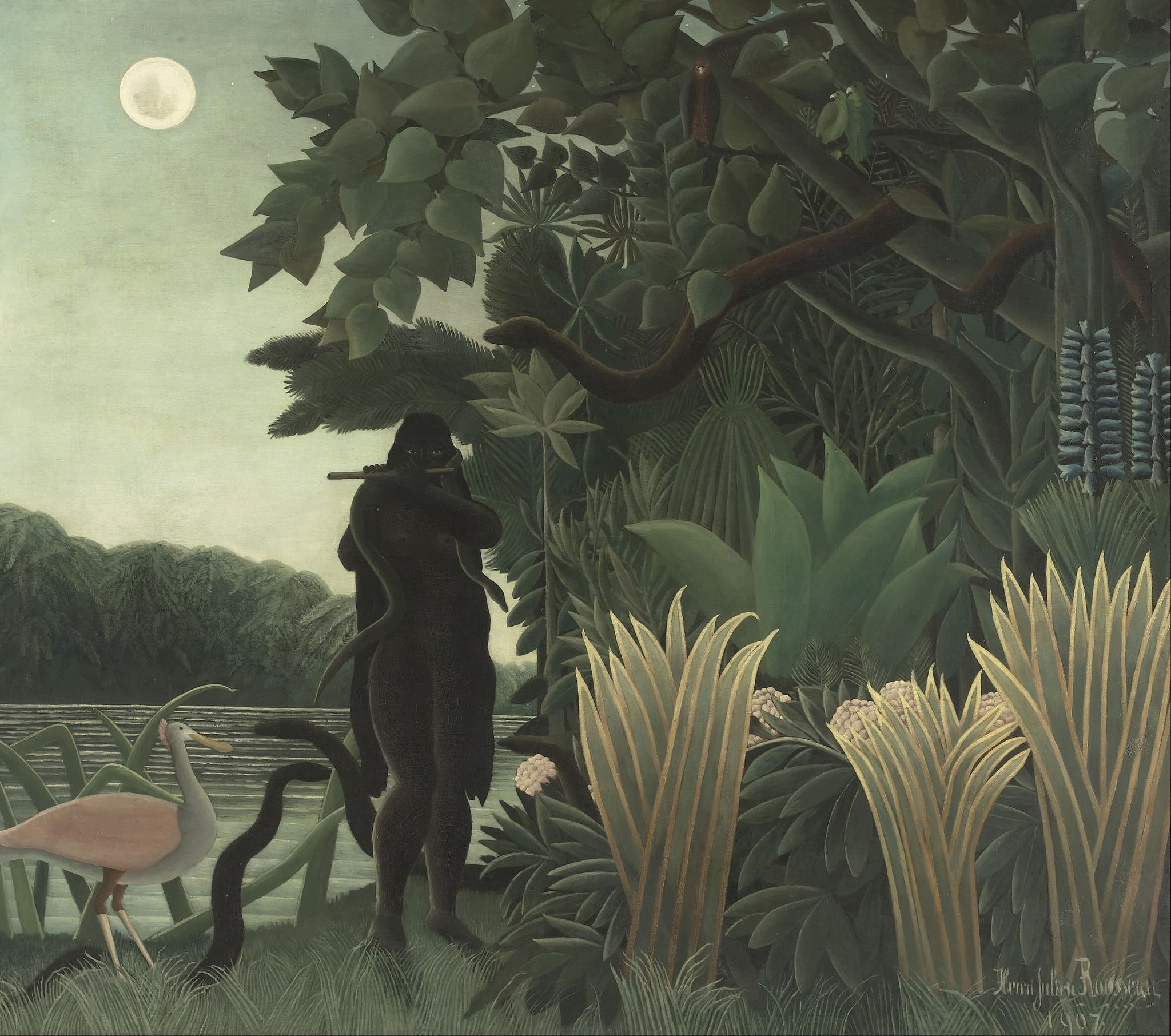
The Snake Charmer (1907) is a museum‑held masterpiece by Henri Rousseau at the Musée d’Orsay and legally inalienable. Anchored to the artist’s 2023 auction record and cross‑category trophy benchmarks, a realistic hypothetical value is $100–150 million, reflecting its icon status, scale, and extreme rarity.
Valuation Analysis
Work and status. The Snake Charmer (La Charmeuse de serpents), 1907, oil on canvas (169 × 189.5 cm), is one of Henri Rousseau’s signature jungle masterpieces, held in the French national collection at the Musée d’Orsay, Paris. Commissioned by Berthe, Comtesse de Delaunay, it passed in 1922 to the couturier Jacques Doucet and entered the Louvre by bequest in 1936; it is now at the Musée d’Orsay. As a work in a “musée de France” collection, it is inalienable under French law and not commercially available [1][3][4].
How the estimate was derived. The valuation is built from comparable analysis. In May 2023, Rousseau’s large late jungle scene Les Flamants sold for $43.535 million at Christie’s New York, resetting the artist’s market by an order of magnitude and establishing a modern benchmark for top‑tier Rousseau paintings [2]. The Snake Charmer is at least as culturally resonant—arguably more so—owing to its monumental scale, earlier date within the mature jungle corpus, and unmatched image recognition across scholarship and exhibitions [1]. Given the extreme scarcity of museum‑caliber jungle canvases in private hands, The Snake Charmer would likely command a substantial premium to Les Flamants in an unrestricted, trophy‑level sale.
Positioning within the broader trophy market. Cross‑category anchors in the late‑19th/early‑20th‑century Modern segment (e.g., Klimt’s Dame mit Fächer at ~$108.4 million) show that truly iconic, rare masterpieces with global name recognition can trade well into nine figures when offered under optimal conditions [5]. Calibrated against that ceiling—and the artist’s 2023 benchmark—the $100–150 million bracket captures both The Snake Charmer’s preeminent status within Rousseau’s oeuvre and current trophy‑lot demand dynamics.
Purpose and caveats. Because this work is in a French national museum and legally inalienable, the figure here functions as a hypothetical fair‑market estimate and a practical guide to insurance/replacement value for loan or indemnity purposes. The lower bound ($100m) reflects a premium over the 2023 record consistent with icon‑level scarcity and museum‑grade demand; the upper bound ($150m) recognizes the competition such a picture would attract from leading institutions and top private collectors in normal market conditions. While macro art‑market cycles can influence execution, the near‑zero supply of comparably important Rousseau jungles—and the singular fame of this image—provides durable support for this range [1][2][5].
Key Valuation Factors
Art Historical Significance
High ImpactThe Snake Charmer ranks among Rousseau’s most celebrated jungle paintings, alongside The Dream and The Sleeping Gypsy. It encapsulates the artist’s singular, visionary synthesis of fantasy, symbolism, and modernity, and is a staple of art-historical literature and exhibitions. Its monumental scale, hypnotic composition, and emblematic subject matter make it a canonical image within early modern art. Works with this level of cultural penetration receive substantial premiums because they are instantly legible to a global audience—curators, scholars, and general visitors alike—amplifying lending demand, scholarly attention, and brand value for institutions or collectors. As a result, art-historical importance here is not merely qualitative; it is directly monetizable in a competitive sale context.
Rarity and Supply
High ImpactRousseau’s most important jungle canvases are overwhelmingly in museums, and the supply of museum-caliber examples in private hands is effectively near-zero. The 2023 sale of Les Flamants was a singular event that rewrote the price level for the artist, underscoring just how rarely top-quality works surface. The Snake Charmer’s combination of scale, date, and iconography makes it irreplaceable within Rousseau’s oeuvre. In markets where demand is global but supply is structurally constrained, scarcity drives nonlinear price effects, especially for masterpieces with instant recognition. This scarcity dynamic justifies a significant premium over lesser subjects and supports a valuation above the recent record when extrapolating to an unrestricted, hypothetical sale.
Provenance and Legal Status
High ImpactCommissioned in 1907, the painting later entered the collection of the famed couturier Jacques Doucet, who bequeathed it to the Louvre in 1936; it now resides at the Musée d’Orsay. This blue-chip provenance is unimpeachable and institutionally anchored, enhancing confidence and value. Although the work is legally inalienable under French law (and therefore not marketable), that status reinforces its stature as a national treasure and heightens its perceived rarity. For valuation purposes, this translates into strong insurance/replacement metrics and, in a purely hypothetical deaccession scenario, the expectation of museum and top‑tier private competition. The clarity and prestige of the ownership history reduce transactional risk and support a top‑of‑market estimate.
Market Benchmarks and Trophy Demand
High ImpactThe 2023 $43.535m result for Les Flamants established a modern benchmark for major Rousseau paintings and proved robust trophy demand for his best work. Across the Modern category, nine‑figure results for blue‑chip icons (e.g., Klimt’s Lady with a Fan) demonstrate headroom when rarity, image power, and provenance align. The Snake Charmer meets these criteria and is arguably more iconic than the 2023 comp, justifying a step‑change premium. While overall market cycles have recently favored selectivity at the high end, that very selectivity often concentrates capital into rare, unquestionably great pictures. The $100–150m range reflects this confluence of artist-specific comparables and cross‑category trophy dynamics.
Sale History
Private sale (Paris)
Sold by Robert and Sonia Delaunay to Jacques Doucet for 50,000 French francs (approx. $4,550 in 1922 USD), with an agreement that the work bequeath to the Louvre.
Henri Rousseau's Market
Henri Rousseau occupies a unique, foundational position in modern art, and the market for his best works is extremely thin. The artist’s auction record was reset in May 2023 when Les Flamants sold for $43.535m at Christie’s New York, a result that vaulted Rousseau into the upper tier of Modern masters at auction. Because most canonical jungle paintings reside in institutions, public offerings of comparable quality are exceptionally rare; as a result, values are highly non-linear, with subject, scale, and freshness commanding steep premiums. Works on paper, portraits, and still lifes transact far lower, underscoring the scarcity premium attached to large, mature “jungle” canvases. Serious activity for top Rousseau paintings is expected to remain private and infrequent.
Comparable Sales
Les Flamants (Flamingos)
Henri Rousseau
Same artist; late ‘jungle’ subject (exotic fauna in dense vegetation), large scale, and closest modern public benchmark; set the standing auction record for Rousseau.
$43.5M
2023, Christie's New York
~$46.1M adjusted
Vase de fleurs à la branche de lierre, première version
Henri Rousseau
Same artist and circa‑period oil; demonstrates recent pricing for non‑iconic subject matter, showing the steep premium commanded by major ‘jungle’ canvases.
$1.3M
2022, Sotheby's New York (Modern Evening Auction)
~$1.4M adjusted
La Charmeuse de serpents (The Snake Charmer) — private sale to Jacques Doucet
Henri Rousseau
Same object; only recorded market transaction for The Snake Charmer. Useful for provenance and historical context, though not indicative of today’s market level.
$5K
1922, Private sale (Robert & Sonia Delaunay to Jacques Doucet, Paris)
~$83K adjusted
Dame mit Fächer (Lady with a Fan)
Gustav Klimt
Category anchor: a late‑19th/early‑20th‑century blue‑chip masterpiece with extreme rarity and museum‑level status; demonstrates current trophy‑lot ceiling in the Modern segment.
$108.4M
2023, Sotheby's London
~$114.9M adjusted
Coin de jardin avec papillons (Corner of a Garden with Butterflies)
Vincent van Gogh
Category reference within Impressionist & Modern: strong but not the most iconic Van Gogh, illustrating current demand for high‑quality, canonical names below the absolute trophy tier.
$33.2M
2024, Christie's New York (20th Century Evening Sale)
~$34.2M adjusted
La Bohémienne endormie (The Sleeping Gypsy) — John Quinn sale
Henri Rousseau
Same artist and top‑tier ‘jungle’ icon; a landmark historical result (520,000 FF) showing early recognition of Rousseau’s masterpieces; useful as a historical analogue, not a modern price point.
$21K
1926, Hôtel Drouot, Paris (John Quinn sale)
~$383K adjusted
Current Market Trends
Within the Modern (Impressionist & Modern) segment, high-end demand has been selective: sellers have become cautious with marquee consignments, but the very best, rarest works continue to attract intense competition and strong prices. Trophy buyers prioritize iconography, provenance, and museum-level quality, often paying disproportionately for instantly recognizable images. While overall auction volumes and averages softened recently, stabilization has emerged, with private sales channels absorbing some upper-tier demand. In this context, an iconic, irreplaceable Rousseau jungle painting would be positioned to outperform category averages, benefiting from cross-border institutional interest and a deep bench of private collectors willing to stretch for once-in-a-generation material.
Sources
- Musée d’Orsay – La Charmeuse de serpents (object page)
- The Art Newspaper – Christie’s New York: Rousseau record ($43.5m)
- Code du patrimoine (France), Art. L451-5 – Inalienability of museum collections
- POP/Joconde – National collections record for La Charmeuse de serpents (1922 sale to Doucet)
- Sotheby’s – Klimt’s Dame mit Fächer sets European auction record (~$108.4m)