How Much Is Autumn Rhythm (Number 30), 1950 Worth?
Last updated: July 22, 2026
Quick Facts
- Last Sale
- $30K (1957, The Metropolitan Museum of Art (acquisition via Sidney Janis Gallery))
- Methodology
- extrapolation
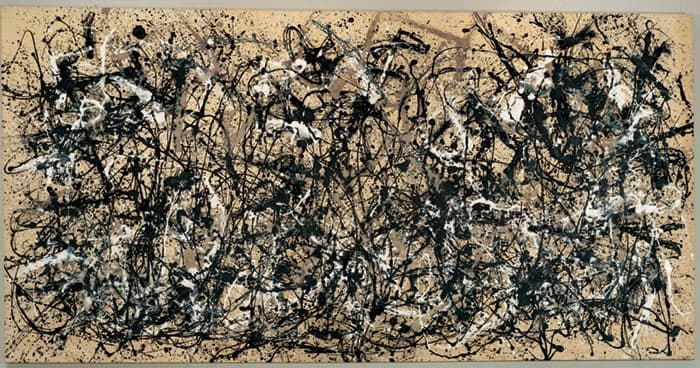
Autumn Rhythm (Number 30), 1950 is a canonical, monumentally scaled Pollock drip painting in The Met’s collection, representing the apex of Abstract Expressionism. Using the artist’s new auction ceiling ($181.2m for a 1948 drip) and the widely reported $200m private sale of a comparable 1948 masterpiece as anchors, a fair-market value today of $250–450 million is justified. Scarcity of peer works and textbook status support a premium at the top of that range.
Valuation Analysis
Conclusion: Autumn Rhythm (Number 30), 1950 warrants a current fair‑market valuation of $250–450 million. This range reflects its position as one of Jackson Pollock’s most important, large‑scale drip paintings—an apex work in a period (1948–50) that defines Abstract Expressionism—and accounts for the step‑change in the artist’s public benchmark alongside sustained private‑sale precedents and extreme scarcity of comparable supply [1][2][4].
How the estimate was derived: We extrapolate above Pollock’s new public auction record of $181,185,000 (Number 7A, 1948; Christie’s, May 18, 2026) [2][3]. Autumn Rhythm is larger, 1950‑dated, and among the most frequently reproduced and taught Pollocks, a canonical status it shares with One: Number 31, 1950 and Lavender Mist: Number 1, 1950. As such, it should command a premium over the 7A result. The range also references the widely reported ~$200 million 2015 private sale of Number 17A, 1948, an A‑tier drip; adjusting for time and the singular renown of Autumn Rhythm, a higher present value is warranted [4]. A 2016 institutional estimate for Blue Poles (1952) around $350 million, while not a formal insurance disclosure, further supports a nine‑figure context for apex Pollocks [6]. Earlier public records like the 2021 sale of Number 17, 1951 at $61.2m (Macklowe) illustrate that non‑apex series or smaller/variant works trade at a steep discount to the 1948–50 monumental drips [7].
Key factors and positioning: Autumn Rhythm’s art‑historical significance is unimpeachable: it is a benchmark of Pollock’s mature drip method and a fixture of survey texts. Its scale (approx. 8 ft 9 in × 17 ft 3 in) and multi‑layered complexity exemplify the qualities the market prizes most in the artist’s oeuvre [1]. Scarcity is acute: nearly all peer‑tier works from 1949–50 are in major museums, making the appearance of any comparable canvas extraordinarily unlikely. The Met’s long‑term ownership and exhibition prominence amplify the work’s brand and global recognition, which, in practical terms, translates into a larger bidder pool should a hypothetical deaccession ever occur [1][5].
Market context: The 2026 spring auctions demonstrated resurgent depth at the trophy level, with Pollock’s record resetting dramatically amid a broader, highly selective market focused on masterpiece‑grade material [2][3]. While the overall art market experienced a slowdown in 2024, blue‑chip postwar trophies—especially landmark Abstract Expressionist works—continue to command intense competition when offered, consistent with Art Basel & UBS reporting on value concentration at the top [8].
Bottom line: Given its canonical status, scale, date, and scarcity, Autumn Rhythm justifies a confident valuation in the $250–450 million range today. Under optimal conditions—pristine condition, comprehensive global marketing, and at least two highly motivated bidders—realized price could press the upper end or exceed it. Even though The Met is extraordinarily unlikely to sell, this range reflects realistic fair‑market dynamics for a truly once‑in‑a‑generation Pollock.
Key Valuation Factors
Art Historical Significance
High ImpactAutumn Rhythm is a defining image of Abstract Expressionism and of Pollock’s radical drip technique at full maturity. Painted in 1950, it sits alongside One: Number 31, 1950 and Lavender Mist as a touchstone of postwar art, reproduced in countless surveys and taught globally. The work’s placement in The Met’s collection and its constant visibility further entrench its canonical status. This significance translates directly to market value: top collectors pay a powerful premium for works that symbolize an artist’s breakthrough and carry broad cultural recognition. Among Pollock’s oeuvre, few paintings match Autumn Rhythm’s art-historical heft, ensuring persistent, global demand at the very top end of the market [1].
Rarity and Supply Constraint
High ImpactPeer-quality, monumental drip paintings from 1948–50 are almost entirely locked in major museum collections, creating a structural supply shortage. This scarcity is one of the strongest price drivers in postwar art: when an apex Pollock emerges, capital concentrates intensely. Blue Poles (1952) at Australia’s NGA is frequently cited in press and public discourse with nine-figure valuations, underscoring just how rare and valuable top-tier Pollocks are within institutions. With virtually no marketable substitutes of similar date, scale, and fame, Autumn Rhythm occupies the most supply-constrained segment of the Pollock market—an environment that reliably commands outsized premiums even in selective macro conditions [1][6].
Scale and Aesthetic Quality
High ImpactMeasuring roughly 8 ft 9 in × 17 ft 3 in, Autumn Rhythm achieves the immersive scale, dynamism, and layered complexity the market prizes most in Pollock. Monumental size magnifies presence, creates immediate museum-level impact, and directly correlates with price in the artist’s market. The orchestration of arcs, splatters, and directional rhythms exemplifies Pollock’s most celebrated visual language from 1949–50. Works that combine this breadth with refined complexity and balance command a premium to smaller or less resolved canvases. Autumn Rhythm’s sheer ambition and aesthetic authority place it squarely within the handful of Pollocks considered the pinnacle of his achievement—and therefore of his value potential [1].
Market Benchmarks and Demand
High ImpactIn May 2026, a large 1948 drip, Number 7A, set a new auction record for Pollock at $181.2 million, recalibrating public pricing for apex works. That result aligns with the widely reported ~$200 million 2015 private sale of Number 17A and confirms deep global appetite for masterpiece-grade Pollocks. Earlier records in the $58–61 million range (e.g., 2013, 2021) apply to smaller or different-series works and are no longer relevant benchmarks for the pinnacle tier. In a market where capital is selective but intense for the very best, Autumn Rhythm’s canonical status and scale justify a substantial premium over the 2026 auction record, supporting a $250–450 million valuation today [2][3][4][7].
Sale History
The Metropolitan Museum of Art (acquisition via Sidney Janis Gallery)
Acquired in 1957; price reported by Sidney Janis oral history as $30,000; involved exchange of a different Pollock valued at $12,000.
Jackson Pollock's Market
Jackson Pollock is a blue-chip, A+ pillar of the postwar market. His most coveted works are the monumental, multicolor drip paintings from 1948–50, which are exceptionally scarce and command nine-figure prices. In May 2026, Christie’s achieved an artist-record $181.2 million for a major 1948 drip, resetting public benchmarks. A widely reported private sale in 2015 placed another 1948 drip at roughly $200 million, reinforcing deep private demand at the top. Quality and scale create sharp stratification: smaller or later-series works trade far lower, while canonical drips are effectively trophy assets chased by a concentrated global collector base and institutions. Liquidity is low at the apex, but competition is intense when masterpieces appear.
Comparable Sales
Number 7A, 1948
Jackson Pollock
Same artist; monumental drip painting from the classic late‑1940s period; public auction record-setter that re‑priced top-tier Pollocks.
$181.2M
2026, Christie's New York (Masterpieces: The Private Collection of S.I. Newhouse)
~$177.2M adjusted
Number 17A, 1948
Jackson Pollock
Same artist; large, canonical drip from the key 1948–50 window; widely reported ~$200m private transaction provides a trophy-level benchmark.
$200.0M
2015, Private sale (reported; David Geffen to Kenneth C. Griffin)
~$273.4M adjusted
Number 17, 1951
Jackson Pollock
Same artist; major large painting (black‑pour series) with prime provenance; important post‑war trophy though a different technique than 1950 multicolor drips.
$61.2M
2021, Sotheby's New York (The Macklowe Collection)
~$71.0M adjusted
Number 19, 1948
Jackson Pollock
Same artist; classic 1948 drip painting that set the public benchmark in 2013; smaller than Autumn Rhythm but firmly within the apex period.
$58.4M
2013, Christie's New York (Post-War & Contemporary Art Evening Sale)
~$81.1M adjusted
Untitled (c. 1948)
Jackson Pollock
Same artist and decade; smaller‑scale drip painting from the late 1940s; shows pricing for strong but non‑monumental works from the key period.
$15.3M
2024, Phillips New York (Evening Sale)
~$15.7M adjusted
Number 28, 1949
Jackson Pollock
Same artist; drip-period canvas from 1949; smaller format illustrates the steep scale/significance premium relative to Pollock’s monumental masterpieces.
$6.7M
2023, Christie's New York (Post-War & Contemporary Art Day Sale)
~$7.1M adjusted
Current Market Trends
The high end of the postwar market is highly selective yet deep for masterpiece-grade works. After a macro-soft 2024, the spring 2026 auctions signaled a trophy-led rebound, with new records for Pollock and peers as capital targeted the most historically important, best-preserved examples. Art Basel & UBS reporting confirms that value continues to concentrate at the top of the market, while mid-tier material remains price-sensitive. In this environment, scarcity and canonical status command pronounced premiums. For Pollock specifically, the new auction ceiling and enduring private benchmarks suggest durable demand for apex 1948–50 drips, supporting valuations well into the nine figures for the handful of museum-caliber canvases.
Sources
- The Metropolitan Museum of Art: Autumn Rhythm (Number 30), 1950 – Object record
- Christie’s press: May 18, 2026 – Marquee Week opens with $1.1bn; Pollock Number 7A achieves $181,185,000
- Artnet News: By the Numbers – Christie’s $1.1 Billion Marquee Night (includes Pollock record detail)
- The Art Newspaper: Ken Griffin spends reported $500m on two Abstract Expressionist paintings (Pollock c.$200m)
- MoMA Archives Oral History: Sidney Janis interview (price and exchange details for The Met acquisition)
- National Museum of Australia: Blue Poles – Defining Moments (context and c.$350m estimate in press)
- Sotheby’s: The Macklowe Collection highlights (Pollock Number 17, 1951 at $61.2m)
- Art Basel & UBS: The Art Market 2025 – Global Market Overview