How Much Is Autumn Rhythm (Number 30) Worth?
Last updated: May 7, 2026
Quick Facts
- Methodology
- comparable analysis
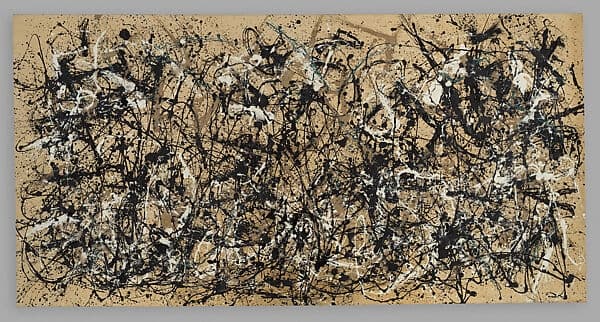
Autumn Rhythm (Number 30), 1950, is a canonical, museum‑held Jackson Pollock drip painting and is effectively off‑market at the Metropolitan Museum of Art. If hypothetically offered under optimal sale mechanics and market conditions, a defensible working range is $100–150 million, contingent on condition, provenance, deaccession constraints and the chosen sale pathway.
Valuation Analysis
Approach and anchors: This valuation uses a comparable‑analysis anchored to the highest transparent auction results for Pollock and directional private‑sale anchors. Autumn Rhythm is in the Metropolitan Museum of Art and has no modern auction record, so its market value is hypothetical and must be inferred from public sales and well‑reported private trades [1]. The clearest public auction anchor is Jackson Pollock’s Number 17 (1951), which realized $61,161,000 at Sotheby’s (Macklowe Collection) in November 2021 [2].
How anchors adjust to Autumn Rhythm: I treat the $61.16M result as a conservative public‑market floor for a marquee evening‑sale Pollock. Autumn Rhythm’s art‑historical prominence, large scale, and museum‑grade provenance justify a substantial premium to that public anchor when sold under optimal conditions. Widely reported private trades (e.g., No. 5, 1948; reported ~$140M, and reported transfers of other marquee Pollocks at still higher headline figures) inform an upper boundary but are discounted here because private deals lack the transparency and consistent comparability of auction records.
Sale mechanics and price formation: The ultimate price would be highly sensitive to sale mechanics. A single‑owner evening sale with robust guarantees, global pre‑sale marketing and a competitive bidder field or a negotiated private treaty with multiple competing bidders could realize prices toward the top of the $100–150M band. Conversely, placement in a day sale, unresolved legal or donor encumbrances, or adverse conservation findings could materially compress value.
Risk adjustments and contingencies: Museum ownership both enhances provenance (supporting value) and constrains liquidity (deaccession rules, donor covenants, reputational barriers). Condition and conservation outcomes, any unusual provenance questions, export or legal restrictions, and the macro market environment at sale time are all contingencies that can move value substantially. For this reason the band is intentionally conservative at the top end relative to the highest reported private anchors but assertive relative to public auction records.
Conclusion: On a reasoned interpolation between transparent auction anchors and directional private ceilings, and after applying prudent transaction and market discounts, I place Autumn Rhythm in a hypothetical market window of $100–150 million. This assumes ideal sale execution, strong buyer appetite, and no prohibitive legal or conservation constraints. To refine this estimate to a narrower figure would require full condition and technical reports, a complete provenance and exhibition dossier, confirmation of deaccession/transferability, and a defined sale strategy (auction vs private treaty).
Key Valuation Factors
Art Historical Significance
High ImpactAutumn Rhythm (Number 30) is widely recognized as one of Jackson Pollock’s signature mature drip canvases from c.1950 and occupies a central place in Canonical narratives of Abstract Expressionism. Its scale, execution and frequent reproduction in scholarship make it an icon rather than a representative secondary work. Buyers of trophy paintings pay for cultural primacy as much as for surface aesthetics; consequently, Pollock canvases of this rank attract institutional validation and private bidders bidding for a museum‑quality monument. For valuation purposes, significance is a primary upward driver: it justifies meaningful uplifts above median Pollock auction outcomes and supports the upper portion of the $100–150M band.
Rarity & Market Supply
High ImpactLarge, museum‑quality Pollock drip paintings that are fresh to the market are extremely scarce. Many of Pollock’s most important canvases are held in major institutions and rarely come to market; when they do, they tend to attract global competition. Autumn Rhythm’s current status in the Metropolitan Museum of Art amplifies that scarcity, because effective market supply is nearly zero while the work remains in public custody. Scarcity concentrates buying interest among ultra‑high‑net‑worth collectors and a handful of institutions, which elevates the probability of a premium result if the work were legitimately made available under strong sale mechanics.
Provenance & Exhibition History
High ImpactLongstanding Met ownership (acquired 1957, Hearn Fund) gives Autumn Rhythm exceptional institutional provenance, reducing authenticity risk and adding reputational value—both crucial for trophy‑level pricing. A robust exhibition record, catalogue raisonné citations and scholarly treatment further increase marketability and justify investor confidence. However, museum provenance also tends to introduce deaccession protocols and donor covenants that can impede a sale or require extended approvals; those governance restraints are value‑relevant. Overall, pristine provenance and exhibition pedigree are high‑impact positives for headline pricing, but they come paired with practical constraints on monetization.
Condition & Conservation
Medium ImpactPollock’s drip surfaces are generally stable but can be affected by earlier restorations, varnish history, support interventions and environmental exposure. A full technical and conservation dossier (high‑resolution photography, X‑rays, pigment analysis and condition report) is essential to underwrite a top‑tier valuation. Adverse findings such as active flaking, unsympathetic overpaints or unsupported relining histories would depress buyer confidence and realizations. Conversely, a clean, well‑documented conservation record will support premium pricing. This factor is medium impact because it can either blunt or amplify the benefits of significance and provenance.
Sale Mechanics & Market Timing
High ImpactThe chosen selling pathway—marquee evening auction with guarantees, private treaty with multiple interested bidders, or single‑owner superstar sale—has disproportionate influence on final price. Evening sales with white‑glove marketing and competitive bidding historically produce the deepest price discovery; private sales can exceed auction results when structured with competing buyers and confidentiality, but lack transparency. Timing relative to macroeconomic and art‑market cycles matters: a robust market and positive signalling events (major retrospectives, blockbuster single‑owner auctions) increase the odds of reaching the upper band. This is a high‑impact variable: optimal mechanics and timing materially increase probability of achieving $100–150M.
Sale History
Autumn Rhythm (Number 30) has never been sold at public auction.
Jackson Pollock's Market
Jackson Pollock is a cornerstone of the post‑war market and a blue‑chip artist whose marquee drip canvases command the highest prices in his oeuvre. Public auction records (the highest transparent sale near $61M) coexist with widely reported private transactions that suggest much higher private‑market ceilings. The market is bifurcated: canonical, museum‑grade works retain strong demand from deep‑pocketed private collectors and select institutions, while mid‑tier and smaller works show more price variability. Pollock remains a top‑tier collectible: masterpieces move markets and are traded through bespoke channels when available.
Comparable Sales
Number 17
Jackson Pollock
Same artist; late-period large drip canvas sold as a marquee evening lot — the strongest transparent public auction anchor for Pollock.
$61.2M
2021, Sotheby's New York (The Macklowe Collection, Evening Sale)
~$73.1M adjusted
Number 19
Jackson Pollock
Late‑1940s drip painting sold in an evening sale; similar period/technique and a major auction-level comparable for market expectations.
$58.4M
2013, Christie's New York (Post‑War & Contemporary Art Evening Sale)
~$81.2M adjusted
Number 28
Jackson Pollock
Drip painting from 1949 sold in a day sale; illustrates market tiering and effect of sale placement/season on realized price.
$6.7M
2023, Christie's New York (Day Sale, Ann & Gordon Getty collection)
~$7.1M adjusted
No. 5
Jackson Pollock
Iconic 1948 drip; widely reported private trade frequently cited as a private-market ceiling — useful directional anchor though not auction-verified.
$140.0M
2006, Private sale (widely reported; David Geffen sale, Nov 2006)
~$224.9M adjusted
Number 17A
Jackson Pollock
Widely reported high-value private transaction often cited in Pollock price benchmarks; implies very high private-market ceilings if reports are accurate.
$200.0M
2016, Private sale (widely reported; Geffen → Kenneth C. Griffin, c.2015/2016)
~$270.0M adjusted
Current Market Trends
Current conditions show a flight to quality: aggregate auction values softened in recent windows, but top post‑war masterpieces remain in demand. Houses increasingly deploy guarantees, private treaties and marquee single‑owner sales to capture trophy pricing, supporting robust private‑sale ceilings even when public auction totals are uneven. Macro factors and timing remain material; optimal marketing and sale structure are essential to realize headline valuations.
Sources
- Metropolitan Museum of Art — collection entry: Autumn Rhythm (Number 30)
- Sotheby's — The Macklowe Collection: Jackson Pollock, Number 17 (1951) sale
- Christie's press release — Jackson Pollock, Number 19 (1948) price realized (2013)
- Chron — reporting on widely cited private sale of Pollock's No. 5 (2006)
- Artnet News — reporting on reported private transfers of marquee Pollock works
- Christie's — overview for high‑profile single‑owner sales (example: Newhouse sale)