How Much Is Full Fathom Five Worth?
Last updated: July 22, 2026
Quick Facts
- Methodology
- comparable analysis
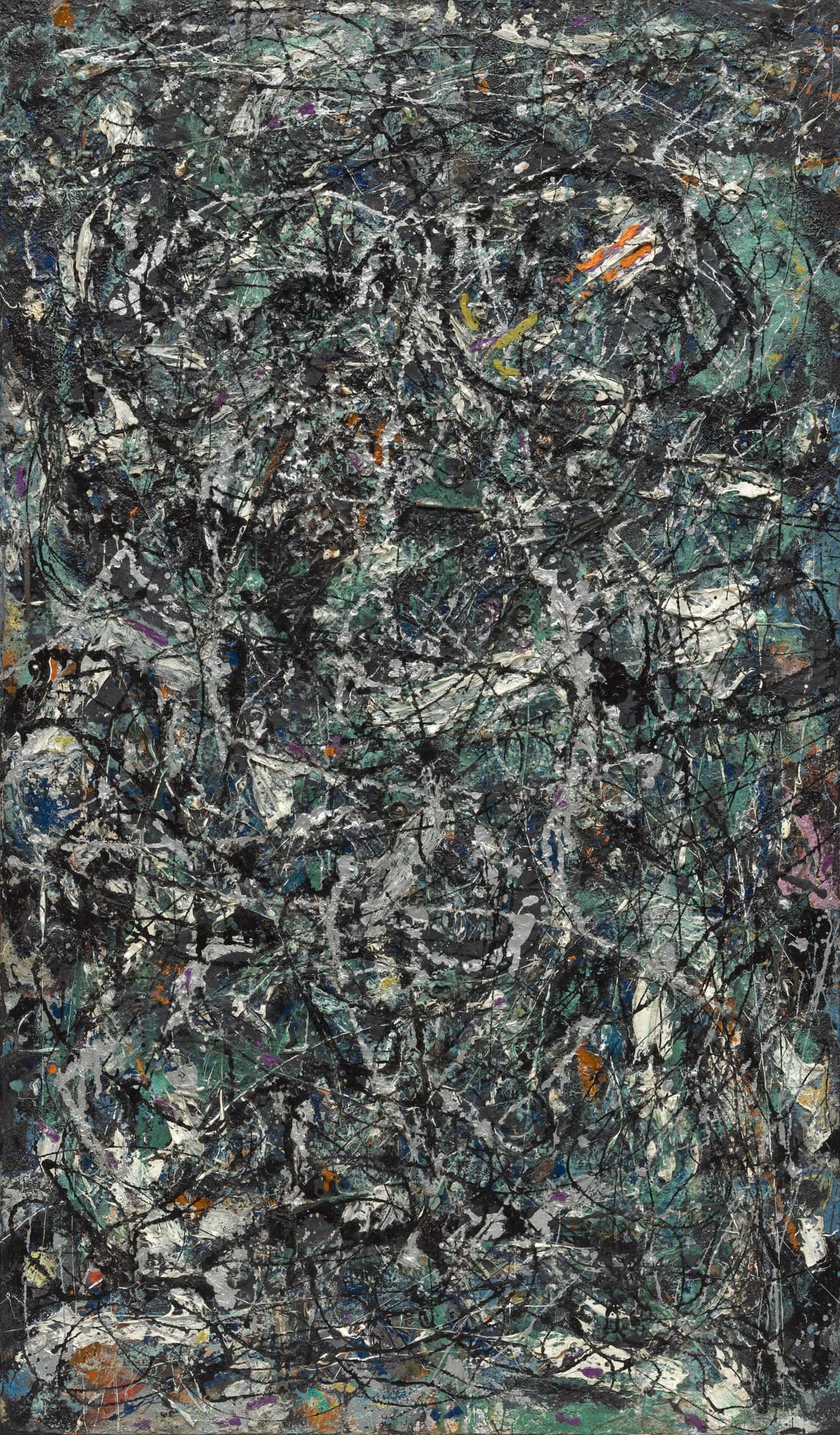
Full Fathom Five (1947) is a seminal early drip painting by Jackson Pollock and a cornerstone of MoMA’s collection. Anchored by Pollock’s 2026 auction record of $181.2m for a 1948 drip and widely reported private benchmarks at $200m and $140m, a realistic hypothetical open‑market value today is $220–$280 million. Its art‑historical primacy and extreme scarcity justify a level above the current public record despite its more modest scale.
Valuation Analysis
Work and status. Jackson Pollock’s Full Fathom Five (1947) is one of the first fully realized drip paintings, measuring 50 7/8 x 30 1/8 in (129.2 x 76.5 cm), executed in oil on canvas with embedded objects. It is in the permanent collection of the Museum of Modern Art, New York, acquired as a gift from Peggy Guggenheim in 1952, and has no public sale history [1]. As a museum cornerstone from the dawn of the drip technique, it occupies a critical position in Pollock’s oeuvre and the narrative of Abstract Expressionism.
Comparable anchor points. The public market for top-tier Pollock drips was reset in 2026, when Number 7A, 1948 sold at Christie’s for $181.2 million with fees, establishing a new auction record for the artist [2]. Private benchmarks for masterpieces in the same core period include the widely reported $200 million purchase of Number 17A (1948) in 2015 and the $140 million sale of No. 5, 1948 in 2006 [3][4]. Below this apex tier, significant but secondary benchmarks include $61.16 million for Number 17, 1951 (Macklowe Collection, 2021) and $54.21 million for Number 31, 1949 (2022), underscoring depth of demand across Pollock’s post‑1947 production [6][7].
How the range was derived. We position Full Fathom Five above the 2026 public record because of its singular art‑historical status as a 1947 breakthrough drip and its canonical visibility within MoMA’s galleries and scholarship [1][2]. While smaller than the largest 1948–50 canvases, its primacy within the development of the drip method partly offsets scale effects that can otherwise drive pricing. The scarcity of comparably important early drips outside institutions further supports an upward extrapolation from the $181.2 million public anchor and tight alignment with the $200 million private benchmark. On this basis, a hypothetical open‑market estimate of $220–$280 million is warranted today.
Market context and momentum. The top end of the Postwar/Modern market has re‑concentrated around blue‑chip names, with 2025–26 seeing renewed confidence and multiple records (including Pollock’s) amid strong evening‑sale performance; this backdrop is supportive for A+ Pollock material [2][5]. Third‑party guarantees and curated single‑owner contexts have further catalyzed competition at the trophy level. In such an environment, a museum‑quality early drip with undeniable scholarship would likely command intense global bidding.
Conclusion. Treating Full Fathom Five as a notional market candidate, we synthesize recent public and private comparables, qualitative art‑historical primacy, and current market dynamics into a robust valuation of $220–$280 million. As the work is museum‑held and effectively off‑market, this figure should be read as a benchmark of fair market value rather than a forecast of transaction likelihood [1][2][3][5].
Key Valuation Factors
Art Historical Significance
High ImpactCreated in 1947, Full Fathom Five is among Pollock’s earliest fully realized drip paintings—the breakthrough that redefined his practice and the trajectory of postwar abstraction. It is repeatedly cited in scholarship and exhibitions as a touchstone for the genesis of the drip technique, and it holds pride of place within MoMA’s narrative of Abstract Expressionism. This primacy endows the work with a qualitative premium independent of sheer size, placing it in the conversation with the most canonically important Pollocks. As a widely reproduced, frequently taught image, its cultural salience compounds its market stature [1].
Scarcity and Ownership (Museum-held)
High ImpactMasterpiece-level drip canvases from 1947–50 are exceptionally scarce in private hands; most reside in top museums. Full Fathom Five has been in MoMA’s collection since 1952 (gift of Peggy Guggenheim) and has never been publicly offered, underscoring its rarity and desirability [1]. When works of comparable caliber do surface, competitive depth is strong, as evidenced by the 2026 auction record. The structural lack of supply elevates hypothetical fair market value because collectors cannot easily substitute another example with equivalent art-historical weight, especially from the critical 1947 breakthrough year [2].
Market Benchmarks and Momentum
High ImpactThe 2026 sale of Number 7A, 1948 at $181.2m with fees re-anchored public pricing for top Pollock drips [2]. Widely reported private deals—$200m for Number 17A (2015) and $140m for No. 5, 1948 (2006)—demonstrate willingness to pay above public records for masterpiece-caliber works [3][4]. Additional public results in 2021–2022 at $61.16m (Number 17, 1951) and $54.21m (Number 31, 1949) show robust demand across periods, creating a strong price gradient into the nine figures for the very best canvases [6][7]. Combined with supportive blue-chip Postwar sentiment in 2025–26, these comparables justify a $220–$280m range [5].
Scale and Physical Characteristics
Medium ImpactAt 50 7/8 x 30 1/8 inches, Full Fathom Five is smaller than monumental 1948–50 canvases that often set records. Size can influence pricing at the trophy level, where wall impact and presence matter. However, the painting’s 1947 date, dense allover composition, and materially rich surface (oil with embedded objects) deliver exceptional aesthetic and historical value that partially offsets scale considerations [1]. In practical terms, scale may temper the very top of the range relative to the largest 1948–50 works, but the work’s primacy keeps it firmly within the apex tier of Pollock valuations.
Sale History
Full Fathom Five has never been sold at public auction.
Jackson Pollock's Market
Jackson Pollock is a defining figure of 20th‑century art and among the most in‑demand Postwar masters. The market distinctly prizes his mature drip paintings from 1947–50, with a new auction record of $181.2m set in 2026 for Number 7A, 1948, nearly tripling his prior public peak [2]. Private benchmarks have reached even higher, including the widely reported $200m purchase of Number 17A in 2015 and $140m for No. 5, 1948 in 2006 [3][4]. Significant results for works from adjacent periods—such as $61.16m for Number 17, 1951 (Macklowe Collection) and $54.21m for Number 31, 1949—demonstrate broad depth and a steep price gradient culminating in nine‑figure sums for the finest drip canvases [6][7].
Comparable Sales
Number 7A, 1948
Jackson Pollock
Major 1948 drip painting from Pollock’s peak period; closest recent public benchmark for a top-tier drip canvas in scale and stature.
$181.2M
2026, Christie's New York (Masterpieces: The Private Collection of S.I. Newhouse)
~$177.6M adjusted
Number 17A, 1948 (private sale)
Jackson Pollock
Widely reported private sale of a masterpiece‑level 1948 drip; directly comparable in period and canonical status to an A‑tier work like Full Fathom Five.
$200.0M
2015, Private sale (reported, to Kenneth C. Griffin)
~$276.0M adjusted
No. 5, 1948 (private sale)
Jackson Pollock
Iconic 1948 drip painting; among the most famous Pollocks. Serves as a high‑end private benchmark for trophy‑level drips.
$140.0M
2006, Private sale (reported)
~$226.8M adjusted
Number 19, 1948
Jackson Pollock
Prime 1948 drip painting sold publicly; excellent period match and widely cited pre‑2026 public benchmark.
$58.4M
2013, Christie's New York
~$82.3M adjusted
Number 17, 1951
Jackson Pollock
Major 1951 canvas from the black‑and‑white series; strong recent public price for a top Pollock, showing depth of demand across periods.
$61.2M
2021, Sotheby's New York (The Macklowe Collection)
~$74.0M adjusted
Number 31, 1949
Jackson Pollock
Blue‑chip 1949 drip painting; close in period and technique to Full Fathom Five and a key public reference from the last cycle.
$54.2M
2022, Christie's New York (20th Century Evening Sale)
~$60.7M adjusted
Current Market Trends
The top end of the global art market has rotated back toward blue‑chip Modern and Postwar masters, with improved liquidity and confidence in 2025–26 after a reset in 2023–24. High‑profile evening sales set multiple records, including Pollock’s $181.2m auction peak, reflecting concentrated demand for scarce, historically important works [2]. The Art Basel & UBS reports describe renewed strength at the high end and continued dominance of Postwar art by value, supported by third‑party guarantees and curated single‑owner offerings [5]. Against this backdrop, masterpiece‑level Abstract Expressionism has been a leading beneficiary, sustaining robust pricing when top examples appear.
Sources
- Museum of Modern Art (MoMA): Full Fathom Five, 1947
- Christie’s Press Release (May 18, 2026): Newhouse sale sets Pollock auction record at $181.2m
- The Art Newspaper (Feb 18, 2016): Ken Griffin spends reported $500m on two Abstract Expressionist paintings
- Los Angeles Times (Nov 3, 2006): Pollock work reportedly fetches $140 million
- Art Basel & UBS Global Art Market Report 2026: Market overview and trends
- New York State Division of Tax Appeals (Order, 2023): Price details for Pollock, Number 17, 1951 (Macklowe Collection)
- Artnet News (May 13, 2022): 20th Century Evening Sale results incl. Pollock Number 31, 1949 at $54.2m