How Much Is Number 32, 1950 Worth?
Last updated: May 7, 2026
Quick Facts
- Methodology
- comparable analysis
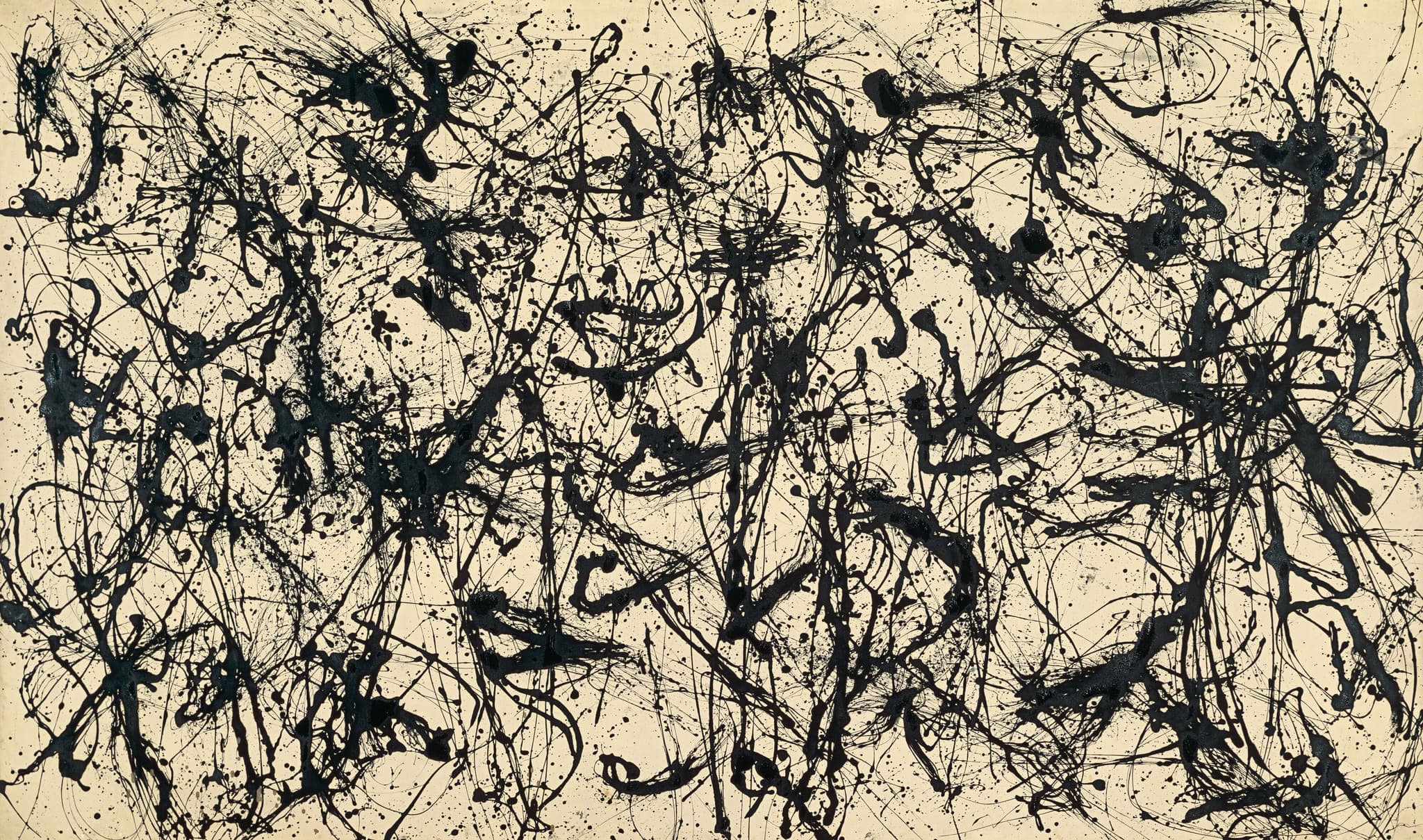
Number 32, 1950 is a museum‑quality, monumental Jackson Pollock (catalogue‑raisonné entry; Kunstsammlung NRW). Balancing auditable public‑auction precedent and widely reported private‑sale ceilings, a conservative presale range for an open‑market offering is $100–150 million.
Valuation Analysis
Valuation conclusion: Based on catalogue‑raisonné inclusion, the painting's monumental dimensions (approx. 269 × 457.5 cm), and continuous museum ownership since 1964, I estimate a conservative public‑auction presale range of $100,000,000–$150,000,000 for Jackson Pollock's Number 32, 1950 if it were to be offered on the open market. This range balances auditable public‑auction precedent with widely reported private‑sale ceilings and the premium that museum‑grade, large‑scale Pollocks command.
Number 32 is documented in the Kunstsammlung Nordrhein‑Westfalen collection entry, which confirms the verso inscription, O'Connor/Thaw catalogue‑raisonné listing and the museum accession (acquired 1964) — evidence that materially reduces attribution and title risk [1]. Because the work is a canonical, mature‑period drip painting of exceptional scale and with long exhibition/publication history, it sits among the artist's most desirable works. Public‑auction precedent is represented by Christie’s 2013 sale of Number 19 (the artist's public auction high‑water mark), which is the most conservative, auditable benchmark for top‑end Pollock prices on the open market [2].
However, the market has demonstrated a higher private‑sale ceiling for canonical Pollocks: widely reported private transactions have established that deeply motivated buyers will pay sums materially above public‑auction highs when the work is pre‑eminent or sold privately [3]. The valuation range offered here therefore deliberately sits above inflation‑adjusted public‑auction highs and below the reported private‑sale ceilings to reflect a realistic expectation for a museum‑quality masterpiece entering a public sale with strong marketing, guarantees and international buyer engagement.
Key value drivers that justify the $100–150M band include the painting's size (a decisive multiplier), its unbroken, reputable provenance and museum imprimatur, and its catalogue‑raisonné and exhibition record, all of which increase buyer confidence and competitive bidding. Offsetting uncertainties that temper the top end are: the absence of a recent sale for this specific canvas (it has remained in institutional care), the need for an up‑to‑date technical/condition report, and potential legal/export constraints given museum ownership in Germany. Any conservation issues would require downward adjustment; conversely, pristine condition and a strategic sale plan (guarantees, seed lots, cross‑market promotion) could push final proceeds toward the high end or trigger a private treaty outcome above the stated band.
Next steps for a formal, transaction‑ready valuation: obtain the museum's current condition and conservation reports, secure high‑resolution photography and technical analysis, confirm legal/title and export status, and solicit confidential market assessments from Christie’s and Sotheby’s evening‑sale specialists. With those documents, a formal auction presale estimate and sale strategy can be finalized.
Key Valuation Factors
Art Historical Significance
High ImpactThis painting dates to 1950, mid‑career of Pollock’s mature drip phase, representing his large‑scale 'all‑over' technique. As such, it carries substantial art‑historical weight. Numbered works from this period are central to the narrative of Abstract Expressionism and Action Painting and appear in major exhibitions and scholarship. The painting's catalogue‑raisonné listing and inclusion in major retrospectives confirms its canonical status, increasing desirability among institutions and top private collectors. Blue‑chip demand for canonical Pollocks is strong because the pool of museum‑quality, large‑scale works is small. For valuation, art‑historical significance raises both presale estimates and the probability of competitive bidding, making it a primary positive driver in price formation.
Provenance & Exhibition History
High ImpactProvenance is continuous from Pollock's studio to Lee Krasner to Marlborough‑Gerson Gallery and to Kunstsammlung NRW (acquired 1964). This unbroken, reputable chain and museum accession strongly mitigate attribution and title risk, which is critical for achieving premium prices. The painting has exhibition and publication history that enhances scholarly recognition and collector confidence. Museum ownership often functions as a market imprimatur, allowing bidders to pay a premium relative to works with gaps or private‑only provenance. Where present, loans to major retrospectives and catalogue‑raisonné inclusion materially increase liquidity and price; for Number 32 these documentation factors are among the most significant positive inputs to the valuation.
Size & Physical Attributes
High ImpactAt approximately 269 × 457.5 cm (≈106 × 180 in), Number 32 is a monumental canvas. Scale is a decisive multiplier in the Pollock market; very large 'all‑over' canvases are scarce and command outsized attention from major institutions and well‑funded private collectors. The painting's medium (varnish/enamel on canvas) and technique are consistent with Pollock's mature methods, which supports authenticity and market desirability. Size affects display logistics, insurance, transport and buyer pool; although it limits the number of potential buyers, it increases the work's status and competitive intensity when offered. In short, size is a high‑impact, value‑enhancing attribute for this work.
Condition & Conservation
Medium ImpactCondition and conservation history are critical variables. Museum stewardship suggests the work is likely well conserved, but no public conservation report was located. Any significant overpainting, relining, structural instability, or heavy restoration could materially depress value; conversely, a stable conservation history maintains top‑tier pricing. Conservation also influences market route — a perfectly stable painting will attract more aggressive guarantees and wider buyer participation. For a formal valuation or sale planning, a full technical examination (high‑resolution photography, cross‑sections, pigment analysis, varnish and ground studies) and an up‑to‑date condition report from the Kunstsammlung NRW would be required to finalize any presale estimate.
Market Comparables & Liquidity
High ImpactComparables drive the numerical estimate: Christie’s 2013 Number 19 (public auction high‑water mark) and widely reported private sales (e.g., 2016/2006) establish the market band. Public‑auction precedent sets a conservative, auditable floor (Number 19, 2013, ~US$58.4M, inflation‑adjusted higher), while private‑sale reports define a potential ceiling (reported sales up to ~US$200M). Because Number 32 is museum‑grade and exceptionally large, its likely eventual selling price would sit well above average auction results for mid‑sized Pollocks but under or near private‑sale ceilings depending on buyer appetite. Liquidity is strong at the very top end; when masterpieces appear, they attract deep‑pocketed global buyers and financial intermediaries, elevating price potential.
Sale History
Number 32, 1950 has never been sold at public auction.
Jackson Pollock's Market
Jackson Pollock occupies a preeminent position in the postwar American and global modern art markets. His late 1940s–early 1950s drip canvases are among the most sought‑after and liquid works within the blue‑chip postwar category. Public auction records, including the 2013 Christie’s sale of Number 19, provide a documented high‑water mark for the artist on the public market, while privately reported transactions have established a substantially higher ceiling for canonical canvases. Demand is concentrated among major museums, deep‑pocketed private collectors and increasingly competitive institutional buyers, creating a durable top tier. Because supply of museum‑quality, monumental Pollocks is extremely limited, price discovery for masterpieces tends to be robust.
Comparable Sales
Number 19, 1948
Jackson Pollock
Same artist and the same mature drip period (late‑1940s/early‑1950s). This is the artist's public‑auction high‑water mark and therefore a primary auction-market precedent when estimating a hypothetical sale for another museum‑quality Pollock.
$58.4M
2013, Christie's New York (Evening sale)
~$79.5M adjusted
Number 17A, 1948 (reported)
Jackson Pollock
Widely reported private‑treaty transaction for a canonical 1948 Pollock. Same artist/period and used in press as a market ceiling for Pollock masterpieces. Useful as a private‑market ceiling, though figures are not auction‑verified.
$200.0M
2016, Private sale (widely reported)
~$264.2M adjusted
No. 5, 1948 (reported)
Jackson Pollock
Another well‑known reported private sale of a landmark 1948 drip painting. Like Number 17A, it illustrates the high end of private demand for canonical Pollocks and helps define a private‑sale ceiling for museum‑quality canvases.
$140.0M
2006, Private sale (widely reported)
~$220.1M adjusted
Untitled (c.1948)
Jackson Pollock
Recent public‑auction sale of a strong but less monumental Pollock from the same general era (reported Nov 2024). Useful to gauge mid‑market levels for quality works that lack the scale or museum provenance of Number 32.
$15.3M
2024, Phillips New York
~$15.5M adjusted
Current Market Trends
Demand for canonical postwar masterpieces remains robust among top collectors and institutions, while supply is constrained—especially for museum‑grade Pollocks. Macroeconomic volatility can temper the breadth of bidder pools, but high‑net‑worth buyers and private institutions continue to compete aggressively for blue‑chip works. Auction guarantees, third‑party guarantors and private‑treaty channels have become standard mechanisms to manage risk and unlock liquidity at the highest levels. As a result, truly exceptional Pollocks rarely see downward price discovery; when offered, they can outperform broader market indices due to concentrated demand and proven long‑term collectability. Currency stability and wealth concentration in key markets (U.S., Europe, Middle East, Asia) also support continued appetite for marquee works.