How Much Is Nocturne in Black and Gold: The Falling Rocket Worth?
Last updated: May 1, 2026
Quick Facts
- Last Sale
- $10K (1946, Private dealer sale to Dexter M. Ferry, Jr.; donated to Detroit Institute of Arts (accession 46.309))
- Methodology
- comparable analysis
If this is the canonical Nocturne in Black and Gold: The Falling Rocket (the 1875/77 canvas central to Whistler’s libel case), it is a museum‑quality masterpiece and would command a hypothetical market/replacement value of roughly $15–60M. If it is a genuine secondary study by Whistler: ~$2–8M; if a workshop or later copy: ~$50k–1M.
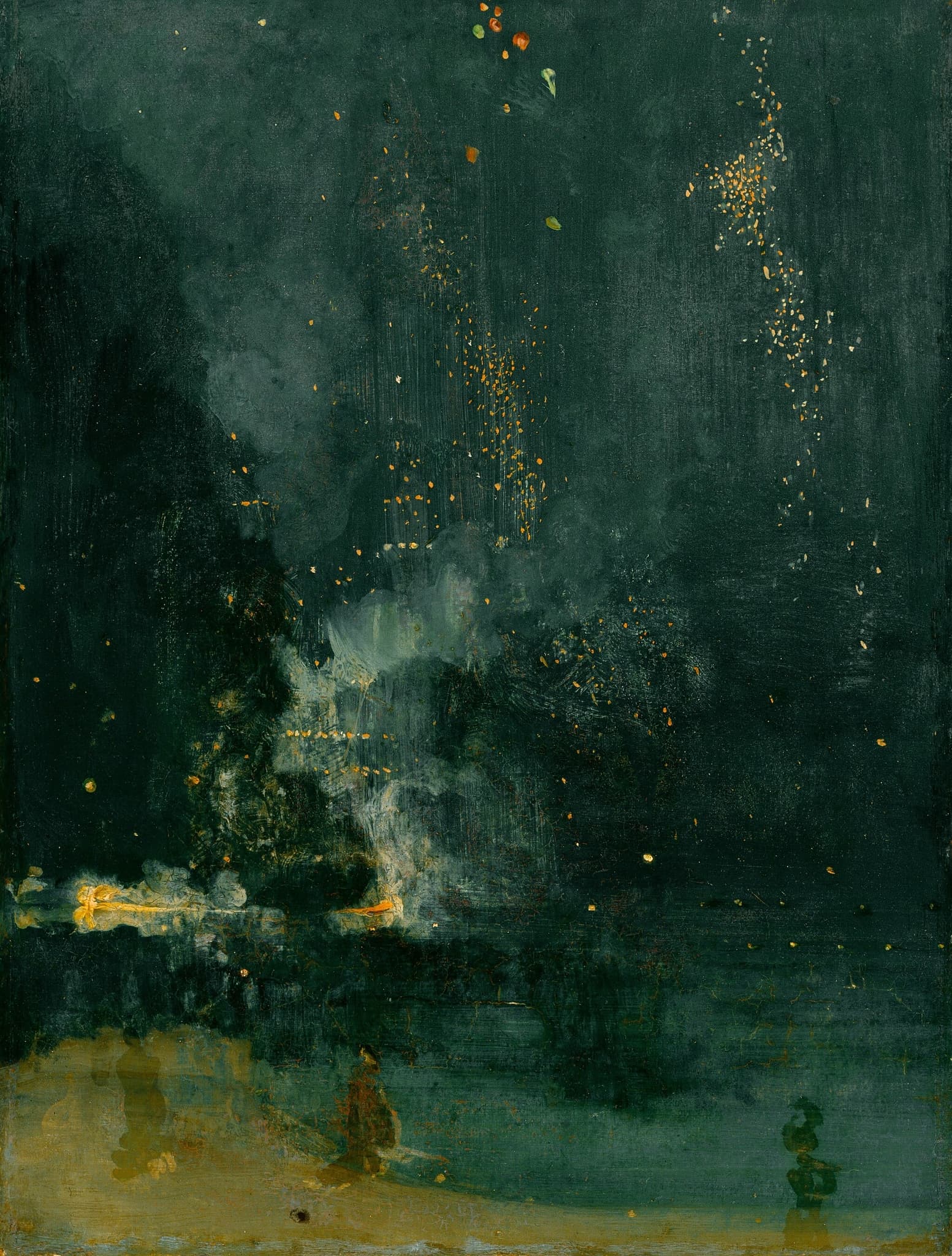
Nocturne in Black and Gold: The Falling Rocket
James Abbott McNeill Whistler • Oil on canvas
View more by James Abbott McNeill Whistler →Valuation Analysis
Valuation conclusion: The valuation presented here is a market‑facing, conservative band based on comparable market evidence, scarcity, and the painting’s historical prominence. If the object is the primary Falling Rocket with solid provenance and good condition, the realistic market/replacement range is approximately $15–60 million. If the object is a documented secondary study by Whistler, the range falls to $2–8 million, and if it proves to be a studio or later copy, the range is roughly $50,000–1,000,000.
Why comparable analysis: Whistler’s active market is thin at the high end because his best nocturnes and portraits are held in institutions and rarely appear for sale. Pricing therefore must reconcile (a) empirical auction results for Whistler oils and works on paper and (b) the extraordinary cultural premium attached to an iconic, provenance‑secure, museum masterpiece. The Detroit Institute of Arts records this title in its collection and lists clear provenance to Untermyer and the 1940 Parke‑Bernet sale, which anchors the attribution and institutional history for the canonical canvas [1]. Additional provenance and sale notes are catalogued in Whistler scholarship and cataloguing resources [2].
The lower‑end Whistler comparables (recent Christie’s/Bonhams results for fresh‑to‑market portraits and small oils realized in the high hundreds of thousands to low single‑millions) set a practical baseline for what the market regularly transacts. The upper band for this valuation reflects the non‑repeatable nature of a single culturally iconic canvas: trophy buyers, institutions and foundations can and do pay large premiums when an artwork of singular historical importance and unquestioned authenticity becomes available. That dynamic produces the bifurcated outcome: typical Whistler sales populate the low end of the market; a canonical Falling Rocket — if saleable — would sit well above ordinary comparables.
Principal risks and next steps: This valuation is provisional. The single most important variables are (1) absolute confirmation of which physical object this is (catalogue‑raisonné number, support, dimensions, recto/verso images and labels), (2) a modern technical/condition report (X‑ray, IR, pigment analysis and restoration history), and (3) full documentation of continuous provenance and title. If you want a transaction‑grade appraisal, obtain high‑resolution images (recto/verso), the DIA/Untermyer/Parke‑Bernet documentation, and a specialist technical assessment; following that, leading auction house 19th‑century specialists can provide a formal confidential estimate and sale strategy.
References supporting this band: the Detroit Institute of Arts catalogue entry and the Whistler scholarship/provenance record supply the core attribution and ownership trail that justify treating the work as a museum masterpiece if the match is exact [1][2].
Key Valuation Factors
Art Historical Significance
High ImpactNocturne in Black and Gold: The Falling Rocket is one of Whistler’s most culturally resonant works by virtue of its role in the 1877 Grosvenor Gallery exhibition and the subsequent 1878 libel trial with John Ruskin. That provenance gives the painting an outsized place in art history, meaning its value is driven not just by formal quality but by narrative and institutional desirability. Institutions and major collectors prize works that are emblematic of an artist’s career or a defining historical moment; that premium is the primary reason a canonical Falling Rocket would sit well above ordinary Whistler market comparables.
Provenance & Exhibition History
High ImpactA continuous, well‑documented provenance that ties the canvas to Whistler, to early collectors (Untermyer) and to the Parke‑Bernet sale materially strengthens market value and marketability. The DIA accession and published provenance reduce attribution risk and make institutional purchase or private sale more feasible. Any gaps, contested ownership, or missing documentary links would materially lower buyer confidence and therefore price; conversely, confirmed loans to major exhibitions or authoritative catalogue‑raisonné citations will lift value toward the top of the range.
Condition & Conservation
Medium ImpactCondition can be decisive. A well‑preserved panel or canvas with limited restoration supports the upper valuation band; conversely, heavy overpainting, structural instability, or extensive retouching reduces value materially. Technical analysis (pigment sampling, X‑ray/IR, varnish study) can also corroborate chronology and authorship; such results may increase market confidence and allow auction houses to place the work in top‑room sales or target museum buyers. A formal conservation report is required to finalize any sale estimate.
Market Comparables & Rarity
High ImpactEmpirical auction evidence for Whistler oils sits in the low single‑millions for top results, while prints and small works frequently trade for much less. Because the Falling Rocket is unique in historical weight and rarity, its valuation must bridge ordinary Whistler comparables and broader 19th‑century trophy outcomes. The scarcity of comparable museum‑quality nocturnes on the market increases potential upside, but the limited pool of buyers for such a work caps short‑term liquidity and can constrain realized price relative to headline‑trophy sales.
Legal/Institutional Constraints & Marketability
Medium ImpactInstitutional ownership, donor restrictions, export controls or disputed title can effectively render a work unsaleable or impose long delays and added transaction costs. A canonical Falling Rocket in a museum collection is typically treated as inalienable by curators; if publicly offered, saleability would attract only the most powerful institutional and private buyers. Clearance of donor terms, export permits and title warranties are essential prerequisites for a clean market sale and will influence net proceeds and the feasible buyer pool.
Sale History
Private sale (Samuel Untermyer, New York)
Parke‑Bernet, New York (lot 29)
Private dealers (Knoedler / Scott & Fowles) sale to Dexter M. Ferry, Jr.
Detroit Institute of Arts (accession 46.309)
James Abbott McNeill Whistler's Market
James Abbott McNeill Whistler occupies a specialized but resilient position in the market: active demand exists for works on paper and small oils, while large museum‑quality nocturnes and portraits seldom appear. Auction results for premium Whistler oils and portraits in recent years have generally ranged from mid‑six figures to low millions, demonstrating strong interest but a limited high‑end liquidity. The primary driver of upward price movement is scarcity combined with fresh provenance or exhibition history; institutional retrospectives and scholarship periodically lift market attention and realized prices.
Comparable Sales
Whistler Smoking
James Abbott McNeill Whistler
Recent major-house sale of a rare small Whistler oil on panel — shows current auction ceiling for premium small Whistler oils.
$1.2M
2021, Christie's New York
~$1.4M adjusted
Portrait of Lucas Alexander Ionides
James Abbott McNeill Whistler
Fresh-to-market, exhibition-quality Whistler portrait that outperformed estimates — demonstrates premium for high‑quality, museum‑grade Whistler works when they appear.
$544K
2024, Bonhams, London
~$562K adjusted
Nocturne (etching) – Swann Galleries record sale
James Abbott McNeill Whistler
Record print sale for a Whistler Nocturne — indicates collector demand and high prices for rare Nocturne states/prints, but in a different medium (prints vs oil).
$282K
2010, Swann Galleries
~$420K adjusted
Meules (Haystacks)
Claude Monet
Blockbuster 19th-century trophy sale — useful as a ceiling/comparative for what a unique, museum‑icon work from this period can achieve in top-market conditions.
$110.7M
2019, Sotheby's, New York
~$140.7M adjusted
Lady with a Fan
Gustav Klimt
Recent high‑profile sale of an iconic early‑20th‑century work — another example of the trophy ceiling for culturally important single works, relevant when modelling an upper‑end scenario for a museum masterpiece.
$108.4M
2023, Sotheby's, London
~$115.5M adjusted
Current Market Trends
The global market cooled in 2024–25 with selective buyer activity at the top end; that has made fresh, well‑provenanced museum‑quality works relatively more desirable when they appear. Major retrospectives (notably large Whistler exhibitions scheduled in 2026) are likely to increase scholarly and collector attention, potentially strengthening demand for top examples tied to major publications and loans.
Sources
- Detroit Institute of Arts — collection entry: Nocturne in Black and Gold, the Falling Rocket
- Whistler Paintings (University of Glasgow) — provenance and sale notes
- Christie's / secondary reporting — example high‑end Whistler oil (Whistler Smoking, Christie’s New York 2021)
- Bonhams press release — Portrait of Lucas Alexander Ionides (strong fresh‑to‑market result, Sept 2024)
- Sotheby's — example of a 19th‑century trophy sale (Monet, Meules) illustrating upper market ceilings