How Much Is Untitled (c.1959) Worth?
Last updated: July 6, 2026
Quick Facts
- Last Sale
- $29.2M (2023, Christie's New York)
- Methodology
- comparable analysis
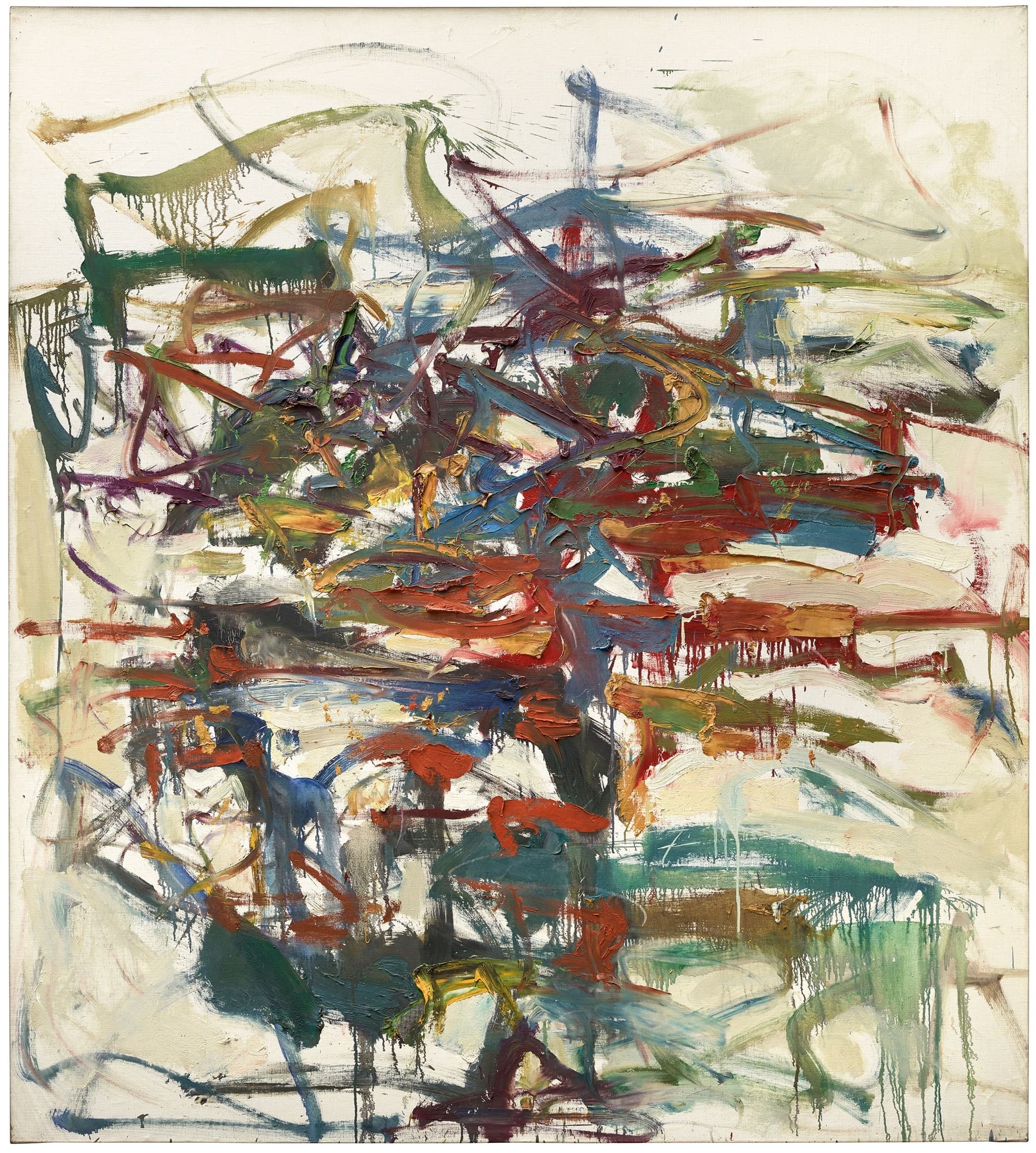
With no images, dimensions or provenance supplied, the market for a Joan Mitchell 'Untitled (c.1959)' is wide: roughly $300,000–$29,160,000. The low end reflects small/poorly documented canvases; the high end is set by Christie’s Nov 9, 2023 auction record for an Untitled (c.1959) and represents the ceiling for a large, museum‑quality, well‑provenanced example [1].
Valuation Analysis
Bottom line: Assuming the painting is an authentic Joan Mitchell 'Untitled (c.1959)' but without images, measurements or provenance, a defensible market range runs from $300,000 to the artist's demonstrated auction ceiling of $29,160,000. The lower bound reflects small, undistinguished or poorly documented works that typically appear in day sales; the upper bound reflects the specific Christie’s Nov 9, 2023 realized result that functions as the current market ceiling for a top example [1].
The Christie’s Nov 9, 2023 'Untitled (c.1959)' is the primary direct comparable and is the clearest evidence of what a large, museum‑quality, fully documented late‑1950s Mitchell can command at auction. If your painting matches that lot in scale, condition and provenance, market value would reasonably be placed toward the high‑single to low‑double‑digit millions and up toward the realised figure; if it does not, value will be materially lower [1].
Other recent headline results (mid‑to‑late career canvases and gallery placements) confirm that when timing, guarantees and buyer interest align, Mitchell canvases can trade in the $20–30M band; but the market is highly concentrated, and most activity clusters well below those headline numbers [2]. This divergence explains the wide valuation bandwidth and supports a scenario‑based approach rather than a single fixed figure in the absence of documentation.
Primary value drivers are: size/visual quality, provenance and exhibition/publication history, authentication (estate/catalogue raisonné), and condition/conservation. Provenance to a major collection or inclusion in museum exhibitions/publications can uplift value substantially; conversely, undocumented ownership histories or major restoration detract materially.
Practical next steps: obtain high‑resolution recto/verso images, exact measurements, stretcher/label details, and a conservator’s condition report. With that material a specialist at Christie’s, Sotheby’s or a leading dealer can issue a much narrower pre‑sale estimate and recommend the optimal sales channel (evening auction, private sale, or day sale). For insurance or sale planning, secure a formal appraisal by an accredited appraiser and consult the Joan Mitchell Foundation/estate for authentication guidance.
Scenario guidance (no documentation): Small/undistinguished canvas: $300,000–$1,000,000; solid mid‑market (good size, reasonable provenance): $1,000,000–$3,000,000; museum‑quality late‑1950s work with strong provenance/publication: $3,000,000–$6,000,000; exceptional, fully documented lot matching Christie’s 2023 sale: up to $29,160,000 (demonstrated ceiling) [1][2].
Key Valuation Factors
Art Historical Significance
High ImpactJoan Mitchell's late‑1950s output is widely regarded as a pivotal moment in her development: canvases from this period display the mature gestural vocabulary and chromatic complexity collectors and museums prize. A c.1959 canvas, if demonstrably by the artist and cited in scholarly literature or included in major retrospectives/catalogue raisonnés, will attract a premium. Works with solid scholarly attribution and exhibition history transition from the broad secondary market into the restricted market for museum‑quality examples, increasing competitive bidding and institutional interest. Conversely, an undocumented or derivative canvas from the period carries significantly less market weight and liquidity.
Size & Visual Quality
High ImpactScale and pictorial presence are decisive: large, museum‑scale canvases (the kinds that show Mitchell's full gestural range) command the highest prices. Small or study‑scale canvases tend to sit in the mid‑six‑figure to low‑seven‑figure band, while large, visually exceptional works attract institutional buyers and competitive evening‑sale bidding. Visual coherence, richness of palette, and clarity of gesture — the qualities that read as unequivocally Mitchellian at first sight — materially increase buyer confidence and value. Size and quality together determine where a work falls within the broad market dispersion.
Provenance & Exhibition History
High ImpactProvenance is a multiplier: documented descent from a notable private collection or a history of museum exhibition/publication reduces buyer risk and elevates marketability. The Christie’s 2023 record lot benefitted from being treated as a marquee evening sale item with strong supporting documentation, a presentation that attracts both institutions and deep‑pocket private buyers [1]. Gaps in provenance, unclear title histories, or absence from scholarly records create due‑diligence friction and typically necessitate discounted estimates or sale through lesser channels.
Condition & Conservation
Medium ImpactCondition issues — tears, relining, heavy inpainting, varnish discoloration or structural instability — materially reduce value and limit buyer participation at the top end. Buyers of high‑end post‑war canvases expect either an original stable surface or a clearly documented, sympathetic conservation history. Significant restoration can lower realized prices and may force sale in a less desirable market window. A formal condition report from a conservator experienced with post‑war oil on canvas is essential to finalize estimates and to inform a sales or insurance strategy.
Market Comparables & Timing
High ImpactRecent comparables — including Christie’s Nov 2023 Untitled (c.1959) at $29.16M and Sotheby’s high‑profile results in 2023–2024 — set the architecture for top pricing and demonstrate that exceptional Mitchells can enter the $20–30M band [1][2]. However, those headline figures are concentrated in a very small number of lots and are often supported by guarantees or private placements. Timing (evening sale vs day sale), auction calendar concentration and the presence of guarantees are therefore central to achieving top prices.
Sale History
Christie's New York
Sotheby's New York
Sotheby's New York
Christie's New York
Joan Mitchell's Market
Joan Mitchell is a blue‑chip post‑war American artist whose market has strengthened materially in recent seasons. Institutional interest, scholarly attention and centennial programming have raised visibility, while a small set of museum‑quality canvases now commands multi‑million and headline prices (a Christie’s Nov 2023 Untitled realized $29.16M). Market liquidity is concentrated: a few high‑quality works drive the top of the market while a broader secondary market exists at much lower price levels. Provenance, publication and condition are the primary determinants that separate trophy lots from everyday market offerings.
Comparable Sales
Untitled (c.1959)
Joan Mitchell
Direct match by title/year — the November 2023 lot is the artist's auction record and therefore the primary ceiling for large, museum-quality late‑1950s Mitchell canvases.
$29.2M
2023, Christie's New York
~$30.9M adjusted
Sunflowers (1990–91)
Joan Mitchell
Major, near-contemporary top-level sale showing sustained multi‑million demand for marquee Mitchell works across periods; useful as a headline comparable for high-end pricing dynamics.
$27.9M
2023, Sotheby's New York
~$29.6M adjusted
Noon (c.1969)
Joan Mitchell
Large, museum‑scale Mitchell from a later (c.1969) period sold strongly in May 2024 — a close size/scale/provenance comparable showing demand for major canvases beyond the 1950s.
$22.6M
2024, Sotheby's New York
~$23.3M adjusted
Current Market Trends
The market for Mitchell is selective but robust at the top end: recent record auction results and centennial institutional programming have increased demand for museum‑quality canvases, even as mid‑market activity remains more subdued. Guarantees and private sales continue to influence ceiling prices, and timing within the auction calendar materially affects outcomes. In short, exceptional late‑1950s Mitchells remain highly sought after, but documentation and sales strategy are decisive in capturing premium results.