Lady with an Ermine Auction History
There is no public auction record for Leonardo’s Lady with an Ermine. The painting entered the Czartoryski collection around 1798 and, with the entire collection, was purchased by the Polish State Treasury in 2016 for €100m (collection price), with custodianship by the National Museum in Kraków. It is now on permanent view at the Princes Czartoryski Museum in Kraków.
- Artwork
- Lady with an Ermine
- Artist
- Leonardo da Vinci
- Best-known sale or transfer
- 2016 €100m state purchase of Czartoryski Collection
- Sale type
- No known public sale
- Current location / owner
- Princes Czartoryski Museum, National Museum in Kraków
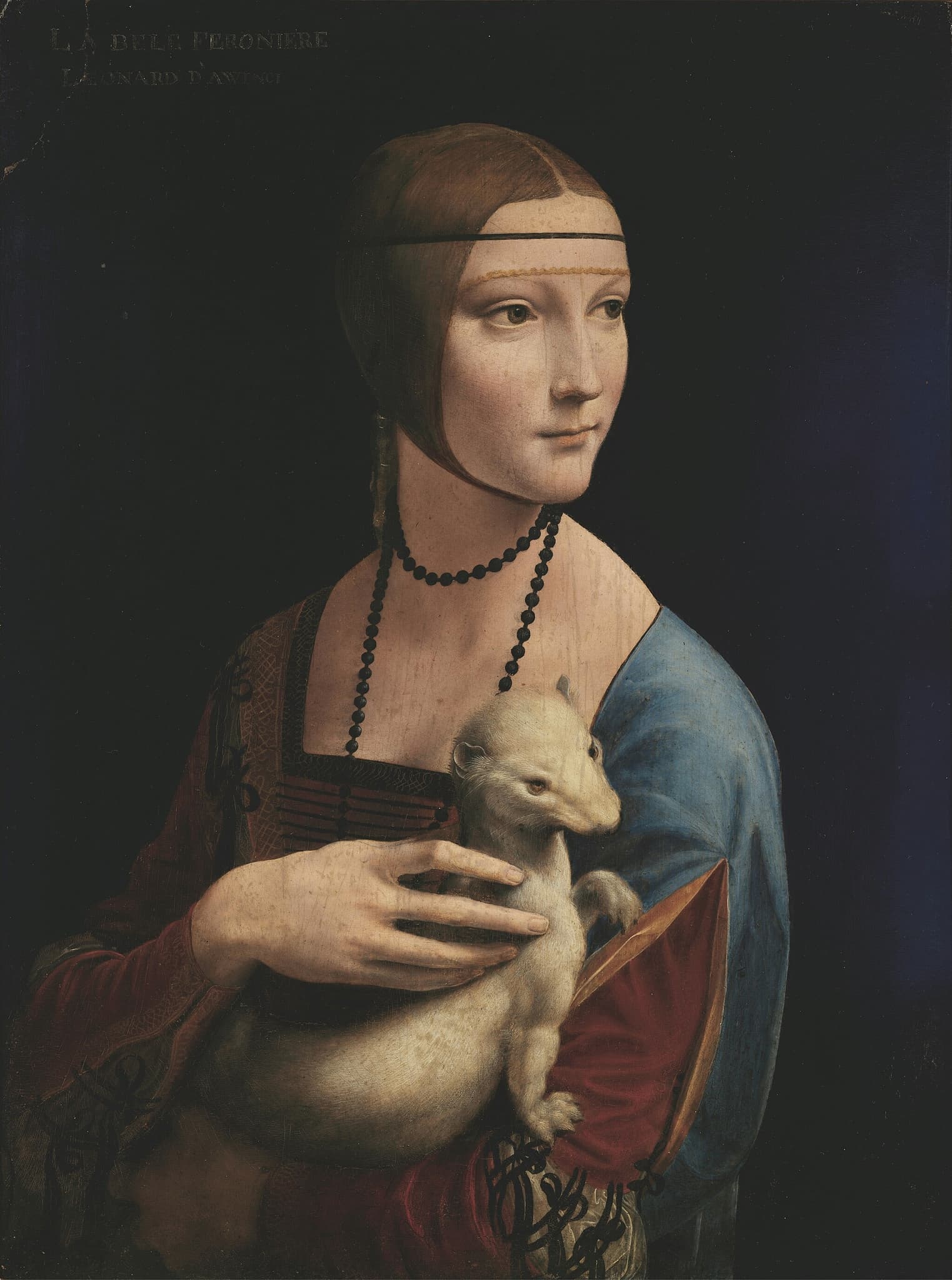
Auction and Ownership Timeline
Painted in Milan
Milan
Leonardo paints Lady with an Ermine, identified as Cecilia Gallerani, dated to c. 1489–1491 [1].
Acquired by Prince Adam Jerzy Czartoryski
Italy
Purchased in Italy (often noted as Rome) by Prince Adam Jerzy Czartoryski and presented to his mother Princess Izabela for the Czartoryski collection, c. 1798–1800 [1][2].
Installed at Puławy ‘Gothic House’
Puławy
Placed on view in the Czartoryski family’s ‘Gothic House’ museum at Puławy, Princess Izabela’s patriotic ‘national museum’ [1].
Exhibited at the Czartoryski Museum, Kraków
Kraków
After periods of exile and safeguarding (including in Paris), the collection returned to Kraków and was displayed in the newly established Czartoryski Museum [5].
Seized by Nazis during WWII
Sieniawa; Berlin
Evacuated from Kraków to Sieniawa, the painting was seized by Nazi authorities and transported to Berlin at the outset of WWII [2].
Displayed in Hans Frank’s Wawel office
Kraków
Governor-General Hans Frank ordered the painting back to Kraków and hung it in his Wawel Castle office [2].
Recovered and returned to Poland
Schliersee; Kraków
Moved to Hans Frank’s residence at Schliersee in 1945, it was recovered by Allied/Polish teams and returned to Kraków in April 1946 [6][2].
Princes Czartoryski Foundation ownership
Kraków
Ownership vested in the newly formed Princes Czartoryski Foundation, with the National Museum in Kraków continuing as custodian [8].
Provenance and Ownership
Painted in Milan around 1489–1491, with the sitter identified as Cecilia Gallerani [1]. Early whereabouts are undocumented. Around 1798, Prince Adam Jerzy Czartoryski acquired the painting in Italy and presented it to his mother Princess Izabela for the family’s collection; by 1809 it was on view in the Gothic House at Puławy [1][2]. After the family’s exile, the collection was re-established in Kraków and exhibited at the Czartoryski Museum from 1876 [5].
During WWII the painting was seized by the Nazis, taken to Berlin, then ordered back to Kraków by Hans Frank for display at Wawel; in 1945 it was moved to Schliersee in Bavaria and recovered by Allied/Polish teams, returning to Kraków in April 1946 [2][6][7]. In 1991 ownership was vested in the Princes Czartoryski Foundation, with the National Museum in Kraków as custodian [8]. On 29 December 2016 the Polish State Treasury purchased the entire Princes Czartoryski Collection for €100m, transferring ownership to the Polish nation; the work is now on permanent view at the Princes Czartoryski Museum in Kraków [3][4][9].
Quick Facts
- Last known sale
- 2016-12-29
- Known sale price
- €100,000,000 (entire Princes Czartoryski Collection)
- Sale type
- Museum acquisition
- Venue / institution
- State Treasury of the Republic of Poland (custody: National Museum in Kraków)
- Current owner or location
- State Treasury of the Republic of Poland; on view at the Princes Czartoryski Museum, National Museum in Kraków
- Publicly viewable?
- Yes
Why This Sale Matters
Lady with an Ermine has no public auction record: it moved from late‑18th‑century private acquisition into a family museum context and, in 2016, into national ownership as part of the Princes Czartoryski Collection [1][2][3]. The 2016 transaction was a negotiated, non‑auction purchase of the entire collection by the Polish State Treasury for €100 million, with no price allocated to individual objects and the National Museum in Kraków designated as custodian [3][4]. Contemporary analysis described the sum as far below the collection’s aggregate estimated market value (around 5%), underscoring how public‑interest deals can diverge from open‑market pricing [5].
Because the 2016 acquisition was not an open‑market sale and set no object‑level price, it does not establish a benchmark for Leonardo paintings. For the artist’s market, the relevant comparator is the auction of Salvator Mundi at Christie’s New York in November 2017 for $450.3 million, which reset both the artist’s and world auction record [10]. A much earlier touchstone is the National Gallery of Art’s 1967 purchase of Leonardo’s Ginevra de’ Benci for a reported $5 million, then a record for any painting—illustrating how extraordinarily rare any market movement for Leonardo paintings has been over decades [11].
In short, Lady with an Ermine is securely in public ownership and effectively off‑market [1]. Its transactional history matters less for price discovery than for demonstrating the pathways by which masterpieces enter and remain in public stewardship. When valuations are discussed, they typically reference external comparables—such as Salvator Mundi’s result—while acknowledging that differences in subject, attribution consensus, condition, and provenance make direct price extrapolation inappropriate. The painting’s significance today is cultural and national: it is a cornerstone of the Czartoryski holdings and a highlight of the National Museum in Kraków, where it is on permanent view [1][9].
Related Pages
Other auction histories by Leonardo da Vinci
Sources
- Lady with an Ermine – Collection record — National Museum in Kraków
- The history of Leonardo’s Lady — The Art Newspaper
- Polish State acquires Czartoryski art collection — PAP – Polish Press Agency
- Senate briefing on the acquisition (two notarial acts; €100m) — Senate of the Republic of Poland
- Behind the scenes of Poland’s €100m art deal — The Art Newspaper
- Hans Frank and Ernest T. DeWald Albright (restitution context) — Monuments Men and Women Foundation
- Poland’s Monuments Men: Estreicher, Lorentz & others — Culture.pl (Adam Mickiewicz Institute)
- Princes Czartoryski Museum – branch page — National Museum in Kraków
- The Past of the Future – Renovation and reopening (Dec 2019) — National Museum in Kraków
- Christie’s sells Leonardo da Vinci’s 500-year-old masterpiece for $450,312,500 — Christie’s
- 10 surprising facts about Leonardo’s Ginevra de’ Benci — National Gallery of Art