The Last Supper Auction History
Leonardo da Vinci’s The Last Supper has no auction or private sale history. As an immovable wall painting protected as Italian State cultural property and part of a UNESCO World Heritage site, it is inalienable and cannot be sold [3][11]. It remains in situ at the Museo del Cenacolo Vinciano, Santa Maria delle Grazie, Milan [13].
- Artwork
- The Last Supper
- Artist
- Leonardo da Vinci
- Sale type
- No known public sale
- Current location / owner
- Museo del Cenacolo Vinciano (Santa Maria delle Grazie), Milan
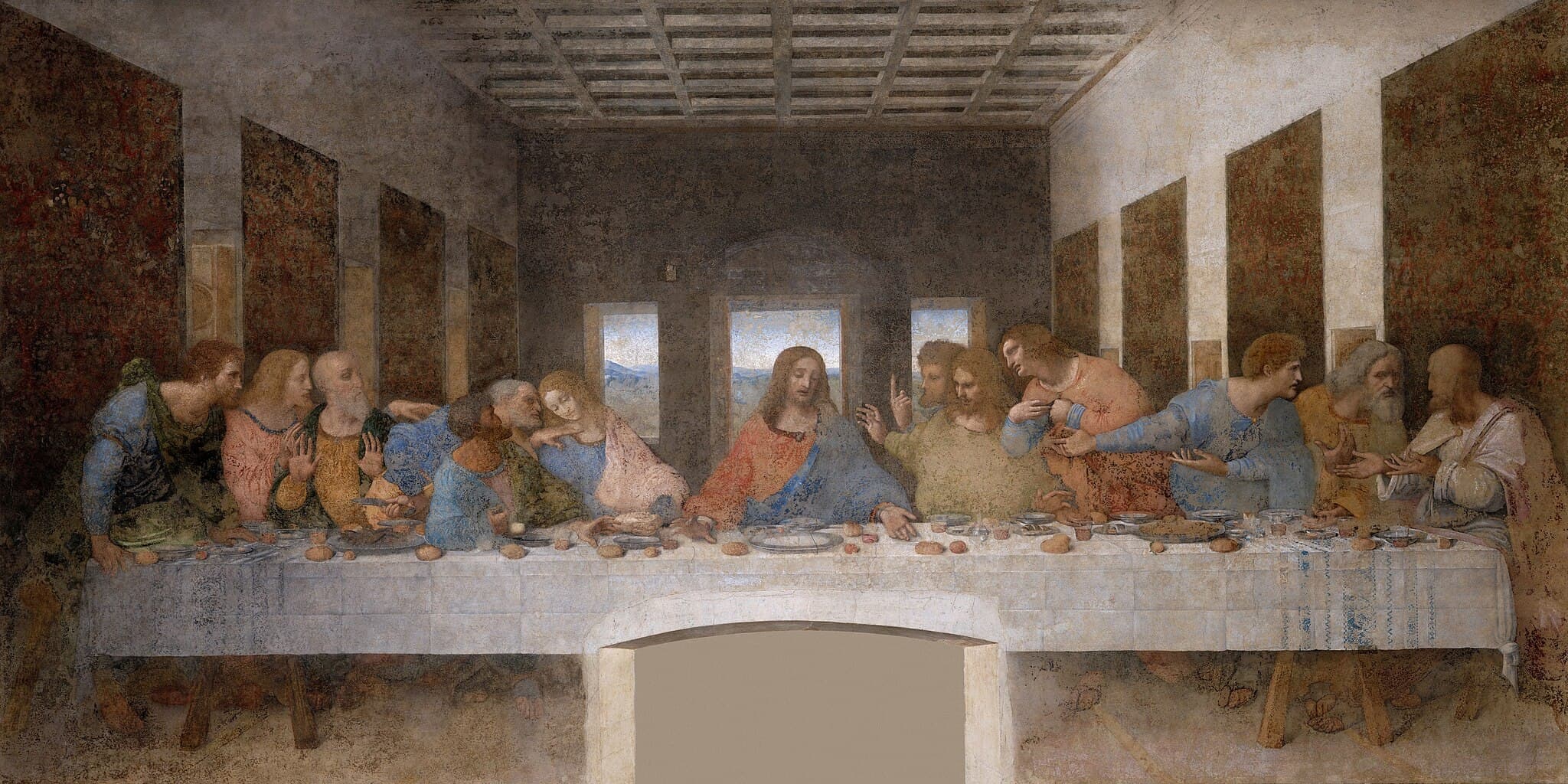
Auction and Ownership Timeline
Commissioned and executed in situ
Santa Maria delle Grazie, Milan
Commissioned by Ludovico Sforza for the Dominican refectory of Santa Maria delle Grazie; Leonardo painted the mural c.1495–1498 on the north wall using an experimental a secco technique [1][2].
Early reports of deterioration
Milan
By 1517, observers such as Antonio de Beatis noted the mural’s deterioration; later accounts by Vasari (1568) and Federico Borromeo (1625) reiterated the problem [2].
Suppression of the convent
Santa Maria delle Grazie, Milan
Under French/Cisalpine rule the Dominican convent was suppressed; archival records document the Cenacolo’s condition and concern during this transition [4].
Attempted detachment by Stefano Barezzi
Santa Maria delle Grazie, Milan
Restorer Stefano Barezzi tried to detach the mural in 1821, damaging areas before recognizing Leonardo’s a secco technique; traces of his intervention remain noted on the surface [6].
Cavenaghi’s conservation concludes
Milan
Luigi Cavenaghi’s studies and early conservation work culminated by 1908, marking a shift toward modern conservation practices for the mural [2].
WWII damage to refectory; mural survives
Santa Maria delle Grazie, Milan
Allied bombings in August 1943 destroyed the refectory roof; The Last Supper survived thanks to protective measures, with stabilizations after the war [3].
Pelliccioli conservation campaigns
Milan
Mauro Pelliccioli undertook major conservation efforts between 1951 and 1954, stabilizing and cleaning the mural [8].
UNESCO World Heritage inscription
UNESCO World Heritage List
The Church and Dominican Convent of Santa Maria delle Grazie with The Last Supper was inscribed on the UNESCO World Heritage List in 1980 [3].
Completion of 1978–1999 restoration
Milan
A microscope-guided restoration led by Pinin Brambilla Barcilon (1978–1999) removed overpaint and stabilized surviving Leonardo passages; unveiled in May 1999 [7].
Management transferred to Pinacoteca di Brera
Milan
Operational management of the Museo del Cenacolo Vinciano was assigned to the Pinacoteca di Brera within a Milan museum hub; ownership remains with the Italian State [12].
Provenance and Ownership
1495–1498: Commissioned by Ludovico Sforza for the Dominican refectory of Santa Maria delle Grazie in Milan, Leonardo executed The Last Supper directly on the north wall using an experimental tempera/oil a secco technique that soon proved fragile [1][2].
Napoleonic era: The Dominican convent was suppressed in 1799; archival sources register concern for the mural during this transition to state oversight [4]. In 1821, Stefano Barezzi attempted to detach the painting, causing damage before the a secco method was recognized [6].
20th century to present: Conservation milestones include Luigi Cavenaghi’s study and work (culminating 1908) [2], Mauro Pelliccioli’s campaigns (1951–1954) [8], and the major restoration led by Pinin Brambilla Barcilon (1978–1999), revealed in 1999 [7]. The complex was inscribed on the UNESCO World Heritage List in 1980 [3]. The mural remains Italian State property, permanently in situ at the Museo del Cenacolo Vinciano; since 3 December 2024, management of the museum has been assigned to the Pinacoteca di Brera within the Ministry of Culture network [5][12][13].
Quick Facts
- Last known sale
- No recorded sale
- Known sale price
- Not applicable
- Sale type
- No known public sale
- Venue / institution
- Museo del Cenacolo Vinciano (Santa Maria delle Grazie), Milan
- Current owner or location
- Italian State property; Museo del Cenacolo Vinciano, Santa Maria delle Grazie, Milan
- Publicly viewable?
- Yes
Why This Sale Matters
No market transaction exists for this artwork. The Last Supper is an immovable wall painting that forms part of the refectory of Santa Maria delle Grazie in Milan and is protected as Italian State cultural property; under the Italian Cultural Heritage Code (D.Lgs. 42/2004), such State cultural assets are inalienable, which precludes sale or export [11]. The site is also inscribed on the UNESCO World Heritage List, reinforcing its protected status and public stewardship mandate [3]. Accordingly, there is no auction or private sale history, and any monetary valuation would be hypothetical only.
Relevance to Leonardo’s market. Although The Last Supper is foundational to Leonardo’s historical reputation and public visibility, its market significance is indirect: it shapes scholarship, museum attendance, and cultural discourse rather than prices. The modern market benchmark for Leonardo is the sale of the transportable panel Salvator Mundi at Christie’s New York in 2017 for $450,312,500 with fees, a record for any artwork at auction [9]. For works on paper, the drawing Head of a Bear achieved £8,857,500 at Christie’s London in 2021, setting a category record for a Leonardo drawing at that time [10]. These comparables underscore that pricing in Leonardo’s market pertains to movable panels and autograph drawings with tradable title, not to site-specific murals like The Last Supper.
Collector takeaway. The Last Supper’s influence is pervasive, but it lives outside the market. Collectors and institutions engage with Leonardo through authenticated panels, drawings, studio works, or historical copies; conservation history and UNESCO status drive scholarly and public interest, not transactions [3][11].
Related Pages
Other auction histories by Leonardo da Vinci
Sources
- Museo del Cenacolo Vinciano – History — Museo del Cenacolo Vinciano
- Museo del Cenacolo Vinciano – Backstage (Conservation and technique) — Museo del Cenacolo Vinciano
- Church and Dominican Convent of Santa Maria delle Grazie with “The Last Supper” — UNESCO World Heritage Centre
- The Last Supper – archival accounts of the suppression — Archivio di Stato di Milano / MiC
- Santa Maria delle Grazie (Refectory/Museum) – property listing — Lombardia Beni Culturali
- Stefano Barezzi traces noted on the surface — Lombardia Beni Culturali
- Pardo, Presses de la sauvegarde – The Last Supper restoration (1978–1999) — ICCROM
- Mauro Pelliccioli e la cultura del restauro nel XX secolo — Direzione regionale Musei Veneto
- Christie’s sells Leonardo da Vinci’s Salvator Mundi for $450.3m — Christie’s
- Leonardo da Vinci, Head of a Bear achieves a world auction record — Christie’s
- Italian Code of the Cultural and Landscape Heritage (D.Lgs. 42/2004) — UNODC
- The Cenacolo Vinciano entrusted to the management of the Pinacoteca di Brera — Museo del Cenacolo Vinciano
- The Last Supper – visiting information — Museo del Cenacolo Vinciano