How Much Is Reflection with Two Children Worth?
Last updated: July 6, 2026
Quick Facts
- Methodology
- comparable analysis
Hypothetical fair‑market auction value for Lucian Freud’s Reflection with Two Children (Self‑Portrait), 1965, is estimated at $60–90 million. The range is anchored to Freud’s $86.3m auction record and recent eight‑figure results for prime oils, with a self‑portrait premium reflecting the work’s iconic status and museum‑grade pedigree.
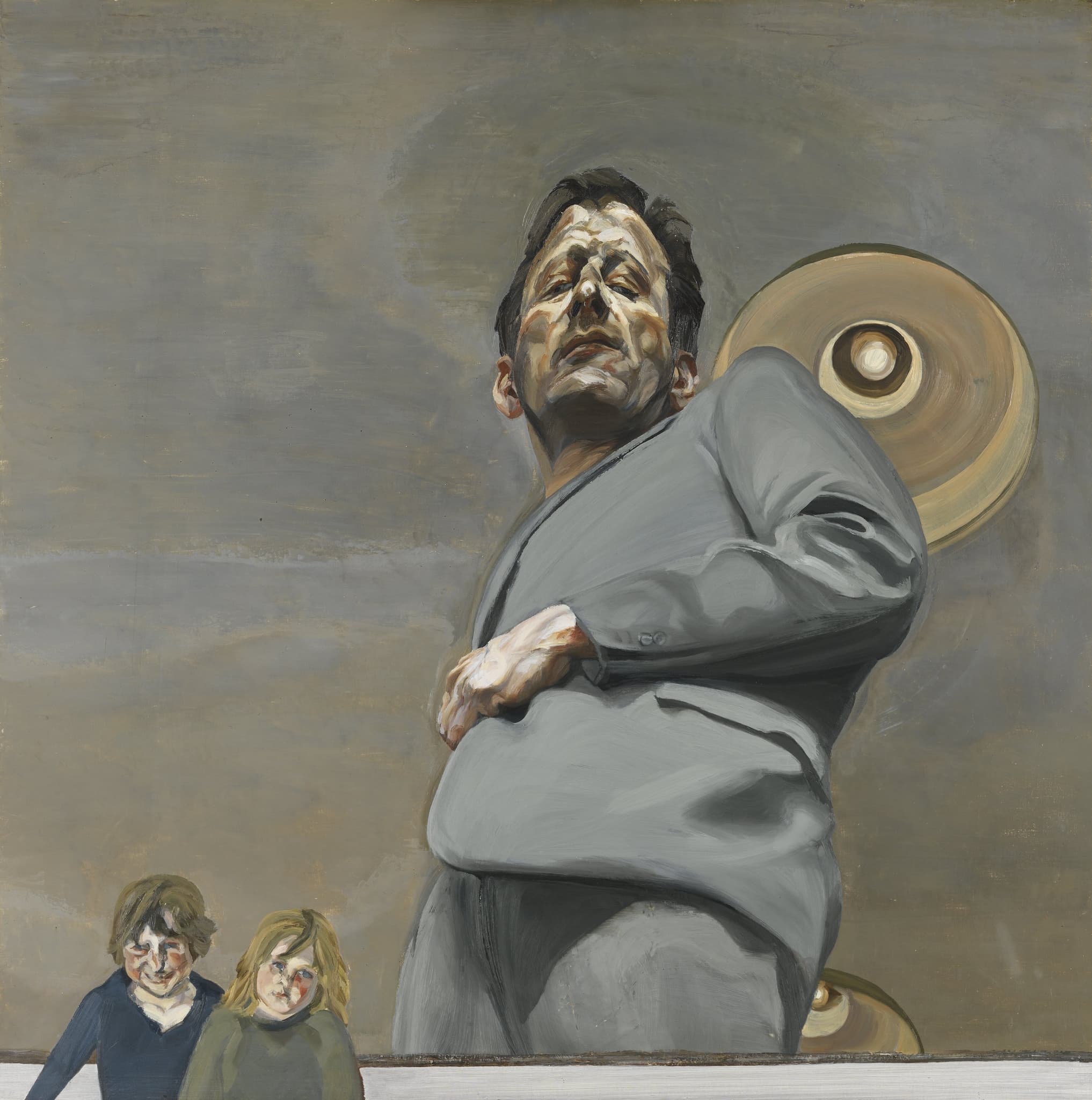
Reflection with Two Children
Lucian Freud, 1965 • Oil on canvas
Read full analysis of Reflection with Two Children →Valuation Analysis
Overview. Reflection with Two Children (Self‑Portrait), 1965 (oil on canvas, 91 × 91 cm), in the Museo Nacional Thyssen‑Bornemisza, is among Lucian Freud’s most widely reproduced images and a cornerstone self‑portrait from the mid‑1960s. Its institutional ownership, deep publication, and sustained exhibition visibility place it at the very top tier of the artist’s oeuvre and market relevance [1].
Market anchors. Freud’s market ceiling was reset at Christie’s New York in November 2022 when Large Interior, W11 (after Watteau) made $86.265 million (price realized, with premium) in the Paul G. Allen Collection sale [2]. Depth in the $30–40 million band was reconfirmed in June 2026 when Sotheby’s London sold the late epic Sleeping by the Lion Carpet for about $38.8 million (with premium) in a record‑setting evening [3]. Earlier bellwethers include Benefits Supervisor Resting at $56.165 million in 2015, a canonical work long treated as a benchmark for peak Freud demand [4], and period‑adjacent Night Interior (1968–70), which realized roughly $12.2 million in 2023, illustrating late‑1960s pricing outside of the most iconic subjects [5].
How the estimate was derived. We position this self‑portrait at $60–90 million fair‑market value, reflecting (i) a robust self‑portrait premium for a celebrated, frequently published image central to Freud’s identity; (ii) mid‑1960s date marking the consolidation of his mature, hyper‑observational style; and (iii) blue‑chip, institutionally held provenance supporting best‑in‑class desirability [1]. The upper bound acknowledges proximity to the $86.3m artist record for a much larger, theatrically complex interior [2], while recognizing that the 91 × 91 cm scale and comparative compositional economy may moderate bids relative to monumental multi‑figure canvases. Conversely, the painting’s iconicity and self‑portrait status counterbalance scale considerations and justify placement near the market’s top echelon.
Positioning and conditions for upside. A marquee evening sale in New York or London with a well‑structured guarantee and global marketing could test or surpass the artist’s record, particularly if cross‑category buyers vie for a definitive, museum‑grade image. Confirmation of clean condition and an unimpeachable provenance/exhibition dossier would further compress bidder risk and support the high end of the range. In today’s selective, “trophy‑first” market, works of this stature continue to command aggressive competition, whereas non‑trophy material is more price‑disciplined [3][5].
Conclusion. In sum, this painting stands among Freud’s most desirable subjects, with art‑historical importance and market optics consistent with near‑record pricing. A $60–90 million estimate is justified by current benchmarks, self‑portrait rarity, and institutional pedigree, with potential for a new artist high under optimal sale dynamics [1][2][3][4][5].
Key Valuation Factors
Art Historical Significance
High ImpactReflection with Two Children is a keystone image in Freud’s self‑portraiture and among his most reproduced works. Created in 1965, it captures the consolidation of his mature, hyper‑observational method with an unusually inventive perspective—looking down into a floor‑placed mirror while including two of his children. As a signature picture within an artist’s defining theme, it is central to scholarship and exhibition narratives. Such works typically sit at the very top of market hierarchies because they synthesize biography, technique, and innovation in a single, memorable composition. The painting’s prominence in surveys and literature increases cultural salience and buyer conviction, translating directly into pricing power for any hypothetical auction.
Self‑Portrait Rarity and Iconicity
High ImpactFreud’s self‑portraits are comparatively scarce relative to the broader portrait corpus, and they carry a well‑documented market premium. Collectors prize self‑portraits for their autobiographical charge and art‑historical importance—they are the works in which artists most explicitly construct and interrogate their personae. This canvas is not only a self‑portrait but a widely recognized one, often reproduced in publications and exhibitions. That dual status—rarity plus cultural familiarity—creates unusually deep demand across regions and collecting categories (postwar masters, portraiture, and museum‑quality single‑lot trophy buyers). In the current “trophy‑first” environment, such an iconic self‑portrait reliably commands top‑tier competition and near‑record pricing in prime sale settings.
Provenance, Exhibition, and Publication
High ImpactInstitutional ownership by the Museo Nacional Thyssen‑Bornemisza confers blue‑chip provenance, long‑term care, and broad public exposure. Museum‑held works tend to be thoroughly catalogued, frequently requested for loans, and extensively reproduced—factors that enhance liquidity and reduce buyer uncertainty. For trophy‑grade material, this visibility fosters brand‑level recognition that extends beyond specialist audiences, enlarging the bidder pool. In a hypothetical deaccession or private treaty arrangement, the museum pedigree would be highlighted as a virtue, supporting a premium against otherwise comparable private‑collection examples. Publication and exhibition density also creates a robust due‑diligence trail, improving confidence among guarantors and underbidders and thereby firming the upper end of the valuation range.
Period and Style (mid‑1960s maturity)
Medium-high ImpactThe mid‑1960s mark a pivotal phase when Freud’s linear early manner gives way to the dense, tactile scrutiny that defines his mature practice. Works from this era are scarce in commerce and disproportionately represented in institutions, reinforcing a supply squeeze. While later monumental nudes have established powerful commercial benchmarks, connoisseurs often prize the 1960s for their rigorous psychological focus and evolving surface facture. As a 1965 canvas with a celebrated composition, the work benefits from this confluence of art‑historical esteem and scarcity. Period‑adjacent auction results (e.g., Night Interior, 1968–70) provide a floor, but the self‑portrait status here justifies a materially higher bracket within Freud’s overall market.
Scale and Compositional Complexity
Medium ImpactAt 91 × 91 cm, the painting is not monumental by Freud’s later standards. The current record holder, Large Interior, W11 (after Watteau), is a larger, multi‑figure tour de force with a theatrical complexity that broadens bidder appeal and underpins its record price. Scale and complexity do correlate with peak results, and this moderates the ceiling for the 1965 self‑portrait relative to the very largest canvases. However, the distinctive overhead viewpoint, mirrored construction, and inclusion of the artist’s children deliver high conceptual impact per square inch. In trophy markets, iconicity and image recognition can offset scale disadvantages, keeping the work competitively positioned near the top of the artist’s price spectrum.
Sale History
Reflection with Two Children has never been sold at public auction.
Lucian Freud's Market
Lucian Freud is a blue‑chip postwar master whose best oils command intense international competition. The artist’s auction record stands at $86.265 million for Large Interior, W11 (after Watteau), achieved at Christie’s New York in 2022, a step‑change from prior highs in the $30–56 million range. Depth between $15–40 million has been repeatedly demonstrated for prime portraits and late nudes, with single‑owner and marquee evening contexts catalyzing top outcomes. Supply at the top end remains thin—especially for museum‑exhibited, canonical images—intensifying demand when A‑material emerges. Private collections, estates, and institutions continue to anchor value through publication and loan histories, and third‑party guarantees are common in securing strong, low‑risk results for the most coveted works.
Comparable Sales
Large Interior, W11 (after Watteau)
Lucian Freud
Market ceiling for Freud: a complex, museum‑level multi‑figure interior that benchmarks trophy demand for prime oils. Though later (1981–83) and much larger than the 1965 self‑portrait, it anchors the top end for iconic, compositionally ambitious Freud paintings.
$86.3M
2022, Christie's New York (Visionary: The Paul G. Allen Collection)
~$94.0M adjusted
Sleeping by the Lion Carpet
Lucian Freud
Prime late nude (1995–96) with stellar provenance and exhibition history; shows current depth of bidding for A‑tier Freud oils in marquee evening contexts. Useful to bracket contemporary trophy pricing vs. an earlier, iconic subject.
$38.8M
2026, Sotheby's London (Masterpieces from the Lewis Collection)
~$37.8M adjusted
Benefits Supervisor Resting
Lucian Freud
Hallmark work from the famed Sue Tilley series (1994); long treated as a bellwether for the artist’s market. Helps set a trophy benchmark for widely reproduced, canon‑defining Freud images.
$56.2M
2015, Christie's New York
~$75.3M adjusted
Portrait on a White Cover
Lucian Freud
Highly desirable nude (2002–03) demonstrating sustained late‑career demand near the $30m level; relevant to gauge the upper‑mid tier for prime oils outside the most iconic subjects.
$29.8M
2018, Sotheby's London
~$37.8M adjusted
Ib Reading
Lucian Freud
Intimate, single‑figure interior (1997); good indicator of demand for focused portrait compositions of roughly comparable scale, albeit later in date and without the self‑portrait premium.
$20.5M
2023, Sotheby's London (Modern & Contemporary Evening Auction)
~$21.6M adjusted
Night Interior
Lucian Freud
Closest period proxy (1968–70) among recent sales: a late‑1960s interior that helps anchor pricing for works near the 1965 self‑portrait’s era. Useful for period calibration, though subject and renown are less iconic.
$12.2M
2023, Sotheby's London (Modern & Contemporary Evening Auction, Face to Face)
~$12.9M adjusted
Current Market Trends
The current market for postwar British figuration is distinctly two‑speed: trophy‑grade works with museum‑level provenance and image recognition attract robust bidding and, in some cases, records, while mid‑tier offerings face disciplined demand. London has rebounded with record evening totals in 2026, and cross‑border liquidity for blue‑chip European postwar art remains healthy. For Freud specifically, the $86.3m 2022 record and the $38.8m 2026 result affirm durable appetite at the high end. In this environment, self‑portraiture and canonical images enjoy a premium as collectors prioritize cultural resonance and long‑term store‑of‑value characteristics, particularly when supported by guarantees and global marketing in marquee evening sales.
Study print
Study this painting as a print
Pair the full artwork with a museum-style study sheet focused on one meaningful detail.
Sources
- Museo Nacional Thyssen‑Bornemisza – Reflection with Two Children (Self‑Portrait) object record
- Christie’s – Paul G. Allen Collection results: Lucian Freud, Large Interior, W11 (after Watteau), $86,265,000
- Sotheby’s – London Summer Season editorial (Sleeping by the Lion Carpet sold £29.3m ≈ $38.8m)
- Christie’s – Post‑sale release, May 2015 (Benefits Supervisor Resting: $56,165,000)
- Sotheby’s – Modern & Contemporary Evening Auction, June 27, 2023 (Night Interior, 1968–70)