How Much Is The Brigadier Worth?
Last updated: July 6, 2026
Quick Facts
- Last Sale
- $34.9M (2015, Christie's New York (Post‑War & Contemporary Evening Sale))
- Methodology
- recent sale
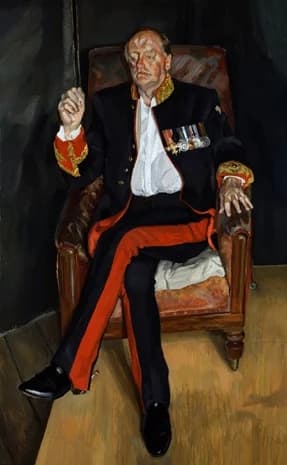
Anchored to Christie's public auction result of $34,885,000 on 10 November 2015, I estimate Lucian Freud’s The Brigadier at $30.0–55.0 million. The 2015 Christie’s sale is the principal market anchor; the range adjusts for current market movement, comparables, provenance/exhibition strength and possible sale mechanics (private treaty versus evening auction).
Valuation Analysis
Valuation anchor and headline conclusion: This opinion is anchored to the confirmed Christie’s New York sale on 10 November 2015 (realized $34,885,000), which remains the primary public market datum for Lucian Freud’s The Brigadier [1]. Using that realized price as the baseline and applying market‑sensitive upward and downward adjustments, the painting’s fair market range today is approximately $30.0–55.0 million.
How the anchor is applied: The 2015 sale provides an objective transaction price for this specific canvas and therefore carries decisive weight. A simple inflation/market adjustment from late 2015 to mid‑2026 would place that 2015 result in the mid‑$40 millions, but practical valuation also accounts for intervening auction evidence, the artist’s record peak, and the painting’s individual strengths (size, sitter, provenance, exhibition history) and weaknesses (any condition or title issues) [2].
Comparables and directional factors: The Brigadier sits in the top tier of Freud’s late‑career portraits because of its large scale, high finish and documented provenance/exhibition history; the artist’s auction record and other late‑period portrait sales provide the ceiling and context for bidder expectations. In a strong evening‑sale environment with active competition the painting is likely to perform around the mid‑range to upper‑range of the estimate; in a softer market, or if the work has unresolved conservation or title matters, price could fall toward the lower bound.
Practical implications for sale or insurance: For a public evening sale at a major house, plan for an estimate/realistic pre‑sale range of roughly $30M–$45M; a negotiated private sale or museum acquisition (with guarantees or promotion) could push achievable proceeds toward $55M. Conversely, undisclosed condition problems, incomplete provenance, or a weak sale catalogue slot could reduce realizations materially below these levels. Before setting a reserve or insurance figure, obtain an in‑person condition report and high‑resolution photography; seek formal market opinions from Christie’s/Sotheby’s Freud specialists and consider a private‑sale negotiation if timing or confidentiality is a priority.
Recommended next steps: commission a professional condition and technical report, collect high‑res imagery and documentation of exhibition/provenance, and obtain two formal specialist opinions from major auction houses. With that documentation in hand you can move confidently to an evening‑sale strategy or a targeted private‑sale process to maximize value.
Key Valuation Factors
Art Historical Significance
High ImpactThe Brigadier is a late‑career, large‑scale portrait by Lucian Freud, executed in the artist’s mature painterly language. Late‑period Freud portraits are highly regarded for their physical presence, chromatic subtlety and psychological acuity; when these qualities are combined with scale and finish the works sit near the top of his market. The sitter (a prominent public figure) and the painting’s clear stylistic affinity with Freud’s established late oeuvre give it strong canonical value. Collectors and museums prize such works as representative statements of the artist’s final decades, and that status materially increases liquidity and price compared with smaller studies or lesser‑finished late pieces.
Provenance & Exhibition History
High ImpactDocumented provenance from Acquavella and the Mezzacappa Collection, together with inclusion in major exhibitions and catalogue entries, substantially reduces buyer hesitation and enhances museum interest. Provenance that demonstrates continuous passage through reputable dealers and collectors mitigates title risk and supports premium pricing. Exhibition history functions as independent validation of importance and condition (works prepared for loans are typically well documented and conserved), and a painting shown in institutional retrospectives is more likely to attract competitive bidding. Strong provenance and exhibition history are therefore major positive drivers that can move realizations above the simple auction anchor.
Market Comparables & Last Sale
High ImpactThe 2015 Christie’s realized price ($34,885,000) is the single best direct comparable and thus the valuation anchor. Artist record examples (e.g., Benefits Supervisor Resting) establish the market ceiling for Freud portraits, while more typical late portraits trade in the mid‑seven to low‑eight figure band. Recent sales of high‑quality late works provide a spectrum: museum‑quality, large canvases with strong provenance are capable of reaching or exceeding the Brigadier’s 2015 result in favourable sale conditions; by contrast, smaller or less well documented late works sell materially lower. Comparables therefore justify a conservative floor near the 2015 result and an upper bound reflecting private‑sale premiums and peak market competition.
Condition & Conservation
Medium ImpactPhysical condition and any conservation history are practical determinants of market value. Major structural issues (relined canvas, paint instability, invasive restorations) or extensive varnish/discoloration can suppress bids by 10–40%, depending on severity. Conversely, perfectly preserved surfaces with full documentation of conservation work support top‑end pricing. A professional condition report and technical analysis (materials dating, x‑rays) are essential pre‑sale steps; they reduce buyer risk and can be used in marketing to substantiate the painting’s state, thereby preserving or enhancing value.
Sale Mechanics & Market Timing
Medium ImpactHow and when the painting is offered will influence final price. A marquee evening auction slot with strong publicity and a competitive bidding environment typically achieves higher headline results. Private sale or dealer negotiation can yield premiums from motivated institutional buyers but may forgo the publicity‑driven buyer competition of an evening sale. Guarantees, third‑party guarantees, and vendor financing alter risk and seller net; in tight markets reserves and guarantee structures can depress perceived upside. Macro factors (interest rates, currency movement, geopolitical conditions) and the calendar (London/New York/Hong Kong sale weeks) also affect the depth of the buyer pool and should inform timing.
Sale History
Christie's New York, Post‑War & Contemporary Evening Sale
Lucian Freud's Market
Lucian Freud (1922–2011) occupies blue‑chip status in the post‑War and contemporary market. His large, psychologically intense portraits and figure paintings are among the most sought‑after works by British artists of the 20th century. Public auction record prices for key canvases have reached the mid‑tens of millions to over fifty million dollars; at the same time a range of late works trade in the mid‑seven to low‑eight figures. The collecting base is concentrated (museums and a limited number of high‑net‑worth private collectors), so supply/demand dynamics make major Freuds highly liquid at the top end but sensitive to sale presentation and provenance.
Comparable Sales
The Brigadier
Lucian Freud
Exact painting — the primary public sale datum and valuation anchor (large, late-period Freud portrait; strong provenance & exhibition history).
$34.9M
2015, Christie's New York
~$45.8M adjusted
Benefits Supervisor Resting
Lucian Freud
Artist auction record and a high-profile, large-scale Freud portrait — useful as an upper-bound comparable for The Brigadier's market potential.
$56.2M
2015, Christie's New York
~$73.7M adjusted
Portrait of David Hockney
Lucian Freud
Late-period Freud portrait of a prominent sitter; sold in London at a materially lower level than Brigadier — a mid-tier comparable for late portraits.
$20.7M
2021, Sotheby's London
~$23.4M adjusted
Ria, Naked Portrait (2006/07)
Lucian Freud
Late-period Freud nude/portrait sold in 2024 — indicates current buyer appetite for late works at mid-seven-figure levels; lower scale/significance than Brigadier.
$15.4M
2024, Christie's London
~$16.2M adjusted
Current Market Trends
As of mid‑2026 the blue‑chip art market remains selective: marquee works by museum‑grade artists continue to find deep pockets of demand, while mid‑market and less distinguished works face greater headwinds. Economic and geopolitical uncertainty has made buyers more conservative, but trophy works with excellent documentation, size and exhibition provenance continue to attract competition. Currency movements and regional buying patterns (US, UK, Middle East) also affect realized prices; overall, well‑provenanced Freud portraits retain a robust, if cautious, market.