How Much Is No. 61 (Rust and Blue) Worth?
Last updated: May 10, 2026
Quick Facts
- Insurance Value
- $180.0M (Internal estimate (replacement-cost methodology))
- Methodology
- comparable analysis
No. 61 (Rust and Blue) (1953) is a monumental, prime‑period Rothko in MOCA’s Panza Collection. Anchoring to the artist’s top public auction benchmarks ($75.1m–$86.9m) and recent market signals, including a ~$100m private sale in 2024, the painting would realistically command $100–150 million if it ever came to market. Its date, scale, archetypal composition, and museum‑level renown position it firmly in the trophy tier.
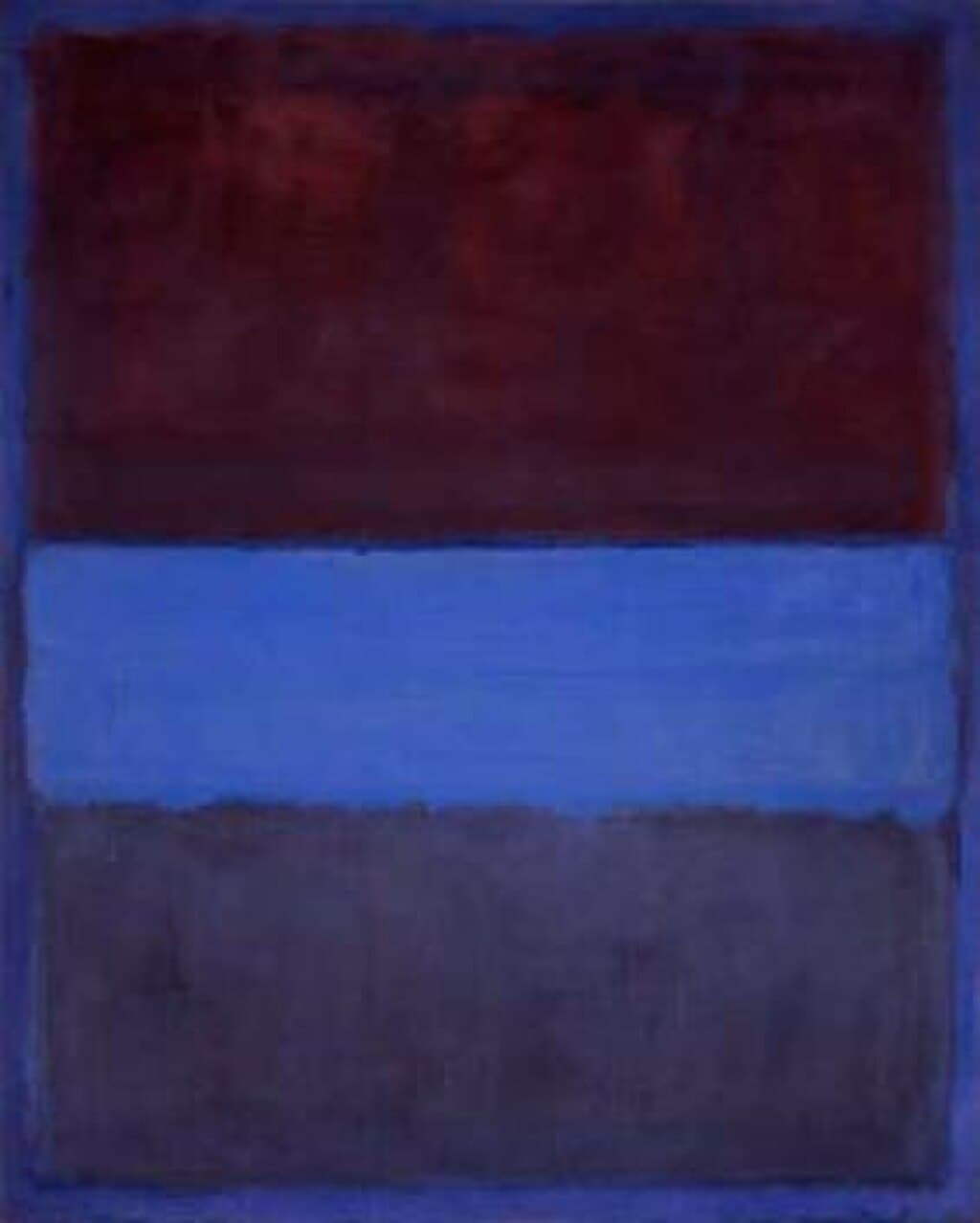
No. 61 (Rust and Blue)
Mark Rothko, 1953 • Oil on canvas
Read full analysis of No. 61 (Rust and Blue) →Valuation Analysis
Conclusion: If Mark Rothko’s No. 61 (Rust and Blue) (1953; 115 1/4 × 92 1/4 in; MOCA, Los Angeles, Panza Collection) were to be sold today through a top‑tier auction or tightly brokered private transaction, a fair market value of $100–150 million is justified. This range is derived by triangulating the artist’s highest public auction benchmarks, recent public results for prime‑period canvases, and private‑market signals, then calibrating for this work’s date, monumental scale, canonical composition, and institutional prominence [1][2][3][4][6][7].
Anchors and comparables: Rothko’s standing auction record remains Orange, Red, Yellow (1961) at $86.88 million (Christie’s, 2012) [1]. Other top public benchmarks include No. 10 (1958) at $81.93 million (Christie’s, 2015) [2] and No. 1 (Royal Red and Blue) (1954) at $75.12 million (Sotheby’s, 2012) [3]. At the next rung down, mid‑1950s canvases of smaller format achieved $46.4 million in 2023 (Christie’s, Untitled, 1955) [4], while a cool‑palette 1954 work in Hong Kong realized ~$32.5 million in 2024, reflecting regional and venue effects rather than a shift in the top New York trophy segment [5]. A 2025 New York marquee sale also demonstrated renewed depth for blue‑chip postwar material, with a prime 1958 Rothko at $62.16 million [8].
Private market signal: In early 2024, Christie’s reportedly brokered a Rothko for approximately $100 million (widely reported as No. 6, Violet, Green and Red), reinforcing that nine‑figure pricing for prime‑period canvases remains achievable outside the public salerooms [6].
Positioning of No. 61 (Rust and Blue): Dated 1953—squarely within Rothko’s most coveted 1949–1956 window—this painting exhibits the archetypal stacked chromatic fields at a commanding, museum‑scale size. It is a widely reproduced, scholarly cited exemplar of the mature idiom, and it resides in a major U.S. museum collection (MOCA, Panza Collection) [7]. Works of this quality, date, and scale almost never surface, which introduces a scarcity premium and elevates substitution risk for any buyer seeking a like‑kind masterpiece.
From anchors to estimate: Calibrating from the artist’s $75–87 million public auction benchmarks for large, classic‑period canvases [1][2][3], adding a scarcity and renown premium for a 1953 museum‑level monument, and cross‑checking against the 2024 nine‑figure private transaction [6], supports a $100–150 million FMV today. Insurance/replacement values for unique, museum‑caliber Rothkos typically sit above FMV due to sourcing friction and marketing risk; a directional replacement figure around $180 million is reasonable in this context. As with any masterpiece‑level asset, condition, venue, guarantee structure, and sale choreography could move the outcome materially, but the center of gravity for No. 61 is decisively in the low nine figures.
Key Valuation Factors
Art Historical Significance
High ImpactPainted in 1953, No. 61 (Rust and Blue) sits in Rothko’s canonical 1949–1956 ‘classic’ window, where his signature stacked chromatic fields coalesced. The work’s monumental size and distilled composition embody the meditative, immersive experience central to Rothko’s contribution to postwar abstraction. It is also among the more frequently reproduced early‑1950s canvases, long integrated into museum discourse. Such art‑historical centrality commands a premium because collectors prize works that anchor the narrative of an artist’s achievement, and institutions view them as touchstones in Color Field and Abstract Expressionist histories.
Date, Scale, and Composition
High ImpactAt 115 1/4 × 92 1/4 inches, the painting is an archetypal, immersive ‘room‑scale’ Rothko. Large, balanced canvases with clear banded fields from the early to mid‑1950s consistently lead the artist’s market. The 1953 date is a bull’s‑eye year, and the composition—stacked chromatic blocks with pronounced blue/rust interplay—delivers the optical vibration and atmospheric depth that top buyers seek. Relative to smaller or later works, this combination of prime period and monumental format places No. 61 in direct competition with the strongest auction benchmarks and private‑sale trophies.
Provenance and Institutional Visibility
High ImpactThe painting is held by the Museum of Contemporary Art, Los Angeles (Panza Collection), conferring exceptional institutional pedigree and sustained public visibility. Long‑term museum placement typically correlates with elevated scholarly publication and exhibition histories, and, by extension, market stature. Should such a work be deaccessioned or privately traded (hypothetically), the provenance would attract broad, top‑tier demand. Institutional ownership also underscores rarity: true substitutes of similar date, scale, and renown are thinly held and seldom available, justifying a replacement‑cost premium.
Market Benchmarks and Liquidity
High ImpactRothko’s top public prices—$86.9m (2012), $81.9m (2015), $75.1m (2012)—remain robust anchors for prime‑period canvases, while mid‑scale works have transacted at $32.5m–$46.4m in 2023–2024. A 2024 private sale reportedly around $100m confirms nine‑figure depth for trophies. While broader markets were selective in 2024, New York evening sales in 2025 showed renewed appetite for blue‑chip postwar material. Against this backdrop, a 1953, museum‑level monument like No. 61 would likely see intense global competition, with liquidity concentrated among seasoned collectors, foundations, and advisors prepared to transact at the low‑nine‑figure level.
Sale History
No. 61 (Rust and Blue) has never been sold at public auction.
Mark Rothko's Market
Mark Rothko is a cornerstone of postwar art with deep, diversified global demand from museums, leading private collections, and foundations. His auction record—Orange, Red, Yellow (1961) at $86.88m (Christie’s, 2012)—has stood for over a decade, with other prime works realizing $75–82m publicly and select mid‑scale canvases trading in the $30–60m range. Recent sales reaffirm a quality‑driven market: a strong 1955 canvas fetched $46.4m in 2023, while a 2024 Hong Kong sale at ~$32.5m underscored venue sensitivity. Private channels continue to set the pace for trophies, with a Rothko reportedly placed around $100m in 2024. Overall, the market for canonical, prime‑period, large‑scale Rothkos remains among the most reliable in the postwar category.
Comparable Sales
Orange, Red, Yellow (1961)
Mark Rothko
Same artist; canonical large, stacked-rectangle composition from Rothko’s classic period; a trophy benchmark for top-end demand and palette appeal, though slightly later (1961) and smaller than No. 61.
$86.9M
2012, Christie's New York
~$123.4M adjusted
No. 10 (1958)
Mark Rothko
Same artist; late‑1950s prime-period canvas with classic stacked fields and comparable presence; a leading auction benchmark close in type if smaller than No. 61.
$81.9M
2015, Christie's New York
~$112.6M adjusted
No. 1 (Royal Red and Blue) (1954)
Mark Rothko
Same artist; very close in date to No. 61 (1954 vs. 1953), large scale, archetypal stacked-rectangle composition with related red/blue chromatic dialogue; a directly relevant comp for period and type.
$75.1M
2012, Sotheby's New York
~$106.7M adjusted
White Center (Yellow, Pink and Lavender on Rose) (1950)
Mark Rothko
Same artist; early classic-period, museum-caliber icon with stacked zones; a long-standing blue-chip benchmark for prime Rothko color-field canvases.
$72.8M
2007, Sotheby's New York
~$114.5M adjusted
Untitled (Yellow, Orange, Yellow, Light Orange) (1955)
Mark Rothko
Same artist; mid‑1950s classic-period canvas; smaller format but archetypal palette and composition; shows current public pricing for strong, non‑trophy scale works.
$46.4M
2023, Christie's New York
~$49.6M adjusted
No. 31 (Yellow Stripe) (1958)
Mark Rothko
Same artist; late‑1950s classic-period, large-scale color‑field painting; a recent marquee-sale result that reflects current top-tier demand in New York.
$62.2M
2025, Christie's New York
Current Market Trends
The postwar market is selective but resilient at the top end. After a softer 2024, New York’s 2025 marquee auctions showed healthier depth for museum‑quality, fresh‑to‑market lots, while Asia remained uneven for AbEx trophies. Public records for Rothko have not surpassed his 2012 auction peak, yet private sales confirm nine‑figure demand for prime‑period works. Bidders are highly discriminating, rewarding canonical date/scale/condition and penalizing repeat offerings or suboptimal venues. In this climate, best‑in‑class Color Field masterpieces—especially early‑ to mid‑1950s Rothkos—attract global competition and can clear low nine figures when expertly positioned.
Study print
Study this painting as a print
Pair the full artwork with a museum-style study sheet focused on one meaningful detail.
Sources
- Christie’s Post-Sale Release (May 2012): Rothko record $86.88m
- Christie’s Results (May 2015): Rothko No. 10 at $81.925m
- Sotheby’s (Nov 2012): No. 1 (Royal Red and Blue) at $75.12m
- Artnet News (Nov 2023): 1955 Rothko sells for $46.4m at Christie’s
- Sotheby’s (Nov 2024): HK Evening Sale results; 1954 Rothko ~US$32.5m
- CNBC (Feb 2024): Christie’s brokers Rothko around $100m (private sale)
- MOCA (Panza Collection) checklist: No. 61 (Rust and Blue), 1953
- Christie’s (Nov 2025): 20th/21st Century New York Auction Results