No. 61 (Rust and Blue)

by Mark Rothko

No. 61 (Rust and Blue) (1953) stages three hovering color fields—rust, saturated blue, and indigo—within a deep blue perimeter. Through thin, layered oil and feathered borders, Mark Rothko turns color into a felt space where warmth and dusk meet, inviting a contemplative, immersive encounter [1][5].

Study Print Studio

Create a personal study print

Build a companion study sheet around the part of this painting that speaks to you most. Choose a detail, shape an interpretation, and walk away with something personal and display-worthy.

Fast Facts

Year
1953
Medium
Oil on canvas
Dimensions
292.74 x 233.68 cm
Location
The Museum of Contemporary Art, Los Angeles (MOCA)
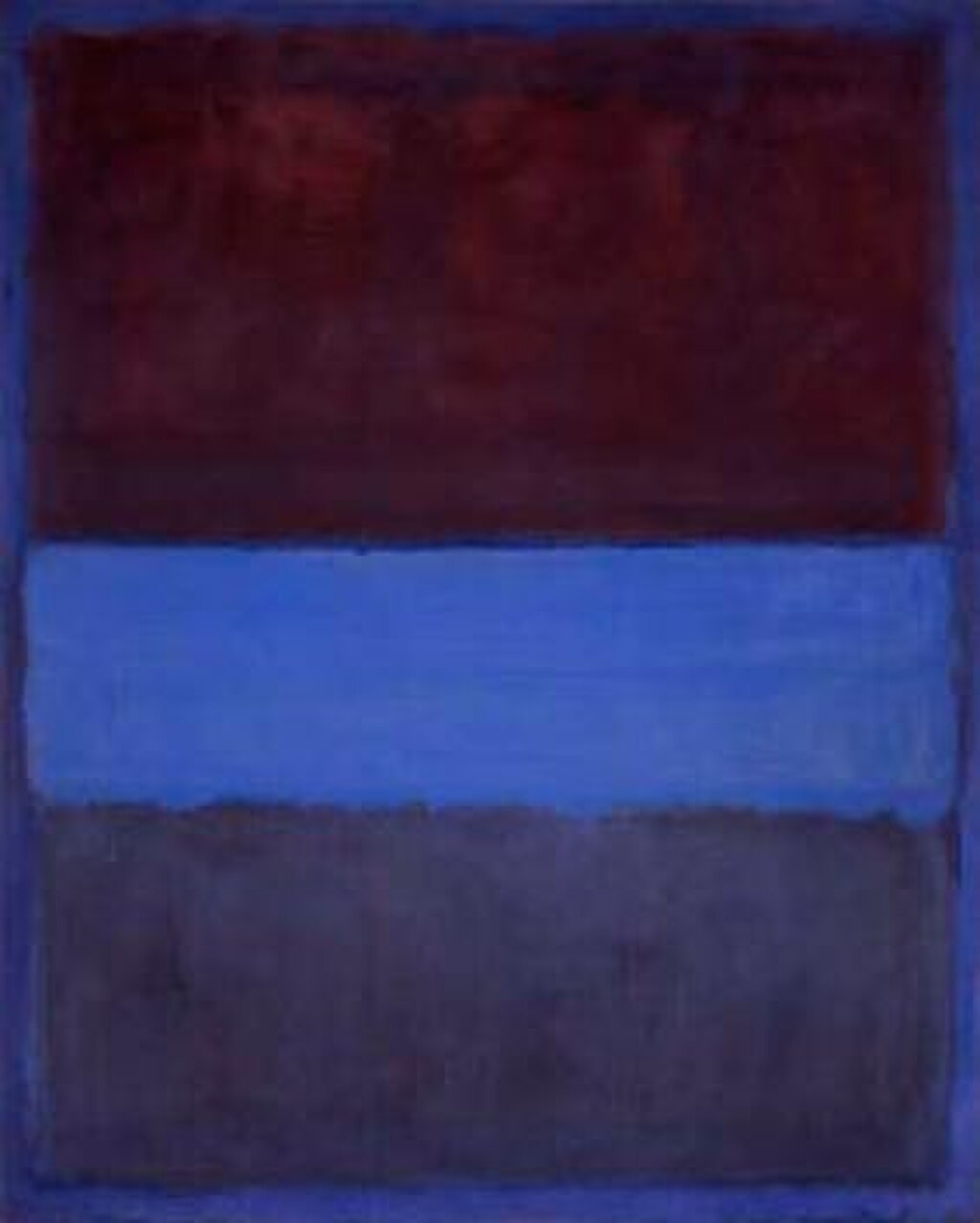
No. 61 (Rust and Blue) by Mark Rothko (1953) featuring Rust field (upper rectangle), Central blue band (threshold), Indigo lower block (depth/night), Blue perimeter (enclosing chamber)

Click on any numbered symbol to learn more about its meaning

Meaning & Symbolism

Rothko organizes No. 61 (Rust and Blue) as three stacked rectangles that appear to float inside a larger, cool blue perimeter: a rust-brown expanse above, a luminous band of saturated blue at center, and a deeper indigo block below. The rectangles’ edges are not drawn but breathed—thin washes fuse at their borders so that forms leak into one another, generating an “inner light” that pulses rather than sits still 56. This optical flicker is not decorative; it is the mechanism by which the painting becomes an event in time. The top rust field reads as bodily warmth and mortal weight; the lower indigo recedes like night. Between them, the central blue functions as a threshold—a zone of passage that both separates and binds the extremes. Rothko’s thinly stained layers let under-hues show through, so the meeting lines never resolve into hard facts; they remain felt tensions. In this suspension, the painting disarms the impulse to name things and routes sensation straight into affect, answering Rothko’s insistence that he is “not an abstractionist” but a painter of basic human emotions 2. Experienced at the scale Rothko intended—hung low, in subdued light, and from intimate proximity—the painting envelops the viewer’s field of vision so that color becomes environment 4. The blue perimeter frames the stacked bars like a dim chamber, pulling the eye inward and slowing perception; the rectangles hover at human scale, enforcing a one-to-one encounter that reads less as picture and more as presence 13. This presence aligns with the “Abstract Sublime”: a modern, nonfigurative answer to vast horizons and atmospheres, where the drama of transcendence is staged using nothing but color, breadth, and breath 7. Many viewers sense a pared-down seascape—earth, horizon, dusk—but Rothko’s feathered borders keep such analogies provisional, never illustrative. The painting’s power, then, is not in symbol but in phenomenology: it makes the act of standing before it feel like arriving at a brink between sorrow and release. Conservation studies of Rothko’s technique clarify how this works: diluted oil layered over absorbent grounds produces halation and afterimage, so color seems to emanate rather than sit on the surface 56. The result is a quiet oscillation—rust advances and warms; blues cool and withdraw—generating a slow, meditative rhythm that the body registers before thought catches up. Why No. 61 (Rust and Blue) is important: it crystallizes Rothko’s mature method in the early 1950s, just before his late, darker cycles, demonstrating how postwar abstraction could carry existential gravity without narrative props 12. It also widens the interpretive field. Read through Rosenblum’s sublime, the painting channels Romantic magnitude into pure chroma 7; read via Jeffrey Weiss’s urban lens, its stacked, glowing panels distill the ambient light and spatial compression of the modern city 8. Either way, the work insists on painting as immediate communion—a shared, wordless interval in which viewers test their own thresholds of vulnerability and hope. By reducing everything to hovering form and atmospheric depth, Rothko turns color into an ethics of attention: stand close, look slowly, and let the border between material and immaterial do its work 245.

Explore Deeper with AI

Ask questions about No. 61 (Rust and Blue)

Popular questions:

Powered by AI • Get instant insights about this artwork

💬 Ask questions about this artwork!

Interpretations

Phenomenology & Embodied Viewing

Rothko designs an encounter rather than an image: hung low and approached closely (he advised roughly 18 inches), the canvas saturates peripheral vision so that color becomes environment and time dilates into breath-by-breath perception 24. The soft, “breathed” borders act as thresholds, where attention toggles between surface and depth, figure and field. Phenomenological accounts read this as a training of the senses—an artwork that does not represent transcendence but induces it. Within this staging, afterimage and halation (products of thin oil over absorbent grounds) generate a slow oscillation the body registers before thought, aligning the piece with a non-discursive, affect-first aesthetics 267. In this view, No. 61 is less a picture than a calibrated situation for presence: an experiment in how looking can become feeling.

Source: Whitney Museum; National Gallery of Art; Ricoeur Studies

Abstract Sublime vs. Landscape Analogy

Rosenblum’s Abstract Sublime reframes Rothko’s hovering fields as heirs to Romantic immensities—vast skies and horizons translated into pure chroma and atmosphere 5. No. 61 courts landscape memory (earth, horizon, dusk), yet refuses depiction; its feathered seams keep reference provisional, preserving transcendence without the crutch of motif 2. This tension—evoking a seascape while eliding it—illustrates how modern sublimity migrates from nature to perception itself. The painting’s scale and softly pulsing “light” produce awe not by showing storms or mountains, but by measuring the viewer against an intangible field. In this lens, the work’s power lies in estranging landscape into experience: the horizon is not out there but arises in the act of seeing, an event unfolding across rust, blue, and indigo.

Source: Robert Rosenblum; National Gallery of Art (American Masters/NGA essay)

Urban Atmosphere Reading

Counter to landscape, Jeffrey Weiss’s urban lens proposes that Rothko’s stacked, glowing panels compress metropolitan light and space—the afterglow of signage, windows, and nocturnal streets distilled into contemplative stillness 8. In No. 61, the rust may feel corporeal, but it also recalls brick and sodium light; the central saturated blue reads like a band of illumination cutting through density; the indigo recedes with the hush of night architecture. This translation of the city’s flux into motionless radiance aligns with postwar modernity: speed outside, slowness inside. Rather than pastoral solace, the painting offers an urban sublime—an interior sanctuary carved from ambient glow and darkness. The result is a secular chapel for city dwellers, where attention is re-paced and modern overstimulation is metabolized into depth.

Source: Jeffrey Weiss (as summarized in The New Yorker)

Material Poetics: Grounds, Bleed, and Inner Light

Conservation and studio research clarify the work’s signature inner light: thinned oil layered over absorbent grounds wicks into the weave, leaving feathered margins that make forms appear to hover 69. These halos are not accidents but instruments—devices that destabilize edge and volume so color can act temporally, flickering as the eye adapts. The blue perimeter’s cool veil slows advance; the rust’s warmth subtly projects; the lower indigo withdraws, setting a counter-rhythm. Such effects place Rothko within Color Field’s material intelligence while distinguishing his surfaces from flat zones: they are atmospheres manufactured by capillary action, transparency, and staining. The painting thus performs a quiet optical dramaturgy, where technique—rather than iconography—delivers the emotional register that Rothko insisted was his true subject 236.

Source: National Gallery of Art; MoMA/Khan Academy

Ethics of Attention: Emotion Beyond Iconography

Rothko resisted being labeled an “abstractionist,” insisting the paintings convey basic human emotions—tragedy, ecstasy, doom—without illustrative props 2. Dore Ashton situates this stance within a humanist, even spiritual, aspiration: to meet viewers at the level of vulnerability and gravity, not program or symbol. No. 61 enacts this ethic by stripping away narrative, leaving only chromatic presence that requires patience, proximity, and quiet. The work’s moral claim is procedural: look slowly, let meaning emerge in the interval between colors’ advance and retreat. Far from decorative colorism, this is an art of discipline and care, where attention is the medium of communion and the painting becomes a shared, wordless compact between artist and viewer about what feelings we can bear—and maybe transform—together 210.

Source: National Gallery of Art (American Masters/NGA essay); Dore Ashton

Related Themes

About Mark Rothko

Mark Rothko (1903–1970), a leading figure of Abstract Expressionism, developed his signature format of stacked, soft-edged rectangles by 1949. Rejecting literal symbolism, he sought to convey fundamental emotions through color, scale, and immersive viewing conditions [2][3][9].
View all works by Mark Rothko

More by Mark Rothko