No. 14
by Mark Rothko
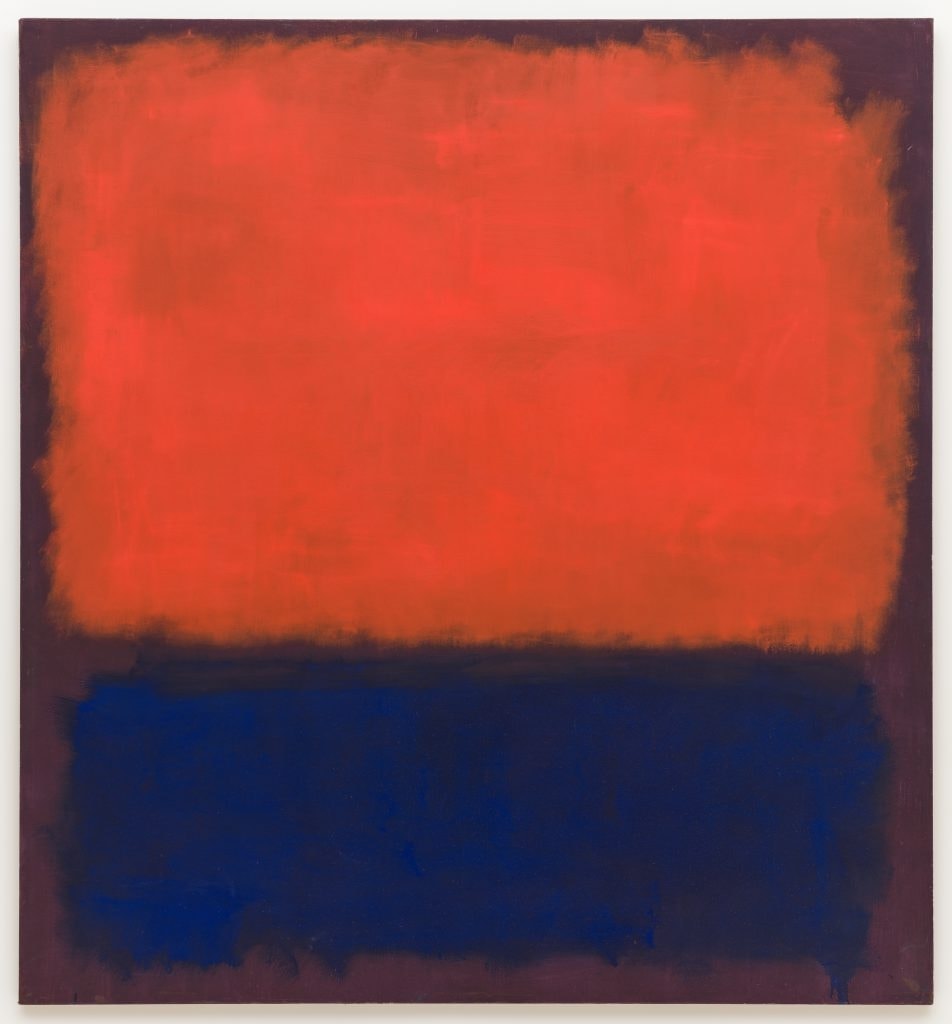
In No. 14, 1960, Mark Rothko stages a charged encounter between a vast, ember-like red-orange plane and a weighty, indigo-blue band that nearly tips into black. The softly frayed borders and faint plum-violet surround cause the colors to hover and breathe, converting sheer scale and chroma into felt experience rather than depiction [1].
Study Print Studio
Create a personal study print
Build a companion study sheet around the part of this painting that speaks to you most. Choose a detail, shape an interpretation, and walk away with something personal and display-worthy.
Fast Facts
- Year
- 1960
- Medium
- Oil on canvas
- Dimensions
- 290.8 × 268.2 cm (114 1/2 × 105 5/8 in.)
- Location
- San Francisco Museum of Modern Art (SFMOMA), San Francisco
Click on any numbered symbol to learn more about its meaning
Meaning & Symbolism
Stand before No. 14 and the composition declares a binary that refuses to settle: an expansive, heated field of red-orange saturates the upper two-thirds while a dense, midnight indigo occupies the lower third. The seam between them is neither a hard horizon nor a tidy border; instead, the red sinks and bleeds into the blue, and the blue presses back, their edges feathered so the transition reads as breath rather than line. Around the perimeter, a murky halo of plum-violet mediates figure and ground, widening in some corners and thinning in others. Rothko’s thinly layered, brushed applications allow under-flashes to flicker through the red, while the blue’s body is heavier, absorbing light rather than reflecting it. These concrete visual facts—hovering rectangles, breathing edges, a cool lower register weighted against a radiant upper—produce a felt dialectic: lift versus pull, presence versus void, hope tempered by gravity 1.
Rothko insisted that such structures were not symbols for anything outside the painting; they are vessels engineered to precipitate states of tragedy, ecstasy, and quiet dread in the viewer 2. In No. 14, the upper red field operates as an emanation—it seems to cast heat—and the blue collects that energy, darkening it into depth. The scale (over nine feet tall) closes the distance between body and image so that color functions as environment, not ornament; at close range the peripheral plum band and the soft borders remove a sense of frame, enlarging the viewer’s psychological space and intensifying the work’s sublime ambition 15. This is why Rothko discouraged narrative readings and used numerical titles: he wanted the painting’s drama to register as immediate, universal feeling rather than as an illustration to decode 2. Within the postwar search for timeless content, his method offered a new path: purge image and leave relation; purge story and leave encounter. As Peter Selz argued, Rothko’s mature canvases convert the picture plane into an interior, meditative theater where color itself performs 4.
Placed in 1960—just after the Seagram Murals and before the darker late decade—No. 14 exemplifies Rothko’s mature syntax of stacked chromatic zones while preserving a high chroma rarely seen in his final years 23. Its orchestration of thin and more loaded passages, and its refusal of crisp edges, manufacture an optical vibration that keeps the eye in motion and the mind in suspense. That suspense is the content. The painting is not about a horizon, yet it borrows that schema to pose an ethical and emotional question: what balance of radiance and gravity can a human consciousness bear? In giving no icon to hold onto, Rothko creates a condition in which viewers confront their own response—some feel uplift, others melancholy, many both. This responsiveness is the work’s measure of success and the reason it remains a touchstone for Abstract Expressionism’s experiential turn: No. 14 shows how a rectangle of red and a bar of blue, paced by a softly breathing edge, can do the work once assigned to narrative and figure—summon the sublime from the simplest means 134.
Explore Deeper with AI
Ask questions about No. 14
Popular questions:
Powered by AI • Get instant insights about this artwork
💬 Ask questions about this artwork!
Interpretations
Historical Context: Postwar Universals, 1960 Pivot
Located just after the Seagram Murals and before the late‑decade darkening, No. 14 sustains unusually high chroma in a mature syntax of stacked zones—evidence of a brief equilibrium between radiance and depth in Rothko’s trajectory 5. Within Abstract Expressionism’s postwar turn, such canvases pursue timeless, universal content via scale and atmosphere rather than iconography 3. 1960 thus marks a pivot: color remains expansive, but the pressure of existential gravity is intensifying, preparing the ground for the somber chapel cycles to come. Read historically, the painting negotiates Cold War anxieties with a language of non‑narrative intensity, exchanging external events for inward, ethical weather. The result is an image that belongs to its moment while bidding for transhistorical address, a hallmark of Rothko’s ambition to make paintings that act on viewers regardless of culture or creed 235.
Source: The Metropolitan Museum of Art; National Gallery of Art; David Anfam
Phenomenology of Viewing: Distance, Light, and Duration
Rothko engineered an environmental encounter: close viewing (often cited around eighteen inches), soft light, and prolonged attention convert color into atmosphere 16. In such conditions, the feathered borders pulse—edges appear to advance and withdraw—while the peripheral field dissolves any stable frame, making the canvas read less as window and more as room 16. This phenomenological setup matters: it relocates meaning from image content to the viewer’s embodied time with the work, a shift consistent with Rothko’s insistence on direct emotional address over interpretation by symbol 2. No. 14 is therefore not only a composition but a protocol: proximity, dimness, and stillness become part of the medium, allowing chroma and value contrasts to stage an inner drama that unfolds at the pace of looking 126.
Source: SFMOMA; The Phillips Collection
Material Intelligence: Layers, Edges, and Optical Weight
The painting’s affect depends on material differentials: thinned, aerated layers in the red‑orange versus more loaded, light‑absorbing blue, articulated by soft, frictive borders 15. These choices create a calibrated optical weight—the lower register sinks and absorbs while the upper radiates and leaks—producing a sustained oscillation instead of stable figure/ground. Anfam situates such handling within Rothko’s late 1950s–early 1960s method: layered veils, scumbled edges, and tuned saturation used not to depict but to vibrate the field 5. Conservation‑adjacent observations on No. 14’s “emergence/withdrawal” edges underscore that content is inseparable from facture; the how of painting is the what we feel. In this light, Rothko’s craft is less reductive minimalism than finely engineered sensation mechanics 15.
Source: SFMOMA; David Anfam
Anti-Landscape: Borrowed Horizon, Emptied Icon
While critics often note a horizon‑like split, Rothko’s own stance rejects depictive readings; the work uses landscape’s schema to trigger spatial expectation, then empties it of referents 34. Selz argued that Rothko converts the picture plane into an interior theater where color performs space rather than describes it—a decisive move from scene to situation 4. In No. 14, the dark lower and radiant upper zones tempt sky/earth metaphors, yet the feathered seam withholds topography, leaving viewers inside a non‑locative, contemplative field. The strategy taps the sublime associated with vast landscapes while refusing narrative and place, aligning Rothko with postwar artists who sought universality through scale and atmosphere instead of motif 34.
Source: MoMA (Peter Selz); The Metropolitan Museum of Art
Medium Reflexivity: Color as Actor, Painting as Event
Selz’s early account frames Rothko’s mature canvases as stages where color, not figure, acts—an emphatic redefinition of painting’s ontology 4. No. 14 literalizes this claim: the composition is a score for chromatic performance, with temperature, value, and edge functioning like dynamics and tempo. Rothko’s refusal of titles and symbols intensifies this reflexivity, turning attention to the painting’s conditions—scale, proportion, saturation—as content 24. In doing so, he positions abstraction not as retreat from meaning but as the shortest route to it: an event of perception that registers as ethical and emotional pressure. The painting’s success thus hinges on our co‑production of the work in time, the viewer’s gaze completing the performative circuit the artist designed 24.
Source: MoMA (Peter Selz); National Gallery of Art
Reception & Institution: Civic Icon, Market Signal
SFMOMA’s 1997 purchase of No. 14—reportedly around $6 million, then a Rothko record—signaled a West Coast commitment to Abstract Expressionism’s experiential legacy while cementing the canvas as a civic emblem 17. Installed at monumental scale, it functions as a threshold work for audiences new to Rothko: immediately legible as color, increasingly demanding as experience. The museum context also realizes the artist’s display ideals—controlled light and viewing distance—enabling the painting’s environmental intent 1. That acquisition story belongs to the work’s contemporary life: it frames No. 14 not only as postwar experiment but as an ongoing public ritual object mediating crowds and contemplation in a major collection 17.
Source: SFMOMA; SFGate
Related Themes
About Mark Rothko
Mark Rothko (1903–1970), a leading figure of Abstract Expressionism, developed his signature format of stacked, soft-edged rectangles by 1949. Rejecting literal symbolism, he sought to convey fundamental emotions through color, scale, and immersive viewing conditions [2][3][9].
View all works by Mark Rothko →