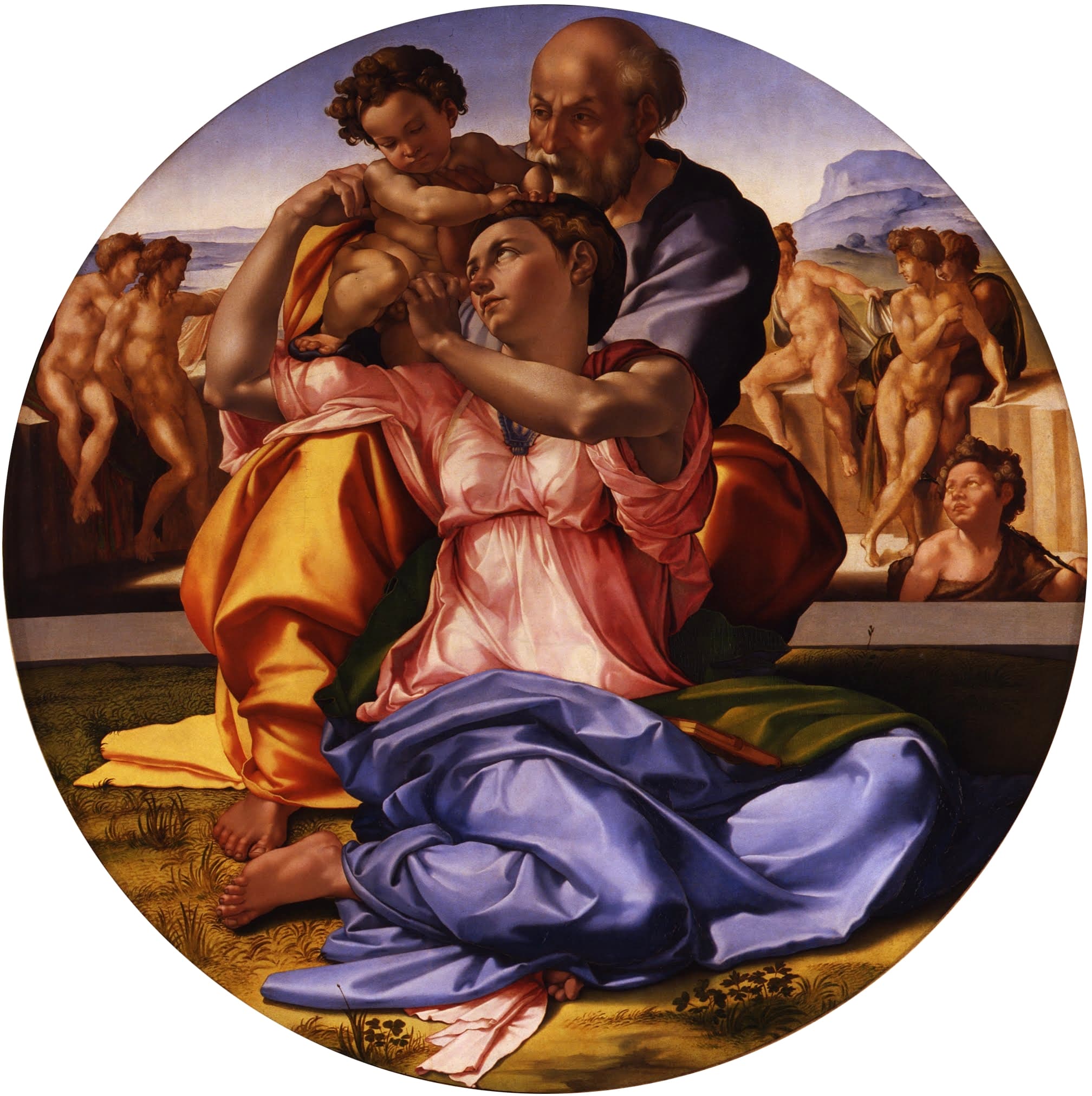
How Much Is Holy Family (Doni Tondo) Worth?
Last updated: June 28, 2026
Quick Facts
- Methodology
- comparable analysis
In a hypothetical, exportable sale, Michelangelo’s Holy Family (Doni Tondo) would command approximately $850 million to $1.1 billion. The estimate is anchored to Leonardo’s Salvator Mundi ($450.3m in 2017) adjusted for inflation and the Doni Tondo’s singular status as Michelangelo’s only securely autograph, fully finished easel painting.
Valuation Analysis
Conclusion: In an unconstrained, exportable open‑market scenario, Michelangelo’s Holy Family (Doni Tondo) would reasonably achieve $850 million–$1.1 billion. This range reflects its one‑of‑one position in Michelangelo’s oeuvre—widely regarded as his only securely autograph, fully finished panel painting—and its canonical museum stature at the Uffizi Galleries [1].
Core benchmarking: The principal market anchor is Leonardo da Vinci’s Salvator Mundi, sold for $450.3 million at Christie’s in 2017—the standing auction peak for any artwork [2]. In 2026 dollars, that result equates to roughly $590–$610 million. While Leonardo’s authorship debates complicated that sale, the Doni Tondo is undisputed in authorship and importance, and uniquely encapsulates Michelangelo’s easel‑painting practice. Given its singularity and museum‑defining profile, a premium above the inflation‑adjusted Leonardo anchor is justified in a competitive setting.
Artist market and scarcity premium: Michelangelo sits at the absolute apex of art history, yet virtually nothing of comparable caliber is privately tradable. His public auction market is almost entirely drawings; even so, a newly identified Sistine Chapel study set the artist’s auction record at $27.2 million in 2026 after extended bidding, underscoring depth of global demand for authenticated autograph material [3]. The leap from rare works on paper to a unique, finished panel painting—by Michelangelo himself—supports a discrete step‑change into the ten‑figure realm.
Cross‑checks: At the next tier, Botticelli’s Portrait of a Young Man Holding a Roundel achieved $92.2 million in 2021—a strong signal for prime Italian Renaissance trophies, yet an order of magnitude below the Leonardo benchmark [5]. This spread helps frame the Doni Tondo’s expected positioning: vastly rarer, more canonical, and singular within the oeuvre of a peerless master. The work’s historic, original carved tondo frame—traditionally associated with Michelangelo’s design—further reinforces integrity and gravitas [1].
Legal context and practicality: As property of the Italian State within the Uffizi, the Doni Tondo is effectively inalienable and not exportable under Italy’s cultural heritage code [4]. The valuation here is therefore a comparative, hypothetical market assessment. Should a unique path allow state‑to‑state acquisition or extraordinary private transfer, global sovereign buyers, leading institutions, and apex private collectors would likely engage, with $1 billion‑plus outcomes entirely credible. Our recommended range—$850 million to $1.1 billion—balances the Leonardo anchor, Michelangelo’s unmatched scarcity, and trophy‑market dynamics while acknowledging uncertainty around transactional mechanics.
Key Valuation Factors
Art Historical Significance
High ImpactThe Doni Tondo is a cornerstone of High Renaissance painting and a pivotal document of Michelangelo’s synthesis of sculptural form, color, and dynamic composition in panel format. It is broadly considered the artist’s only securely autograph, fully finished easel painting to survive, giving it a unique and unrepeatable status within an oeuvre otherwise dominated by sculpture and fresco. Its canonical standing extends beyond Michelangelo studies, shaping scholarship on Florentine art circa 1500, the Holy Family iconography, and the interchanges among the three giants—Michelangelo, Leonardo, and Raphael. This singularity elevates the painting from merely ‘important’ to a museum‑defining, identity‑shaping masterpiece.
Rarity and Supply Constraints
High ImpactMichelangelo’s autograph works almost never come to market. The artist’s tradable market consists overwhelmingly of drawings, where the best sheets now command mid‑eight figures at auction, signaling intense global competition even for secondary media. No finished autograph panel paintings by Michelangelo have traded publicly in modern times, and none comparable to the Doni Tondo exist in private hands. This vanishingly scarce supply, paired with deep demand from sovereign collections, major museums, and apex private collectors, concentrates potential price formation in the uppermost tier of name‑asset trophies, where bidding psychology and institutional imperatives can push prices well beyond conventional comparables.
Condition and Integrity
Medium ImpactWhile detailed, up‑to‑date conservation data are essential for final pricing, the work’s long stewardship at the Uffizi and retention of its historic carved tondo frame—traditionally associated with Michelangelo’s design—suggest a high degree of integrity. Panel paintings of this age can present structural and surface considerations (joins, warping, varnish history), so a current technical report would be required to calibrate risk and confirm stability. Absent material condition concerns, the survival of the original frame and the panel’s continuous care in a leading institution would be read positively by buyers and insurers, reinforcing confidence at the extreme top of the market.
Provenance and Institutional Pedigree
High ImpactCommissioned for the Florentine merchant Agnolo Doni, recorded with the Doni family by the late 16th century, and in the Medici/Uffizi orbit by the 17th century, the painting carries an enviable, centuries‑long, blue‑chip provenance culminating in a premier state collection. Works that are both foundational to a museum’s identity and embedded in national patrimony accrue an institutional cachet that amplifies demand among peer institutions and sovereign buyers. For a unique Michelangelo painting with continuous elite provenance and exhibition history, this pedigree not only mitigates authenticity risk but also enhances perceived cultural capital, a critical intangible driver at the nine‑ and ten‑figure level.
Legal and Exportability Considerations
Medium ImpactUnder Italy’s cultural heritage code, state‑owned works in museum collections are effectively inalienable and not exportable. Practically, this painting is not for sale. However, valuation for risk management and policy purposes often requires a hypothetical, exportable open‑market figure. In the unlikely event of a transfer mechanism (e.g., state‑to‑state acquisition or extraordinary ministerial framework), logistical and regulatory complexity could affect deal structure, timing, and buyer pool composition. Even so, such constraints may increase perceived rarity and urgency among qualified buyers, supporting the high estimate in a negotiated context while keeping the valuation explicitly hypothetical.
Sale History
Holy Family (Doni Tondo) has never been sold at public auction.
Michelangelo's Market
Michelangelo’s market is defined by extreme scarcity and museum dominance. Autograph paintings and marbles are virtually absent from trade; the public market centers on drawings, which have climbed into the mid‑eight figures when strongly attributed and linked to the Sistine Chapel. In February 2026, a newly identified study for the Libyan Sibyl realized $27.2 million at Christie’s New York, setting the artist’s auction record and demonstrating intense global demand for authenticated works on paper with canonical relevance. Because supply of any autograph material is thin—and of paintings effectively nonexistent—collector appetite is concentrated and deep, with sovereign entities and top museums representing a significant portion of potential demand at the very highest price levels.
Comparable Sales
Salvator Mundi
Leonardo da Vinci
Closest market anchor: a singular High Renaissance panel by Michelangelo’s direct peer; global trophy status; public auction sale establishing market depth for an undisputed blue‑chip Renaissance masterpiece.
$450.3M
2017, Christie's New York
~$588.0M adjusted
Portrait of a Young Man Holding a Roundel
Sandro Botticelli
Top recent Old Master painting result (Italian Renaissance panel, museum‑level quality) showing depth of demand for prime Renaissance trophies, though a portrait rather than a holy subject.
$92.2M
2021, Sotheby's New York
~$109.0M adjusted
Study for a foot of the Libyan Sibyl (recto); Study of a leg with knee bent (verso)
Michelangelo
Same artist; current auction record for Michelangelo; evidences extreme scarcity and bidding depth for autograph works, even on paper, tied to Sistine Chapel studies (core to his canon).
$27.2M
2026, Christie's New York
~$26.8M adjusted
A nude man (after Masaccio) and two figures behind
Michelangelo
Same artist; major rediscovered drawing and previous record; underscores the price ceiling for tradable Michelangelo works on paper versus the hypothetical value of a unique autograph painting.
$24.3M
2022, Christie's Paris
~$26.6M adjusted
Head of a Young Apostle (drawing)
Raphael
Peer benchmark in the High Renaissance for works on paper; demonstrates top‑end pricing for A+ sheets by Michelangelo’s closest contemporary, informing scarcity premiums for the period.
$47.9M
2012, Sotheby's London
~$66.8M adjusted
The Rest on the Flight into Egypt
Titian
Prime Italian Renaissance painting by another marquee master; religious subject matter (Holy Family) provides subject‑matter proximity to the Doni Tondo.
$22.2M
2024, Christie's London
~$22.4M adjusted
Current Market Trends
Old Masters have seen a selective resurgence since 2025, with buyers gravitating to historically validated, scholarship‑rich masterpieces and away from speculative segments. Trophy‑class results—anchored by Leonardo’s 2017 record and reinforced by high‑profile Renaissance sales—signal durable demand for blue‑chip names. Supply of A+ material remains the main constraint, and when exceptional works surface, cross‑category bidding (from Modern/Contemporary buyers) is common. Guarantees and discreet private sales are prevalent at the top end. Regulatory regimes in Europe can delay or prevent export, which may limit transactional options but can also heighten anticipation and value psychology when works are hypothetically priced for risk, indemnity, or policy planning.
Sources
- Uffizi Galleries – Holy Family (Doni Tondo)
- The New York Times – Leonardo da Vinci Painting Sells for $450 Million
- Christie’s Press – Rare Michelangelo Study Sells for $27.2m (Artist Record), 2026
- Italy’s Cultural Heritage Code (Legislative Decree 42/2004) – Inalienability of State Collections
- Sotheby’s – Botticelli Portrait Sells for $92.2 Million (2021)