How Much Is Libyan Sibyl (Sistine Ceiling) Worth?
Last updated: April 27, 2026
Quick Facts
- Methodology
- extrapolation
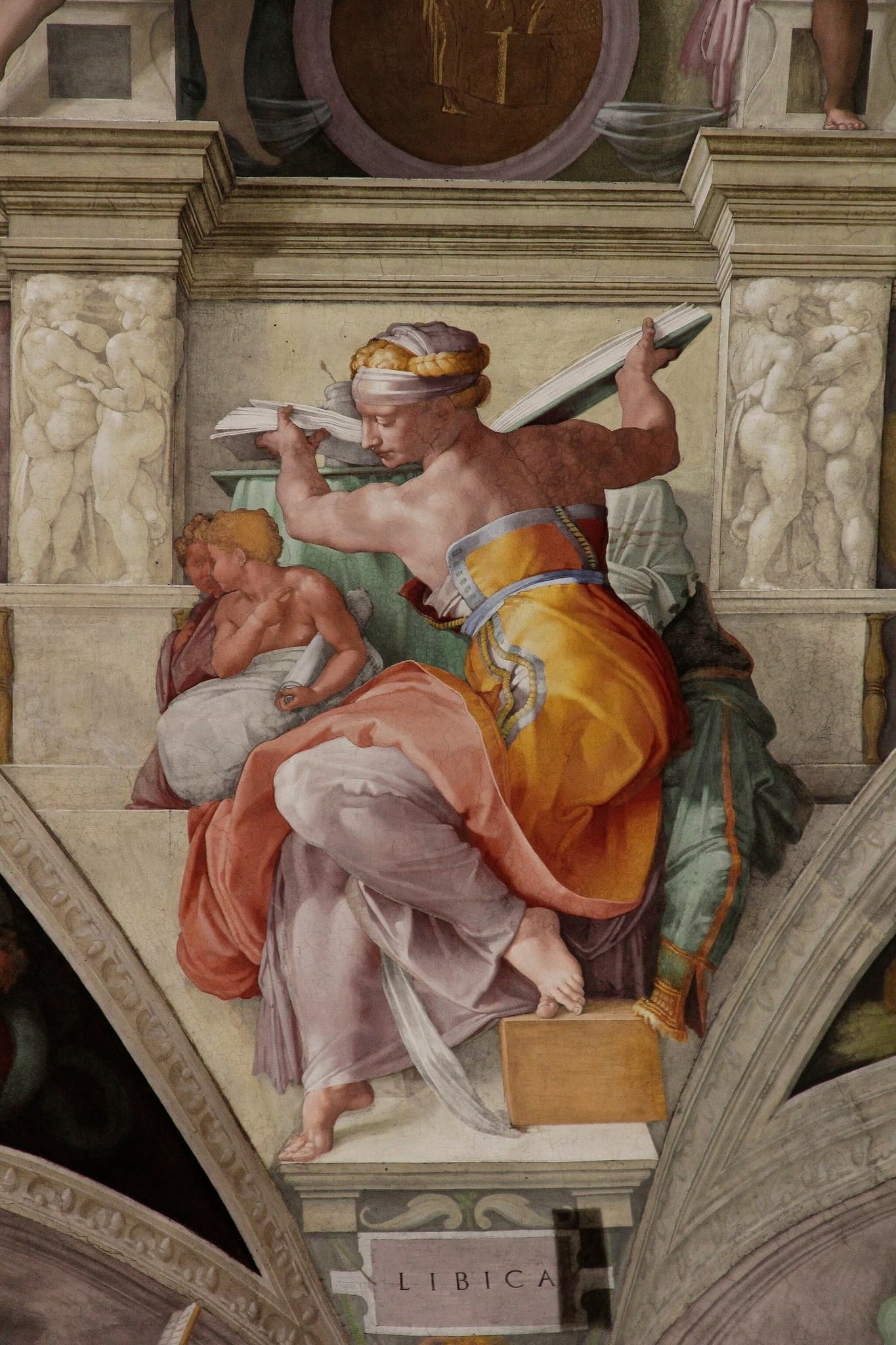
The original Libyan Sibyl is an in-situ fresco on the Sistine Chapel ceiling and is not legally marketable. For a hypothetical, alienable equivalent, we estimate $500–700 million, above the current artwork price record, reflecting the image’s singular art-historical importance, the artist’s extreme scarcity, and recent record-setting demand for directly related Michelangelo studies. This range is anchored by the artist’s drawing records and the Salvator Mundi benchmark.
Valuation Analysis
Object status and scope. Michelangelo’s Libyan Sibyl is not a market-tradeable artwork: it is an integral fresco on the Sistine Chapel ceiling, Vatican City, and remains permanently installed in the Holy See’s collection [1]. Accordingly, there is no true market price. This estimate synthesizes a hypothetical “alienable equivalent” value—what a comparably significant, saleable Michelangelo of painting-scale stature might achieve if offered without legal or physical constraints. The range is positioned above the all-time auction record price for any artwork ($450.3 million for Leonardo’s Salvator Mundi) to reflect the Sibyl’s exceptional cultural standing [4].
Anchors and proxies. Because no Michelangelo paintings or fresco fragments of this magnitude trade, the only robust, repeatable market proxies are autograph drawings. Importantly, a newly identified double-sided Study for a foot of the Libyan Sibyl achieved $27.2 million with premium at Christie’s New York on February 5, 2026—now the artist’s auction record—directly evidencing the demand premium for material tied to this very figure from the Sistine Ceiling [2]. Previously, an autograph red-chalk figure study sold at Christie’s Paris in 2022 for about $24.4 million, underscoring depth for prime Michelangelo drawings when quality and provenance align [3].
Art-historical primacy. Within the ceiling’s program, the Libyan Sibyl is among Michelangelo’s most celebrated images, commonly reproduced and studied. The Metropolitan Museum preserves the famed red-chalk Studies for the Libyan Sibyl, a canonical sheet that illustrates how central this figure is to Michelangelo’s process and to High Renaissance draftsmanship, further attesting to its stature and global recognition [5].
Deriving the range. Extrapolating from: (i) the artist’s current drawing record specifically tied to the Libyan Sibyl ($27.2m) [2], (ii) broader top-tier Michelangelo drawing prices (~$20–25m+) [3], and (iii) the overarching price ceiling for artworks ($450.3m) [4], a major, painting-scale, alienable Michelangelo of this renown would command a substantial premium. The $500–700 million range reflects: the Sibyl’s iconic status within a supreme monument of Western art; the near-total absence of tradeable Michelangelo paintings; intense, global trophy competition; and the demonstrated bid depth for even preparatory sheets directly linked to this figure.
Positioning and caveats. This is a hypothetical construct for an otherwise inalienable fresco. It assumes: clear title, market-standard due diligence, museum-grade condition, and unrestricted international transfer. While macro conditions and buyer pool composition could influence outcomes, the range sits confidently above the current global record and at the pinnacle of Old Master valuation benchmarks, consistent with the Libyan Sibyl’s unrivaled cultural and art-historical weight [1][2][4][5].
Key Valuation Factors
Art Historical Significance
High ImpactThe Libyan Sibyl is a signature image within Michelangelo’s Sistine Chapel ceiling, one of the apex achievements of Western art. As one of the monumental sibyls and prophets framing the Genesis narratives, it is instantly recognizable and extensively published and taught. Its centrality to the ceiling’s iconographic and formal program places it among the most reproduced images in Renaissance art. This level of cultural saturation and scholarly consensus confers an exceptional prestige premium, analogous to a handful of canonical Renaissance masterpieces. In a hypothetical sale context, such primacy justifies pricing above category norms and supports a range well beyond typical Old Master ceilings.
Extreme Scarcity of Tradeable Michelangelos
High ImpactThere is near-zero supply of autograph paintings or movable frescoes by Michelangelo in modern markets; the top of his category is effectively defined by works on paper. When authentic, museum-caliber drawings surface, they command fierce bidding and record prices. A 2026 Libyan Sibyl foot study reached $27.2m, and a 2022 autograph figure study achieved ~$24.4m—figures that are extraordinary for drawings and signal the depth of global demand for primary Michelangelo material. By extrapolation, an alienable, painting-scale masterpiece with direct Sistine relevance would command a multiple of drawing prices, especially given the brand’s rarity and the trophy-seeking behavior at the ultrahigh end.
Ownership and Transfer Constraints
High ImpactThe fresco is permanently installed in the Sistine Chapel and belongs to the Holy See; it is effectively inalienable. This means no true market price can be observed or tested. Our range therefore models a hypothetical scenario in which an equivalent, fully alienable Michelangelo of comparable scale and importance were to be offered in a transparent, internationally accessible sale. Removing legal and logistical barriers is crucial to isolating the object’s pure demand value; in practice, those barriers elevate institutional and cultural value but prevent price discovery. The constraint amplifies uncertainty but also underscores why any hypothetical number must sit at the very top of the market.
Comparable Benchmarks and Records
Medium ImpactThe strongest concrete benchmarks are Michelangelo’s autograph drawings, especially those linked to the Sistine Chapel. The 2026 record ($27.2m) for a Libyan Sibyl study and the 2022 result (~$24.4m) for a prime figure drawing demonstrate willingness to pay at the mid–eight-figure level for preparatory material. The all-time global artwork price record ($450.3m for Leonardo’s Salvator Mundi) establishes the broader ceiling. Given the Libyan Sibyl’s canonical status and the artist’s scarcity, a rational extrapolation places a painting-scale, alienable equivalent above that record. The $500–700m band balances record anchoring with the exceptional cultural and historical premium attached to this image.
Sale History
Libyan Sibyl (Sistine Ceiling) has never been sold at public auction.
Michelangelo's Market
Michelangelo’s market is among the scarcest and most competitive in Old Masters. Authentic autograph paintings effectively do not trade; market activity concentrates in drawings, which command exceptional prices when quality and provenance align. In 2026, a double-sided study for the Libyan Sibyl achieved $27.2 million with premium at Christie’s New York, setting a new auction record for the artist and confirming intense demand for sheets linked to the Sistine Chapel. In 2022, an autograph red-chalk figure study realized approximately $24.4 million in Paris, the prior record. These results position Michelangelo at the top of the historical-drawings category and signal deep global appetite for any masterwork tied to his most celebrated projects.
Comparable Sales
Study for a foot of the Libyan Sibyl (recto); Study of a leg with knee bent (verso)
Michelangelo
Direct autograph study for the Libyan Sibyl on the Sistine Ceiling; same artist and project. Best like‑for‑like market proxy.
$27.2M
2026, Christie's New York
~$26.7M adjusted
A nude young man (after Masaccio) surrounded by two figures
Michelangelo
Top‑tier autograph drawing in red chalk; showcases market depth for prime Michelangelo figure studies (artist auction record prior to 2026).
$24.4M
2022, Christie's Paris
~$27.3M adjusted
Head of a Young Apostle (study for The Transfiguration)
Raphael
Canonical High Renaissance head study tied to a major masterpiece; establishes category ceiling for fresco‑related autograph drawings.
$47.8M
2012, Sotheby's London
~$64.5M adjusted
Head of a Muse (study for a Vatican fresco cycle)
Raphael
Record‑level Renaissance drawing; red‑chalk head study for a monumental Vatican fresco program—closely analogous to Sistine‑related studies.
$47.9M
2009, Christie's London
~$69.5M adjusted
Diagram of a rectangular block of marble (small autograph sketch)
Michelangelo
Minor autograph sheet demonstrating baseline demand for Michelangelo on paper; useful as a lower‑bound brand/value context (not a figure study).
$202K
2024, Christie's New York
~$208K adjusted
Current Market Trends
The Old Masters segment has shown renewed strength relative to some contemporary categories, with collectors gravitating toward canonical, scholarship-rich material. High-profile Renaissance results and active institutional participation have sustained momentum at the top end, while supply remains structurally thin—particularly for Italian High Renaissance masters. Works on paper linked to major monuments have been standout performers, and record-level bidding for Michelangelo’s drawings demonstrates that demand concentrates around masterpieces with unimpeachable attribution and provenance. In this environment, an alienable, painting-scale Michelangelo masterpiece would likely attract intense global competition and set a new benchmark for the category and potentially for the art market overall.
Sources
- Vatican Museums — Sibilla Libica (Sistine Chapel Ceiling)
- Christie’s Press — Rare Michelangelo study for the Sistine Chapel sells for $27.2m (artist record), Feb 5, 2026
- Christie’s Paris — Michelangelo, A nude young man (after Masaccio) surrounded by two figures, May 18, 2022
- The Guardian — Leonardo da Vinci’s Salvator Mundi sells for $450m at auction, Nov 15, 2017
- The Metropolitan Museum of Art — Studies for the Libyan Sibyl (red chalk), Acc. 24.197.2