How Much Is Prophet Isaiah (Sistine Ceiling) Worth?
Last updated: April 27, 2026
Quick Facts
- Insurance Value
- $2.0B (Hypothetical insurance proxy by analyst; benchmarked to Salvator Mundi record and Mona Lisa 1962 policy)
- Methodology
- extrapolation
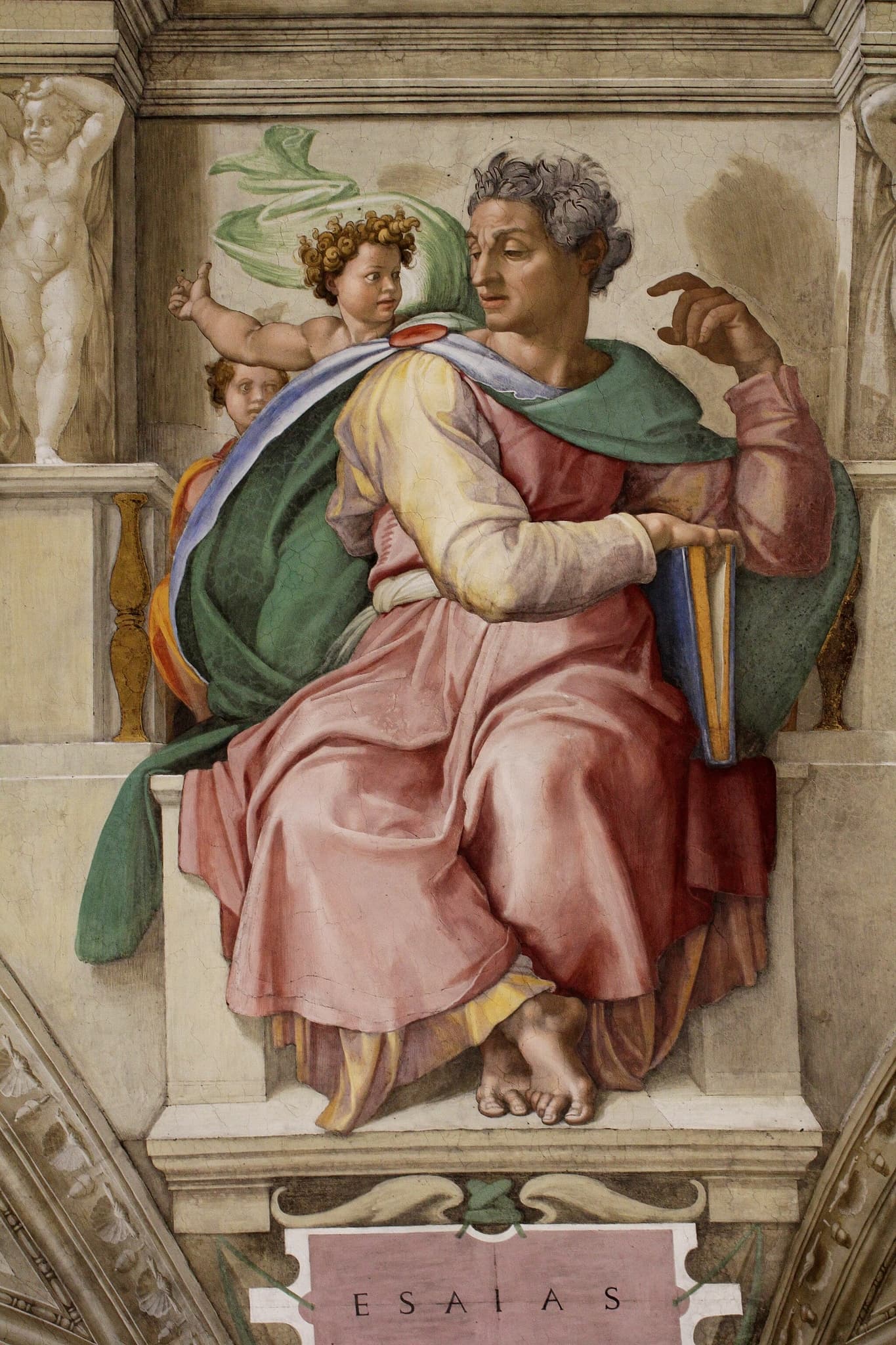
Prophet Isaiah is an integral fresco on the Sistine Chapel ceiling and cannot be sold; a market price does not exist. Using an insurance-style, sovereign‑patrimony framework anchored to category high-water marks, we estimate a hypothetical value of $1–3 billion.
Valuation Analysis
Overview. Michelangelo’s Prophet Isaiah is one of the monumental enthroned figures framing the narrative scenes on the Sistine Chapel ceiling (c. 1508–1512). Executed in buon fresco, the pigments chemically bond to wet plaster and become part of the building fabric, rendering the work immovable and inseparable from the chapel itself [1][2]. As a central component of perhaps the most celebrated ceiling in Western art, Isaiah stands within the absolute apex of the High Renaissance canon.
Methodology. Because the fresco is sovereign cultural patrimony and not market‑alienable, a direct market value is inapplicable. Accordingly, this estimate adopts an insurance/indemnity proxy—a framework museums and states use to quantify risk for world‑heritage assets—extrapolated from the strongest available market signals and the artwork’s singular cultural weight.
Benchmarks and comps. The modern market’s high‑water mark for any artwork is Leonardo da Vinci’s Salvator Mundi at $450,312,500 in 2017, defining the trophy ceiling for Renaissance masterworks with extraordinary narrative power [3]. A sovereign benchmark is the Mona Lisa’s $100,000,000 insurance valuation for its 1962–63 U.S. tour—often cited as implying roughly a billion dollars in today’s terms, underscoring the order of magnitude appropriate for unique, globally iconic masterpieces [4]. Within Michelangelo’s tradable corpus, supply is essentially limited to drawings; a red‑chalk study tied to the Sistine program achieved $27.2 million at Christie’s in 2026—a new artist auction record—demonstrating deep, global demand for autograph material connected to the ceiling [5].
Positioning Isaiah within the ceiling. Among the seated Prophets and Sibyls, Isaiah is widely reproduced and art‑historically central to the cycle’s framing architecture. While the Creation of Adam is the ceiling’s singularly most iconic panel, Isaiah remains canonical and non‑substitutable at a level categorically beyond any tradable Michelangelo sheet. Its status, scale, and integrated architectural context confer an “infinite rarity” premium unattainable in conventional markets.
Conclusion. Synthesizing these factors, we assign a hypothetical insurance‑style valuation of $1–3 billion. The lower bound is justified by sovereign‑heritage precedents and the irreplaceability of a major Sistine figure; the upper bound reflects the logical premium above the global auction record for any artwork, once one accounts for Isaiah’s canonical status and non‑transferability. This figure is not a sale price but a rigorous risk‑management proxy suitable for indemnity modeling and strategic planning for a work that is, in practice, beyond the market [3][4][5].
Key Valuation Factors
Art Historical Significance
High ImpactProphet Isaiah belongs to Michelangelo’s Sistine Chapel ceiling, one of the most consequential achievements in Western art. Within the program, the seated Prophets and Sibyls are the monumental anchors that frame the narrative scenes; Isaiah is among the most frequently cited and reproduced figures in scholarship and survey literature. Its authorship by Michelangelo during the High Renaissance, its integral role in the ceiling’s theological and visual structure, and its five-century reception history confer extreme cultural primacy. In art-historical terms, Isaiah sits in the same echelon of global recognizability and importance as the ceiling’s most celebrated passages, warranting a valuation framework that acknowledges its canonical, non-substitutable status within a UNESCO-level heritage site.
Rarity and Supply Dynamics
High ImpactAutograph Michelangelo objects are vanishingly scarce on the market; the trade consists almost exclusively of drawings, which appear irregularly and command multi-million-dollar prices. No executed frescoes by Michelangelo are tradable; the Sistine Ceiling’s figures are unique by definition and functionally irreplaceable. This absolute scarcity creates an ‘infinite rarity’ premium not captured by conventional comparables. The 2026 record for a red‑chalk Sistine study at $27.2 million underscores how works merely preparatory to the ceiling already inhabit the top tier of Old Master pricing. Extrapolating from preparatory sheets to a finished, canonical fresco figure embedded within the most famous chapel in Christendom justifies an insurance-style valuation orders of magnitude higher.
Legal/Immovability and Ownership Constraints
High ImpactThe fresco is executed in buon fresco and chemically fused to the plaster substrate, making it a structural part of the Sistine Chapel. It is owned by the Holy See and administered by the Vatican Museums as sovereign cultural patrimony. As such, it is not deaccessionable or market‑alienable, and any ‘value’ must be framed as a hypothetical indemnity limit rather than a transactional price. The impossibility of sale paradoxically elevates its theoretical valuation by emphasizing irreplaceability and the prohibitive costs—cultural, diplomatic, and technical—associated with any loss scenario. This legal and physical immovability is a central input to the $1–3 billion insurance‑style range.
Market Benchmarks and Trophy Premium
High ImpactThe valuation is calibrated to two anchor benchmarks: the $450.3 million sale of Leonardo’s Salvator Mundi, the auction high for any artwork, and the Mona Lisa’s $100 million 1962 tour insurance valuation (commonly cited as implying roughly $1 billion today). These establish the scale at which singular Renaissance masterpieces are appraised in market and sovereign contexts. Michelangelo’s own market—though limited to drawings—set a new record at $27.2 million in 2026 for a Sistine‑related study, signaling robust, global appetite for works connected to the ceiling. Isaiah’s canonical status and non‑transferability justify a premium over these references, placing a prudent indemnity proxy in the $1–3 billion band.
Sale History
Prophet Isaiah (Sistine Ceiling) has never been sold at public auction.
Michelangelo's Market
Michelangelo’s market is among the thinnest of any blue‑chip Old Master. Authentic works that trade are almost exclusively drawings, often studies for major projects, with top sheets achieving eight‑figure prices. The current auction record is $27.2 million (Christie’s New York, 2026) for a red‑chalk study tied to the Sistine Chapel’s Libyan Sibyl, eclipsing the prior $24.3 million record set in Paris in 2022. Even minor autograph fragments can far exceed estimates due to extreme scarcity and global demand from top private collectors and institutions. Because no paintings or sculptures by Michelangelo meaningfully trade, pricing for immovable masterworks like the Sistine frescoes must be extrapolated from these drawing records and broader trophy benchmarks.
Comparable Sales
Study for a foot of the Libyan Sibyl (recto); Study of a leg with knee bent (verso)
Michelangelo Buonarroti
Same artist; preparatory study directly related to the Sistine Chapel ceiling (Libyan Sibyl). Best recent market proxy for autograph material tied to the ceiling. Price is with premium.
$27.2M
2026, Christie's New York
~$26.7M adjusted
A nude young man (after Masaccio) surrounded by two figures
Michelangelo Buonarroti
Same artist; rare early autograph drawing, key benchmark for Michelangelo sheets. While not a Sistine study, it calibrates demand for top-tier Renaissance draftsmanship. Price is with premium (USD equivalent at sale).
$24.3M
2022, Christie's Paris
~$26.7M adjusted
Study for the Risen Christ
Michelangelo Buonarroti
Same artist; major autograph drawing (historic record-setter in 2000). Useful long-run benchmark for top Michelangelo works on paper versus today’s pricing. Price is with premium (USD equivalent at sale).
$12.3M
2000, Christie's London
~$22.8M adjusted
Head of a Young Apostle
Raphael
High Renaissance master; record-setting Old Master drawing. Establishes the upper bracket for museum-caliber Renaissance works on paper that directly inform fresco/altarpiece programs.
$47.9M
2012, Sotheby's London
~$67.0M adjusted
Portrait of a Young Man Holding a Roundel
Sandro Botticelli
Top-tier Old Master painting result in recent years. Calibrates what the market pays for A+ Renaissance paintings with impeccable quality and narrative, bracketing a ceiling figure’s hypothetical value.
$92.2M
2021, Sotheby's New York
~$108.8M adjusted
Salvator Mundi
Leonardo da Vinci (attrib.)
Record price for any artwork. Though a panel painting (and attribution has been debated), it functions as the market’s high-water mark for singular Renaissance masterpieces, useful as an upper-bound reference.
$450.3M
2017, Christie's New York
~$562.9M adjusted
Current Market Trends
Old Masters have shown relative stability versus contemporary sectors, with 2025 bringing a rebound and strong demand for best‑in‑class works amid tight supply. Record and near‑record prices for top Renaissance and Baroque names demonstrate deep, globally diversified bidding when quality, provenance, and narrative align. At the very top of the pyramid, the 2017 Salvator Mundi price continues to anchor expectations for singular masterpieces, while museum‑caliber rediscoveries and securely attributed drawings outperform. Against this backdrop, non‑tradable, sovereign‑heritage works—particularly those by Michelangelo—are valued through insurance‑style proxies that logically sit above auction comparables, reflecting irreplaceability and the cultural capital embedded in world‑heritage monuments.
Sources
- Vatican Museums: Sistine Chapel — Virtual Tour
- Encyclopaedia Britannica: Fresco painting
- Christie’s Press Release: Leonardo da Vinci’s Salvator Mundi sells for $450,312,500
- Guinness World Records: Highest insurance valuation for a painting (Mona Lisa, 1962)
- Christie’s Press Release: Rare Michelangelo study for the Sistine Chapel sells for $27.2m (2026)