How Much Is The Fall and Expulsion from the Garden Worth?
Last updated: July 3, 2026
Quick Facts
- Methodology
- extrapolation
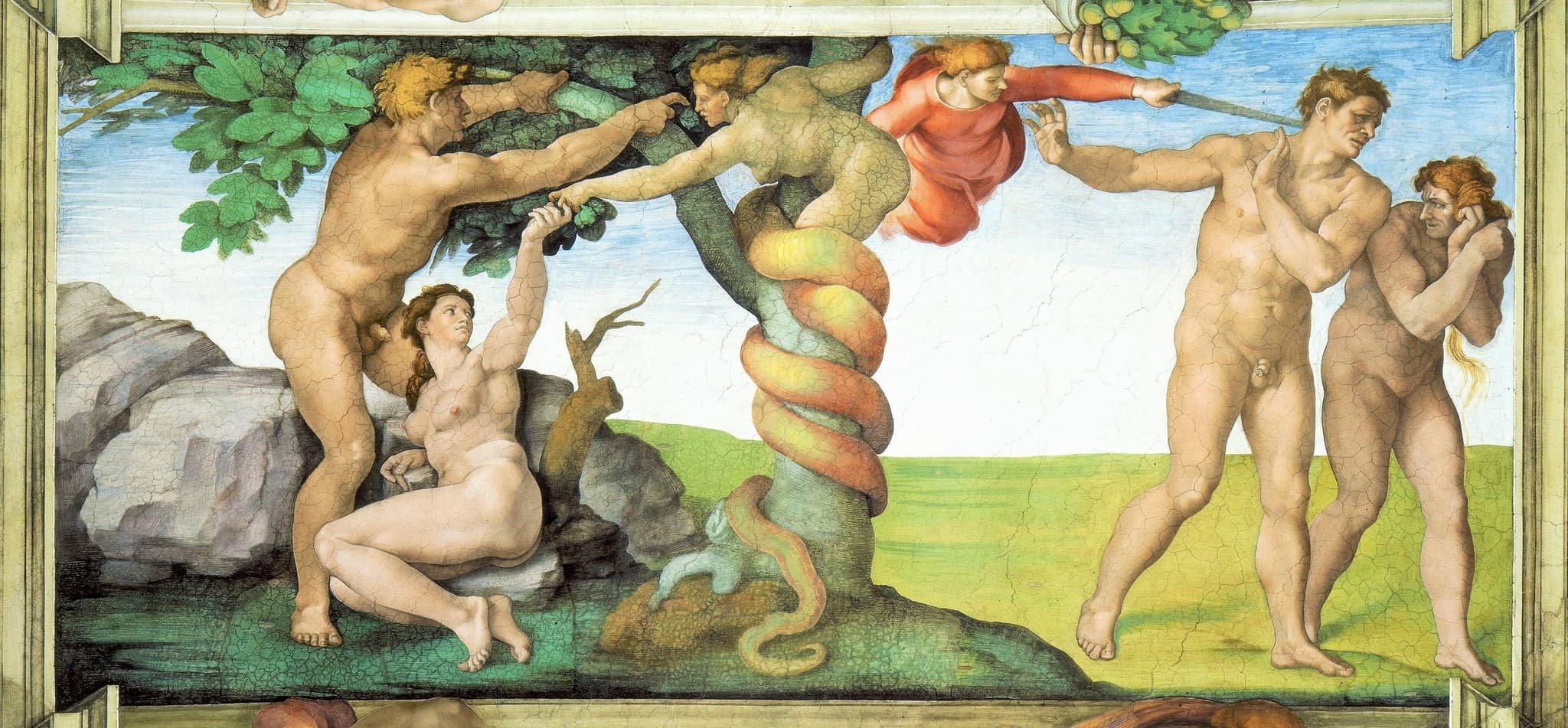
Michelangelo’s The Fall and Expulsion from the Garden (Sistine Chapel ceiling, c.1509–10) is an immovable fresco that has never traded. Extrapolating from the artist’s drawing record and the modern ceiling for Renaissance ‘trophy’ prices, we estimate a hypothetical market value of $2.5–4.0 billion if the work were legally transferable. This reflects its singular art-historical stature, extreme scarcity, and unmatched global recognition.
Valuation Analysis
Object and status. The Fall and Expulsion from the Garden (Peccato originale e cacciata dal Paradiso terrestre) is a central fresco on the Sistine Chapel ceiling, painted by Michelangelo around 1509–1510 and preserved in situ at the Vatican Museums. It has never been offered for sale and is not a market-tradable object in any conventional sense [1].
Method and premise. Because the fresco is immovable and unsaleable, our valuation is a hypothetical, market-grounded extrapolation that assumes a legal pathway to transfer and physical separability from the monument. The estimate synthesizes closest-available artist benchmarks (Michelangelo drawings), broader Renaissance trophy results, and the work’s singular cultural weight.
Artist benchmarks. The only autograph works by Michelangelo that reliably reach the market are drawings. The current auction record is $27.2 million (with premium) for a newly discovered red-chalk study for the Sistine ceiling sold at Christie’s New York on February 5, 2026—a landmark price that underscores demand for prime, Sistine-related sheets [2]. The prior record, set at Christie’s Paris in 2022, was approximately $24.4 million for an early drawing [3]. These results establish a modern willingness to pay peak prices for scarce, museum-caliber Michelangelo material even at small scale and on paper.
Trophy comparables. At the market’s upper limit for Renaissance masterpieces, Leonardo da Vinci’s Salvator Mundi realized $450,312,500 at Christie’s in 2017, setting the contemporary ceiling for Old Master paintings and confirming deep, global capital for canonical, single-image trophies [4]. While Leonardo’s panel provides a price anchor, the Sistine fresco’s cultural resonance and public recognition—as a pillar of the world’s most famous painted interior—far exceed any portable painting’s profile.
Conclusion and range. Balancing these proxies, we estimate a hypothetical value of $2.5–4.0 billion for The Fall and Expulsion, assuming (purely for valuation purposes) that it could be lawfully deinstalled, conserved, and sold. This range reflects (i) the work’s central place within Michelangelo’s greatest achievement; (ii) extreme supply scarcity at the artist’s pinnacle; (iii) the proven readiness of the market to pay nine figures for the most coveted Renaissance works; and (iv) the immense, durable “brand” equity of the Sistine imagery. Practical impediments (legal protection, moral heritage claims, deinstallation risk) explain why the work will not trade; they do not diminish its notional price in a hypothetical, unconstrained transaction.
Key Valuation Factors
Art Historical Significance
High ImpactThis fresco is a core narrative panel of the Sistine Chapel ceiling—Michelangelo’s most celebrated achievement and among the defining images of Western art. It encapsulates two foundational episodes of Genesis (the Temptation and the Expulsion) within a single, supremely composed field, displaying the artist’s revolutionary treatment of the human form and his command of large-scale narrative. Its pedagogical and cultural reach is effectively universal: it is reproduced in textbooks, exhibitions, and media worldwide, and studied alongside The Creation of Adam as a pinnacle of High Renaissance invention. That centrality within Michelangelo’s oeuvre and within global visual culture supports a valuation at the absolute apex of the market.
Uniqueness and Irreplaceability
High ImpactAs an in situ fresco integral to the Sistine Chapel, this work is not fungible: there is no equivalent object that could substitute for its authorship, scale, context, and historical aura. Michelangelo’s autograph paintings and frescoes are effectively off-market; only a handful of drawings trade. The combination of unrepeatable authorship, exceptional preservation through major restorations, and sixteenth-century execution in a papal commission makes the work essentially one-of-one at a global level. In a hypothetical market, such absolute scarcity commands a singularity premium—far in excess of even the most coveted portable Old Master paintings—because buyers are competing for an asset that cannot be duplicated or closely approximated.
Market Benchmarks and Trophy Demand
High ImpactThe modern ceiling for Old Master pricing was established by Leonardo da Vinci’s Salvator Mundi at $450.3 million in 2017, demonstrating deep, cross-border capital for once-in-a-generation Renaissance masterpieces. Within Michelangelo’s own market, the $27.2 million record for a Sistine-related drawing confirms fierce competition for top-tier works tied to his most famous commission. Extrapolating from these benchmarks to a central Sistine fresco—whose cultural standing and global recognition eclipse even the highest-profile portable pictures—supports a multi-billion-dollar range. In short, when scarcity, authorship, and universal brand recognition align, the market pays premiums that extend well beyond established nine-figure results.
Legal/Logistical Constraints and Transferability
Medium ImpactThe fresco is protected heritage, immovable, and not a market-tradable asset. Our valuation therefore models a hypothetical scenario in which legal transfer and responsible deinstallation were possible. While such constraints eliminate real-world liquidity, they also shape the notional price: if a path to sale existed, the combination of singularity and global demand could concentrate unprecedented bidding. Practical risks—deinstallation complexity, conservation requirements, and public-interest considerations—would add cost and execution risk, but in a trophy-driven market those would be absorbed into a premium rather than depress fundamental value. The medium impact rating reflects their relevance to feasibility, not to the object’s inherent worth.
Sale History
The Fall and Expulsion from the Garden has never been sold at public auction.
Michelangelo's Market
Michelangelo sits at the pinnacle of Old Master demand, but his market is defined by extreme scarcity. Autograph paintings and frescoes do not trade; the only material that reliably appears on the market is drawings. Even within that narrow segment, sales are rare and trophy-caliber sheets trigger intense institutional and private competition. The current auction record is $27.2 million (Christie’s New York, 2026) for a newly discovered Sistine-related red-chalk study, surpassing the prior €23.2 million/$24.4 million benchmark set in Paris in 2022. These prices, achieved by comparatively small works on paper, underscore how a hypothetical, major autograph painting or fresco would eclipse normal Old Master bounds, given the artist’s canonical status and the near-total absence of supply.
Comparable Sales
Study for a foot of the Libyan Sibyl (recto); Study of a leg with knee bent (verso)
Michelangelo
Autograph red‑chalk study directly for the Sistine Chapel ceiling—same artist and commission; strongest market proxy for a prime Sistine‑related work.
$27.2M
2026, Christie's New York
~$26.7M adjusted
A nude man (after Masaccio) and two figures behind him
Michelangelo
Autograph early drawing by Michelangelo; while not Sistine‑specific, it benchmarks current demand and pricing for rare, museum‑level Michelangelo sheets.
$24.4M
2022, Christie's Paris
~$26.3M adjusted
Salvator Mundi
Leonardo da Vinci
Pinnacle High Renaissance master painting with sacred subject; sets the modern upper bound for Old Master prices and indicates trophy‑level demand for canonical Renaissance works.
$450.3M
2017, Christie's New York
~$578.7M adjusted
Portrait of a Young Man Holding a Roundel
Sandro Botticelli
Record‑level Renaissance trophy by a near‑contemporary master; though a portrait (not biblical), it calibrates what top collectors pay for best‑in‑class early Renaissance works.
$92.2M
2021, Sotheby's New York
~$107.2M adjusted
Head of a Young Apostle
Raphael
Top‑tier Renaissance drawing by Michelangelo’s eminent contemporary; a benchmark for museum‑quality Old Master draftsmanship closely tied to a major altarpiece.
$47.8M
2012, Sotheby's London
~$65.6M adjusted
Lot and His Daughters
Peter Paul Rubens
Monumental Old Master biblical narrative painting that achieved a trophy price; while Baroque (not High Renaissance), it helps bracket market appetite for grand sacred history subjects.
$58.2M
2016, Christie's London
~$76.4M adjusted
Current Market Trends
Old Masters remain a smaller but resilient segment of the global art market, with performance increasingly concentrated at the apex. While mid-tier material can be price-sensitive, blue-chip Renaissance trophies continue to draw deep, global bidding, particularly when fresh to market, securely attributed, and tied to iconic narratives. Benchmarks like Leonardo’s $450.3 million Salvator Mundi have reset expectations for what singular works can command, and recent Michelangelo drawing records demonstrate that scarcity premiums remain robust. In this context, a central Sistine fresco—if hypothetically transferable—would attract unprecedented cross-border demand from both private collectors and institutions, supporting a multi-billion-dollar valuation.
Sources
- Vatican Museums – Peccato originale e cacciata dal Paradiso terrestre (Sistine Chapel ceiling)
- Christie’s Press Release – Rare Michelangelo study for the Sistine Chapel sells for $27.2m (artist auction record), Feb 5, 2026
- Artnet News – Rediscovered Michelangelo drawing sells for €23.2m at Christie’s Paris (artist record at the time), May 18, 2022
- Artnet News – Leonardo da Vinci’s Salvator Mundi sells for $450.3 million, Nov 2017