The Burning Woman in Guernica
A closer look at this element in Pablo Picasso's 1937 masterpiece
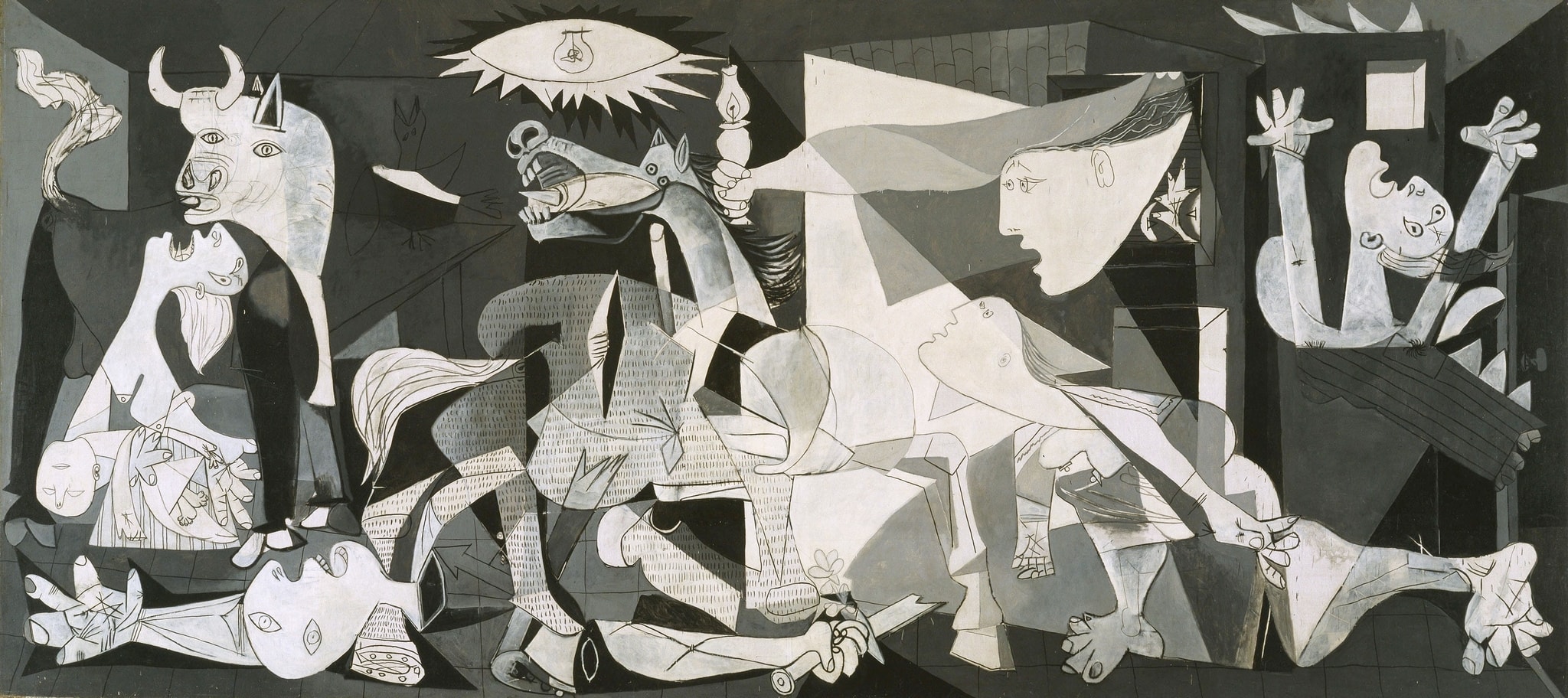
At the far right of Picasso’s Guernica, a woman flings up her arms and screams as her home erupts in flames. This “Burning Woman” condenses the terror of aerial bombardment into a single, unforgettable image—turning a specific atrocity in 1937 Spain into a universal charge against modern warfare.
Historical Context
Picasso painted Guernica in 1937 for the Spanish Pavilion at the Paris International Exposition, transforming the mural into a public, didactic protest against fascist violence. The Museo Reina Sofía characterizes the work as a colossal, poster-like indictment of barbarity that warned of a wider war to come 1. On 26 April 1937, German and Italian aircraft bombed the Basque town of Guernica, deploying high‑explosive and incendiary munitions that set entire streets ablaze; the catastrophe’s fires became a central motif in the mural 2.
Within this historical frame, the rightmost figure is the civilian caught by those fires. Reina Sofía identifies her as the woman who cries to the heavens with arms raised while a house burns behind her—an image distilled from reportage but reshaped for the Pavilion’s international audience 1. Britannica underscores the relevance of incendiary bombing to the painting’s subject, aligning the figure’s engulfing flames with the new tactics of mechanized war 2. Through this placement and theme, the “Burning Woman” anchors Guernica’s contemporary witness and its urgent, public-facing message.
Symbolic Meaning
The “Burning Woman” has become an emblem of civilian suffering in the age of aerial warfare. Rather than depict a named victim or locale, Picasso forged a universal sign: a body hurled into an inferno that has invaded the home, the most intimate sphere of protection 13. The Prado’s scholarship reads her—together with the left‑panel mother and dead child—as the painting’s human core, a condensed image of terror produced by modern tactics designed to incinerate noncombatants 3.
Reina Sofía emphasizes Picasso’s shift from specific reportage to a symbolic language; the burning house and flailing arms signify indiscriminate destruction and the collapse of civic order 1. Anne Wagner’s art-historical reading extends this, arguing that the women of Guernica “scream and stagger, mourn and burst into flame,” making female bodies and domestic space the very targets through which the mural channels mechanized violence 6. In this frame, the right-hand figure is not a bystander but a protagonist of history: her upward cry, set against an inferno, names the new frontier of war where home, shelter, and the civilian body are no longer spared. She stands as a perpetual indictment, compressing the horrors of 1937 into a symbol legible anywhere.
Artistic Technique
Picasso renders the figure in grisaille—a stark range of blacks, whites, and grays linked by curators to newsreel and press photography—heightening immediacy while stripping away distracting color 4. The body is modeled in high contrast so that pale limbs and an open mouth flare against a dark, cubically fractured interior; jagged, triangular shards read as leaping flames 5.
Expressive distortions intensify her agony: hands splay with impossibly extended fingers, the head is torqued into a howl, and the figure seems both inside and ejected from the burning structure—ambiguity that fuses space and body into a single cry 5. By pushing form toward abstraction, Picasso converts eyewitness detail into an image that is formally economical yet emotionally shattering.
Connection to the Whole
Compositional analyses liken Guernica to a triptych: the left “Pietà,” a tumultuous center, and the right “house in flames with the woman screaming” 7. The Burning Woman functions as the mural’s closing wing, completing a rightward surge from the lamp-bearer and the running figure toward the edge where catastrophe peaks 1.
This placement balances the bereaved mother on the left, so that civilian anguish brackets the horse-and-bulb axis and frames the work’s indictment of war 12. At the literal margin of the painting—and of architectural safety—she shows how modern bombardment breaches thresholds, carrying destruction from the public square into private rooms. As a terminus of the narrative arc and a visual crescendo, she helps convert Guernica from a scene of attack into a chorus of civilian voices, sealing the painting’s anti‑war force.
Explore More from This Painting
This detail is one part of Guernica. Use the links below to return to the full interpretation, browse the full set of details, or view the painting's valuation if available.
Sources
- Museo Nacional Centro de Arte Reina Sofía — Guernica (collection entry)
- Encyclopaedia Britannica — Guernica | Description, History, & Facts
- Museo del Prado — Encyclopedia: “Guernica [Picasso]”
- The Metropolitan Museum of Art — Heilbrunn Timeline: Pablo Picasso (1881–1973)
- Smarthistory — Pablo Picasso, Guernica
- London Review of Books — Anne Wagner, “The Women of ‘Guernica’”
- Museos en Femenino — Guernica (Reina Sofía didactics)